Meiosis (1.4) - LS
 Call Kai
 Learn
Learn Practice Test
 Spaced Repetition
 Match
Match Flashcards
 Knowt Play
1/55

There's no tags or description
Looks like no tags are added yet.
Name | Mastery | Learn | Test | Matching | Spaced | Call with Kai | Chat |
|---|
No analytics yet
Send a link to your students to track their progress
56 Terms
Diagram of the whole process of meiosis?
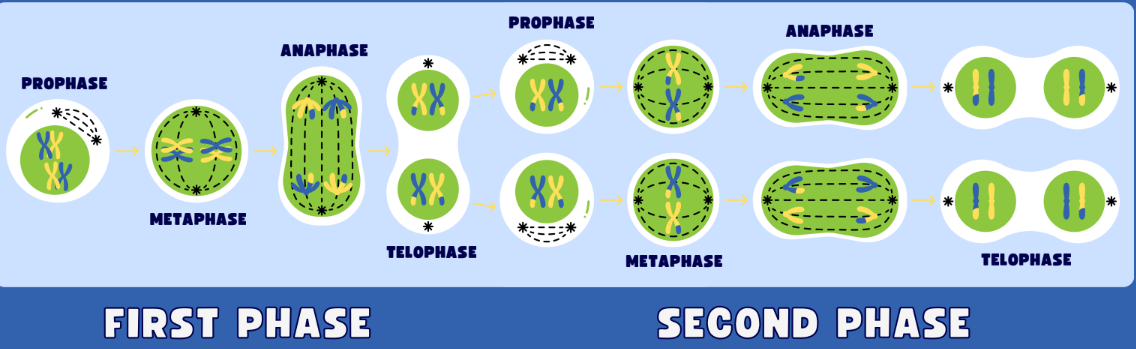
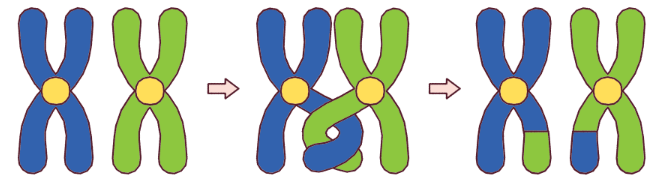
Diagram of crossing over
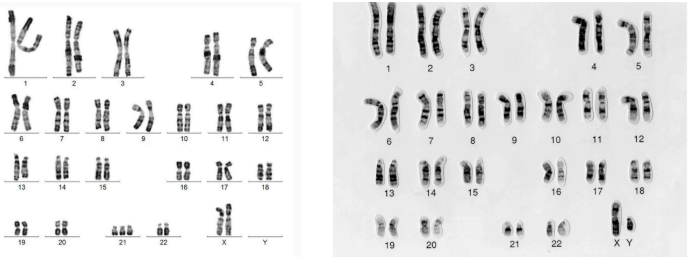
is this a normal karyotype ?
yes
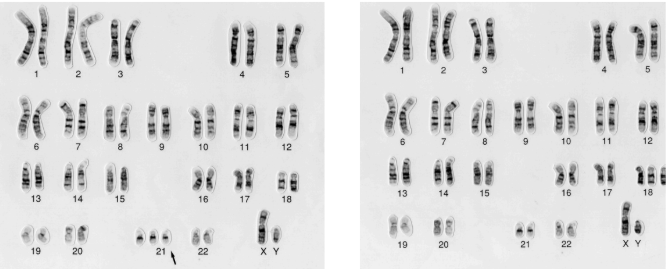
is this is a normal karyotype?
no, its trisomy
What do chromosomes form?
Chromosomes form part of the chromatin network in the nucleus and carry genetic information (DNA).
Where are chromosomes found in the cell?
Chromosomes are located in the nucleus of eukaryotic cells.
What is chromatin?
Chromatin is the thread-like network of DNA and proteins that condenses to form chromosomes during cell division.
What is interesting about somatic cells?
All somatic (body) cells of an organism have the same number of chromosomes.
How do chromosomes occur in somatic cells?
Chromosomes occur in homologous pairs: one inherited from the mother and one from the father.
How many chromosomes do somatic cells have?
Somatic cells are diploid (2n) because they contain two sets of chromosomes.
What is the diploid chromosome number in humans?
46 chromosomes (23 pairs).
How are homologous pairs formed?
Each paternal chromosome has a matching maternal chromosome of similar size and shape, forming a homologous pair.
Can something differ between homologous chromosomes?
Yes. They carry the same genes but the alleles may be different.
What happens before a cell divides?
Each chromosome replicates during interphase, forming two identical sister chromatids joined by a centromere.
Where does DNA replication occur?
DNA replication occurs during Interphase (S-phase), before meiosis or mitosis begin
What does meiosis produce?
Meiosis produces gametes.
What are gametes?
Gametes are sex cells such as sperm cells and egg cells (ova).
What happens during meiosis?
During meiosis the chromosome number is reduced from diploid (2n) to haploid (n).
How many chromosomes do haploid cells have?
Haploid cells contain one set of chromosomes (n).
What occurs during fertilisation?
During fertilisation a male gamete and female gamete fuse to form a diploid zygote.
Where does meiosis occur in animals (males)?
In the testes to produce sperm cells.
Where does meiosis occur in animals (females)?
In the ovaries to produce ova.
Where does meiosis occur in plants (male)?
In the anthers to produce pollen grains.
Where does meiosis occur in plants (female)?
In the ovules within the ovary to produce egg cells.
How many divisions occur in meiosis after DNA replication and what happens?
Two divisions occur:
Meiosis I – Reduction division where homologous chromosomes separate and two haploid cells form.
Meiosis II – Sister chromatids separate, producing four haploid cells.
Prophase I (4)
Chromosomes condense and become visible.
Homologous chromosomes pair up (synapsis).
Crossing over may occur between chromatids.
Spindle fibres begin forming from opposite poles.
Between what does crossing over occur?
Between non-sister chromatids of homologous chromosomes.
Where does crossing over occur?
During Prophase I.
What specific thing happens during crossing over and what is its effect?
Sections of DNA are exchanged between chromatids, increasing genetic variation.
When does crossing over happen?
When homologous chromosomes pair during synapsis forming bivalents.
What happens during crossing over?
Chromatids break and rejoin at the chiasma while exchanging genetic material.
What is the plural of chiasma?
Chiasmata.
What does crossing over produce?
Recombinant chromatids with new allele combinations.
What do chromatids that do not exchange DNA remain as?
Parental chromatids.
Metaphase I (4)
Homologous chromosome pairs line up along the equator of the cell.
One chromosome of each pair faces each pole.
Centromeres attach to spindle fibres.
The arrangement is random (independent assortment).
What are two ways genetic variation is formed during meiosis?
Independent assortment
Crossing over
Anaphase I (4)
Spindle fibres shorten.
Homologous chromosomes separate.
One chromosome from each pair moves to opposite poles.
Sister chromatids remain attached.
This reduces the chromosome number to haploid.
Telophase I (4)
Chromosomes reach opposite poles.
Nuclear membranes may reform.
Cytokinesis divides the cell.
Two haploid daughter cells form.
Prophase II (4)
Chromosomes condense again.
Nuclear membrane breaks down (if present).
Spindle fibres form.
Chromatids are no longer identical due to crossing over.
Metaphase II (2)
Chromosomes line up individually at the equator.
Centromeres attach to spindle fibres.
Anaphase II (2)
Sister chromatids separate.
Each chromatid moves to opposite poles.
Telophase II (3)
Chromosomes reach poles.
Nuclear membranes reform.
Cytokinesis produces four haploid daughter cells.
What is a karyotype?
A karyotype is a diagram or photograph showing the chromosomes of a cell arranged in homologous pairs.
What are the contents of a normal human karyotype?
22 pairs of autosomes and 1 pair of sex chromosomes (gonosomes).
What information can be deduced from a karyotype?
Chromosome number
Sex of the individual
Presence of chromosomal abnormalities
Missing or extra chromosomes
What are some errors that can occur in abnormal meiosis
Sometimes chromosomes fail to separate properly, resulting in abnormal chromosome numbers.Sometimes chromosomes fail to separate properly, resulting in abnormal chromosome numbers.
What is different in Down syndrome?
Trisomy 21.
When does Down syndrome occur?
When non-disjunction occurs during meiosis.
What are the parts of a chromosome?
Two sister chromatids
Centromere
DNA molecules
Genes
Why are chromosomes important in cell division?
They ensure genetic information is accurately copied and passed to daughter cells.
What is diploid (2n)?
Cells with two sets of chromosomes (body cells).
What is haploid (n)?
Cells with one set of chromosomes (gametes).
Why is haploid important for reproduction?
It ensures the chromosome number remains constant after fertilisation.
What is a limitation of chromosome models used in class?
Models simplify chromosomes and may not accurately show DNA complexity or chromosome movement.
What is required when drawing stages of meiosis from a microscope?
Correct title
Label structures clearly
Use pencil
Draw large and neat diagrams
Name another chromosomal abnormality sometimes studied in case studies.
Klinefelter syndrome (XXY chromosomes)