Rad 115 Week 1 & 2
 Call Kai
 Learn
Learn Practice Test
 Spaced Repetition
 Match
Match Flashcards
 Knowt Play
1/49

There's no tags or description
Looks like no tags are added yet.
Name | Mastery | Learn | Test | Matching | Spaced | Call with Kai | Chat |
|---|
No analytics yet
Send a link to your students to track their progress
50 Terms
SID
Source to Image Distance
SID increases → beam intensity increases
SOD
Source to Object Distance
OID
Object to Image Distance
Kvp
Kilovoltage peak
mAs
Milliamperage per second
IR
Image Receptor
Who discovered x-ray?
Wilhelm Roentgen
What year was the X-ray discovered?
1895
What was the first X-ray?
Bertha’s Hand
mAs
Quantity of photons in x-ray beam
time the beam is on
directly proportional to exposure (mAs up → exposure up → image darker)
Measured in R
NO relationship with distance, distance doesn’t change mAs
kVp
controls quality and intensity of x-ray beams
inversely proportional to contrast (kVp up → contrast down)
Represented by HVL
kVp increase → quantity increase → Scatter increase → contrast down
HVL
Thickness of material that turns R in half
reduces intensity (mAs and quantity)
Filtration
Reduces quantity of x-rays overall, and increases penetration
removes the low energy x rays
Long wavelength x-ray photons
have low energy
Stay in the object and cause ionization and maybe cancer
More harmful than short wave photons
When kVp increases
mAs increases because of the increase in speed
Current increases
Quantity increases
penetrability increases
contrast decreases
X-rays travel at
at the speed of light
in sine waves
in a straight line
All x-ray machines must have filtration of 2.5mm of aluminum
To absorb longer wavelengths

the red area is the ______, and the highest point
crest
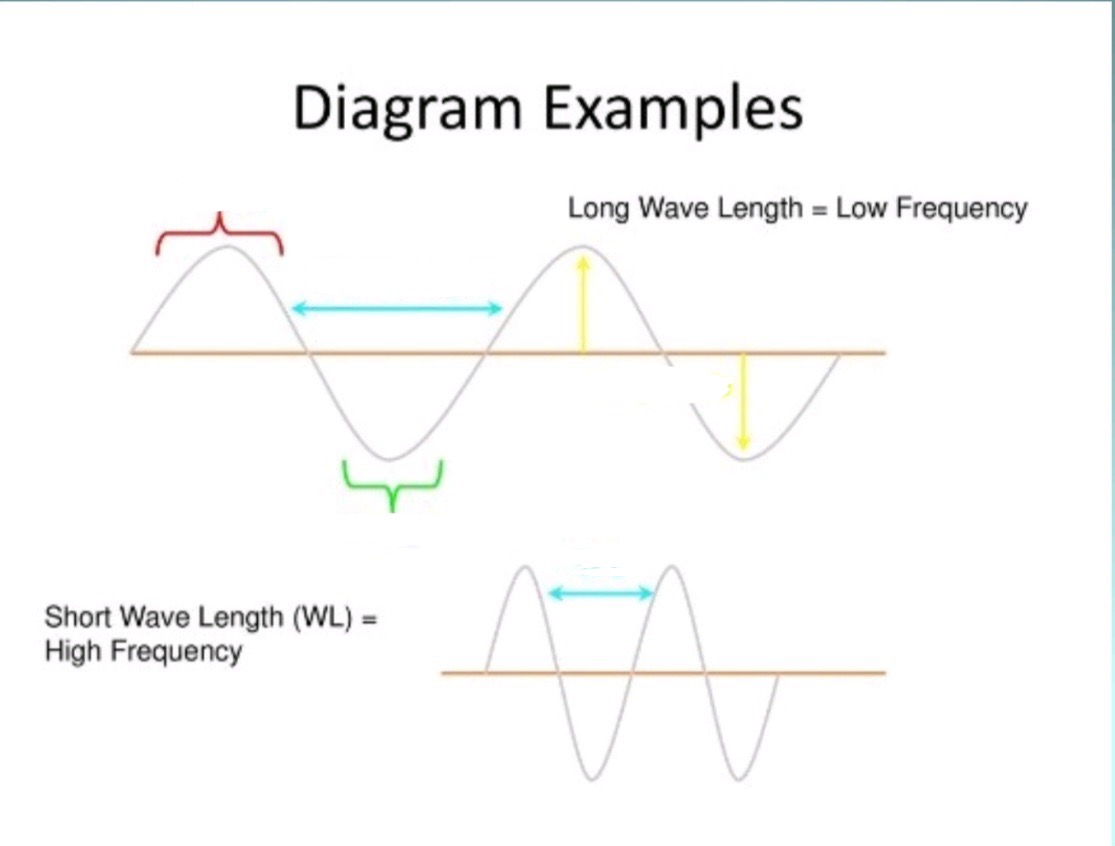
The blue area is the _________ and the distance between 2 crests
Wavelength (WL)

The yellow area is the
Amplitude
What is the process of x-ray production?
1) electrons come through the cathode on the negative side of the x-ray tube
2) The tungsten filaments heat up and create an electron cloud (thermionic emission)
3) the negatively charged electrons from the thermionic emission are attracted to the anode on the positive side of the tube, and hit the tungsten target.
4) heat and x-rays are released upon impact
Distance (d)
When distance decreases, magnification decreases
x-ray intensity decreases as distance increases
Formula for mAs
mAs= mA x S
SDD
Source to detector distance
1 second is how many milliseconds?
1000
Soft X-rays
Low-energy waves, long wave length
cause more harm than hard x-rays
Hard X-rays
High-energy x-rays, short wave length
mA
Milliamperage
determines beam quantity or intensity
High mA → High Current → more x-rays
Low mA → Low Current → fewer x-rays
Electric Current, equal to electric charge of 1 coulomb per second
Ampere (A)
Tube Current
Direct relationship with beam intensity (quantity)
quantity up → number of electrons up → patient dose up
Exposure Time
Direct relationship with intensity/quantity of beam
Time increase → quantity increase
generally, less than 1 second
decimals, fractions, milliseconds (ms), S
Equation for mAs (controls quantity)
mA x seconds = mAs
mAs Reciprocity
Same IR/DD exposure resulting from different mA and times
ex) 3mA x 2s = 6 mAs
6mA x 1s= 6 mAs
Density
old term
amount of silver in hard copy film
overall blackness of film
NOT related to brightness
IR/DD Exposure
new term referring to image property of visibility
mAs
has nothing to do with brightness
one of the photographic properties
15% Rule
15% increase in kVp = 2x exposure
15% decrease in kVp =1/2x exposure
Maintenance
decrease kVp 15%, double mAs
increase kVp 15%, halve mAs
Inverse Square Law
relationship of x-ray quantity/intensity to distance
I 1 / I 2 = D 22 / D 21
I1 x D12 = I2 x D22
Exposure Maintenance Formula/ Direct Square Law
Maintains same IR/DD exposure when SID is changed
mAs 1 / mAs 2 = D 21 / D 22
Standard Tabletop SID
40” or 100cm
Standard Chest SID
72” or 180 cm
Why is the standard chest SID greater?
So that the chest is not magnified
Overexposure is
too dark
a result of high quantity or mAs
Underexposure is
Too light
result of low quantity or mAs
kVp is usually
75 to 100
based on desired contrast
mAs is adjusted to meet ..
exposure needs
Prime Factors
millamperage-second (mAs)
kilovoltage (kVp)
distance (d)
X-ray quantity is affected by
mAs
D
kVp
Filtration
X-ray Quality is affected by
kVp
Filtration