Lithosphere PPQs
 Call Kai
 Learn
Learn Practice Test
 Spaced Repetition
 Match
Match Flashcards
 Knowt Play
1/69

There's no tags or description
Looks like no tags are added yet.
Name | Mastery | Learn | Test | Matching | Spaced | Call with Kai | Chat |
|---|
No analytics yet
Send a link to your students to track their progress
70 Terms
What is an igneous process?
A process by which rocks and minerals are created by the cooling and hardening of magma or molten lava
What is a metamorphic process?
A process by which igneous processes or tectonic plate movements can alter existing rocks with high temperature and pressure, without melting them
What is a sedimentary process?
A process by which minerals settle and build up to produce layers of deposited sediment
Give two examples of metamorphic processes
Limestone becoming marble, mudstone becoming slate
What metal ores are deposited by hydrothermal deposition?
Tin, copper, lead, silver, gold and arsenic
What is Lasky's principle?
As the purity of a mineral decreases, the amount of mineral present increases exponentially
What is the stock/resource base?
All of the material that exists in the lithosphere that can be exploited now, will be exploitable when prices rise or when new technologies are developed
What is the resource?
All the material that is theoretically available for exploitation, includes deposits that can be exploited now and deposits that can be exploited when prices rise or new technologies are developed in the future.
What is the reserve?
The material that can be exploited now, economically, using existing technology
Describe IR spectroscopy
Different materials emit infrared radiation as different wavelengths and these can be used to identify them
Describe gravimetry
Gravimeters detect variations in gravity caused by variations in density and mass
Describe magnetometry
Magnetometers detect rocks that are magnetic, e.g. magnetite
Describe seismic surveys
Sound waves are produced by controlled explosions or a seismic vibrator on the surface, the echoes can give information on the depth, density and shape of the rock strata
Describe resistivity
The measurement of the difficulty of which electricity passes through a material
Describe trial drilling
Produces samples of the rocks underground, most expensive technique
What factors affect mining viability?
Ore purity
Chemical form of the mineral
Overburden hardness and depth
Hydrology
Cut-off ore grade
Transport costs
Market economics
How does ore purity affect mining viability?
If the purity is low then more rock will have to be mined, more spoil will be produced, more energy will be needed for processing and mining, more pollution will be generated
How does hydrology affect mining viability?
Higher precipitation or impermeable rocks below increase drainage costs
How does depth affect mining viability?
Costs increases as depth increases
The sides of the mine cannot be vertical because of the risk of collapse so the amount of rock that needs to be removed increases
As depth increases, the amount of water that flows into the mine from surface runoff or groundwater also rises, increasing pumping costs significantly
What are the factors that affect transport cost?
Distance to market, the ease of bulk transport, the presence of suitable existing transport infrastructure and whether the bulk of the mineral has be reduced by processing
What are the environmental impacts of mining?
Land loss for other uses
Habitat loss
Loss of aesthetics
Dust
Noise
Turbid drainage water
Spoil disposal
Mine site restoration
Unstable spoil heaps
Acid mine leachate
How may acid mine leachate be controlled?
Pass through a filter bed of crushed limestone to immobilise metals and prevent them from being carried into rivers
How may unstable spoil heaps be controlled?
Landscaping to reduce gradients
Adding soil, nutrients and planting vegetation
Spoil heap drainage
How can turbid drainage water be controlled?
Sedimentation lagoons
How can noise pollution be controlled?
Embankments and baffle mounds
Blasting at set times of day and restricting blasting to daytime only
How can dust pollution be controlled?
Water sprays
What is bioleaching?
The use of living organisms to extract metals from their ores. The metals in the solution produced can be separated by electrolysis or using carbon filters
Explain why a reduction in the market price for tin would change the ‘cut-off ore grade’.
There would be an increased COOG because a lower market price means less money available for extraction and processing
Give one reason why the energy required for extraction increases as the ore grade declines.
Increased amount of ore must be mined/processed
Increased amount of overburden must be removed
Reduced efficiency of extraction – (residual mineral is greater proportion of the mineral present)
Explain how one property of a named mineral resource or mineral group may make it possible to detect its presence with a geophysical technique
Magnetism of iron ore or magnetite - Magnetometry
High density of igneous deposits - Gravimetry
High electrical resistance of igneous deposits – Resistivity
How is coal formed (igneous, sedimentary alluvial, sedimentary biological, sedimentary evaporite or metamorphic)?
Sedimentary biological
How is halite/sodium chloride salt formed (igneous, sedimentary alluvial, sedimentary biological, sedimentary evaporite or metamorphic)?
Sedimentary evaporite
How is slate formed (igneous, sedimentary alluvial, sedimentary biological, sedimentary evaporite or metamorphic)?
Metamorphic
How is hydrothermal copper ore formed (igneous, sedimentary alluvial, sedimentary biological, sedimentary evaporite or metamorphic)?
Igneous
How is gravel formed (igneous, sedimentary alluvial, sedimentary biological, sedimentary evaporite or metamorphic)?
Sedimentary alluvial
Name a major use of limestone
Building construction
What is the formation process of limestone?
Sedimentation
What is a major use of sand?
Glass
What is the formation process of granite?
What is the formation process of halite/sodium chloride salt?
Marine sediments
Describe the processes that produce hydrothermal metal mineral deposits
Groundwater is superheated
Hot groundwater dissolves the minerals in the rock
A mineral rich solution forms and travels up through the hydrothermal vents
As the water moves up it loses temperature and pressure
As the mineral solution cools, minerals crystallise out in order of their solubility
Outline how an assessment in the viability of a mine requires information about the mineral deposits
Chemical form
Ore purity
Ore body area
Ore body shape
Quantity
Outline how an assessment in the viability of a mine requires information about the associated geological structures
Explain the meaning of resource in terms of quantity and viability of exploitation
All materials that are known or thought to exist that can be now or in the future with future technology
Explain the meaning of reserve in terms of quantity and viability of exploitation
What can be profitably mined under current conditions
How would the cut off ore grade change if the market prices rise?
It would decrease
Outline one way that improved technology may be used to exploit low grade ores
Phytomining – plants absorb metal minerals, once incinerated the heavy metals can be collected from the ash
Outline one method that may be used to measure the pH of the drainage water from a mine spoil heap
Use universal indicator paper, red – acid, green – neutral, blue – alkaline
pH meter with calibration
Describe one named remote sensing method that may be used to find areas where trial drilling may be carried out
Seismic surveys – create soundwaves at the surface which pass through the rock and reflect back, detecting rock depth and density
Explain why the exploitation of low grade ore may increase the environmental damage cause by mineral exploitation
More rock must be mined
More habitat loss
More overburden
More ore extracted
More energy used
More pollution produced
How does the resource of a mineral differ from its reserves?
The resource is the theoretical materials that can be extracted now or in the future, Reserve is what you can profitably mine now
Suggest one reason why the energy used for extraction increases as the ore grade declines
More rocks must be mined and processed
Describe one method that is used to extract metals from low grade ones
Electrolysis after leachate collection
Exploratory drilling to search for new deposits is very expensive
Describe one method that is used to find the areas where drilling may be worthwhile
Seismic surveys – detect rock density and depth, soundwaves are produced at the surface, pass through the rock and reflect back
Suggest why an increase in the market price may change the cut-off ore grade of a mineral
The COOG decreases because more money can be spent on extraction, and lower grade ores can be exploited
Outline the advantages and disadvantages of using satellite surveying techniques rather than ground-based surveys
Advantages – cost effective, less labour intensive, lower habitat impact
Disadvantages – less information given, no physical rock to analyse, high initial cost, less sub-surface information
Describe one method of exploiting minerals from low grade ore deposits
Phyto mining - incineration
Leachate – electrolysis
Bioleaching – add acidophilic fungi or bacteria to make the rock acidic, metals become soluble and leachate dribbles out
Use one example to describe how material substitution may be used to conserve the reserves of metal minerals
Copper cables can be replaced with plastic
Copper pipes can be replaced with plastic
Steel car panels can be replaced with plastic
Copper electricity cables can be replaced with aluminium
Describe a method that may be used to extend the operation of a mine by exploiting low grade ores
Leachate collection can be done via electrolysis
Large scale mechanisation is cheaper
Explain why the exploitation of low grade ores is likely to affect the energy required to extract the metal
As ore purity increases, processing needed increases, so more energy is needed
As the demand for minerals increases, new deposits must be found and mines developed
Outline two features of a mine that may affect its viability
Overburden depth – more has to be removed if it's deeper
Overburden hardness – more difficult to remove if it's harder
Overburden stability – more is removed if looser
Mine drainage – high pumping cost if it has poor drainage
Outline how a change in the economy may cause the cut-off ore grade of a mineral to change
If the market price increases, the COOG lowers
Outline methods that may be used to reduce the environmental problems caused by machinery noise
Sound baffles
Restrict working hours
Outline methods that may be used to reduce the environmental problems caused by dust
Water sprays
Afforestation
Outline two ways in which open cast-mining causes more environmental damage than deep mining
More spoil heaps – more landslides and more erosion
More overburden removed – more waste disposal
More surface disturbance – more habitat loss
Describe one method that may be used to measure the pH of mine drainage water
Colour comparison of universal indicator paper
Outline two features of the overburden above the mineral that can affect the viability of the mine
Hard – difficult to mine
Loose – more removed
Depth – increased cost
Outline two methods of reducing environmental problems caused by mine machinery
Use water sprays to reduce dust pollution
Quieter transport, e.g. rails replace lorries
Time of traffic – avoid sensitive times
Afforestation to deflect noise
One method used in spoil heap reclamation is the addition of soil followed by tree planting. The soil must have the right texture to reduce the risk of soil erosion.
Outline a method used to estimate the proportions of sand, silt and clay in a soil sample
Dry the sample, sieve it and then weigh it
Figure 3 shows a cross section of a granite batholith and its associated geological structures
Explain how hydrothermal processes produced economically recoverable metal ore deposits
Hot mineral solutions flow along fissures, away from batholith
Different minerals have different solubilities
Mineral solutions cool with movement away from source
Minerals separated by deposition at different positions
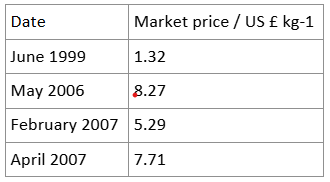
The table shows the market price of copper on selected dates
(Prices adjusted to April 2007 value)
Explain why the cut-off ore grade was highest in June 1999
A greater purity is needed for profit as it has the lowest market price
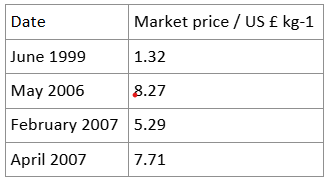
The table shows the market price of copper on selected dates
(Prices adjusted to April 2007 value)
Explain why the market price in May 2006 caused the estimates of reserves to increase
Low grade ore becomes economic and profitable