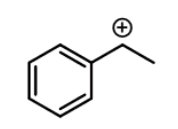
Organic Structure, Hybridization, Resonance, Aromaticity
 Call Kai
 Learn
Learn Practice Test
 Spaced Repetition
 Match
Match Flashcards
 Knowt Play
1/33

There's no tags or description
Looks like no tags are added yet.
Name | Mastery | Learn | Test | Matching | Spaced | Call with Kai | Chat |
|---|
No analytics yet
Send a link to your students to track their progress
34 Terms
What must be true for a molecule to be aromatic?
it is cyclic, it is fully conjugated (no sp3 carbons), it is planar, and follows huckels rule
What is huckels rule?
in order for a molecule to be aromatic, the total # of pi electrons in the molecule must be equal to 4n+2 where n is a whole, positive integer (including 0)
Formal charge =
Z - 1/2S - U (where Z = element group number, S = number of shared electrons, U= = number unshared electrons)
All individual formal charges should add to BLANK
Total charge on molecule
How to determine the hybridization of an atom?
Count number of attached atoms, and number of lone electron pairs
If an atom has 4 atoms/lone pairs, what is the hybridization?
sp3
If an atom has 3 atoms/lone pairs, what is the hybridization?
sp2
If an atom has 2 atoms/lone pairs, what is the hybridization?
sp
When does electron counting for hybridization not apply?
when a lone pair is next to a pi bond
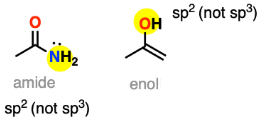
In each pi-bond, how many electrons are pi electrons?
2
If an atom has two lone pairs, is sp2 hybridized, and is adjacent to a pi bond
one lone pair will be pi electrons and the other will be hybrid
If a lone pair of electrons on an sp2 hybridized atom is adjacent to pi bonding
the pair are pi electrons
what is the order of stability for carbocations?
MOST STABLE: allylic > 3o > 2o > 1o > vinyl
an allylic carbocation

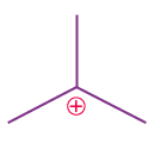
tertiary carbocation
secondary carbocation
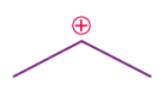
primary carbocation
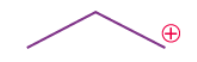
vinyl carbocation
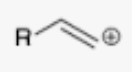
Benzyllic carbocations are more stable than
allylic carbocations
More strain in a cyclic molecule will cause a greater
heat of combustion
If the heat of combustion of a molecule is lower, it is
more stable
a positive charge is most stable on the BLANK electronegative atom
least
a negative charge is most stable on the BLANK electronegative atom
most
more covalent character means a molecule is
more stable
charge separation in a molecule makes it
less stable
What are the three main type of resonance transformations?
neutral, charged, allylic
in neutral resonance transformations
electrons from a double bond move to a bonded atom, creating opposite positive and negative charges
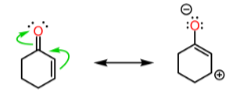
In charged resonance transformations
pi electrons move to a charged atom, creating a charge on the oppositely bonded atom (in one electron move, an extra can move th charge further)
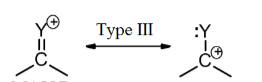
Allylic resonance
When a lone pair creates a pi bond and the adjacent pre-existing pi bond is forced into a lone pair on the opposing atom
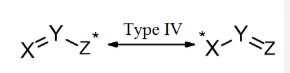
the most stable lewis structure will have
an overal charge of 0
If the the negative charge is on a substituent atom to a benzene ring, it can move to the
para and ortho positions
why is a negative charge on a substituent unable to move to the meta positions of a benzene ring?
requires more than one move of the electrons
If a substituent atom is adjacent to an available position on a benzene ring for a charge move
it can accept that charge
benzyllic carbocation
(secondary) follows same trend as other carbocations