Chapter 1 - Instrumentation, Hemodynamics, and Doppler
 Call Kai
 Learn
Learn Practice Test
 Spaced Repetition
 Match
Match Flashcards
 Knowt Play
1/99

There's no tags or description
Looks like no tags are added yet.
Name | Mastery | Learn | Test | Matching | Spaced | Call with Kai | Chat |
|---|
No analytics yet
Send a link to your students to track their progress
100 Terms
Tardus parvus indicates which of the following?
(A) Severe outflow disease
(B) Severe inflow disease
(C) Downstream arteriolar dilatation
(D) Showering emboli
(B) Severe inflow disease
Tardus parvus is the waveform appearance in which the systolic upstroke is delayed. This waveform shape is indicative of severe proximal, or inflow, disease
The venous system contains what percent of all of the blood in the body?
(A) 20% to 30%
(B) 50%
(C) 60% to 70%
(D) 99%
(C) 60% to 70%
The venous system holds approximately 66% of the blood in reserve at any one time.
With inspiration, which of the following is true?
(A) Abdominal pressure increases and intrathoracic pressure decreases
(B) Abdominal pressure decreases and intrathoracic pressure increases
(C) Abdominal pressure increases and intrathoracic pressure increases
(D) Abdominal pressure decreases and intrathoracic pressure decreases
(A) Abdominal pressure increases and intrathoracic pressure decreases
With inspiration, the diaphragm moves inferior, compressing the IVC and causing increased abdominal pressure. At the same time, the intrathoracic pressure decreases, causing blood to be sucked into the thorax from the upper extremities and head.
As the blood vessel decreases in size, which of the following is true?
(A) There is an increase in velocity and an increase in pressure
(B) There is a decrease in velocity and a decrease in pressure
(C) There is an increase in velocity and a decrease in pressure
(D) There is a decrease in velocity and an increase in pressure
(C) There is an increase in velocity and a decrease in pressure
The continuity equation (Q = V A) indicates that where area decreases, velocity increases.
According to Bernoulli, where velocity increases, pressure decreases.
Which of the following is true in the presence of a nonhemodynamically significant stenosis?
(A) There is a corresponding pressure increase at the point of stenosis
(B) There is a corresponding pressure decrease distal to the point of stenosis
(C) There is a corresponding pressure increase proximal to the point of stenosis
(D) There is a corresponding pressure decrease at the point of stenosis
(D) There is a corresponding pressure decrease at the point of stenosis
Pressure decreases at the point of a stenosis. In a nonhemodynamically significant stenosis, the pressure returns to normal distal to a stenosis because the velocity decreases to the prestenotic velocity.
Monophasic flow in a resting lower extremity artery
(A) Is indicative of normal flow
(B) Is indicative of moderate to severe disease
(C) Is normal if the patient is >60 years of age
(D) Is normal with ABIs of 0.9 or greater
(B) Is indicative of moderate to severe disease
Phasicity of the arterial waveform indicates the resistiveness of the distal bed. In a resting lower extremity , the distal arterioles are high-resistance. Therefore, a high-resistance multiphasic waveform is expected. Monophasic flow indicates dilatation of the distal arterioles, indicative of moderate to severe disease
Which of the following will increase the hemodynamic resistance?
(A) Decrease the viscosity of the blood
(B) Increase volumetric flow rate
(C) Decrease the vessel length
(D) Increase vessel length
(D) Increase vessel length
If resistance increases, flow decreases. Resistance is caused by a decrease in vessel radius, an increase in vessel length, or an increase in viscosity.
With laminar flow in a straight vessel, what part of the flow is said to be the fastest?
(A) The center of the stream
(B) At the boundary layer
(C) Velocities are the same across the stream
(D) Toward the edges
(A) The center of the stream
In laminar flow, blood travels fastest in the center of the vessel, and becomes progressively slower as it nears the edges.
In the venous circulation, which of the following is the only variable of hydrostatic pressure?
(A) Height
(B) Gravity
(C) Density
(D) Viscosity
(A) Height
In the venous system, height, or distance from the heart, is the only variable in the equation.
Which of the following occurs with deep inspiration?
(A) There is an increase in blood flow from the lower extremities to the right heart
(B) There is an increase in blood flow from the upper extremities and head to the right heart
(C) There is a decrease in subdiaphragmatic pressures
(D) There is an increase in pressure in the thorax
(B) There is an increase in blood flow from the upper extremities and head to the right heart
With deep inspiration, there is increased flow from the upper extremities and head as a result of decreased pressure in the chest.
A delay in the systolic upstroke is termed
(A) Monophasic flow
(B) Laminar flow
(C) Turbulence
(D) Tardus parvus
(D) Tardus parvus
Tardus parvus is a sloped, or delayed systolic upstroke as a result of proximal arterial disease. Healthy arteries should have a sharp systolic upstroke.
According to Poiseuille’s law, an increase in the pressure difference causes
(A) A decrease in flow
(B) An increase in viscosity
(C) An increase in flow
(D) An increase in resistance
(C) An increase in flow
Poiseuille’s law relates flow to changes in pressure, the radius of the vessel, the length of the vessel, and viscosity of the blood. As the pressure difference (i.e., gradient) increases, flow increases.
Which of the following will have the greatest impact on resistance in a vessel?
(A) Viscosity
(B) Pressure difference
(C) Vessel length
(D) Vessel radius
(D) Vessel radius
In Poiseuille’s law, the radius component is to the fourth power (r⁴). Therefore, changes in radius will have a dramatic impact in flow.
If the radius of a blood vessel is halved, what is the corresponding change in flow?
(A) The flow is one-fourth of what it was before the narrowing
(B) The flow is one-half of what it was before the narrowing
(C) Blood flow is decreased by a factor of 16
(D) Blood flow is decreased by a factor of 20
(C) Blood flow is decreased by a factor of 16
In Poiseuille’s law, the radius component is to the fourth power (r⁴). A change in radius by one-half is equivalent to a 16-fold decrease in flow.
What effect does increasing vessel length have on flow?
(A) The longer the vessel, the more flow there is
(B) The longer the vessel, the lower the flow
(C) The longer the vessel, the fewer the frictional losses
(D) The longer the vessel, the less resistance there is
(B) The longer the vessel, the lower the flow
Length is directly related to resistance. The longer a vessel, the more resistance there is due to frictional losses, and therefore, decreased flow.
According to Bernoulli,
(A) There is no relationship between pressure and velocity
(B) V elocity increases as pressure increases
(C) Pressure and velocity are inversely related to each other
(D) V elocity and pressure are directly related to each other
(C) Pressure and velocity are inversely related to each other
Bernoulli’s principle states that pressure and velocity have an inverse relationship as part of the law of conservation of energy .
What type of flow is commonly seen at the entrance of large vessels?
(A) Laminar
(B) Parabolic
(C) Chaotic
(D) Plug
(D) Plug
Plug flow, which resembles a flat wave front before the flow assumes a more parabolic shape, is typically seen in the proximal aorta and at the entrance of large vessels.

This waveform exhibits characteristics consistent with
(A) A distal low-resistance bed
(B) A distal high-resistance bed
(C) A multiphasic waveform
(D) Turbulent flow
(A) A distal low-resistance bed
The displayed waveform is monophasic with a large amount of diastolic flow, indicative of a distal low-resistance bed.
What is the type of flow most commonly seen in vessels in the body?
(A) Laminar
(B) Turbulent
(C) Plug
(D) Stenotic
(A) Laminar
Laminar flow is considered to be the predominant type of flow present within the blood vessels of the body. In laminar flow, blood is fastest in the center, with flow slowing progressively toward the vessels’ walls.
When tardus parvus is present, it indicates
(A) Mild disease more distally
(B) Normal flow
(C) Disease proximal to the point of sampling
(D) Severe disease distal to the point of sampling
(C) Disease proximal to the point of sampling
Tardus parvus is a delayed systolic upstroke consistent with proximal arterial disease. The normal arterial waveform has a sharp upstroke.
Which of the following increases as vessel area decreases?
(A) Pressure
(B) Velocity
(C) Flow
(D) Cardiac output
(B) Velocity
According to the continuity equation (Q = V A), velocity increases where area decreases.
The stationary red blood cells along the vessel walls are called the
(A) Viscosity layer
(B) Boundary layer
(C) Friction layer
(D) Cellular layer
(B) Boundary layer
The boundary layer is a stationary layer of red blood cells (RBCs) adjacent to the vessel wall. RBCs progressively increase in velocity until the fastest flow in the center of the vessel is reached
Distal to a nonhemodynamically significant stenosis,
(A) The velocity decreases and the pressure increases
(B) The velocity and pressure decrease
(C) There is a pressure drop
(D) The velocity increases and the pressure decreases
(A) The velocity decreases and the pressure increases
Distal to a nonhemodynamically significant (or “critical”) stenosis, the velocity decreases (i.e., returns to normal), and there is a corresponding pressure increase consistent with Bernoulli’s principle.
Ohm’s law is analogous to Poiseuille’s law, where current is represented by
(A) Flow
(B) Resistance
(C) Pressure difference
(D) Gravity
(A) Flow
Ohm’s law (I = V/R) is analogous to Poiseuille’s law (Q = ΔP/R). Pressure is represented by voltage, flow is current, and resistance is the same for both.
Increasing resistance has what effect on flow?
(A) Flow is increased with an increase in resistance
(B) Flow is decreased with an increase in resistance
(C) Flow and resistance are unrelated
(D) There are too many other variables to tell
(B) Flow is decreased with an increase in resistance
Poiseuille’s law (Q = ΔP/R) states that flow is inversely proportional to resistance. As resistance increases, flow decreases.
In which blood vessels do nutrient and waste exchange occur?
(A) Arterioles
(B) Capillaries
(C) Venules
(D) Arteries
(B) Capillaries
Capillaries are the microscopic vessels connecting arterioles and venules, and are the location for nutrient/waste exchange.
Which of the following is true about hydrostatic pressure?
(A) In a supine patient the hydrostatic pressure is greater at the ankles than at the heart
(B) In a standing patient, with arm raised over head, the arm has a positive hydrostatic pressure
(C) In a completely supine patient, the hydrostatic pressure is zero across all levels
(D) In a standing patient, the hydrostatic pressure at the heart is 100 mm Hg
(C) In a completely supine patient, the hydrostatic pressure is zero across all levels
Hydrostatic pressure is based on vertical distance from the heart (the effect of height in the equation). When supine, everything is the same level as the heart, so the hydrostatic pressure is zero. When standing, anything below the heart is a positive hydrostatic pressure and anything above the level of the heart is negative hydrostatic pressure.
Which of the following can be predicted by Poiseuille’s law?
(A) Volume flow in a tube
(B) Flow velocities in a tube
(C) Pulsatility in arteries
(D) Turbulence distal to a stenosis
(A) Volume flow in a tube
Poiseuille’s law predicts volume flow (Q) when the radius and length of the vessel, viscosity of the blood, and pressure gradient are known
A 50% reduction in the radius of a blood vessel results in what factor of energy loss?
(A) 2×
(B) 5×
(C) 16×
(D) 25×
(C) 16×
In Poiseuille’s law, volume flow is proportional to the radius to the fourth power (r⁴). A 50% reduction, or halving, of the radius results in a decrease in flow of 16×
A 50% reduction in diameter is equal to what percent reduction in area?
(A) 10%
(B) 25%
(C) 50%
(D) 75%
(D) 75%
A 50% reduction in diameter results in a 75% reduction in area.
Why is blood slowest in the capillaries?
(A) To permit maximum exchange of nutrients and wastes
(B) To be slow enough to enter the venules
(C) Due to increased right heart pressures
(D) Due to decreased left heart pressures
(A) To permit maximum exchange of nutrients and wastes
Capillaries are about the same size as red blood cells (RBCs). The friction caused by the RBCs touching the vessel walls causes the cells to move very slowly , permitting maximum exchange of nutrients and wastes.
Spectral broadening is
(A) An abnormal flow pattern
(B) Common in tortuous vessels
(C) Unusual in the carotid bulb
(D) Never seen with CW Doppler
(B) Common in tortuous vessels
Spectral broadening is seen whenever many flow velocities are present in a sample volume. Spectral broadening is common with the use of large spectral gates and CW Doppler, and also in the presence of turbulence, which may be a result of stenosis, areas of vessel dilatation, and tortuous vessels. Spectral broadening will also be seen if the spectral gain is too high.
Which of the following is representative of normal lower extremity peripheral venous flow?
(A) Pulsatile flow
(B) Respiratory phasicity
(C) High transmural pressure
(D) Nonspontaneous flow
(B) Respiratory phasicity
Lower extremity peripheral venous flow should be spontaneous, have respiratory phasicity , be noncontinuous, and be nonpulsatile. Veins typically have low transmural pressure, and will appear elliptical when supine due to the increased pressure outside the vessel compared to the pressure inside the vessel.
Red blood cells increase scatter by 16 times if the frequency is doubled because they are
(A) Weak reflectors
(B) Raynaud’s scatterers
(C) Rayleigh scatterers
(D) Specular reflectors
(C) Rayleigh scatterers
Rayleigh scatterers are very small reflectors compared to the wavelength of the beam. Red blood cells, which are a type of Rayleigh scatterer, scatter to the fourth power of the frequency , so a doubling of frequency causes 16× more scatter. Scatter is a type of attenuation because the sound energy is directed into all directions, leaving less energy to be transmitted through the tissue.
In order to eliminate mirror image artifact, which of the following techniques can be employed?
(A) Increase angle closer to 90 degrees
(B) Increase color or spectral gain
(C) Increase acoustic power
(D) Reduce angle to flow
(D) Reduce angle to flow
Mirror-image artifact occurs when there is a close to 90-degree angle to flow, or when the color/spectral gain is too high.
The spectral waveform is too dark. Which of the following would be the best method to improve the image?
(A) Increase the output power
(B) Increase the spectral gain
(C) Decrease the spectral gain
(D) Increase the PRF
(B) Increase the spectral gain
Spectral gain is the control that makes the spectral waveform brighter or darker. Increase the spectral gain if the spectral signal is too dark, but be careful not to increase the spectral gain too much
A sonographer switches to a higher frequency transducer . What effect will that have on aliasing?
(A) Increased risk of aliasing
(B) Decreased risk of aliasing
(C) Aliasing will definitely not occur
(D) Transducer frequency does not affect aliasing
(A) Increased risk of aliasing
Frequency shift (FD) is directly proportional to operating frequency (f). The higher the frequency shift, the greater the risk for aliasing. Aliasing occurs when the frequency shift exceeds the Nyquist limit, equal to one-half of the PRF .
Which of the following will reduce the risk of aliasing?
(A) Increase the depth
(B) Decrease the PRF
(C) Increase the Doppler angle
(D) Lower the scale control
(C) Increase the Doppler angle
In the Doppler equation, frequency shift (FD) is directly proportional to the cosine of the Doppler angle (cos θ). Increasing the angle causes the cosine of the angle to decrease, resulting in a lower frequency shift. Decreasing the frequency shift reduces the risk of aliasing.
All of the following are components of the Doppler shift equation except for
(A) Frequency
(B) Spatial pulse length
(C) Doppler angle
(D) Propagation speed
(B) Spatial pulse length
The Doppler equation includes everything listed except spatial pulse length. In addition to frequency , Doppler angle, and propagation speed, the Doppler equation also includes frequency shift and velocity of the blood.
Which of the following is a processing technique used to formulate the spectral waveform?
(A) Fast Fourier transform
(B) Autocorrelation
(C) Zero crossing detection
(D) Phase waveform processing
(A) Fast Fourier transform
Fast Fourier transform (FFT) is a processing technique used to convert complex frequency information into the spectral signal with which the sonographer is familiar. Autocorrelation is used for color Doppler processing.
Which of the following will occur with an increase in the ensemble length?
(A) There will be more sensitivity to slow flow
(B) The mean velocities will be less accurate
(C) There will be less acoustic exposure to the patient
(D) The temporal resolution will be improved
(A) There will be more sensitivity to slow flow
Ensemble length, also known as packet size, is the number of pulses per scan line used to make the color Doppler image. The higher the ensemble length, the better the ability to document slow flow, and the more accurate the measured mean velocities. The tradeoff of higher ensemble length is a slower frame rate (i.e., worse temporal resolution).
Aliasing occurs for which of the following reasons?
(A) The velocities are too low
(B) The PRF is too high
(C) The sampling rate is too slow
(D) The sampling rate is too high
(C) The sampling rate is too slow
Aliasing occurs due to an insufficient sampling rate. If the sampling rate is too slow, aliasing will occur. Increasing the PRF (scale) will increase the number of pulses sent per second, reducing the risk of aliasing.
Increasing the pulse repetition frequency
(A) Decreases the number of cycles in a pulse
(B) Decreases the number of pulses per second
(C) Increases the imaging depth
(D) Increases the measurable frequency shift
(D) Increases the measurable frequency shift
Increasing the PRF (scale) increases the Nyquist limit. The higher the Nyquist limit, the higher the measurable frequency shift without aliasing.
Power Doppler uses
(A) Frequency shift information to generate directional information
(B) Frequency shift information to generate velocity information
(C) Amplitude information to generate a signal
(D) Amplitude information to generate velocity and direction information
(C) Amplitude information to generate a signal
Power Doppler uses the amplitude of the Doppler shift in order to generate a color signal, but is not able to measure velocities or determine direction of flow.
What effect does increasing the packet size have on color Doppler?
(A) Ability to examine faster flow
(B) More accurate mean velocities
(C) More accurate maximum velocities
(D) Improves frame rate
(B) More accurate mean velocities
A higher packet size, also known as ensemble length, enables more accurate mean velocities and better ability to measure slow flow, but at the expense of frame rate.
Which of the following does not provide direction of flow information?
(A) Spectral Doppler
(B) Color Doppler
(C) Power Doppler
(D) CW Doppler
(C) Power Doppler
Power Doppler does not permit measuring of velocity or direction of flow.
With CW Doppler , how many transducer elements are needed at a minimum?
(A) One
(B) Two
(C) Four
(D) There is no minimum
(B) Two
With CW Doppler, two piezoelectric elements are needed: one to continuously transmit sound and one to continuously receive. PW transducers only need one element to send and receive because these actions are not happening simultaneously, as they are with CW.
What is the biggest advantage of pulsed-wave Doppler?
(A) Ability to select sample depth
(B) There are no effective velocity limits
(C) There are no depth limits
(D) Lower acoustic output
(A) Ability to select sample depth
The ability to select an angle-corrected sample depth and selectively choose the vessel to sample is PW Doppler’s greatest advantage. PW Doppler is limited by aliasing, which means it cannot sample high velocities in deep vessels. PW Doppler uses more cycles per pulse, and therefore puts more acoustic energy into the patient than grayscale imaging.
A sonographer is performing a renal arterial Doppler study. The sonographer wishes to more accurately measure acceleration time. Which control needs to be adjusted so the waveform can be stretched out to permit a more accurate measurement?
(A) Doppler gate
(B) Scale
(C) Wall filter
(D) Sweep speed
(D) Sweep speed
The sweep speed adjusts how many waveforms are displayed on the screen at one time. Use a fast sweep speed to have fewer waveforms displayed, and a slower sweep speed to have more waveforms displayed.
Which of the following causes the most acoustic energy exposure to the patient?
(A) Spectral Doppler
(B) Color Doppler
(C) Gray-scale imaging
(D) M-mode
(A) Spectral Doppler
Spectral Doppler is an unscanned mode. In scanned modes (2D grayscale, color Doppler), the beam is swept across a path and the energy is spread out over a wider area. In unscanned modes (M-mode, spectral Doppler), the energy is concentrated to one scan line, and therefore concentrated to a smaller area. This permits less time for heat dissipation, potentially causing increased bioeffects.
Which of the following Doppler modes does not use the Doppler frequency shift information to generate the signal?
(A) Spectral Doppler
(B) Color Doppler
(C) CW Doppler
(D) Power Doppler
(D) Power Doppler
Power Doppler does not use the frequency shift itself to obtain color data, but the amplitude of the shift. This enables power Doppler to be very sensitive to slow flow and not angle dependent like spectral or color Doppler.
Why is it important for the spectral Doppler gain to be adjusted appropriately?
(A) If the gain is too low the velocities will be over-measured
(B) If the gain is too low the risk of aliasing is increased
(C) If the gain is not adjusted properly the velocities may be measured inaccurately
(D) If the gain is too high the velocities will be under-measured
(C) If the gain is not adjusted properly the velocities may be measured inaccurately
Spectral gain makes the spectral waveform brighter or darker. Over-gaining the spectral waveform causes over-measurement of the velocities whereas under-gaining the spectral waveform causes under-measurement of the velocities.
Which of the following is true about color Doppler?
(A) It is a continuous wave technique
(B) It is subject to aliasing
(C) It is commonly used because of the improvement in frame rate
(D) It can accurately measure peak systolic and end diastolic velocities
(B) It is subject to aliasing
Color Doppler is a PW technique, and therefore is subject to aliasing.
In order to decrease the Doppler shift, which of the following must be increased?
(A) Doppler angle
(B) Transducer frequency
(C) Velocity of blood
(D) Packet size
(A) Doppler angle
Increasing the Doppler angle decreases the cosine of the angle. Cosine of the Doppler angle is directly related to frequency shift. Therefore, if the angle is increased, the cosine of the angle is decreased, and therefore the frequency shift is decreased.
The transmitted frequency is 5.0 MHz. The received frequency is 5.0 MHz. Which of the following is true?
(A) The reflector is moving toward the transducer
(B) The reflector is moving away from the transducer
(C) The reflector is moving parallel to the beam
(D) The reflector is not moving with respect to the transducer
(D) The reflector is not moving with respect to the transducer
Doppler shift is the difference between transmitted frequency and received frequency . If the difference between the two frequencies is zero, the Doppler shift is zero, indicating no movement with respect to the transducer.
In the equation to calculate the Doppler shift, what does “c” in the equation represent?
(A) Frequency shift
(B) Propagation speed
(C) Velocity of blood
(D) Transducer frequency
(B) Propagation speed
The letter “c” is always used to represent speed. In ultrasound, “c” is propagation speed, which is assumed to be 1,540 m/s.
If the frequency of the transducer is increased, what happens to the Doppler shift?
(A) The Doppler shift increases
(B) The Doppler shift decreases
(C) The Doppler shift stays the same
(D) It depends on the direction of flow
(A) The Doppler shift increases
Frequency shift and operating frequency are directly related. If the operating frequency is increased, the Doppler shift is increased
At which angle will the Doppler shift be at a maximum?
(A) 0 degrees
(B) 90 degrees
(C) 60 degrees
(D) 15 degrees
(A) 0 degrees
The Doppler shift is highest at a 0-degree angle. The cosine of zero is one, so multiplying the Doppler equation by one does not change the result.
At which Doppler angle will the Doppler shift be at its lowest?
(A) 0 degrees
(B) 90 degrees
(C) 60 degrees
(D) 15 degrees
(B) 90 degrees
The Doppler shift is lowest at a 90-degree angle. The cosine of 90 is zero, and multiplying an equation by zero causes the result to be zero.
What angle to flow is the most accurate?
(A) 0 degrees
(B) 90 degrees
(C) 60 degrees
(D) 15 degrees
(A) 0 degrees
A 0-degree angle is most accurate. At angles higher than 0 degrees, the degree of error progressively increases.
What is considered to be the largest angle permissible in order to avoid a large measurement error?
(A) 0 degrees
(B) 90 degrees
(C) 60 degrees
(D) 45 degrees
(C) 60 degrees
Angles should not be used greater than 60 degrees because above that point, the degree of error is considered to be too high.
Which of the following describes the relationship between velocity and pressure?
(A) Doppler effect
(B) Bernoulli Principle
(C) Poiseuille’s Law
(D) Spectral effect
(B) Bernoulli Principle
The Bernoulli principle describes the inverse relationship between velocity and pressure.
What will occur if the sample volume is large relative to the size of the vessel?
(A) Aliasing
(B) Loss of diastolic flow information
(C) Inaccurate peak systolic measurement
(D) Spectral broadening
(D) Spectral broadening
Spectral Doppler gates that are large include a wide variety of velocities into the signal. Spectral broadening is seen when there are many velocities present.
Color pixels are seen outside of the vessel walls. What control should be adjusted to eliminate this artifact?
(A) Decrease the gate size
(B) Decrease the color gain
(C) Decrease the PRF
(D) Increase the PRF
(B) Decrease the color gain
Color gain controls the “bleeding” of pixels outside the vessel wall. If the vessel is not filling to the walls, increase the color gain. If the color pixels are bleeding outside the walls, decrease the color gain.
The PRF is 2,500 Hz. Above what Doppler shift will aliasing occur?
(A) 1,250 Hz
(B) 1,500 Hz
(C) 2,500 Hz
(D) 5,000 Hz
(A) 1,250 Hz
The Nyquist limit is half the PRF. Above the Nyquist limit is when aliasing occurs. The Nyquist limit in this example is 1,250 Hz.
What is the most optimal angle for 2D, gray scale imaging?
(A) 0 degrees
(B) 90 degrees
(C) 60 degrees
(D) 15 degrees
(B) 90 degrees
Grayscale imaging is best imaged at a 90-degree angle. Spectral and color Doppler cannot be performed at 90 degrees.
A red blood cell is moving toward a stationary transducer . What can be said about the frequency of the reflected sound compared to the frequency of the incident sound?
(A) It is not possible for the machine to measure incident frequency
(B) The frequencies will be identical
(C) The incident frequency will be greater than the reflected frequency
(D) The reflected frequency will be greater than the incident frequency
(D) The reflected frequency will be greater than the incident frequency
A positive Doppler shift occurs when a reflector is moving toward a stationary source, which in the case of ultrasound is the transducer. With a positive shift, the reflected frequency is greater than the transmitted frequency .
What is the Doppler shift when a reflector is not moving compared to the stationary observer?
(A) The Doppler shift is zero
(B) The Doppler shift is very high
(C) The Doppler shift cannot be calculated
(D) The Doppler shift is negative
(A) The Doppler shift is zero
The Doppler shift is the difference between transmitted and received frequencies. A stationary reflector will have a Doppler shift of 0
What is the Doppler shift when the transducer is 90 degrees to the direction of flow?
(A) It is zero
(B) It is at a maximum
(C) It is most accurate
(D) It is very high
(A) It is zero
There is no Doppler shift at a 90-degree angle. The highest and most accurate Doppler shift occurs at a 0-degree angle.
A negative Doppler shift occurs when
(A) Both reflector and observer are stationary
(B) The velocity of the reflector is negative
(C) A reflector is moving away from a stationary observer
(D) A reflector is moving toward a stationary observer
(C) A reflector is moving away from a stationary observer
When the reflector moves away from the transducer, there is a negative Doppler shift; the reflected frequency is less than the transmitted frequency . The Doppler shift is the reflected frequency minus the transmitted frequency .
Aliasing occurs because the sampling rate is too
(A) Fast
(B) Slow
(C) High
(D) Expensive
(B) Slow
Aliasing occurs when the sampling rate is too slow. There needs to be at least two to three samples per cycle to avoid aliasing.
The higher the Doppler angle the _______ the degree of measurement error
(A) Greater
(B) Less
(C) Harder to calculate
(D) Harder to reproduce
(A) Greater
The higher the Doppler angle, the greater the degree of inaccuracy . Remember: the most accurate angle is 0 degrees, and the degree of error increases as angle increases.
For venous flow, a _______ setting should be used to look for slower flow.
(A) Lower gain
(B) Lower scale
(C) Higher scale
(D) Lower persistence
(B) Lower scale
Slow venous flow requires sensitivity . Therefore, the scale should be decreased when looking for slow venous flow. Some veins may have faster flow, such as in the presence of an arteriovenous fistula. The scale should be adjusted according to the velocity to be measured.
In one type of Doppler , mean velocity and direction of flow are displayed as a color . What type of Doppler technique is this?
(A) Power Doppler
(B) Spectral Doppler
(C) Amplitude Doppler
(D) Color Doppler
(D) Color Doppler
Color Doppler is a Doppler technique in which mean velocity and direction of flow are displayed as color pixels on top of grayscale information.
When must angle correction be used in spectral Doppler?
(A) At all times
(B) Any time continuous-wave Doppler is used
(C) Whenever arterial flow is measured
(D) When velocity information is needed
(D) When velocity information is needed
Angle correction is possible with PW spectral Doppler. Angle correction permits peak systolic and end diastolic flow velocities to be measured. Angle correction is not limited to arterial flow, as there are some studies where venous velocities need to be measured. Angle correction is not possible with CW Doppler.
Which of the following is representative of the pulsatility index?
(A) Peak systolic velocity minus end diastolic velocity divided by the end diastolic velocity
(B) Peak systolic velocity minus end diastolic velocity divided by the peak systolic velocity
(C) Peak systolic velocity minus end diastolic velocity divided by the mean velocity
(D) Peak systolic velocity times end diastolic velocity minus the peak systolic velocity
(C) Peak systolic velocity minus end diastolic velocity divided by the mean velocity
The pulsatility index (PI) is PS-ED/Mean, or peak systolic velocity minus end diastolic velocity divided by the mean velocity .
You are imaging a carotid artery and aliasing is noted. Which of the following techniques would best eliminate the aliasing?
(A) Increasing the operating frequency
(B) Increasing the scale
(C) Increasing the gain
(D) Lowering the baseline
(B) Increasing the scale
Increasing the scale increases the PRF , which reduces the risk of aliasing. Increasing the operating frequency will worsen aliasing. Lowering the baseline does not eliminate aliasing if the frequency shift still exceeds the Nyquist limit. It may look like the aliasing is resolved, but if the frequency shift exceeds the Nyquist limit, there is still aliasing even if it appears to be gone.
Which of the following has no influence on aliasing?
(A) Gain
(B) Pulse repetition frequency
(C) Operating frequency
(D) Angle of flow
(A) Gain
Gain does not influence aliasing, but operating frequency, PRF, and angle of flow may increase or decreases the risk of aliasing.
Which of the following is directly related to the amplitude of the Doppler shift?
(A) The Doppler angle
(B) The operating frequency
(C) The velocity of flow
(D) The number of red blood cells present
(D) The number of red blood cells present
The number of red blood cells present represents the amplitude of the Doppler signal.
Which of the following has no effect on the Doppler shift?
(A) Operating frequency
(B) Pulse repetition frequency
(C) Propagation speed
(D) Velocity of the blood
(B) Pulse repetition frequency
Changing the PRF does not change the Doppler shift. PRF does affect whether there is aliasing in that the Nyquist limit (1/2 PRF) must be greater than the Doppler shift.
The frequency of the transducer is increased while performing a carotid ultrasound. What will be the effect on the Doppler frequency shift?
(A) It increases
(B) It decreases
(C) It does not change
(D) It depends on the PRF
(A) It increases
The Doppler shift is directly proportional to operating frequency . If the frequency is increased, the Doppler shift is increased.
Aliasing is present while performing a pulsed-wave lower extremity arterial examination. Which of the following is needed in order to eliminate the aliasing?
(A) Increase the Doppler shift
(B) Decrease the PRF
(C) Decrease the PRP
(D) Decrease the scale
(C) Decrease the PRP
Decreasing the PRP is the same as increasing the PRF because PRP and PRF are reciprocals. Therefore, decreasing the PRP will reduce the risk of aliasing.
Compared to a higher frequency transducer , a lower frequency transducer
(A) Increases the risk of aliasing
(B) Decreases the risk of aliasing
(C) Improves the spatial resolution of the image
(D) Increases the velocities
(B) Decreases the risk of aliasing
To eliminate aliasing, the Doppler shift needs to be reduced below the Nyquist limit. Operating frequency is directly related to Doppler shift, so if the frequency is decreased, the Doppler shift is decreased, reducing the risk of aliasing.
If the blood pressure represents the potential energy in the system, what represents the kinetic energy?
(A) Velocity of the blood
(B) Pressure in a stenosis
(C) Radius of the vessel
(D) Flow volume
(A) Velocity of the blood
Kinetic energy is the velocity of the blood.
PW Doppler is used for transcranial Doppler studies because
(A) CW is too sensitive
(B) CW does not permit selection of sample volume depth
(C) CW cannot accurately measure high velocities
(D) CW has too many artifacts associated with it
(B) CW does not permit selection of sample volume depth
With CW Doppler, there is no user selectable sample volume. Therefore, sampling depth cannot be selected. PW Doppler permits sample depth adjustment.
Bernoulli’s principle describes
(A) Flow volume as it relates to resistance
(B) Frictional losses from vessel length and viscosity
(C) Inverse relationship between velocity and pressure
(D) Direct relationship between velocity and pressure
(C) Inverse relationship between velocity and pressure
Bernoulli’s principle describes the inverse relationship between velocity and pressure. If velocity increases, pressure decreases because of energy conservation rules.
A vessel that is feeding a low-resistance bed will likely have which type of flow?
(A) Tardus parvus
(B) Monophasic
(C) Multiphasic
(D) Diastolic flow reversal
(B) Monophasic
Monophasic flow implies forward flow through all phases of the cardiac cycle. Low-resistance flow beds typically have monophasic flow when normal.
Flow that has low-velocity systolic “thumps” with no diastolic flow is indicative of which of the following?
(A) Normal arterial flow
(B) Proximal stenosis
(C) Distal obstruction or edema
(D) Distal arteriovenous fistula
(C) Distal obstruction or edema
Occlusive “thumping” may occur proximal to severe edema or occlusion. There is very low velocity systolic flow and absent diastolic flow. This flow pattern is called “thumping” because of the noise heard over the Doppler speaker.
Which setting can be adjusted to permit color Doppler twinkling artifact as an aide in identifying small calcifications?
(A) Scale
(B) Frequency
(C) Priority
(D) Persistence
(C) Priority
The priority setting allows color pixels to replace grayscale pixels or grayscale pixels to replace color pixels, as selected by the operator.

Which artifact is seen in the image?
(A) Ghost image
(B) Reverberation
(C) Electronic noise
(D) Mirror-image
(B) Reverberation
Reverberation is a common artifact deep to a specular reflector, in this case, the common carotid artery. It can be mistaken for thrombus or plaque.

In the image, an artifact is present near the baseline. This artifact is called
(A) Blooming
(B) Aliasing
(C) Mirror-image
(D) Clutter
(D) Clutter
Clutter is an artifact that occurs when there is noise near the baseline. It can be eliminated with wall filters.
The y-axis of the spectral waveform may represent all of the following EXCEPT
(A) Frequency shift
(B) Velocity
(C) Doppler shift
(D) Time
(D) Time
The y-axis of the spectral waveform usually represents frequency shift or velocity . Time is along the x-axis.

In this image, the gate is relatively large compared to the size of the vessel. Therefore, the spectral waveform is exhibiting
(A) Mirror image artifact
(B) Spectral broadening
(C) Clutter
(D) Aliasing
(B) Spectral broadening
Spectral broadening occurs with large gates relative to the vessel and causes loss of the spectral window.
If the Doppler shift is said to be negative, what does that mean regarding flow?
(A) Flow is traveling away from the transducer
(B) Flow is in the venous system
(C) Flow is retrograde
(D) Flow has a poor attitude
(A) Flow is traveling away from the transducer
A negative Doppler shift means the reflectors are traveling in a relative direction that is away from the transducer.
If there is no Doppler shift, which of the following is true?
(A) The vessel is occluded
(B) 90-degree angle of incidence
(C) Spectral gain is too low
(D) More than one of the above
(D) More than one of the above
Absence of a Doppler shift may result from no movement of reflectors, or the inability to detect a Doppler shift related to a 90-degree angle of incidence.
Which of the following, if increased, will NOT increase the amount of flow?
(A) Pressure gradient
(B) Length of vessel
(C) Radius of vessel
(D) Area of vessel
(B) Length of vessel
Length of vessel is a component of resistance, the enemy of flow. If the resistance is increased, flow is decreased.
Which of the following is a constant and does not change in a nonhemodynamically significant stenosis?
(A) Area
(B) Velocity
(C) Flow
(D) Pressure
(C) Flow
Flow is a constant and does not change in a nonhemodynamically significant stenosis.
The Doppler shift is in which range of sound?
(A) Audible sound
(B) Infrasound
(C) Ultrasound
(D) Medical diagnostic ultrasound
(A) Audible sound
The actual Doppler shift (reflected frequency – transmitted frequency) is in the audible range of sound. The noise coming from the speaker of a Doppler instrument is the Doppler shift itself.
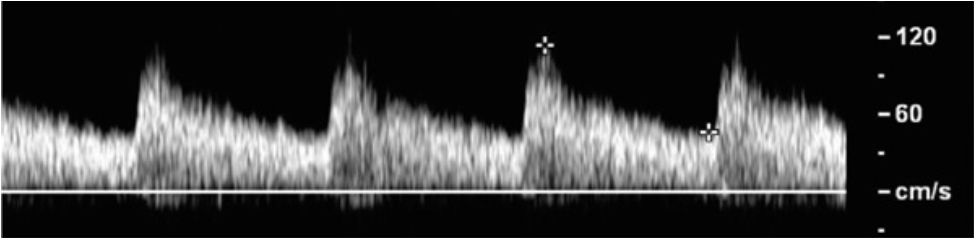
The image has spectral broadening. What might be one way to eliminate the spectral broadening in this image?
(A) Open spectral gate wider
(B) Decrease the spectral gain
(C) Elevate the baseline
(D) Increase the PRF
(B) Decrease the spectral gain
In this image, the spectral gain is too high, causing spectral broadening. Decreasing the gain may decrease the spectral broadening unless the broadening is being caused by other reasons, such as turbulence.

In the image, there is a blue vessel. Based on the information given, this is
(A) A vein
(B) An artery
(C) Flow toward the transducer
(D) Flow away from the transducer
(C) Flow toward the transducer
Color only indicates direction of flow, not artery or vein. In this example, the vessel is blue. According to the color scale given, “blue” is toward the transducer.