RBT Initial Competency Assessment
 Studied by 0 people
 Call Kai
 Learn
Learn Practice Test
 Spaced Repetition
 Match
Match Flashcards
 Knowt Play
1/63

There's no tags or description
Looks like no tags are added yet.
Name | Mastery | Learn | Test | Matching | Spaced |
|---|
No study sessions yet.
64 Terms
Continuous Measurement
All instances of behavior are recorded; exact, accurate data collection.
Duration
Continuous Measurement
The time that elapses from the beginning to the end of a behavior.
Example: Recording how long the learner cries by using a timer that can be started once the crying begins and stopped once the behavior ends.
Rate
Continuous Measurement
Frequency/the amount of times that a behavior occurs during the observation time. To calculate, divide the frequency by the total observation time.
Example: Collecting Hand Raising in a Classroom setting.
Monday: Learner raised hand 15 times in a 39 minute time period → 15/39= 38%
Tuesday: Learner raised hand 18 times in a 56 minute time period → 18/56= 32%
Frequency (Event/Count)
Continuous Measurement
The total number of times that a behavior occurs throughout a specific observation period.
Example: Counting mands on a clicker.
Inter-Response Time (IRT)
Continuous Measurement
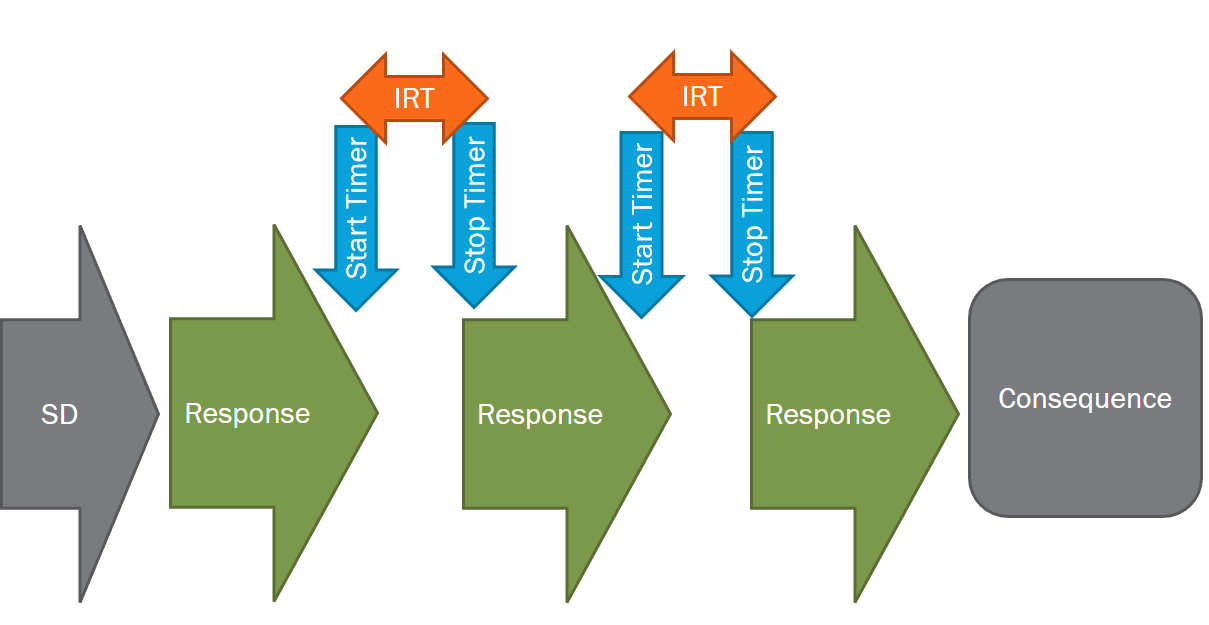
The elapsed time between consecutive occurrences of a behavior; essentially the time between multiple instances of a behavior.
SD does not need to be present.
Example: An RBT asks a learner to “clap hands.” The child claps their hands once, then 3 seconds later the child claps again. The IRT is 3 seconds.
Latency
Continuous Measurement
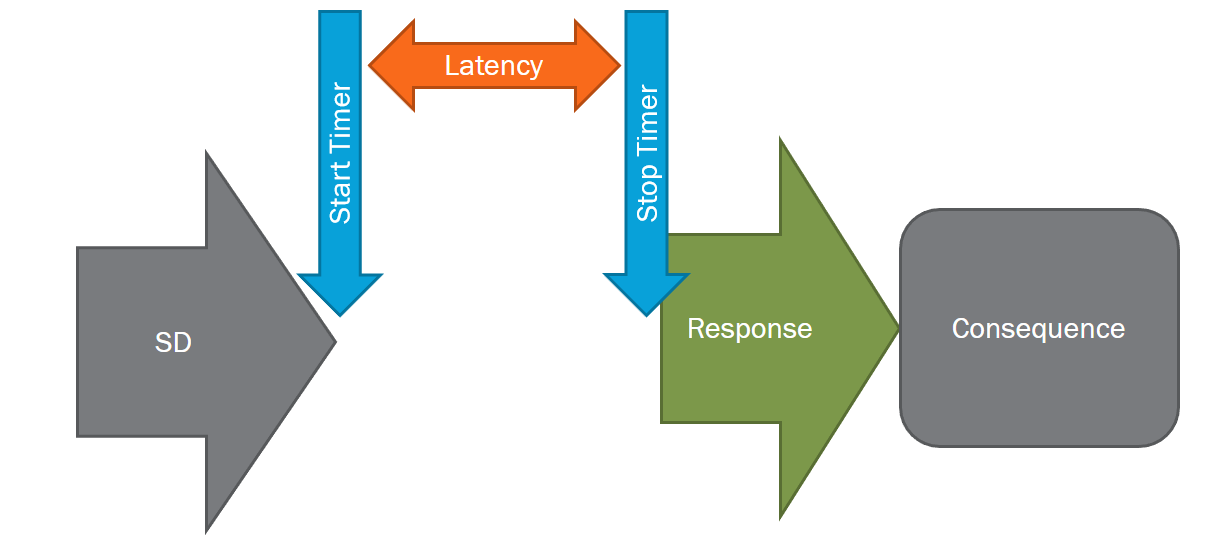
Measuring how long it takes for a behavior to occur after an SD has been presented; the time between the SD and the initial response of the behavior.
SD has to have occurred.
Example: An RBT asks a child to “touch their nose.” After 3 seconds, the child begins the behavior of touching their nose. The child demonstrated a 3-second latency when responding to the SD.
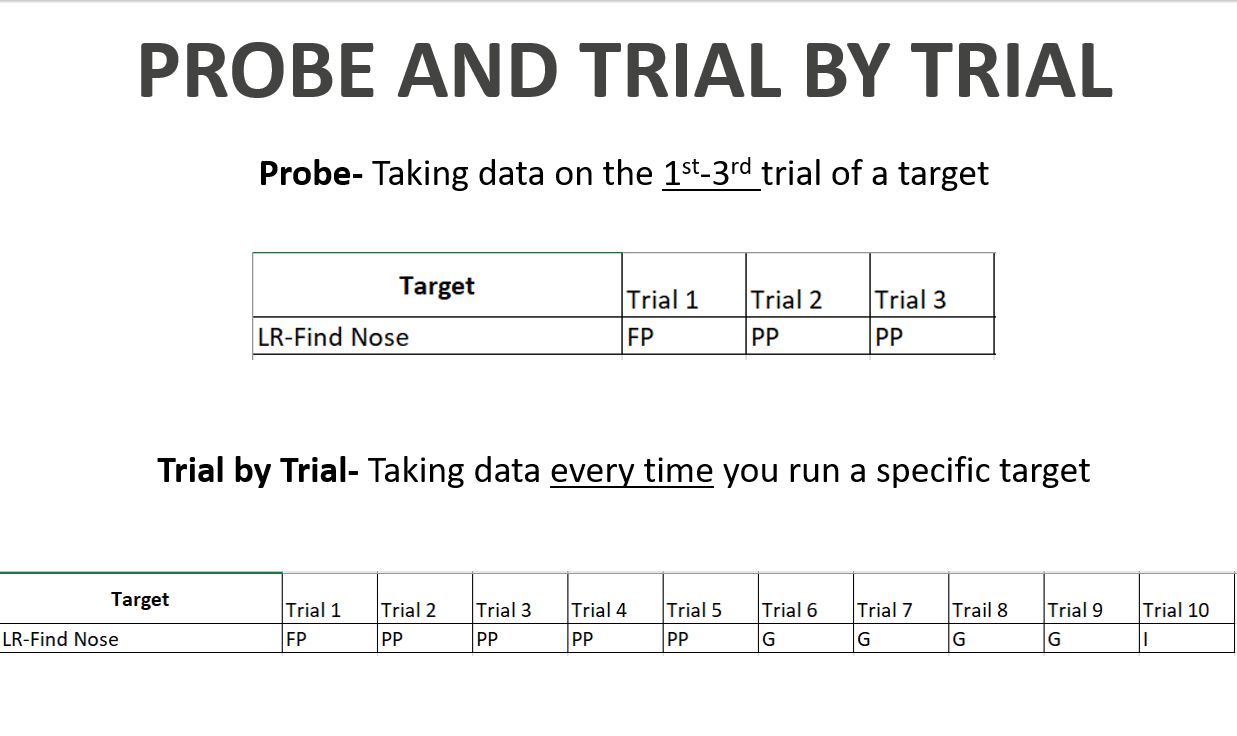
Probing
Continuous Measurement
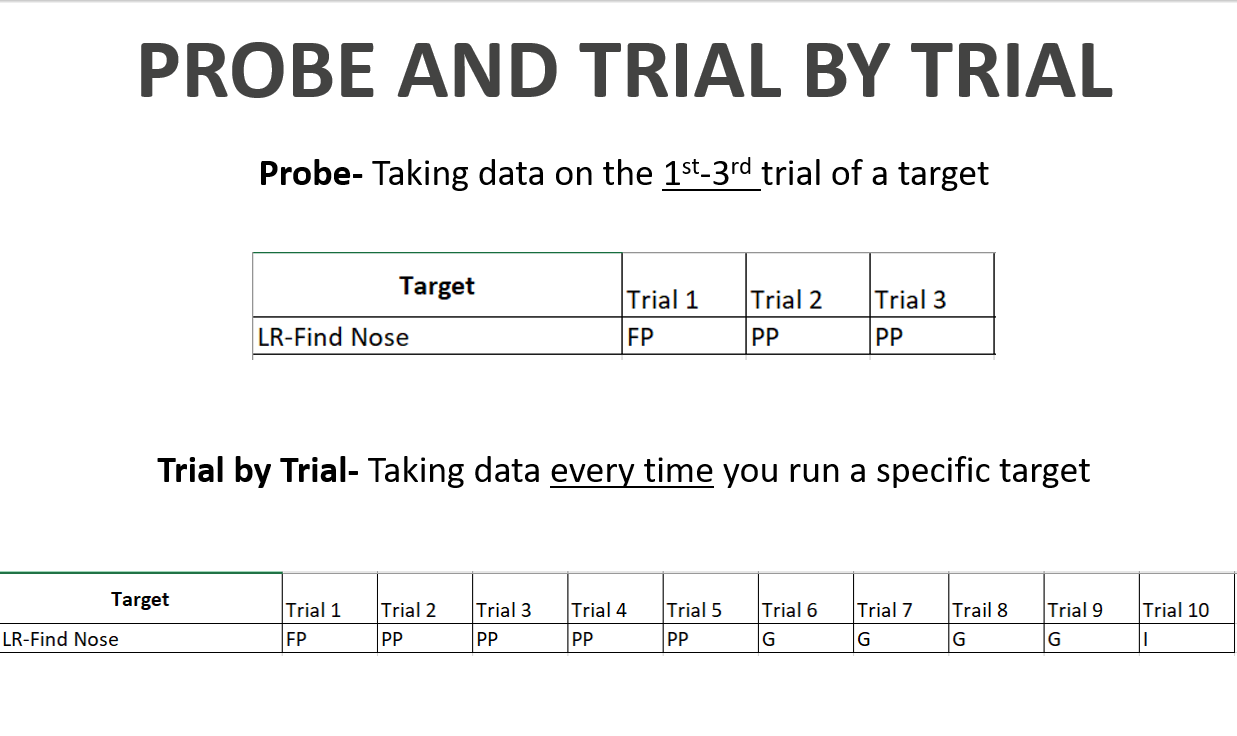
Taking data on the 1st - 3rd trials of a program; typically to determine if the program is in the learner’s skill set.
Trial-by-Trial
Continuous Measurement
Taking data each time a program is ran.
Discontinuous Measurement
Does not account for all instances of behavior, gives an estimation of data collection.
NOT an exact, accurate representation
Occurs by dividing an observation into intervals, and recording whether a behavior occurred during some or all of an interval, or at a specific time in the interval.
Typically used for behaviors that occur at such high rates it would be difficult for the observer to track every occurrence, or behaviors that do not have a clear start and end time.
Partial Interval Recording
Discontinuous Measurement
Observation period is divided into intervals and we record whether the behavior happened at any time during the interval. The RBT records if the target behavior occurs at all, even just once, in a given time span.
Used for behaviors that we want to decrease.
Example: An RBT observes a child for 10 minutes. The observation period is separated into 30 second intervals. If the behavior occurs at any part of the interval, the RBT would record it as “yes.” For each interval, the RBT will mark whether or not the behavior occurred.
No matter how many times the behavior happens in the interval, you are only taking data once per interval.
Whole Interval Recording
Discontinuous Measurement
The observation is divided into intervals, and the observer records whether a target behavior occurs for the entire interval. The behavior must be present during the entire set time span.
Used for behaviors we want to increase.
Example: An RBT observes a learner for 10 minutes. The observation period is divided into 30 second intervals. If the behavior occurs the entire interval, the RBT will mark “yes” for each interval the behavior occurred and mark “no” when the behavior did not occur for the entire interval.
Momentary Time Sampling
Discontinuous Measurement
Specified intervals are set, and the observer records whether the behavior occurs at the end of the interval.
The observer records if the learner engages in a target behavior at predetermined, precise moments.
Example: An RBT wants to determine how often a learner remains on task. They decide to check on the student every 5 minutes to determine their on-task behavior. The RBT sets a timer for 5 minutes; when the timer goes off, the observer looks at the learner to see if they are engaged in on-task behavior. If the learner is on-task, the RBT would mark “yes.” If the learner was off-task, the RBT would mark “no.”
Phase Change Line
When baseline data stops and the intervention begins.

x-axis
line that runs horizontally.
typically, the x-axis has numbers representing different time periods or names of things being compared.
often when data was collected
y-axis
line that runs vertically.
typically, the y-axis has numbers for the amount that is being measured. The y-axis usually starts counting at 0 and may be divided into equal parts.
often occurrences/duration
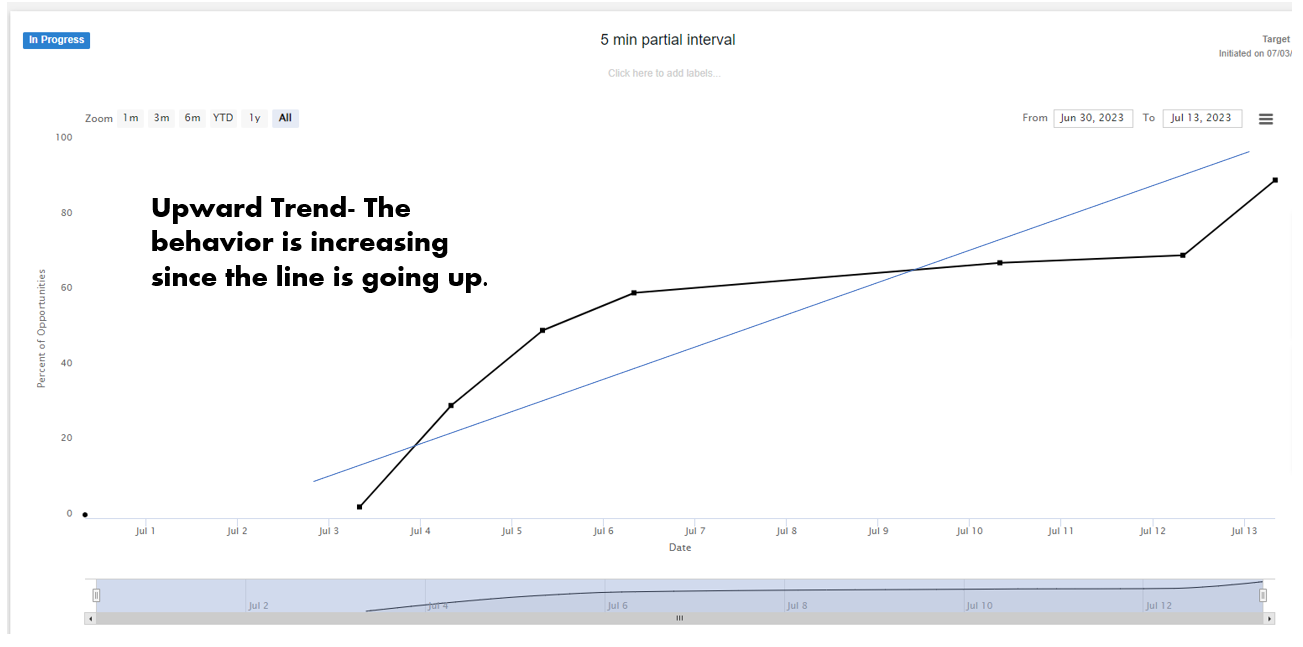
Trend
Overall direction taken by the data path.
Downward Trend

Upward Trend
Permanent Product Data Collection
The behavior results in tangible evidence that the behavior occurred.
Example: Homework completed, car accident, pencils broken by a learner
Preference Assessment
Determine the learner’s likes, dislikes, and potential reinforcers.
Interview with Learner
Preference Assessment
If the learner has the skill to answer questions, we simply ask them what they'd like to do.
Interview with Parent
Preference Assessment
Having a conversation with parents to talk about things the learners play with at home (during initial intake)
Free Operant Assessment
Preference Assessment
Spend time following the learner closely, seeing what they gravitate towards in the environment.
Learners have free access to stimuli in the environment, and data is collected on how long the learner spends with an item or activity.
Single Stimulus Assessment
Preference Assessment
Providing one highly preferred option to the learner (usually for early learners)
typically to used to encourage manding for the desired choice
Paired (Forced) Choice
Preference Assessment
Present two items (usually toys or edibles), allow the learner to pick. After played with or consumed, present another trial of two items.
Only two options at a time.
Multiple Stimulus with Replacement (MSW)
Preference Assessment
Set out preferred items, let the learner pick one, record as highest preferred.
When the item is gone or taken away from the learner, replace the chosen item elsewhere in the field. Take away the non-chosen items and replace with new items.
When the learner chooses the next time, record it as the second most preferred.
Continue until out of stimuli.
Multiple Stimulus without Replacement (MSWO)
Set out preferred items, let the learner pick one, record as highest preferred.
When it is gone or taken away from the learner, do NOT replace the chosen option back in the field.
When they choose the next time, record it as the second most preferred. Repeat this process until out of stimuli.
Creates a hierarchy of preferences.
ABC Data
used for reinforcing (increasing) behavior; Antecedent, Behavior, Consequence
Take ABC Data when:
When you are observing the reoccurrence of a maladaptive behavior that you would like to target for intervention.
When you experience a behavior for the first time.
When your BCBA asks you to.
Antecedent
A stimulus, event, direction, circumstance or action that evokes a behavior.
An event or action that occurs immediately before a behavior.
Discriminative Stimulus (SD): A stimulus that has history of being reinforced; a direction that we give our learner such as "clap your hands" or a stimulus that alerts you that reinforcement is available.
Example: Being a baby and being taught to touch your head, and your parents cheered for you. A trainer saying “Touch your head” would now be considered and SD, due to parents reinforcing when you were a child.
Behavior
An observable and measurable activity of a living organism.
Consequence
What happens directly after a behavior; affects whether that behavior will increase (Reinforced) or decrease (Punished).
There are consequences for desired and undesirable behavior.
In that moment, a consequence can be ANYTHING that follows the behavior. By looking at the data, we can tell if it has been reinforced or punished based on if the data is increasing or decreasing.
ABC for reinforcing behavior
A child is sitting at the lunch table and sees a cookie they want. To gain access to the cookie, the child signs “eat.” The therapist gives the child the cookie because they asked to eat it.
Antecedent: the child sees a cookie on the table.
Behavior: the child signs to eat.
Consequence: the therapist gives the child the cookie.
The child was reinforced for signing “eat,” so the child is more likely to engage in this behavior in the future when they want a cookie.
ABC for decreasing behavior
A child is sitting at a table and sees a cookie they want. To gain access to the cookie, the child screams at the therapist. The therapist ignores the child, and the child does not get the cookie because they did not properly ask.
Antecedent: the child sees a cookie on the table.
Behavior: the child screams.
Consequence: the therapist ignores the child.
The child was not reinforced for screaming, so they are not likely to use this behavior to gain access to a cookie in the future.
Discrete Trial Training
A structured ABA intervention strategy that breaks down specific targeted skills into "discrete" steps.
Used to increase skill acquisition and decrease maladaptive behaviors.
Teaching through discrete trials breaks each skill down into specific components.
There are three components to DTT:
an SD (a stimulus or direction)
the response or behavior
a consequence
If this is a teachable moment (which is what discrete trials are: an opportunity for a response to occur), the consequence will be reinforcement or a correction.
Naturalistic Teaching/Natural Environment Teaching (NET)
Teaching that occurs in the child’s natural environment.
Naturalistic teaching procedures are strategies that take place in an individual's everyday environment and routines.
Naturalistic teaching procedures could take place in a home, in the community, in a school setting, at mealtimes, at play times, or during any other common activity or routine.
Chaining
The completion of one contingency is immediately followed by the next in a predetermined chain; the process used to teach learners the chronological order on how to complete a task.
3 different ways we can can teach chaining.
Forward Chaining
Backward Chaining
Total Task Chaining
Forward Chaining
A behavior chain procedure which begins with teaching the first step and then full physical prompting through the remaining steps until the first step is mastered. Then, moving on to the first 2 steps, 3 steps, and so on.
Backward Chaining
A behavior chain procedure which begins with teaching the last step, and full physical prompting the other steps that come beforehand.
The sequence of responses should still be taught in the correct order.
Once at an independent level with the last step, the RBT works backward with the learner to learn the steps prior.
Total Task Chaining
A behavior chain procedure in which all steps are taught in the sequence, prompting only as need through challenging steps in the chain.
Ideally, the learner should be performing independently on most of the steps and only have issues on one or two steps.
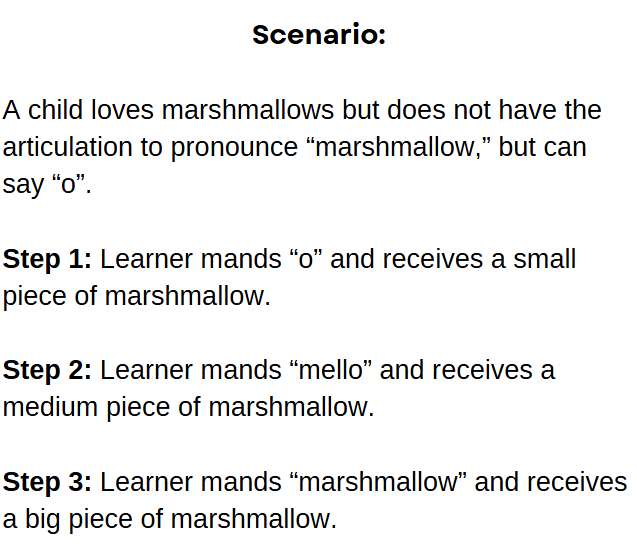
Shaping
Systematically differentially reinforcing successive approximations to a terminal behavior.
Essentially, reinforcing baby steps (successive approximations) until the learner meets the end goal (terminal behavior).
When shaping, each approximation should be closer in form to the terminal behavior than the previous attempt. As a result, more reinforcement is provided for each baby step of a new, larger skill.
Moreover, previous, successive attempts of the terminal behavior should no longer be reinforced.
Used on a day-to-day basis
Behavior can be shaped in terms of topography, frequency, duration, latency, and magnitude.
Discrimination Training
The process of teaching discrimination (difference between two things).
Reinforcing or punishing a response in the presence of one stimulus, and extinguishing or allowing it to recover in the presence of another stimulus.
AKA - being able to discriminate between like objects, items, activities, etc.
Example: When the learner gives the correct response, the RBT will reinforce the behavior.
When the learner gives the incorrect response, the RBT will not reinforce the behavior and will correct the child. The hope is that next time the learner will be able to discriminate between the desired behavior and any other behavior they could engage in.
Stimulus Control Transfer
Stimulus control is the stimulus that evokes a particular behavior.
Stimulus control transfer is when we transfer control from one stimulus to another. When working with the learners, stimulus control transfer and prompt fading go hand-in-hand.
When introducing new concepts to learners, we will typically use a full physical prompt to help our leaners engage in that behavior.
At the beginning, the stimulus that controls their behavior is the prompt, rather than the SD. Overtime, we fade our prompt so that our SD becomes the stimulus controlling their behavior.
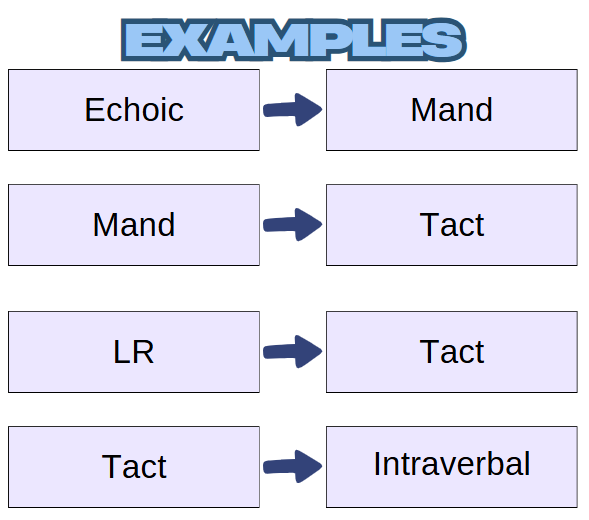
Transfer Trials from Operant to Operant
Another type of Stimulus control transfer.
Transfer trials take a an operant that the learner is strong with and transfers the response to another operant that the child is still learning.
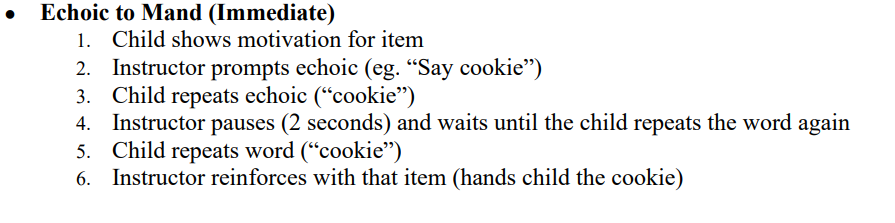
Echoic to Mand transfers (IMMEDIATE)
The most commonly used transfer trial.
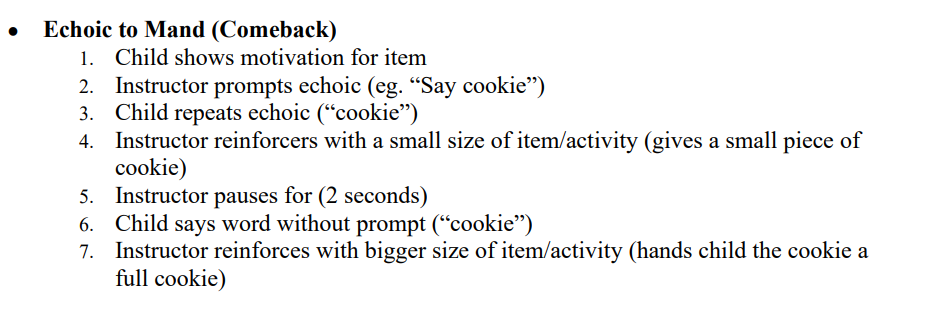
Echoic to Mand transfers (COMEBACK)
The most commonly used transfer trial.
Prompting
Any behavior that the RBT engages in that increases the likelihood that the Learner will respond correctly.
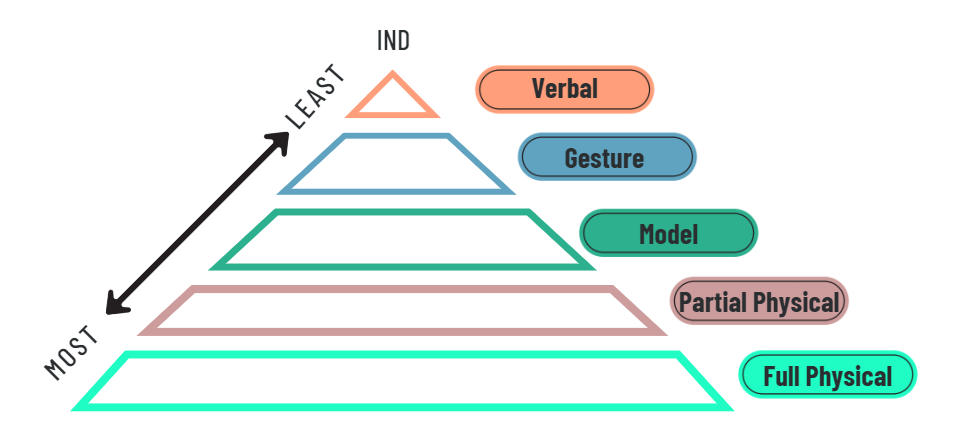
Prompts range from Least to Most Intrusive; there are 2 types of prompts.
Response Prompts
Operates directly on the learner’s response. The prompt occurs after the instruction.
The prompt is provided by the teacher.
Examples:
full physical prompt (hand over hand prompting; most Intrusive)
partial physical (physical guidance from the wrist or above)
model (demonstrating the correct response)
gesture prompt (gesturing/pointing to the correct response)
verbal prompt (telling the learner the entire answer)
partial verbal prompt (telling the learner only part of the answer; least intrusive)
Stimulus Prompts
Prompts operates directly on the antecedent task; prompts that manipulate the environment. Instead of prompting the child, something in the provided stimuli is changed to help set the correct answer apart from distractors.
Prompt typically occurs before the instruction.
Prompt is embedded in the material.
Examples:
increased detail
brightness level
color differentiation
positional prompt (correct answer is closer)
template
size differentiation (correct answer is larger)
Inadvertent Prompts
Inadvertent prompts are prompts the RBT accidentally uses.
Inadvertent prompts can lead the learner to respond correctly — not because the learner has acquired the skill — but because they are following the teacher's prompt, without the teacher being aware they are doing it.
Fading Prompts
Prompts need to be faded over time so the SD controls the behavior.
Fading prompts allows the RBT to transfer stimulus control from the prompt to the discriminative stimulus (SD).
The way you fade your prompts depends on the category of prompt you’re using:
Response prompts vs. stimulus prompts
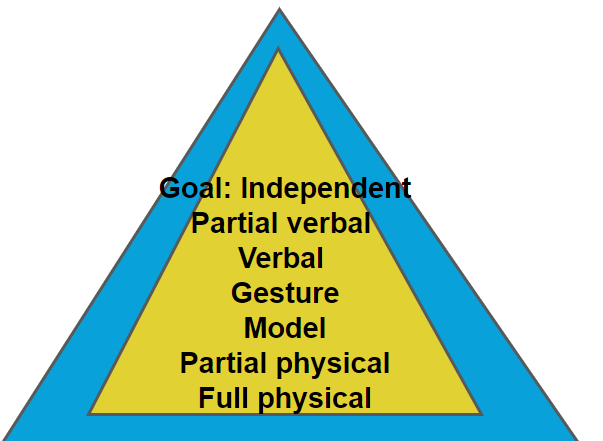
Fading Response Prompts
When fading response prompts, we will first start with the least intrusive prompt that guarantees a correct response from the child. The therapist will only increase intensity if the learner requires more assistance.
The therapist will then fade the intensity of the prompt to reach Independence.
Stimulus Fading
The antecedent stimulus changes gradually, while the response stays essentially the same.
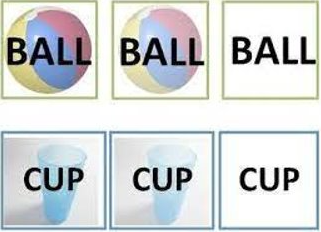
Token Economy
When a child is earning small reinforcement, then trades the small reinforcement in for a larger prize.
The reinforcer is faded out once the token becomes the conditioned reinforcer.
The learner earns tokens to cash in for a larger reinforcer once all tokens are earned
Generalized Reinforcer: The token that is being used and earned.
Backup Reinforcer: The reinforcer that is delivered once the tokens are earned.
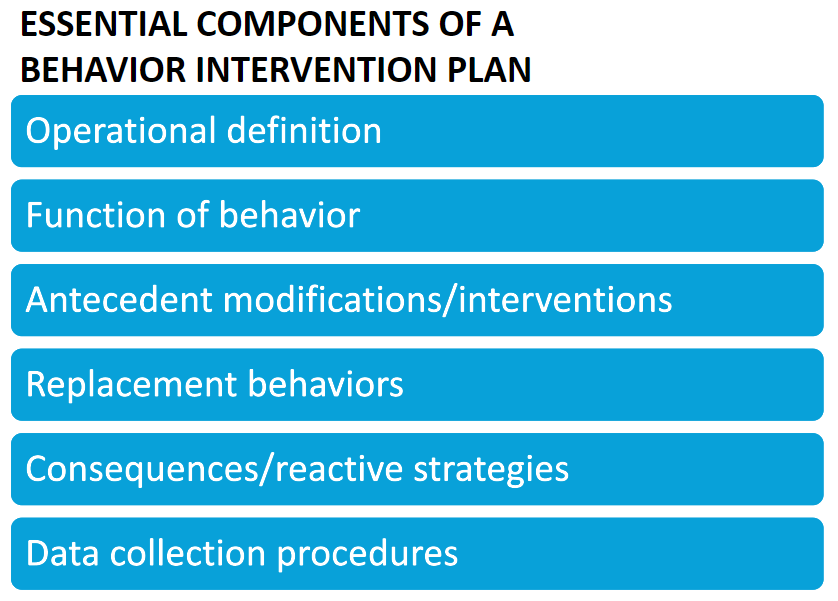
Behavior Intervention Plan
A written improvement plan for the learner.
BIPs guide all team members on how to respond to challenging behaviors and teach appropriate alternatives.
This consistency helps learners feel safe and understood, reducing confusion and frustration.
BIPs are based on a Functional Behavior Assessment (FBA).
Antecedent Interventions
They are proactive strategies that alter the environment with the goal of preventing the behavior of concern from happening.
Examples:
Reducing task difficulty
Redirection
NCR (noncontingent reinforcement)
Activity schedule
Motivating Operations (MO)
Types of Antecedent Intervention; environmental variable that changes the value of a reinforcer or punisher.
ESTABLISHING OPERATIONS (EO)
environmental variable that temporarily INCREASES the values of a reinforcer; deprivation
ABOLISHING OPERATIONS (AO)
environmental variable that temporarily DECREASES the value of a reinforcer; satiation
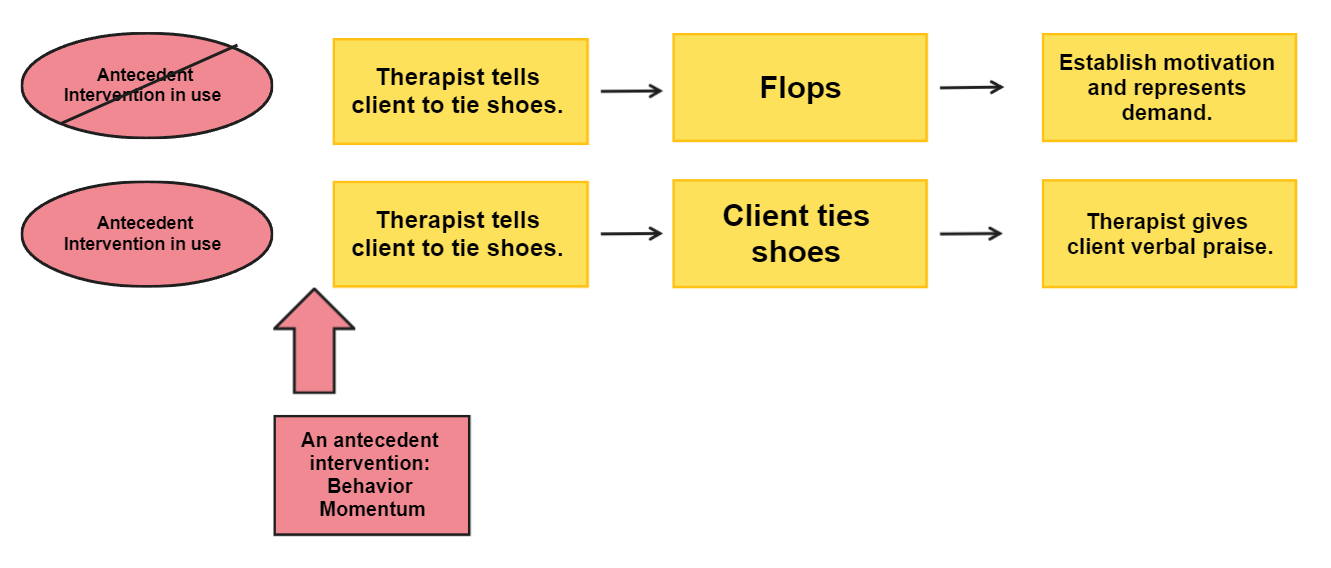
Behavioral Momentum
Type of Antecedent Intervention; high probability request sequence; a series of easy-to-follow requests that the learner has a history of compliance with.
When the learner complies with several high-request, the RBT immediately delivers the target request (low-p)
Functional Communication Training
Type of Antecedent Intervention; develops an alternative communicative response as an antecedent to the problem behavior.
The alternative communicative response will also produce the reinforcer that has maintained the problem behavior, so the communicative response is functionally equal to the problem behavior.
So, hopefully the challenging behaviors will decrease over time.
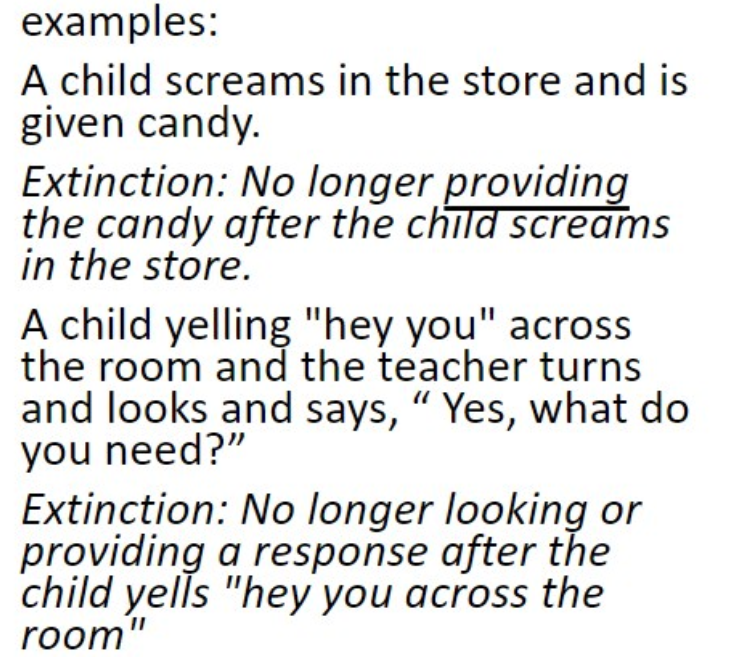
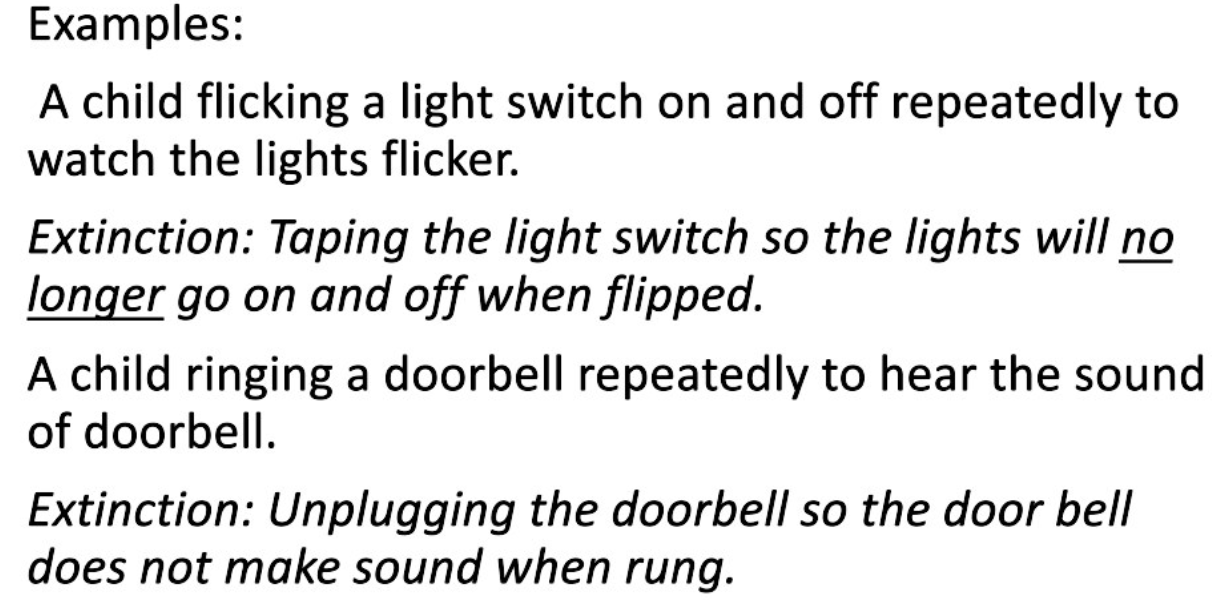
Extinction
No longer reinforcing a previously reinforced behavior, typically results in behavior decreasing or diminishing.
In order to place a behavior on extinction, a practitioner needs to identify what is maintaining the behavior.
Extinction of behaviors maintained by: Positive Reinforcement (access or attention)
Extinction of behaviors maintained by: Negative Reinforcement (escape/avoidance)

Extinction of behaviors maintained by: Automatic Reinforcement
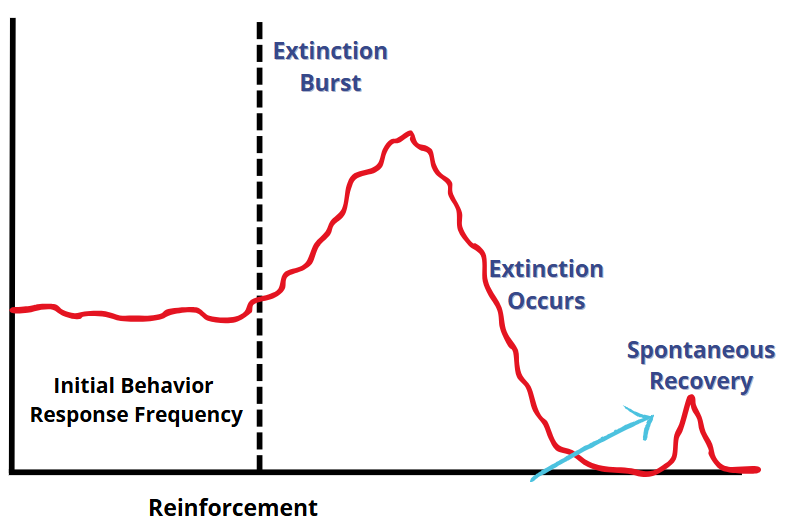
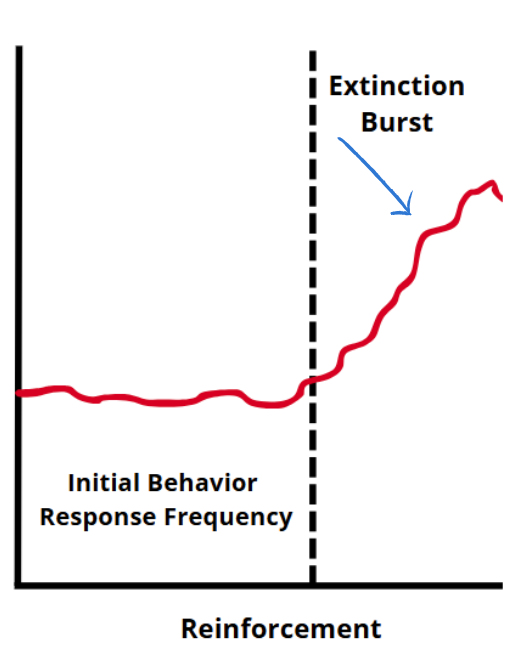
Extinction Burst
Behaviors put on extinction could initially increase in topography, duration, and force before decreasing.
When encountering an extinction burst, the extinction procedure must be maintained or the threshold will just be increased.
Spontaneous Recovery
When a behavior that has previously been put on extinction re- occurs after a period of time without its existence.