Long Term Memory
 Studied by 0 people
 Call Kai
 Learn
Learn Practice Test
 Spaced Repetition
 Match
Match Flashcards
 Knowt Play
1/93

There's no tags or description
Looks like no tags are added yet.
Name | Mastery | Learn | Test | Matching | Spaced | Call with Kai |
|---|
No study sessions yet.
94 Terms
Amnesic Syndrome and double dissociation with STM
- profound long-term impairment with a relative preservation of all other intellectual capacities.
- Double dissociation with STM syndrome:
impairment in LTM, intact STM; Impairment in STM, intact LTM.
Anterograde vs. Retrograde Amnesia
Anterograde: acquiring new memories
Retrograde: remembering events from before the brain injury
Medial Temporal Lobe amnesia has damage in _______, primarily _______. Alcoholic Korsakoff's syndrome has damage in areas that project to _______, mostly in _______ and _______.
MTL; hippocampus
hippocampus; mammalian bodies, anterior thalamic nuclei
T/F: Medial Temporal Lobe amnesia and Alcoholic Korsakoff's Syndrome show almost identical symptoms of amnesia.
True
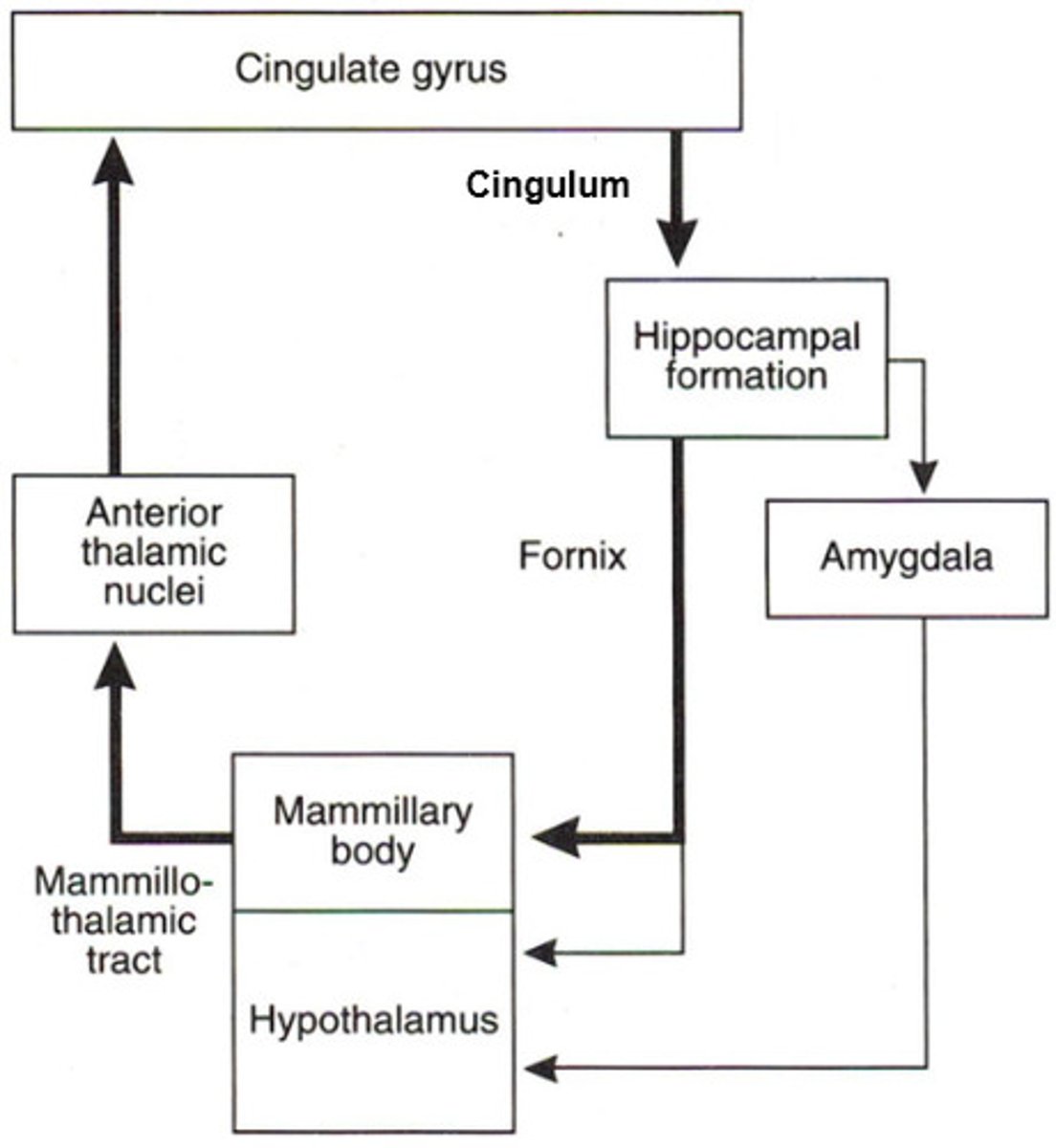
Circuit of Papez
Direct Loop
Indirect Loop
established the relationship between Mammalian bodies, anterior thalamic nuclei, and hippocampus, and retrosplenial cortex.
- anterior thalamic nuclei -> hippo is direct loop/projection to hippo
- mammillary bodies -> anterior thalamic nuclei -> hippo is the indirect loop
but the take away is that through this circuit, everything is connected, which is why Alcohol Korsakoff's and MTL amnesia ultimately show the same symptoms despite different origins.
wernicke-korsakoff syndrom phases
1. Wernicke phase: transient confusional state, acute with motor impairments (considered a medical emergency)
after recovery with large doses of thimine, enters Korsakoff phase
2. Korsakoff Phase: chronic, severe amnesia, personality changes (happy, passive, loses taste for alc), tendency to confabulate
Wenicke-Korsakoff Syndrom patients were often
Vitamin B1 (thiamine) deficient + alcoholics
Korsakoff's patients uniquely have personality changes due to damage in ______ ____ addition to Mamillary Bodies
mediodorsal nuclei
T/F: you can have amnesic syndrome without damage to hippocampus
True. If one of the structures are damaged, info can't flow to the cortex even without having to go through hippocampus (circuit of papez)
Mamillary Body vs. Mediodorsal nuclei causes amnesia
mamillary bodies (MB or ATN)
- Korsakoff pts have additional damage to mediodorsal nuclei, which projects to frontal lobe and causes personality changes.
Medial temporal Lobe resection procedure benefits/cons
It was used for psychotic patients and it gave benefits of frontal lobotomy while preserving personality (no usual side effects) as they only picked out the temporal lobe tissues. But they realized bilateral hippocampal lesions led to loss of recent memory.
Why did they do MTL resection on patient HM, who was suffering with epilepsy?
- known epileptogenic qualities of uncus/hippocampus (causes seizures)
- absence of post-op seizures in usual temporal lobe resections
Patient HM allowed ______ deficit to become aware because
memory; this procedure was only done in psychotic people whose symptoms prevented them from learning that the technique was causing amnesia
In order to cause amnesic symptoms, the lesion had to be...
at least 5 cm deep, bilateral (removal of hippo)
HM had deficit in ____ term memory.
long (amnesia) - removal of hippocampus only causes amnesia, not short term memory deficits (double dissociations)
what did HM teach us?
amnesia can be caused by removal of hippocampus (great discovery back then) not just Korsakoff's Syndrome
LTM can be divided into ________ memory and _________ memory. Describe them
Declarative: memories you can consciously recollect (ex. facts, events, semantic memory)
Nondeclarative: memories not consciously recollected. "show by doing". ex) classical conditioning, perceptual representation system, procedural memory, non associative learning
T/F: In amnesic patients, all of their LTM is damaged.
False - they usually have impaired declarative memory, but intact nondeclarative memory
Intact Skill Learning (3 examples)
An example of non-declarative learning being intact in amnesics.
Mirror Tracing: Patient HM (amnesic patient) tried to track the shape of a star by looking in the mirror. Mirror reversal is a motor skill that requires practice and learning. He mastered the skill perfectly by Day 3 but he had no recollection of learning on Days 1 and 2.
Pursuit-Tracking task: even after 1 week gap in learning, amnesic patients picked up right where they left off without conscious recollection of having practiced.
Mirror-Reversed Reading: all 3 groups of amnesic patients (N.A., Korsakoff, electric compulsive therapy patients) did as well as controls in mirror-reversed reading. Their skills improved equally.
Tower of Hanoi
In Mirror Reversed Reading, why did controls do better than amnesic patients in repeated words trials vs. non repeated word trials?
Because repeated words require more semantic knowledge which amnesic patients lack.
Intact Priming
An exposure to a stimuli helps you perform better/recognize it faster when you see the stimuli again. ex) FLAMINGO -> _LA_IN_O
With priming, your ______/________ representation has been primed with the previous representation of the stimuli, making processing go faster.
system/perceptual
Eyeblink conditioning task involved ________ conditioning.
CS:
US:
CR/UR:
Classical conditioning
CS: tone
US: puff in the eye
CR/UR: blink
In the eyeblink conditioning study, in which condition did amnesics get conditioned to blink just with CS (tone) vs. not get conditioned? What did this show?
They only got conditioned when the tone and air puff overlapped. But when the two stimuli occurred separately with a gap between the two, the conditioning did not occur. Controls were conditioned in both conditions. It showed that awareness is absolutely necessary for classical conditioning, since amnesic patients who forgot the tone was there did not get conditioned.
Which brain areas are critical for binding declarative memories?
Hippocampus and Medial Temporal Lobe
T/F: you can still have non-declarative without unified representation of information
True
MTL and its significance with declarative memory
MTL is organized in a hierarchial manner. Information processed in the cortex funnels down to MTL, which is then processed through hippocampus to have that declarative memory stored.
Declarative Memory requires binding information across _______ ____ into unitary representations that can be declared into _______.
cortical areas; consciousness
Areas associated with nondeclarative memory
basal ganglia (skill learning), neocortex (priming), cerebellum (classical conditioning)
Nondeclarative memory reflects changes within _____, _____, and _______ processing systems
sensory, motor, and perceptual (not having to unify them into one thing unlike declarative memory)
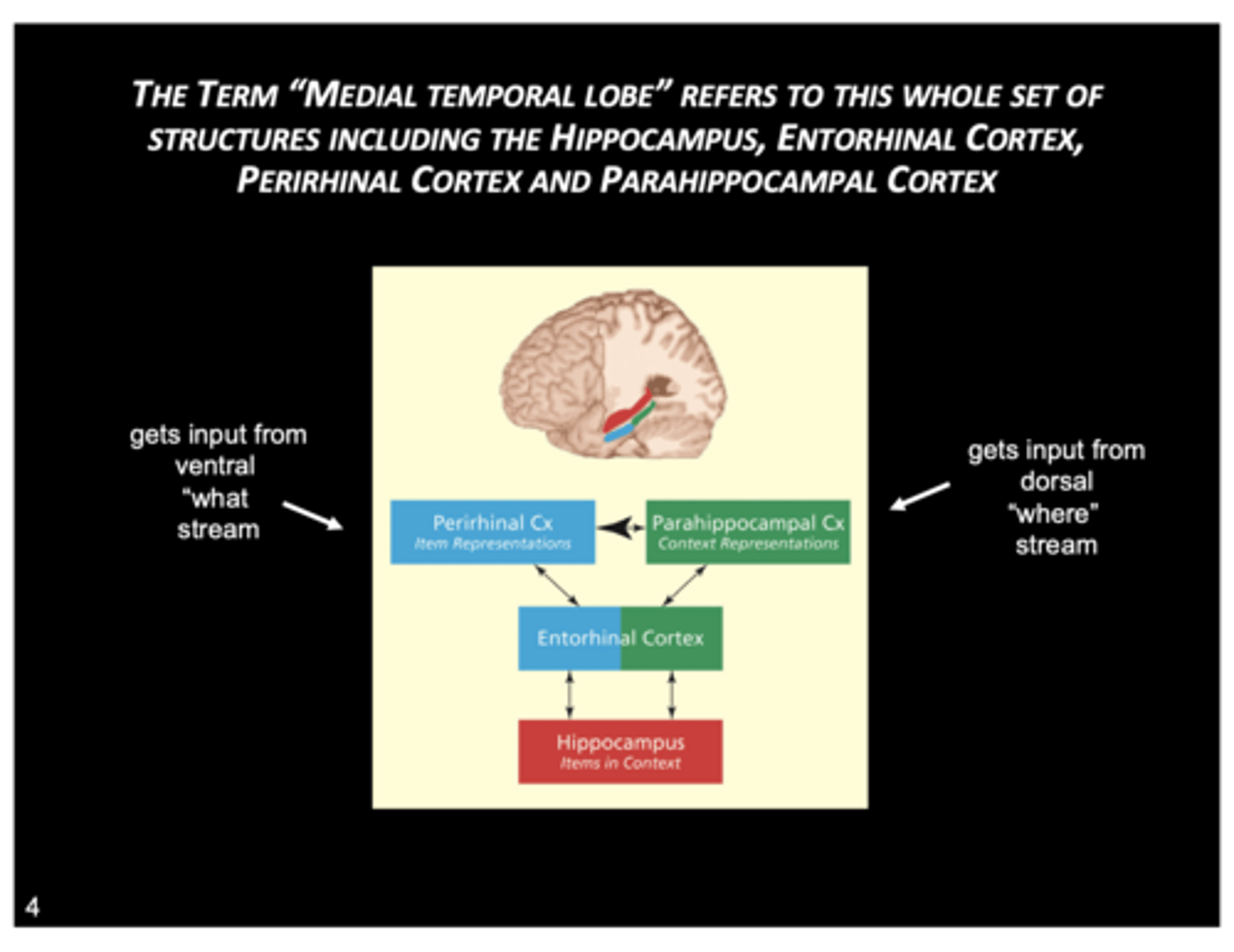
Standard model of MTL and why it's not perfect
MTL: hippocampus and surrounding structures (Parahippocampal cortex, perirhinal cortex, entorhinal cortex (input cortex))
hippo -> subiculum -> entorhinal cortex -> perirhinal cortex/parahippocampus circuit
Medial Temporal Lobe is critical for binding declarative memories. It's not perfect because some argued amnesics only have impaired episodic memory, not the entire declarative memory.
which declarative memory involves re-experiencing a personal experience?
Episodic Memory
Riding a bike is an example of
all 3: episodic, semantic, procedural
They found that amnesics struggled to have intact ______ memory, not ______ memory. BUT, there was a confounding variable in the study that needed to be ruled out. What was it?
episodic; semantic
confound: episodic memory was anterograde, while semantic memory was retrograde (a word they've known prior to brain damage)
In order to test anterograde learning of new semantic knowledge (not episodic), what did they make patient HM do?
They made him memorize words that came after his brain surgery in 1953. (ex. charisma, psychedelic, etc.) and observed his ability to learn new information
When they tested Patient HM's anterograde learning of semantic knowledge, what did they found?
HM showed temporal gradient, a greater decline in learning of newer words compared to controls, showing amnesics are also impaired at semantic knowledge as well as episodic language.
The children (kate, john, beth) all had damage in... showed impairment in ________ memory
hippocampus bilaterally; had amnesia since birth; episodic
The children had profound damage in all 3 aspects: ______, _______ and ______. They had intact _______ memory, but impaired _______ memory.
spatial, temporal, episodic
semantic; episodic
intact semantic memory tested by information subtest, vocabulary subtest, comprehension subtest
what is the proposed hierarchical account of episodic and semantic memory?
A hierarchical account that hippocampus is for episodic memory formation, while its surrounding areas (parahippocampus cortex, perirhinal coortex, entorhinal cortex) are for semantic memory. Therefore, it's possible to only have impaired episodic memory while semantic memory is intact. (but if semantic memory is damaged episodic is also damaged)
The children vs. Patient HM
children: only impaired in episodic memory because their damage was in hippo
HM: impaired in both because he had damage to the surrounding cortical areas as well as hippocampus
The two amnesic patients, Patient SS had damage in hippocampus + surrounding areas, and Patient PS had damage in hippocampus only. What results did they show when tested for semantic memory?
Patient SS showed semantic impairment and could not recognize meanings for words introduced after the onset of amnesia. Patient HS, however, performed noramlly, showing that these different brain areas affect different kinds of memories.
According to the hierarchical account, why can't we have selective impairment in semantic memory that leaves episodic memory untouched?
Because the information flow in the surrounding areas is blocked, so they can't reach hippocampus.
semantic dementia patients have a damage in _____ area. Semantic Dementia is a variant of __________ dementia.
anterior and lateral temporal lobe
Frontotemporal
sementic dementia patients show double dissociation with amnesic patients in what way?
They have intact episodic memory, and impaired semantic memory
Why did they use complex figure to test semantic dementia patients?
Because it's a perceptual, non-verbal cue that allows them to show episodic memory. They'll fail all verbal tests so other tests would be meaningless.
in the episodic vs. semantic memory test, AD patients are equivalent to
hippocampal amnesic patients
In SEMANTIC memory test, (SD/AD) patients failed really bad.
SD (intact episodic, impaired semantic)
In episodic memory test where patients were asked "which one of these objects did you see previously?", SD patients did well in (Perceptually Identical/Perceptually Different) task because...
Perceptually identical. It's because they rely on perceptually identical cues for their episodic memories. But when they see the same object (ex. telephone) in a different shape/color, they can't use the semantic knowledge to apply the knowledge.
T/F: semantic dementia patients have intact episodic memory in all situations.
False. They have intact episodic memory only when the object shown is perceptually identical because they can't apply semantic knowledge.
T/F: AD patients did bad on episodic memory test overall, especially on Perceptually different task.
True (hippocampal amnesia -> bad episodic memory performance)
what drives impairment in episodic memory in Semantic Dementia patients?
semantic memory! Same idea with how they perform worse in episodic memory tasks with perceptually different objects shown.
T/F: based on what we learned with anterograde amnesia and episodic vs. semantic memory, episodic and semantic memories are 2 functionally independent processes.
True-ish
- They interact with each other, but they have separate acquired knowledge. Episodic memory has aspects of both semantic and perceptual aspects. Episodic memory is a moment of experience, while semantic memory is acquired over time.
compare and contrast the hierarchical model of semantic and episodic memory vs. account using semantic dementia
T/F: hippocampus is only important for learning new memories
no! It's critical for at least some period of time to consolidate memory (retrograde amnesia) But after consolidation, memories are no longer dependent on hippocampus.
Standard Model of consolidation
Retrograde memory loss suggests that old memories may not be fully consolidated at the time of injury
If hippocamus plays a time-limited role, there should be a ______gradient for old vs. recent memories.
temporal; recent memories impaired, old memories intact
(recent memories are more susceptible to injuries)
________ is necessary for a bit to bind together early memories, but once information is stabilized in the ______, it's no longer needed.
Hippocampus; cortex
Alcoholic Korsakoff's Patients' face recognition performance declined as they showed photos from most recent decades. What does this say about the relationship between hippocampus and consolidation?
They probably got more and more amnesic as time went on, with less functioning hippocampus. This shows the time-limited role of hippocampus as hippocampus worked better for older memories but not for most recent memories, unable to consolidate recent pictures.
what did patient PZ show with his book?
He became an alcoholic Korsakoff patient after writing a whole book. his case proved that the temporal gradient cannot be the fact that they didn't learn recent memories tested because he had written them down in his book a couple years ago.
How is Transient Global Amnesia useful to study hippocampal function? What was the result?
Because they have acute hippocampal amnesia for ~6-10 hours and recover right away, so they can test the function of hippocampus. When hippocampus was ON (after TGA), they showed perfectly normal performance, but when hippo was OFF (during acute TGA), they showed temporal gradient in recent memories. It shows less consolidation in recent memories occurred.
Why did Sanders & Warrington's study show the opposite trend compared to the temporal grade shown in Albert et al.?
Warrington chose stimuli that controls for semantic contribution and is equally salient at one time vs. another. In Albert et al., there's a clear temporal gradient showing the vulnerability of more recent memories because the memorability of old memories made them become semantic memories. Sanders and Warrington made sure all memories were episodic.
double dissociation between semantic dementia and amnesic patients
semantic: intact episodic, impaired semantic
amnesia: intact semantic, impaired episodic
T/F: In Sanders & Warrington, more recent memories were more vulnerable to being forgotten/getting them wrong.
False - they showed opposite effect, where more recent memories were more intact.
T/F: In Sanders & Warrington, the control line is flat.
false, it showed similar trends as ammesics, showing that episodic memories decay over time for everyone.
In Albert et al., old memories are ______ while new memories are ______. In Shallice and warrington, old and new memories are both _______.
semantic; episodic; episodic
episodic memory (inc/dec) as time goes on. Semantic memory (inc/dec) as time goes on.
dec; inc
Which pattern of temporal gradient do amnesic syndrome patients show?
As time goes on, their episodic memories completely vanish, and semantic memory decreases with more recent decades.
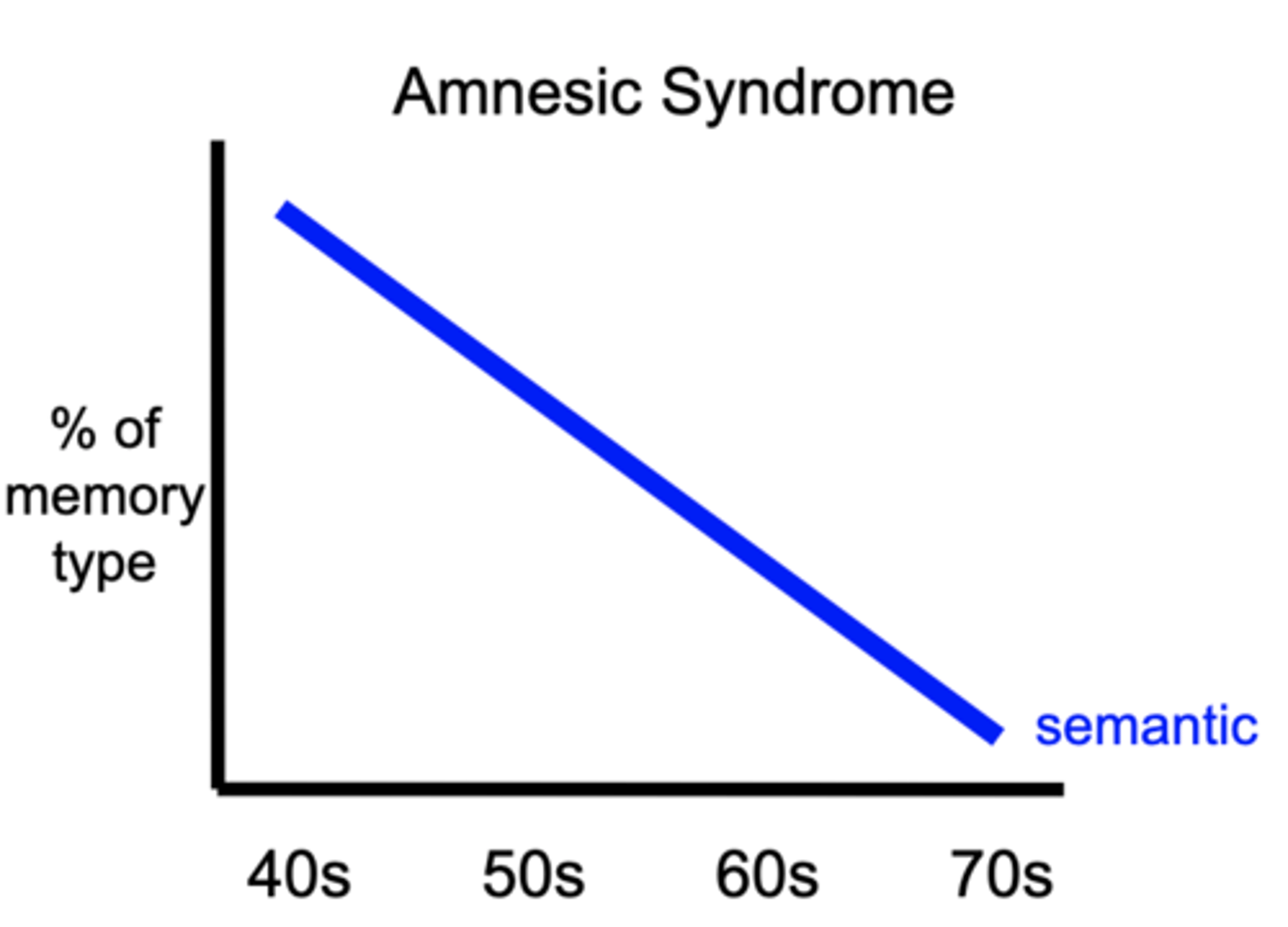
which pattern of temporal gradient do semantic dementia patients show?
opposite of previous picture. Semantic memory disappears completely and episodic memory increases with more recent years.
T/F: the trend that amnesic syndrom patients show (decreasing semantic memory with recent years) is equivalent to hippocampus having limited time role that makes recent memories more vulnerable.
False
Compare and Contrast standard model of consolidation and Multiple Trace Theory
Both emphasize the need for hippocampus in memory consolidation/formation.
However, Standard Model only says hippocampus has time-limited temporal gradient for both episodic and semantic memory. MTT says hippocampus is ALWAYS (not just at one point) necessary to retrieve episodic memory, while semantic memory becomes stronger over time.
(episodic memory in flat line, semantic memory with negative slope)
One possibility why episodic memory is dependent on the hippocampus
Hippocampus has a role in imagining experiences (more fundamental than the known role of memory by hippocampus)
re-experiencing itself, not the memory per say
Can hippocampal amnesics imagine an experience without a memory (past) component? What did this study show?
No! they were all impaired at describing their imagination. They know what's supposed to be at a certain setting semantically, but can't provide details.
similarity between episodic memory and imagining
they both involve salient visualization of an experience within a rich spatial setting/context
Absence of hippocampal amnesics' ability to imagine experiences can affect their ability to...
re-experience or reconstruct past events (basically having episodic memory)
T/F: hippocampus is there to bind the memory
False. It's mostly there to create the imagination to re-live the past experiences and store them as episodic memories.
Frontal Lobe Amnesics have a problem with _______ ____ of memories.
strategic use
ex) planning, monitoring, organizing of memories that facilitates encoding and retrieval
purpose of memory is to shape our behavior, so memories are useless unless we can utilize them strategically
examples of strategic use of memory
temporal ordering (this memory happened relative to which event), source memory (where we learned the fact from), metamemory
Frontal patients show relatively intact anterograde memory compared to Korsakoff/MTL amnesic patients. How did they differ from controls?
They showed mild decrements in memory tasks because they lacked the ability to strategically retrieve the memory. They still performed better than Korsakoff or MTL because they already have the stored memory nonetheless.
Frontal patients, given a list of 15 words to sudy and asked to reproduce the list order from random array of words, were given tests of word recall, word recognition, and word sequencing. What was the result?
They performed perfectly fine with word recognition and word recall, but impaired at word sequencing. This is due to their deficit in temporal ordering.
how was the memory for temporal order assessed?
correlated the judged order (by participants) with the actual presentation order(that they were supposed to replicate) of the words
how was memory of frequency of occurrence measured in frontal lobe amnesics? what was the result?
they were shown a series of designs and had to decide whether designs were composed of straight or curved lines. Each design was presented 1, 3, 5, 7, or 9 times. Although everyone, including controls, started underestimating the amount of times designs were shown as frequency increased, frontal lobe patients underestimated the frequency much worse.
To test source memory in frontal lobe amnesics, they made patients learn 20 trivia facts. One week later, they did a recall test for 20 learned facts and 20 other random facts. What were the two kinds of source errors?
1. recalled learned fact, but said it's from another source (extra-experimental source error bc they said it's from another source even though it was from experiment)
2. recalled other fact, but said it was from the learning session (experimental source error)
T/F: frontal patients showed more source error than older adults
True - they performed much worse with sourcing than both old and young adults
When testing metamemory, after 5 min delay, did frontal patients or amnesic patients perform worse at recall of sentences? When did their percent recall become similar?
Amnesic patients; became similar for frontals after 1-3 day delay
T/F: in the feeling of knowing performance, 1-3 day delay frontal patients did predict their result well since they did well on the recall test.
False. they had very little confidence that they remembered, showing their lack of metamemory. (but 5 min delay frontal patients were good at feeling of knowing test).
which group performed the worst at feeling of knowing performance, out of frontal, amnesic, korsakoff?
Korsakoff (hippocampal amnesia + frontal amnesia)
Which memory impairment resembles a milder form of frontal lobe memory impairment? Contrast to which kind of amnesia?
Age-associated memory impairment; this kind of impairment does not show similar symptoms to Alzheimers/hippocampal amnesia.
How did they test healthy aging (mild frontal lobe dysfunction) using skin conductance orienting response (SCOR)?
SCOR is caused by unexpected, salient stimuli such as tones. Tone are presented at an irregular interval, and they require selective attention paradigm, asking old group and young group to either 1) ignore the tones and listen to the story or 2) attend to tones and ignore the story.
Difference in SCOR result between old and young group
Old group showed no difference in SCOR when they were told to attend vs. ignore to the tone. They continued to respond to the tones they were told to ignore. young group were selectively able to habituate quickly between 2 conditions. They ignored the tone when told to ignore (less SCOR) response.
Other tests that measured memory for frequency of occurrence in young vs. elderly population
Novel visual stimuli (chinese characters) shown 0-6 times. Later showed them a pair of stimuli and asked which one was shown more frequently. Elderly group was more likely to be impaired at discriminating how many times the item was shown.
Mere Exposure effect
Mere exposure effect is an example of (implicit/explicit) memory. showed that the repeated exposure leads to...
implicit;
it leads to higher likeability scale! Greater exposure -> more likelihood of liking it. As the novel ideograms were presented in higher frequency, both elderly and younger groups increased likelihood.
T/F: only older people are susceptible to false memory paradigm, where they falsely believe a synonymous word was shown after being exposed to a list of similar words.
False. It happens to everyone, but more frequently in older adults.
How do they organize false memory pradigm results? Results?
They divide words into studied words, related lures (synonymous word not in the list), and unrelated lures. "Remember" signifies whether the person actually had a vivid memory of presentation of the word. Older adults were convinced that they remember the falsely presented word.
T/F: declines in veridical memory (false memory presentation) are inevitable consequences of aging. Evidence?
false! Frontal lobe functions depend highly on each individual.
In one study, they divided older adult groups into two groups: high FL, low FL. Older adults who had high FL functioning had accuracy close to younger adults in false memory paradigm. It was only older adults with low FL functioning that struggled.