Psychology 101: Brain, Behavior, Consciousness, and Senses
 Call Kai
 Learn
Learn Practice Test
 Spaced Repetition
 Match
Match Flashcards
 Knowt Play
1/117

Earn XP
Description and Tags
Comprehensive vocabulary flashcards covering neuroanatomy, neuronal communication, the nervous and endocrine systems, genetic foundations, consciousness, sleep, and sensory perception domains.
Name | Mastery | Learn | Test | Matching | Spaced | Call with Kai | Chat |
|---|
No analytics yet
Send a link to your students to track their progress
118 Terms
Neuron Doctrine
The concept defined by Camillo Golgi and Santiago Ramón y Cajal, who jointly won the Nobel Prize in Physiology/Medicine in 1906, establishing that the nervous system is made up of discrete individual cells.
Cell Body
The part of a neuron, also known as the soma, that coordinates tasks and keeps the cell alive.
Dendrites
Branch-like structures of a neuron that receive information from other neurons.
Axon
The extended fiber of a neuron that transmits information to other neurons, muscles, or glands.
Myelin Sheath
An insulating layer of fatty material that covers the axon of a neuron to speed up signal transmission.
Synapse
The junction or gap between the axon of one neuron and the dendrites or cell body of another.
Conduction
The movement of electrical signals within an individual neuron.
Transmission
The movement of chemical signals across the synapse between neurons.
Resting Potential
The stable negative electrical charge of a neuron's cytoplasm relative to the extracellular space when at rest, typically −70mV.
Depolarization
The process during an electrical signal where a neuron's membrane potential becomes less negative.
Hyperpolarization
The process where a neuron's membrane potential becomes more negative than its resting potential.
Action Potential
An electric signal that is conducted along a neuron's axon, occurring only when the threshold for stimulation (−55mV) is met.
All-or-None Law
The principle stating that an action potential always occurs at the same size and strength—it fires completely or not at all, though its frequency can differ.
Repolarization
The stage of the electrical impulse where the neuron membrane restores its negative internal charge to return to its resting state.
Refractory Period
The phase following an action potential during which a neuron undergoes hyperpolarization and cannot immediately fire another action potential.
Neurotransmitters
Chemical messengers that cross the synaptic gap to transmit information from one neuron to another.
Central Nervous System
The primary division of the nervous system composed of the brain and spinal cord.
Spinal Reflexes
Simple, automatic pathways in the nervous system that rapidly generate muscle contractions without direct brain processing, such as the pain withdrawal reflex.
Somatic Nervous System
A major subdivision of the peripheral nervous system comprising nerves that convey information into and out of the CNS to control voluntary muscles and sensory organs.
Autonomic Nervous System
The subdivision of the peripheral nervous system that carries involuntary commands regulating blood vessels, internal body organs, and glands.
Sympathetic Nervous System
The branch of the autonomic nervous system that arouses the body to expend energy in response to threat or stress ('Fight or flight').
Parasympathetic Nervous System
The branch of the autonomic nervous system that calms the body to conserve and maintain energy ('Rest and digest').
Corpus Callosum
A thick band of nerve fibers connecting the right and left cerebral hemispheres, allowing communication between them.
Frontal Lobe
The lobe of the cerebral cortex responsible for abstract thinking, planning, and voluntary movement via the motor cortex.
Temporal Lobe
The lobe of the cerebral cortex responsible for hearing, language processing, and storing knowledge of word meanings.
Parietal Lobe
The lobe of the cerebral cortex containing the somatosensory cortex, responsible for processing touch information and spatial guidance.
Occipital Lobe
The lobe located at the back of the cerebral cortex responsible for processing visual information.
Thalamus
A subcortical structure that filters and relays information from all senses (except smell) to the cerebral cortex.
Hypothalamus
A subcortical structure that regulates body temperature, hunger, thirst, and sexual behavior.
Hippocampus
A subcortical structure in the limbic system critical for creating new memories and integrating them into long-term storage.
Amygdala
A subcortical structure located in the limbic system that plays a central role in emotional processes and emotional memories.
Medulla
An extension of the spinal cord in the hindbrain that coordinates heart rate, circulation, and breathing.
Pons
A hindbrain structure that relays information from the cerebellum to the rest of the brain and regulates breathing rate and sleep cycles.
Cerebellum
A large structure of the hindbrain that controls fine motor skills, coordination, and balance.
Neuroplasticity
The brain's ability to adapt and reorganize its structure and functional connections in response to inputs, learning, practice, or injury.
Endocrine System
A network of glands that produce and secrete hormones directly into the bloodstream to regulate body functions.
Hormones
Chemical messengers produced by endocrine glands that travel through the bloodstream and bind to receptors to affect behavior and physiology.
Behavioral Endocrinology
The scientific study of the bidirectional interactions between hormones and behavior, including aggression, mating, and parenting.
Pituitary Gland
The 'master gland' of the body's endocrine system, controlled by the hypothalamus, which secretes messenger hormones to direct other glands and regulate growth.
Hyperthyroidism
A condition such as Grave's disease caused by an overproduction of thyroxine, resulting in agitation, bulging eyes, and weight loss.
Hypothyroidism
A disorder characterized by reduced levels of thyroid hormones, leading to symptoms such as tiredness, feeling cold, and weight gain.
Adrenal Glands
Glands located above the kidneys that secrete hormones involved in the stress response, including epinephrine (adrenaline) and norepinephrine (noradrenaline).
Pancreas
An endocrine gland that secretes insulin and glucagon to regulate blood sugar levels.
Gonads
Sex glands (ovaries in females, testes in males) that produce sex hormones such as estrogens, progesterone, androgens, and testosterone.
Chromosomes
Threadlike structures made of DNA molecules containing genes; humans possess 23 pairs in almost every cell.
Genes
Specific units of hereditary information composed of DNA sequences that dictate the building of proteins controlling traits.
Alleles
Alternative variations or versions of a specific gene that account for variations in inherited traits.
Genotype
The complete genetic makeup or sequence inherited by an organism.
Phenotype
The observable physical and behavioral characteristics resulting from the interaction of genotype and environment.
Range of Reaction
The principle that genes set strict upper and lower boundaries for potential expression (such as IQ), while environmental factors determine where within that range an individual falls.
Epigenetics
The study of gene-environment interactions detailing how environmental factors alter gene expression without changing the underlying DNA sequence.
Consciousness
A person's subjective experience of the world and mind.

Problem of Other Minds
The fundamental difficulty we have in perceiving or confirming the conscious experience of entity types other than ourselves.
Dualism
The philosophical view championed by René Descartes that the mind and body are fundamentally separate entities, proposing that consciousness resides in the pineal gland.
Monism
The philosophical position that the mind and body are part of the same underlying physical entity.
Intentionality
One of the four basic properties of consciousness, defined as its quality of being directed toward an object or action.
Unity
The property of consciousness describing its ability to integrate information from all body senses into a coherent whole.
Selectivity
The property of consciousness describing its capacity to include only some objects or details while filtering out others.
Transience
The property of consciousness describing its continuous tendency to shift and change focus over time.

Levels of Consciousness
Variaching states of awareness and wakefulness spanning from full conscious wakefulness, lucid dreaming, and sleep to minimally conscious states, vegetative states, anesthesia, and coma.
Vegetative State
A state characterized by wakefulness without awareness, where an individual may show simple responses to stimuli without voluntary control.
Insomnia
A sleep disorder involving persistent difficulty falling or staying asleep occurring at least 3 nights a week for at least one month.
Treatment: Cognitive behavioral therapy
Parasomnia
A category of sleep disorders involving unwanted motor behaviors or experiences during sleep, including sleepwalking, REM sleep behavior disorder, restless leg syndrome, and night terrors.
Sleep Apnea
A sleep disorder in which an individual repeatedly stops breathing for periods of 10 to 20 seconds or longer during sleep, often treated with a CPAP device.
2 types: Obstructive (airway gets blocked) & Central (CNS fails to initiate breathing)
Narcolepsy
A sleep disorder characterized by sudden, involuntary sleeping episodes during normal waking hours.
Physiological Dependence
A state of drug dependence marked by altered bodily functions that result in physical withdrawal symptoms when usage ceases.
Psychological Dependence
An emotional need or craving for a drug to maintain psychological well-being despite potential negative consequences.
Hypnosis
An altered state of consciousness characterized by focused attention, reduced external awareness, and an enhanced responsiveness to suggestion.
Meditation
The practice of intentional focus on a limited sensation (such as breathing or sound) to deepen self-awareness and quiet mental activity.
Sensation
The process by which sensory receptors detect physical information from sensory organs.
Perception
The brain's organization, identification, and interpretation of sensory signals in order to form a mental representation.
Transduction
The process by which biological sensors convert physical energy or signals from the environment into neural signals sent to the CNS.
Bottom-Up Processing
Perceptual processing that constructs a complex mental representation by starting directly from raw sensory inputs.
Top-Down Processing
Perceptual processing where the brain interprets incoming sensory information using existing knowledge, expectations, and context.
Absolute Threshold
The minimum intensity of physical stimulation needed to detect a stimulus 50% of the time.
Just Noticeable Difference
The minimal change in a stimulus required for a person to detect that a difference has occurred; also referred to as sensory acuity.
Weber's Law
The psychophysical principle stating that the just noticeable difference of a stimulus is a constant proportion rather than a constant fixed amount.
Sensory Adaptation
The gradual decline in sensitivity to constant, prolonged stimulation over time.
Inattentional Blindness
The perceptual failure to notice a visible object or event because attention is directed elsewhere.
Change Blindness
The perceptual failure to notice significant changes introduced into a visual scene.
Cones
Photoreceptors in the retina that operate under normal daylight conditions, detecting fine detail and color.
Rods
Photoreceptors in the retina that become active only under low-light conditions to provide night vision in grayscale.
Fovea
An area of the retina where visual acuity is highest because it contains a dense concentration of cones and no rods.
Retinal Ganglion Cells
Neurons in the retina that organize electrical signals received from bipolar cells and send their axons out to the brain via the optic nerve.
Trichromatic Theory
The theory proposing that color perception results from the combined patterns of activity across three types of cones sensitive to distinct wavelengths: Red (Long), Green (Medium), and Blue (Short).
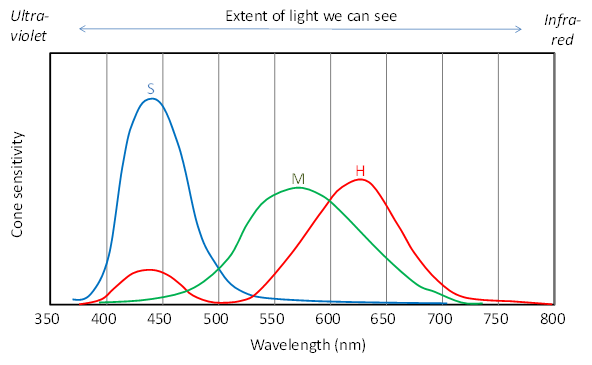
Opponent Process Theory
The theory suggesting that color vision depends on opposing neural mechanisms (black-white, blue-yellow, red-green).
Afterimage
A visual sensation that continues to persist after the original stimulus has been removed.

Gestalt Psychology
An approach to perception emphasizing that the human mind naturally organizes isolated sensory elements into integrated patterns or unified wholes ('Prägnanz').
Monocular Visual Cues
Depth perception cues available to perceive distance when using only one eye, such as occlusion, relative size, cast shadows, shading, linear perspective, and texture gradient.
Binocular Cues
Depth perception cues that depend on the visual input from both eyes simultaneously, including convergence(the coordinated inward movement of both eyes toward each other to maintain a single, focused image when looking at a close object) and retinal disparity.
Ventral Visual Stream
The visual processing pathway that projects to the temporal lobe, dedicated to identifying object meaning and identity ('What is it?').
Dorsal Visual Stream
The visual processing pathway that projects to the parietal lobe, dedicated to determining location and movement to guide action ('Where is it?').
Cochlea
A fluid-filled, spiral structure in the inner ear containing hair cells that convert mechanical vibrations into neural impulses.
Monaural Cues
Auditory cues that allow sound localization using input from a single ear.
Essential for determining whether a sound is coming from above, below, in front of, or behind the listener
Binaural Cues
Auditory cues that localize sound sources by comparing differences in vibration timing and level (intensity) between both ears.
McGurk Effect
A perceptual illusion demonstrating sensory integration where visual speech signals override conflicting auditory speech signals.
Conductive Hearing Loss
Hearing impairment caused by physical damage to the eardrum or the ossicles in the middle ear.
Age or genetics if bones aren’t formed
Sensorineural Hearing Loss
Hearing impairment caused by damage to the cochlea, auditory hair cells, or auditory nerve.
Exposure to loud sounds

Touch Receptors
Cutaneous mechanoreceptors embedded in the skin
Meissner's corpuscles- pressure and lower frequency vibrations
Pacinian corpuscles- changes in pressure and higher frequency vibrations
Merkel’s disks- light pressure
Ruffini corpuscles- stretch
Nociception
The sensory process of detecting noxious or painful stimuli via specialized nerve endings that send electrical signals up the spinal cord to the brain.