Section 2.4 Translation
 Call Kai
 Learn
Learn Practice Test
 Spaced Repetition
 Match
Match Flashcards
 Knowt Play
1/18

There's no tags or description
Looks like no tags are added yet.
Name | Mastery | Learn | Test | Matching | Spaced | Call with Kai | Chat |
|---|
No analytics yet
Send a link to your students to track their progress
19 Terms
A Review of Peptide Bonds
Quick overview of 8.XX from Exam 1

Overview of the Translation Machinery
mRNA has information for protein primary sequence
tRNA acts as the translator, reading the mRNA and bringing the right AA
Aminoacyl-tRNA (charged tRNA) enters ribosome at A-site (Acceptor or aminoacyl)
Peptidyl-tRNA with growing peptide chain is in the P-site (peptide)
Uncharged tRNA moves into E-site (Exit or empty) and dissociates
Ribosome is peptidyl transferase and forms peptide bonds
Contains large and small subunits
~65% rRNA and 35% protein; rRNA is the enzyme
In cytoplasm and rough ER; Mitochondria and chloroplasts have their own

Principles of the Genetic Code
Ribosome reads 5’ → 3’; Protein in synthesized from amino- (N-) to carboxyl- (C-) terminus
ORF begins with a start codon ends with a stop codon
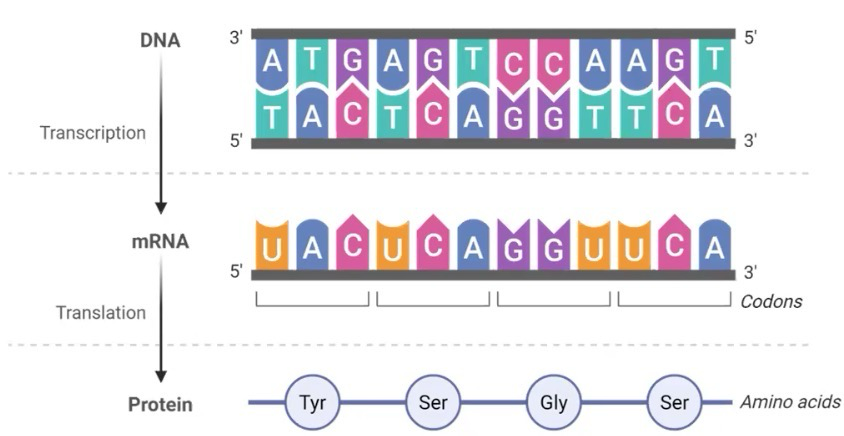
Codons are series of three bases which specifies one AA
ORF is a continuous series of codons; the genetic code is non-overlapping (As in it reads three bases, and then jumps to the next three; means each AA is independent)
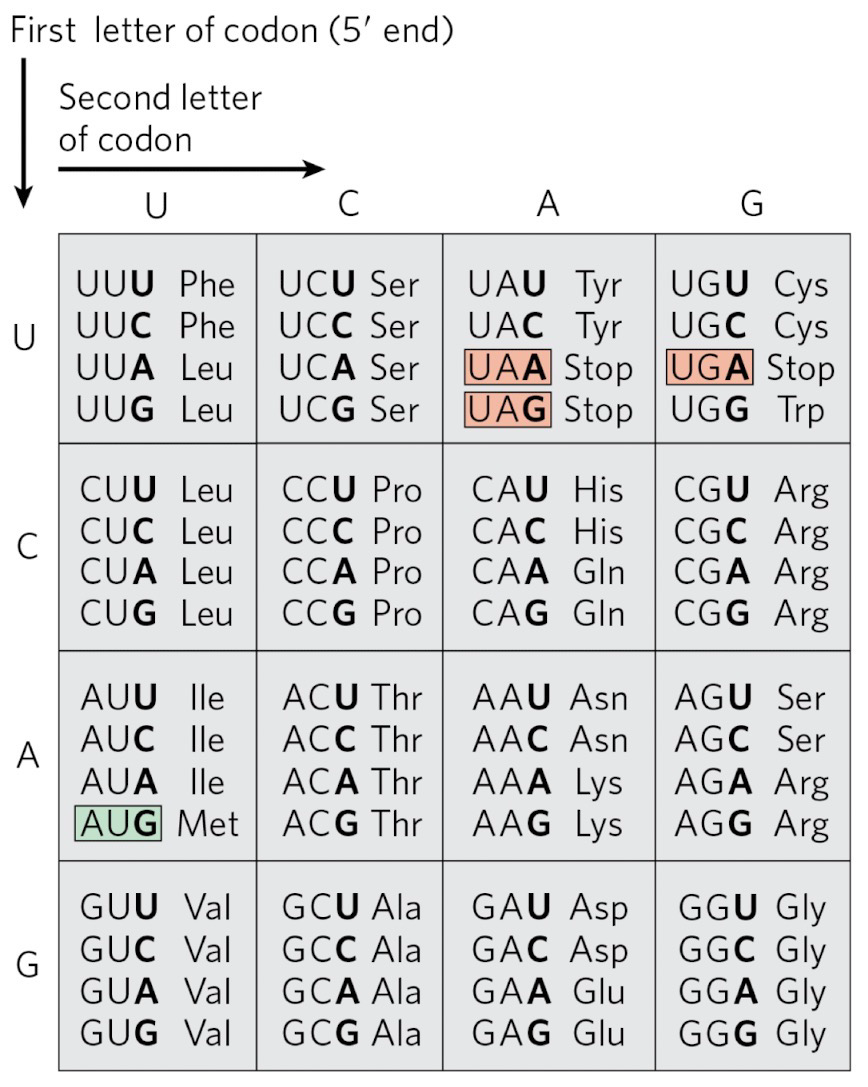
The Genetic Code
Same in prokaryotes and eukaryotes
64 possible codons
Degenerate: Most AAs are encoded by more than one codon (Except M and W)
AUG is the start codon
Three stop codons (UAA, UAG, and UGA); They do not code AAs
Transfer RNA (tRNA)
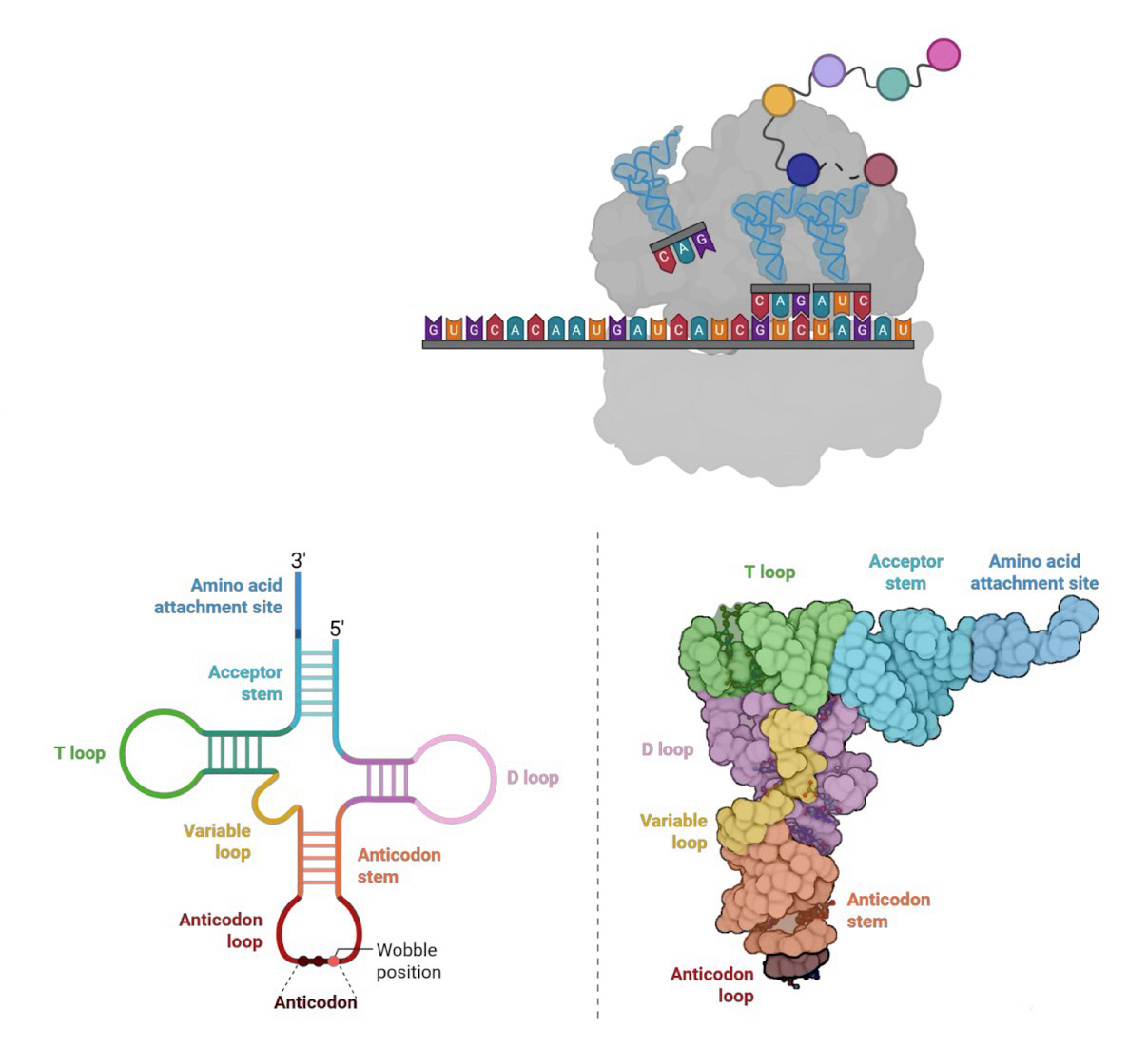
tRNAs are 74-93 nt long, forms a cloverleaf secondary structure; contains many modified bases:
Acceptor stem: Carries specific AA; AA esterified by carboxyl group to the 2’-OH or 3’-OH of A residue at 3’ end of tRNA
Anticodon loop: Contains anticodon to allow bping with codon
D arm/loop: Contains dihydrouridine (D); Continues overall folding on tRNAs
TΨC arm/loop: Contains ribothymidine and pseudouridine (Ψ) which has an unusual C-C bond; Contributes to overall folding and interacts with the large-subunit rRNA
Variable arm/loop: present in some tRNAs; Length varies
Same 3D structure for all tRNAs
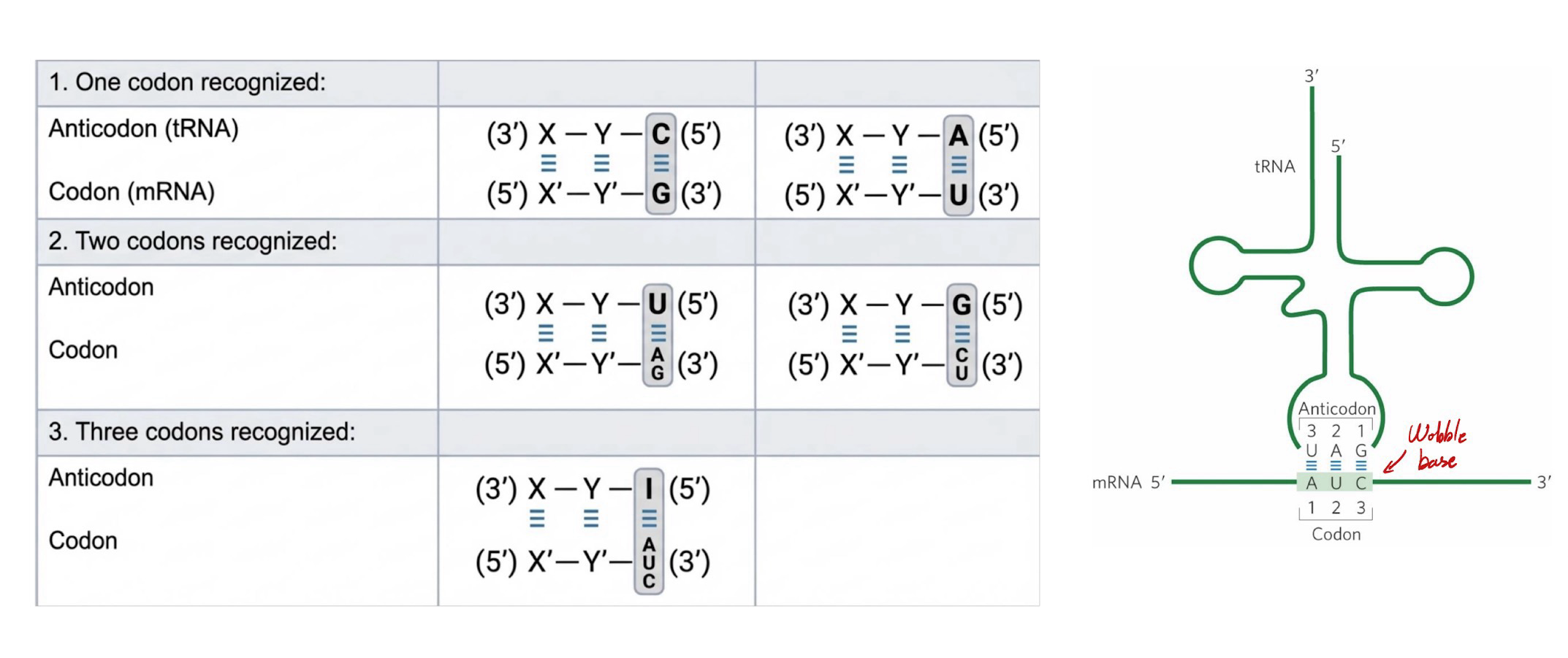
Interaction between anticodon and codon of mRNA; The wobble base (WILL BE ON EXAM)
Anticodon: Three base sequence on tRNA that base pairs with mRNA codons
First two bases of codon form strong Watson-Crick-Franklin base pairs with the anticodon
The wobble base: Third base of most codon pairs loosely with the anticodon: Allows rapid dissociation during protein synthesis; ~32 tRNAs are required to translate all codons (instead of 64; conservation of resources)
The wobble position is the ONLY position where GU base pairing can occur
Some tRNAs can have inosine monophosphate (IMP), or I base, which can pair with A, U and C
Charging tRNAs with AAs
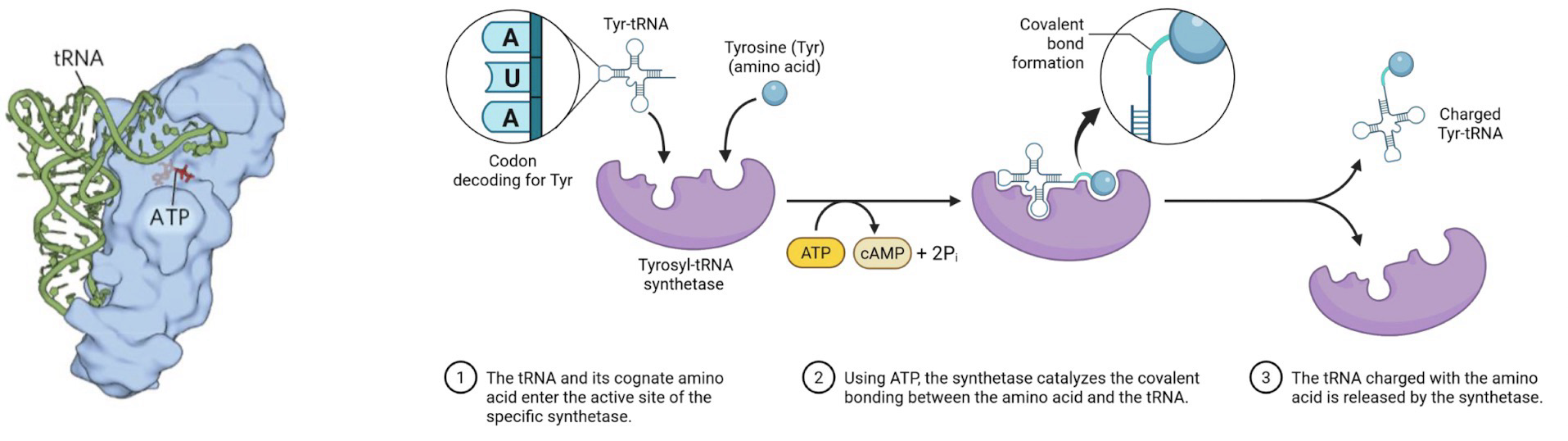
Aminoacyl-tRNA synthetases (20) add an AA to the 3’ end of the appropriate tRNA creating a charged tRNA (Uses ATP)
Selects tRNA by binding to the bases that are unique to each tRNA = Variant bases
Bases in tRNA that confer binding specificity can be found in the acceptor stem the anticodon loop, including the nucleotides on the anticodon itself, and the variable arm
I.e., a single G=U base pair in the AA arm of tRNAAla determines the tRNA recognition by Ala-tRNA synthetases
Basically, a few nts on tRNAs are specifically recognized by specific Aminoacyl-tRNA synthetases
Translation Overview
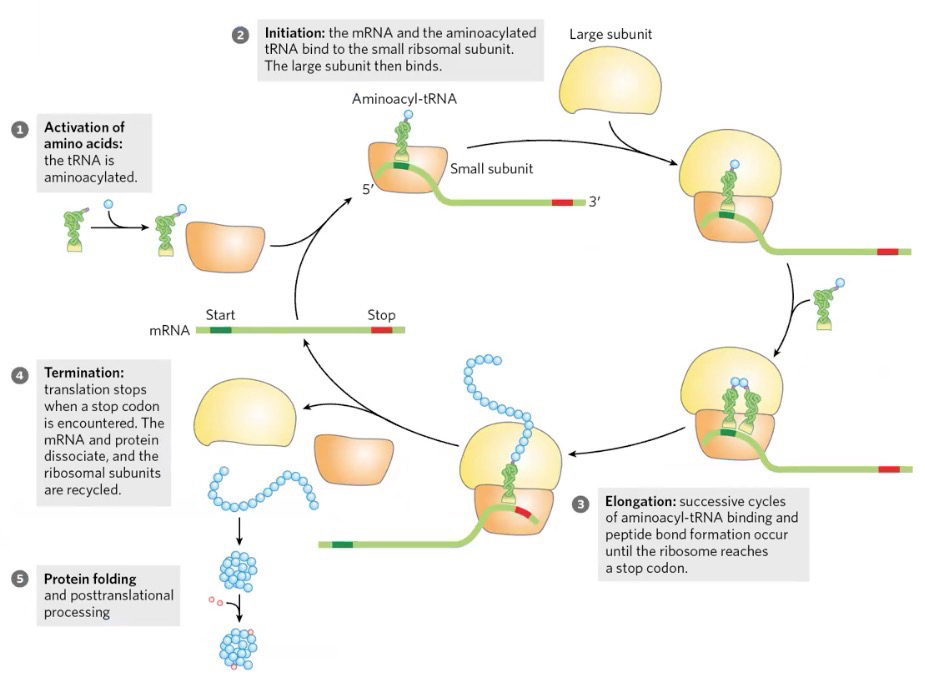
Activation of AA: tRNA is aminoacylated
Initiation: mRNA and charged tRNA binds to small ribosomal subunit; Large subunit then binds
Elongation: Cycles of aminoacyl-tRNA binding and peptide bond formation occur until stop codon
Termination: Via stop codon; mRNA and protein dissociates, ribosomal subunits are recycled
Protein folding and posttranslational processing
Prokaryotic Initiation Factors (IFs)
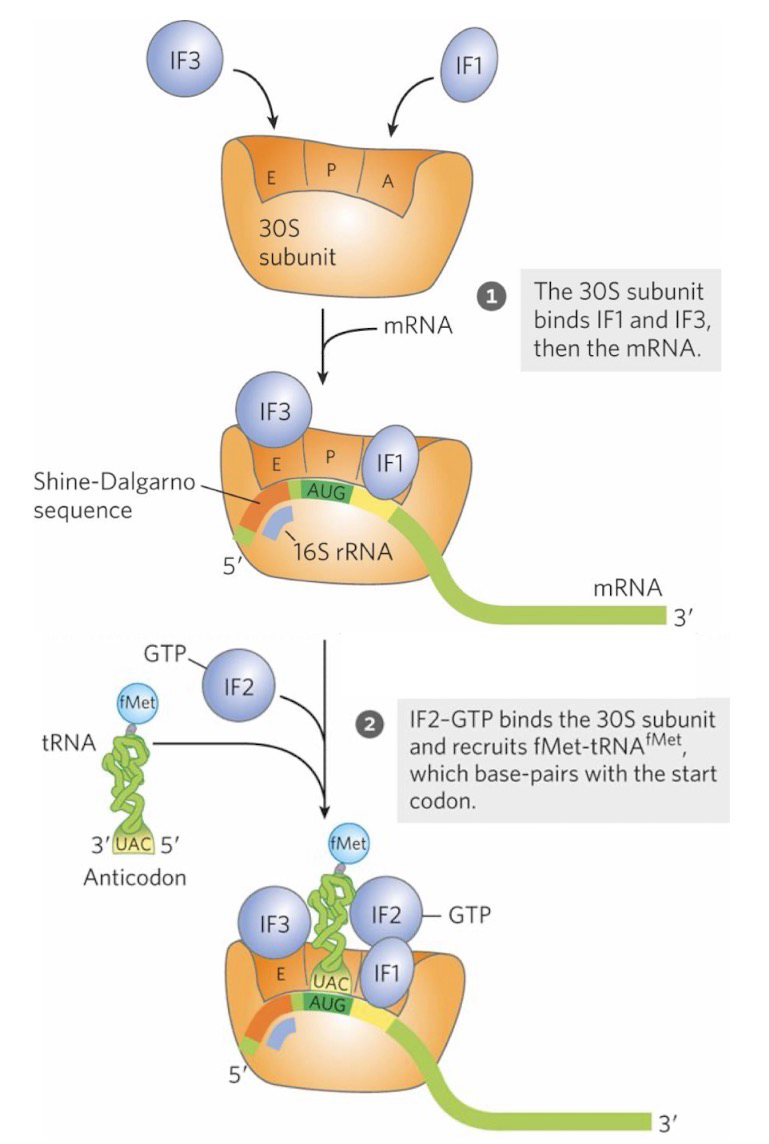
Acts on 30S ribosomal subunit to form translation initiation complex
IF-1 blocks premature tRNA binding at A-site
IF-3 blocks premature binding of 50S subunit
mRNA base pairs with 16S rRNA in the 30S subunit; Shine-Dalgarno sequence region in mRNA guides initiating (5’)AUG to its correct position (P-site)
IF-2 binds fMet-tRNAfMet and inters it into P-site; Also binds GTP
mRNA start codon base pairs with the fMet-tRNAfMet anticodon
AUG is the only codon to bring an AA to P-site, everything else goes on the A-site
Shine-Dalgarno Sequence in Prokaryotes
Shine-Dalgarno Sequence: An mRNA sequence where ribosomes bind; 8-13 nt purine-rich element in mRNA; complementary to a sequence in the 16s rRNA
mRNA Shine-Dalgarno sequence pairs to 16S RNA in the 30S ribosomal subunit; Positions start codon in the ribosomal P-site
Start codon is AUG encoding N-formylmethionine (fMet); Doesn’t matter what AA is after; fMet-tRNAfMet inserts fMet at amino-terminal; Met-tRNAMet inserts M in internal AUGs
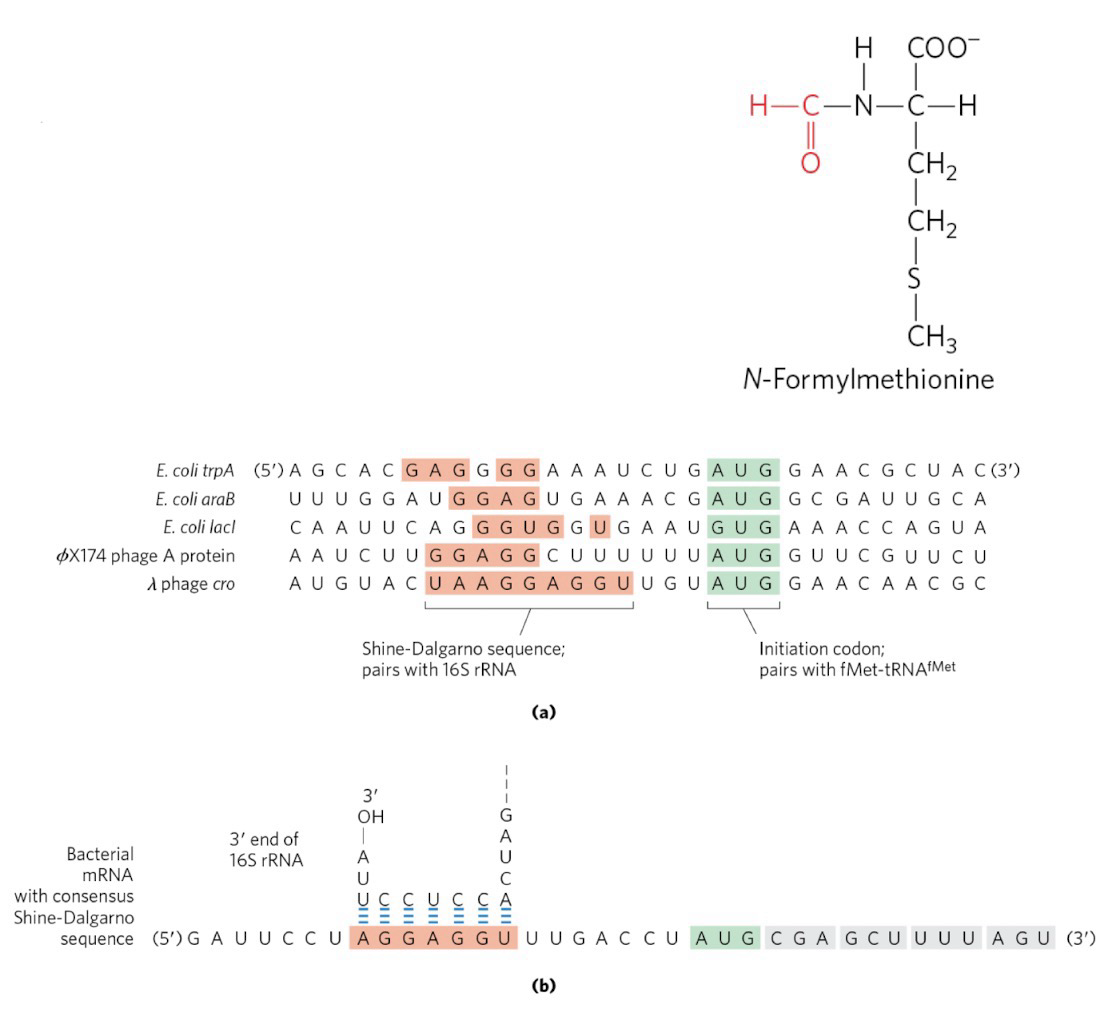
Translation Initiation Complex in Prokayotes
IF-2 hydrolyzes its GTP and causes all IFs to dissociate (IF-2-GTP → IF-2 + GDP + Pi)
50S subunit binds and completes the translation initiation complex, meaning:
A-site vacant
P-site has fMet-tRNAfMet
E-site vacant
mRNA start codon AUG in P-site

Prokaryotic Elongation Factors (EFs)
Needed to bring aminoacyl-tRNAs into ribosome
EF-Tu delivers charged tRNA to A-site; Base pairs tRNA anticodon with second mRNA codon
EF-Tu-GTP hydrolyzes GTP → GDP + Pi and releases the tRNA:
A has tRNA, P still has fMet-tRNA, E still vacant
EF-Tu-GDP is recycled to EF-Tu-GTP by EF-Ts, a nucleotide exchange factor (Binds and replaces nt with a new one; aka exchanges GDP for GTP)
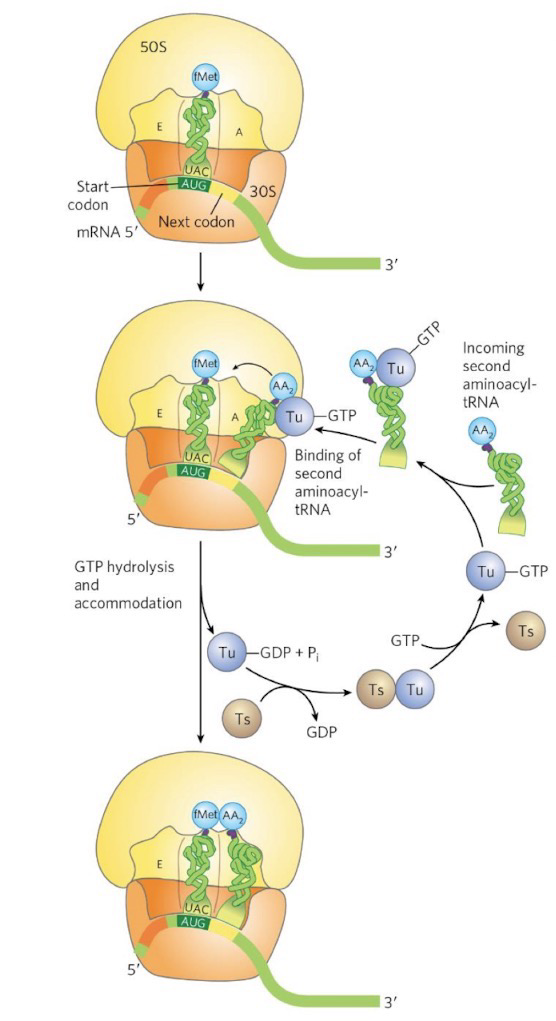
Peptide Bonds & Translationation in Prokaryotic Translation
Ribosome (23S rRNA) is a peptidyl transferase
fMet is transferred to amino group of aminoacyl-tRNA in the A-site and forms a dipeptidyl-tRNA; ⍺-amino group of AA in A-site acts as nucleophile
Translocation: EF-G moves ribosome one codon towards 3’ end of mRNA:
Shifts anticodon of dipeptidyl-tRNA from A to P site
Shifts anticodon of uncharged tRNA from P to E site
Leaves A site open for new aminoacyl-tRNA
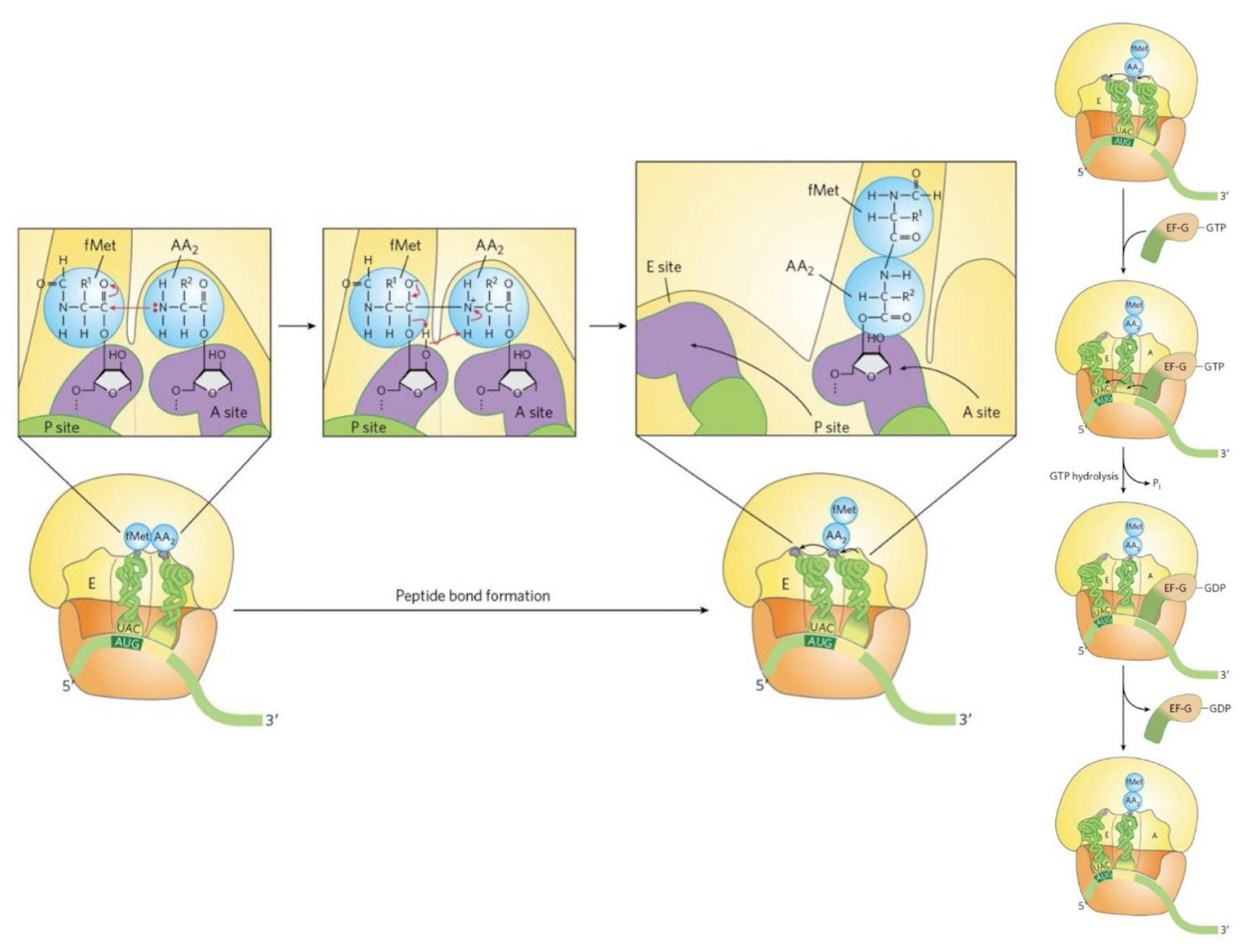
Translation Termination and Recycling in Prokaryotes
Termination occurs at stop codons (UAA, UAG, UGA); This pauses the ribosome and leaves A site open, allowing RFs to bind
Termination factors (release factors): Proteins RF1, RF2, and RF3 “tricks” 23S rRNA to hydrolyzes terminal peptidyl-tRNA bond, releases polypeptide and last uncharged tRNA, and causes dissociation of 70S ribosome into its subunits
Ribosome recycling factor (RRF): Uses GTP to help ribosome dissociation; IF3 helps tRNA dissociate.
IF3 and 30S subunit complex can now initiate translation again
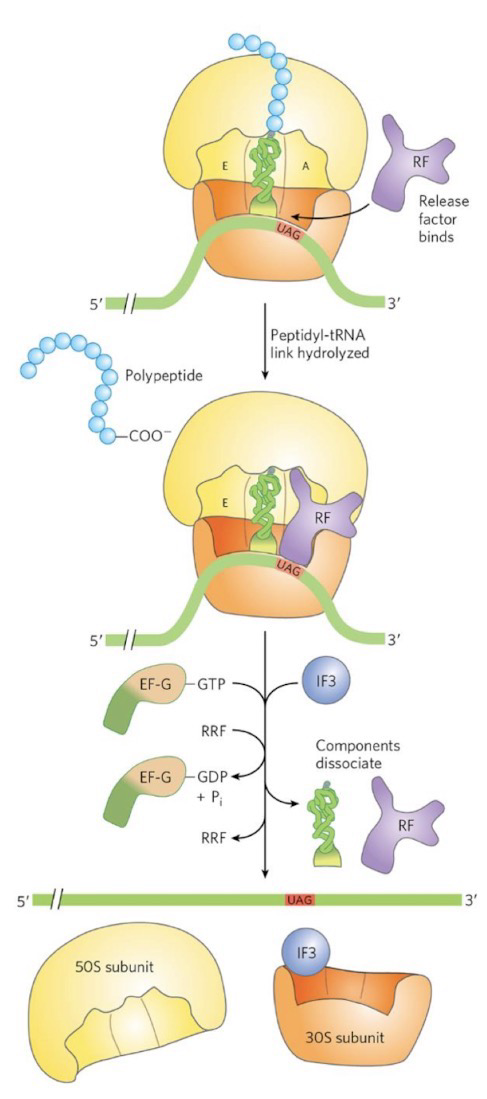
Eukaryotic Initiation Factors (eIFs)
Eukaryotic cells have at least 12 initiation factors: eIF1A is a functional homolog of IF1 and eIF3 to IF3
eIF4F complex binds to mRNA 5’ cap; Mediates interaction with preinitiation complex; binds to poly(A) binding protein (PABP), circularizing mRNA; facilitates regulation of gene expression
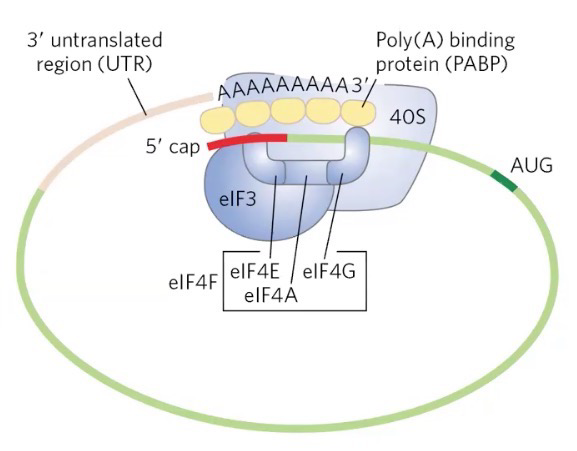
Eukaryotic Initiation of Transcription
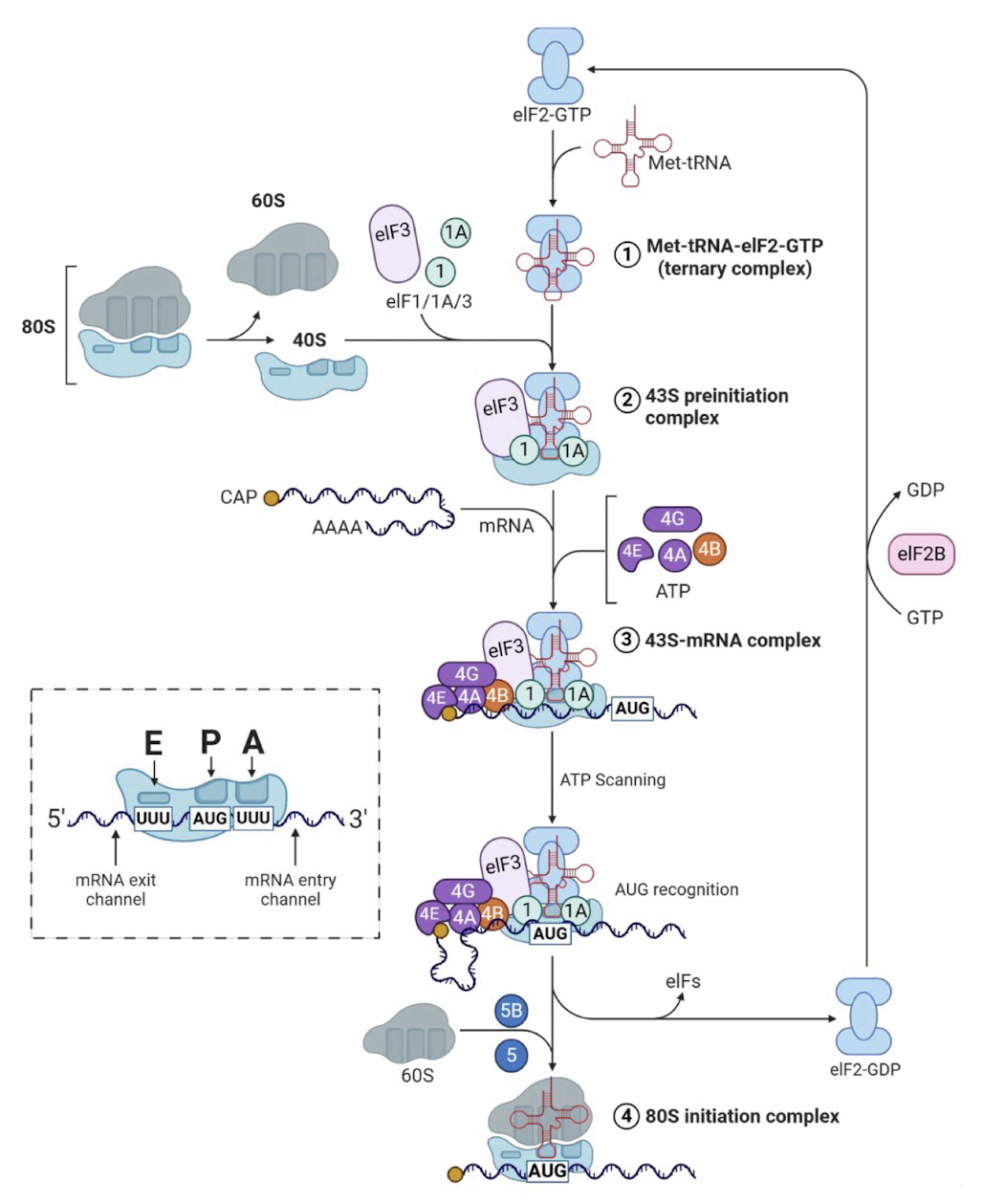
eIF 2 binds Met-tRNAMet to the 40S subunit first
eIF4F complex brings mRNA to 40S after tRNA is in P-site
Ribosome scans mRNA 5’ → 3’ to find AUG (Almost always the first AUG sequence) within Kozak sequence (5’ …accAUGg… 3’)
More or less the same as in prokaryotes
Selective Toxicity
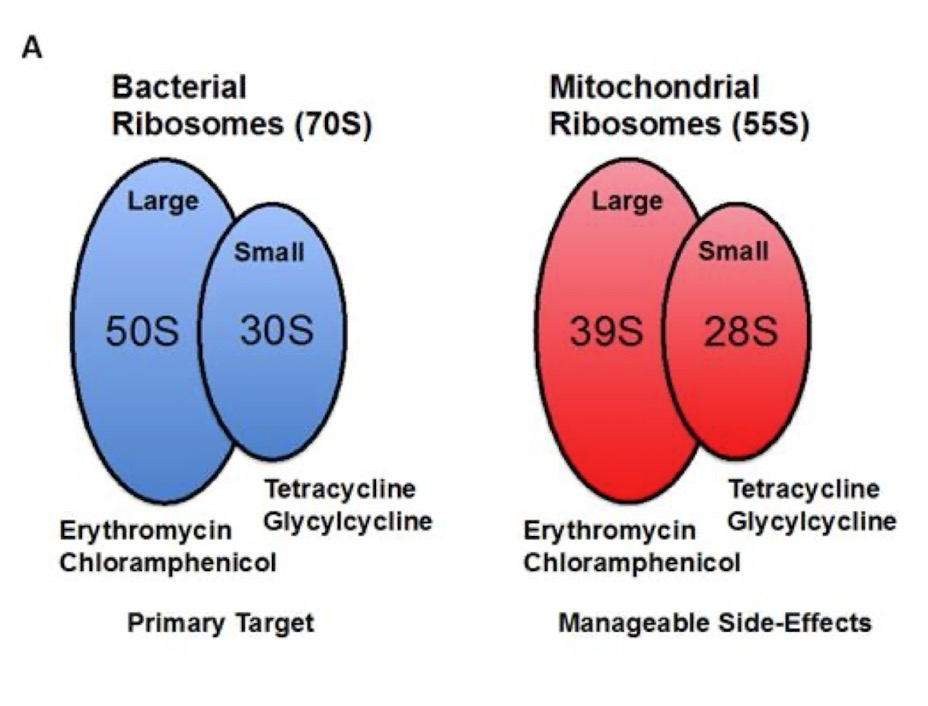
Antibiotics can target rRNA specific to prokaryotic ribosomes

Translation as an Antibiotic Target
Chloramphenicol inhibits peptidyl transferase (23S)
Tetracycline blacks A-site entry of tRNA
Erythromycin prevents translocation
Streptomycin changes shape of 30S and causes mRNA to be misread

Chloramphenicol Toxicity
Chloramphenicol inhibits peptidyl transferase, blocking peptide bond formation during translation
Mainly targets bacterial ribosome (selective toxicity)
Unfortunately, human mitochondrial have their own ribosomes that resemble prokaryotic ribosomes, so high dosages can cause side effects