CELL ORGANELLES (PG 61-65)

0.0(0)
Studied by 2 people
call kaiCall Kai
Locked
learnLearn
examPractice Test
spaced repetitionSpaced Repetition
heart puzzleMatch
flashcardsFlashcards
GameKnowt Play
Card Sorting

1/34

encourage image

There's no tags or description

Looks like no tags are added yet.

Last updated 10:58 PM on 9/12/26
Name
Mastery
Learn
Test
Matching
Spaced
Call with Kai
Chat

No analytics yet

Send a link to your students to track their progress

35 Terms

1
New cards

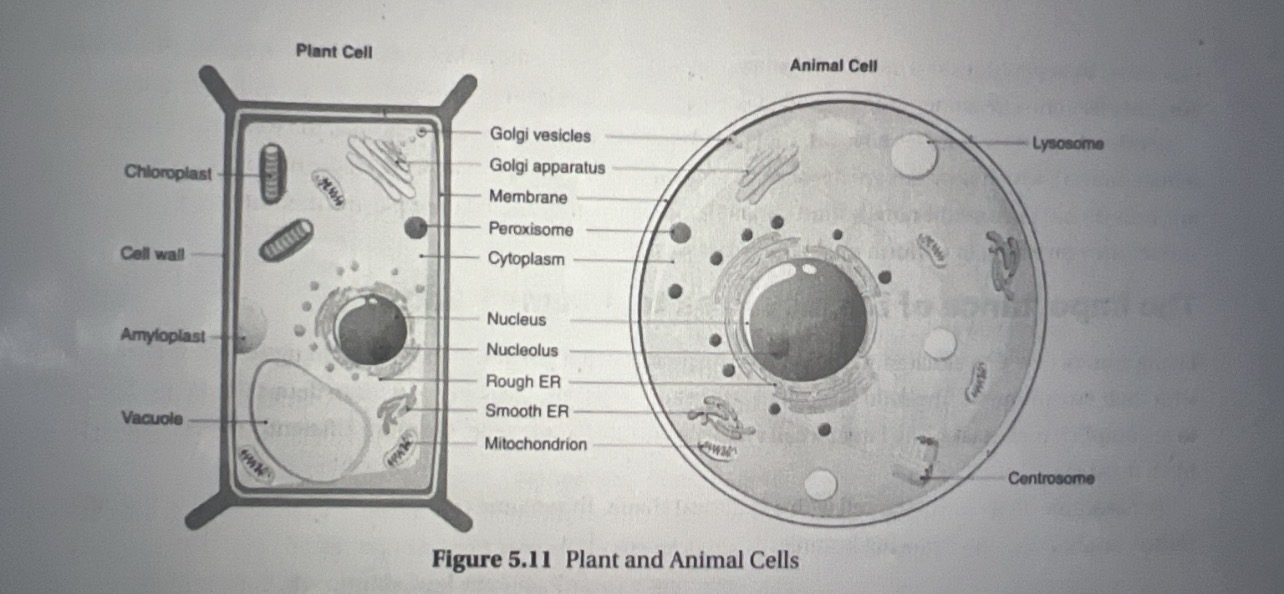
What is the endomembrane system?

The nuclear envelope, ER, Golgi, lysosomes, vacuoles, transport vesicles, and plasma membrane working together.


  • (🧬 Nuclear envelope = the nucleus’s outer covering

    Think of the nucleus as a little room inside the cell.

    • 🏠 Nucleus = the room

    • 🧱 Nuclear envelope = the walls around the room

    • 🧬 DNA = the important stuff inside the room)


<p>The <strong>nuclear envelope, ER, Golgi, lysosomes, vacuoles, transport vesicles, and plasma membrane</strong> working together.</p><p></p><ul><li><p>(<span data-name="dna" data-type="emoji">🧬</span><strong> Nuclear envelope = the nucleus’s outer covering</strong></p><p>Think of the <strong>nucleus as a little room</strong> inside the cell.</p><ul><li><p><span data-name="house" data-type="emoji">🏠</span> <strong>Nucleus</strong> = the room</p></li><li><p><span data-name="bricks" data-type="emoji">🧱</span> <strong>Nuclear envelope</strong> = the walls around the room</p></li><li><p><span data-name="dna" data-type="emoji">🧬</span> <strong>DNA</strong> = the important stuff inside the room)</p></li></ul></li></ul><p></p>
2
New cards

What does the endomembrane system do?

It modifies, packages, and transports proteins, lipids, and carbohydrates where they need to go.
<p>It <strong>modifies, packages, and transports</strong> proteins, lipids, and carbohydrates where they need to go.</p>
3
New cards

What is the endosymbiosis hypothesis

It says that mitochondria and chloroplasts used to be free-living prokaryotes that were swallowed by larger cells and eventually became organelles.

4
New cards

What evidence supports endosymbiosis?

Mitochondria and chloroplasts:

  • Have their own DNA

  • Have their own ribosomes

  • Reproduce by binary fission, like bacteria


5
New cards

What is kleptoplasty?

When an organism takes in photosynthetic cells/organelles and keeps their chloroplasts working instead of digesting them.

6
New cards

What is compartmentalization?

Dividing the cell into separate areas so different jobs can happen separately

7
New cards

Why is compartmentalization helpful?

It makes the cell more efficient because different reactions can happen in different places without interfering with each other.

8
New cards

Why do some organelles have folded membranes?

The folds give the organelle more surface area for reactions to happen.

Example: mitochondrial cristae.

9
New cards

Why is surface area important for a cell?

The cell uses its surface to take in nutrients, remove waste, and exchange materials with its environment.

<p>The cell uses its surface to <strong>take in nutrients, remove waste, and exchange materials</strong> with its environment.</p>
10
New cards

What happens to surface area-to-volume ratio as a cell gets bigger?

It decreases

<p>It <strong>decreases</strong></p>
11
New cards

Why are smaller cells more efficient?

They have a larger surface area compared with their volume, so they can exchange materials more efficiently

<p>They have a <strong>larger surface area compared with their volume</strong>, so they can exchange materials more efficiently</p>
12
New cards

How can cells increase surface area?

They can make folds in their membranes.

Examples:

  • Mitochondrial cristae

  • Intestinal villi


<p>They can make <strong>folds</strong> in their membranes.</p><p>Examples:</p><ul><li><p>Mitochondrial cristae</p></li><li><p>Intestinal villi</p></li></ul><p></p>
13
New cards

What does the plasma membrane do?

It controls what enters and leaves the cell.

<p>It controls <strong>what enters and leaves the cell</strong>.</p>
14
New cards

What is selective permeability?

The membrane lets some things through but blocks other things.

<p>The membrane <strong>lets some things through but blocks other things</strong>.</p>
15
New cards

What are phospholipids made of?

A hydrophilic head and two hydrophobic tails.

Easy:

💧 Head = likes water
🚫 Tails = avoid water

<p>A <strong>hydrophilic head</strong> and <strong>two hydrophobic tails</strong>.</p><p>Easy:</p><p><span data-name="droplet" data-type="emoji">💧</span> Head = likes water<br><span data-name="no_entry_sign" data-type="emoji">🚫</span> Tails = avoid water</p>
16
New cards

Why do phospholipids form a bilayer?

The heads face the water, while the tails hide away from water.

<p>The heads face the <strong>water</strong>, while the tails hide <strong>away from water</strong>.</p>
17
New cards

What is the fluid mosaic model?

The cell membrane is like a flexible, moving layer made of different parts floating around in it

<p>The cell membrane is like a <strong>flexible, moving layer</strong> made of different parts floating around in it</p>
18
New cards

What are some things found in the plasma membrane?

  • Phospholipids

  • Proteins

  • Glycoproteins

  • Glycolipid


<ul><li><p>Phospholipids</p></li><li><p>Proteins</p></li><li><p>Glycoproteins</p></li><li><p>Glycolipid</p></li></ul><p></p>
19
New cards

What do membrane proteins do?

They can:

  • Transport materials

  • Help with cell signaling

  • Anchor the cell

  • Help chemical reactions happen


<p>They can:</p><ul><li><p>Transport materials</p></li><li><p>Help with cell signaling</p></li><li><p>Anchor the cell</p></li><li><p>Help chemical reactions happen</p></li></ul><p></p>
20
New cards

What do glycoproteins and glycolipids do?

They help cells recognize each other.

<p>They help cells <strong>recognize each other</strong>.</p>
21
New cards

What do steroids do in the membrane?

They help adjust membrane fluidity.

<p>They help <strong>adjust membrane fluidity</strong>.</p>
22
New cards

What can easily cross the phospholipid bilayer?

Small hydrophobic/nonpolar molecules, such as:

  • O₂

  • CO₂

  • N₂


23
New cards

What cannot easily cross by itself?

Large polar molecules and ions.

They need membrane proteins to help them cross.

24
New cards

What are aquaporins?

Special membrane proteins that allow water (H₂O) to move through the membrane.

25
New cards

What is a cell wall?

A stiff outer layer around plant, fungal, and prokaryotic cells that gives the cell support and protection.

26
New cards

What is passive transport?

Movement from HIGH concentration → LOW concentration.

Does NOT require energy.

Think:

HIGH → LOW = PASSIVE

<p>Movement from <strong>HIGH concentration → LOW concentration</strong>.</p><p><span data-name="star" data-type="emoji">⭐</span> <strong>Does NOT require energy.</strong></p><p>Think:</p><p><span data-name="arrow_up" data-type="emoji">⬆</span> HIGH → <span data-name="arrow_down" data-type="emoji">⬇</span> LOW = <strong>PASSIVE</strong></p>
27
New cards

What is diffusion

The movement of molecules from high → low concentration without energy.

<p>The movement of molecules from <strong>high → low concentration</strong> without energy.</p>
28
New cards

What is osmosis?

The diffusion of water across a membrane.

<p>The <strong>diffusion of water</strong> across a membrane.</p>
29
New cards

What is facilitated diffusion?

Movement from high → low concentration, but the molecule needs a membrane protein to help it cross.

Still NO energy.

<p>Movement from <strong>high → low concentration</strong>, but the molecule needs a <strong>membrane protein</strong> to help it cross.</p><p>Still <strong>NO energy</strong>.</p>
30
New cards

Why is facilitated diffusion called “saturable”?

Because there are only so many membrane proteins available to help molecules cross.

<p>Because there are only <strong>so many membrane proteins</strong> available to help molecules cross.</p>
31
New cards

What is active transport?

Movement from LOW → HIGH concentration.

Requires energy.

Think:

LOW → HIGH = ACTIVE

<p>Movement from <strong>LOW → HIGH concentration</strong>.</p><p><span data-name="star" data-type="emoji">⭐</span> <strong>Requires energy.</strong></p><p>Think:</p><p><span data-name="arrow_down" data-type="emoji">⬇</span> LOW → <span data-name="arrow_up" data-type="emoji">⬆</span> HIGH = <strong>ACTIVE</strong> <span data-name="high_voltage" data-type="emoji">⚡</span></p>
32
New cards

What does the sodium-potassium pump do?

It pumps:

  • 3 Na⁺ OUT

  • 2 K⁺ IN

And it uses energy.

<p>It pumps:</p><ul><li><p><strong>3 Na⁺ OUT</strong></p></li><li><p><strong>2 K⁺ IN</strong></p></li></ul><p>And it uses <strong>energy</strong>.</p>
33
New cards

What are endocytosis and exocytosis?

Both require energy and are forms of active transport.


Endocytosis: cell takes stuff IN 📥
Exocytosis: cell sends stuff OUT 📤

<p>Both require <strong>energy</strong> and are forms of active transport.</p><p></p><p><strong>Endocytosis:</strong> cell <strong>takes stuff IN</strong> <span data-name="inbox_tray" data-type="emoji">📥</span><br><strong>Exocytosis:</strong> cell <strong>sends stuff OUT</strong> <span data-name="outbox_tray" data-type="emoji">📤</span></p>
34
New cards

What happens during endocytosis?

The cell membrane wraps around material and makes a vesicle to bring it inside.

<p>The cell membrane <strong>wraps around material and makes a vesicle</strong> to bring it inside.</p>
35
New cards

What happens during exocytosis?

A vesicle fuses with the cell membrane and releases its contents outside.

<p>A vesicle <strong>fuses with the cell membrane</strong> and releases its contents outside.</p>



