Intoduction to enthalpy cycles.
 Call Kai
 Learn
Learn Practice Test
 Spaced Repetition
 Match
Match Flashcards
 Knowt Play
1/3

Earn XP
Description and Tags
https://www.youtube.com/watch?v=C6xFruVCd_U
Name | Mastery | Learn | Test | Matching | Spaced | Call with Kai | Chat |
|---|
No analytics yet
Send a link to your students to track their progress
4 Terms
What does hess’s law state
If a reaction can be carried out by two different pathways, then the total enthalpy change for these two pathways will be the same,provided that starting and final conditions are same for both pathways.
Why are enthalpy cycles useful
If we cannot measure the enthalpy change of a reaction , e.g some reactions dont take place under normal conditions, if we can find alt pathway going from reactants to products, then we can measure enthalpy changes of these reactions, then apply hess’s law to work out enthalpy change needed.
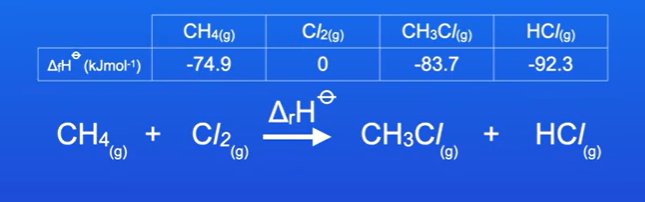
How do we work out standard enthalpy change of reaction using standard enthalpy change of formation data provided.
Standard enthalpy of formula only applies to formulas , cl2 is element so its 0
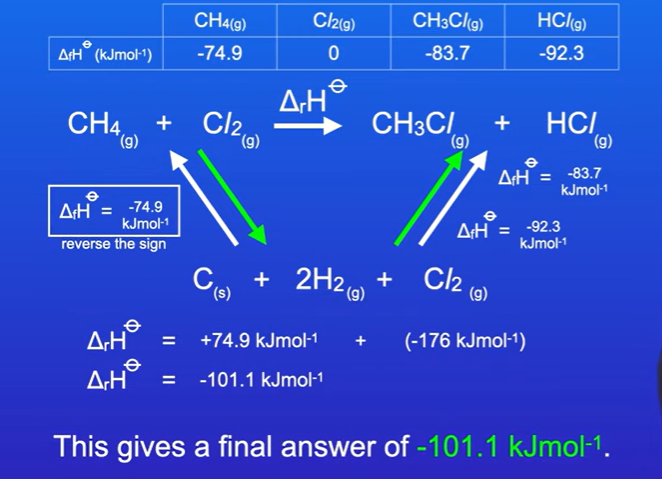
Write out the elements of the reactants, (C + 2H2 + Cl2)
Draw arrows pointing upwards from elements to reactants / products.
The standard enthalpy change of formation of methane is -74.9, standard enthalpy change of formation of chloromethane is -83.7 kJmol-1, standard enthalpy change of formation of Hcl is -92.3 kJmol-1
We want to go from reactants to products, so draw new green arrows, the left hand white arrow pointing in wrong direction , this means when doing calculation ,the sign must be reversed for SECOF for methane.
Total standard enthalpy change of formation for right hand side is -176 kJmol-1
So standard enthalpy change of reaction is +74.9 kJ mol -1 + (-176kJmol-1) = -101.1 kJmol-1
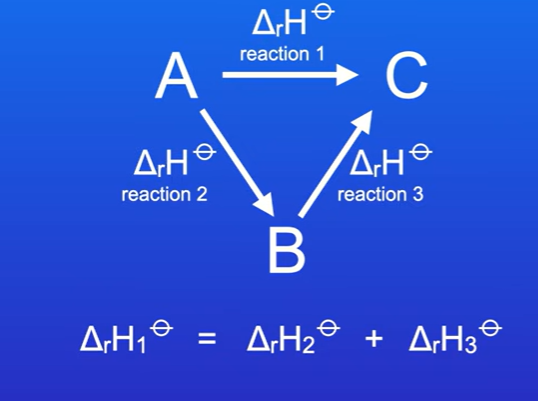
Example of chemical A to C showing hess’s law
Imagine chemical A could be converted to chemical b, then chemical b can be converted to chemical c, all enthalpy changes measured for reactions btw.
Hess’s law says If a reaction can be carried out by two different pathways, then the total enthalpy change for these two pathways will be the same,provided that starting and final conditions are same for both pathways.
In this reaction, we have two different pathways to make product C, We can go either reaction 1 , 2 plus 3.
Enthalpy change for reaction 1 will be the same as enthalpy change for reaction 2 and enthalpy change for reaction 3. (Enthalpy cycle)