HNDA unit 2.4, HNDA unit 2.3, HNDA Unit 2.2, HNDA Exam 2
 Call Kai
 Learn
Learn Practice Test
 Spaced Repetition
 Match
Match Flashcards
 Knowt Play
1/229

There's no tags or description
Looks like no tags are added yet.
Name | Mastery | Learn | Test | Matching | Spaced | Call with Kai | Chat |
|---|
No analytics yet
Send a link to your students to track their progress
230 Terms
A bundle of neural processes outside the central nervous system and in the peripheral nervous system
Nerve
Where neural impulses are transmitted between junctions of 2 neurons or a neuron and effector organ
Synapse
The chemical agents that are discharged to have the neural impulses cross the synapse to another cell
Neurotransmitters
What is a charge difference measured in millivolts?
Resting potential
Rapid depolarization of the cell membrane results in?
Action potential
- temporary reversal of the electric potential along the membrane for a brief period
After the action potential there is a brief period where the membrane cannot be stimulated
Refractory period
A neuron is composed of?
cell body and two types of cytoplasmic processes
neural processes include:
- axon= conducts impulses away from cell body, covered in myelin sheaths
- dendrite= contains multiple branches which function to receive and conduct impulses toward cell body

An accumulation of neuron cell bodies outside the CNS
Ganglion
EX: trigeminal ganglion
What are the types of nerves?
Afferent- sensory- towards the CNS from periphery
Efferent- movement- away from CNS to periphery
What are the divisions of the nervous system?
CNS- brain, spinal cord
PNS- cranial nerves and everywhere else
What is the system of membranes in the brain?
Meninges, 3 layers
Dura matter- surrounds and supports large venous channels carrying blood from the brain toward the heart
Arachnoid matter
Pia matter

What are the major divisions of the brain?
Cerebrum- largest division contains cerebral hemispheres
Cerebellum- second largest division
Brainstem
- medulla= closest to spinal cord
-Pons= connects medulla w/ cerebellum and higher brain centers
- midbrain= include relay stations for hearing, vision, and motor pathways
Diencephalon
- thalamus= central relay point for incoming nerve impulses
- hypothalamus= regulates homeostasis

What is involved in the reflexes that do not immediately involve the brain?
Spinal cord
-links brain to rest of the body
What composes the PNS?
All the nerves stretching their pathways among the CNS and receptors, muscles, and glands of the body
What is the PNS divided into?
Afferent
Efferent
What is the Efferent PNS divided into?
Somatic- nerves controlling muscular system and external sensory, receptors and effectors
Autonomic- involuntary
What can the Autonomic NS of the PNS divide into?
Sympathetic- fight or flight- arise in spinal cord and relays to ganglion
Parasympathetic- rest and digest
Ganglia fibers associated with the head and neck may be either?
Preganglionic neurons- before relaying to ganglion
Postganglionic neurons- after relaying to ganglion
What are the 12 cranial nerves
1. Olfactory- S
2. Optic- S
3. Oculomotor- M
4. Trochlear- M
5. Trigeminal- B
6. Abducens-M
7. Facial- B
8. Vestibulocochlear- S
9. Glossopharyngeal- B
10. Vagus- B
11. Accessory- M
12. Hypoglossal- M
Only Overgrown Orangutans Try To Aggravate Fat Vagrants Getting Vodka And Hamburgers
Nerve name acronym
Some Say Marry Money But My Brother Says Big Boobs Matter More
Nerve s/m acronym
The vascular system/ circulatory system of the head and neck consist of?
Arterial blood supply
Capillary network
venous drainage
What is a large network of blood vessels called?
Vascular plexus
What is the way blood vessels communicate with each other within the system?
Anastomosis

What are the connection channels among the vessels
Anastomose
-where vessels meet
What are the different types of Anastomoses?
Veno-venous anastomosis= between veins
Arterio-venous anastomosis= between artery and vein
What is an artery?
the component of the vascular system where BV arise from the heart and carry oxygenated blood away from it to the tissues
What is an arteriole?
smaller branch of an artery
What is a capillary?
smaller branch of an arteriole that supplies blood to larger tissue areas b/c there are so many of them
-smallest branch of blood vessels
What is a vein?
blood vessel that carries deoxygenated (poorly oxygenated) blood to the heart
What is blood filled spaces between 2 layers of tissue called?
Venous sinuses
-called meninges for the brain
The system of membranes of the CNS is the meninges which has 3 layers; what are their names?
Dura matter
Arachnoid matter
Pia matter
What are the major arteries of the head and neck?
Comon carotid
Subclavian
The left and right-side arteries arise from?
Aorta (largest artery of the body)
What artery is considered branchless?
Common carotid
- splits into internal and external carotid arteries
Where is the common carotid artery located?
Alongside of neck- under SCM in carotid sheath

What is the carotid sheath?
Part of the deep cervical fasciae of the neck and surrounds the vascular components of the neck
Where do we take pulse from for CPR?
Carotid sinus
-swollen area just prior to bifurcation into the internal and external CA
What artery arises laterally to the common carotid of the R and L?
Subclavian artery
What does the subclavian artery supply?
Intracranial and extracranial structures, but mainly supplies L and R upper arms
What is the normal BP?
HR?
What about for a child?
less than 120/80
80 to 100 BPM
60 to 140 BPM
Where does the Internal carotid artery supply?
intracranial structures such as ophthalmic artery
-eye, orbit, lacrimal gland
What does the external carotid artery divide into and where? (towards the end)
Divides into superficial temporal and maxillary arteries within the space behind the neck in the mandible

What are the set of branches of the external carotid artery that are grouped according to location?
Anterior
Medial
Posterior
Terminal
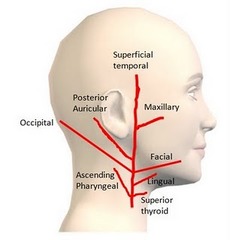
What are the 3 anterior branches from the ECA?
Superior thyroid artery
lingual artery
facial artery (external maxillary artery)

What are the branches of the superior thyroid artery?
what do they supply?
-infrahyoid a, SCM branch, superior laryngeal a, cricothyroid branch
- tissues inferior to the hyoid bone: infrahyoid muscles, SCM, larynx muscles, thyroid gland
What is interesting about the lingual artery?
where does it supply?
- enters at base of tongue and end at the tip
- does not accompany the corresponding nerve
- sublingual branch
-tissues superior to hyoid bone: suprahyoid muscles, floor of mouth, tongue
What does the sublingual branch of the lingual artery supply?
mylohyoid muscle, sublingual salivary gland, mucous membrane of floor of mouth
Which anterior external carotid artery has a complicated path?
Facial artery
Where does the facial artery run?
medial to mandible--> over subman salivary gland--> crosses border of mandible (feel notch just in front of angle of mandible)--> runs forward and up beside nose--> ends near canthus of the eye
What does the facial artery supply?
buccal
zygomatic
nasal
infraorbital
orbital regions
What are the major branches of the facial artery?
What do they supply?
ascending palatine- soft palate, palatine m, palatine t
submental- submand lymph n, subman salivary g, mylohyoid and digastric m
inferior labial- lower lip tissues including facial exp muscles
superior labial-upper lip tissues including facial exp muscles
angular artery- end of facial artery- tissues alongside of nose
What is the medial branch of the ECA?
what does it supply?
What is a special sub-branch?
Ascending pharyngeal- small with numerous branches
- they supply pharyngeal walls, soft p, and meninges
- tonsillar branch- source of serious blood loss during tonsillectomy
What are the posterior branches of the ECA?
Occipital artery
Posterior auricular
What does the occipital artery of the posterior ECA supply?
suprahyoid and SCM muscles, occipital scalp tissues, and meningeal tissues of occipital region
- passes through back of ramus and up posteriorly

What does the posterior auricular artery of the posterior ECA supply?
internal ear and the mastoid air cells in mastoid process
- arises about tip of styloid process, runs behind acoustic meatus
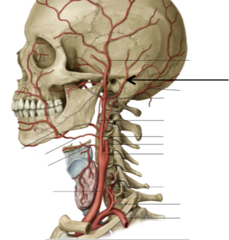
What are the terminal branches of the ECA?
superficial temporal
maxillary
What arteries are within the parotid salivary gland?
superficial temporal- starts within gland
maxillary - starts at neck of condyle and in gland
What are the branches of the superficial temporal artery of the terminal ECA?
What do they supply?
transverse facial artery- parotid duct and nearby tissue- runs along zyg arch
middle temporal artery- temporalis muscle
parietal branch and frontal branch - part of scalp regions of frontal and parietal regions
What is giant cell arteritis (GCA)?
or temporal arteritis- inflammation of lining of arteries
- usually affects arteries of head, temples
- causes headaches, jaw pain, blurred or double vision- tender
Who is most likely to suffer from GCA?
older induvial- above 50- avg 70
women 2x likely than men
What is polymyalgia rheymatica?
arthritic condition that causes stiffness and aching in neck, shoulders and hips
- has increase 10-15 %
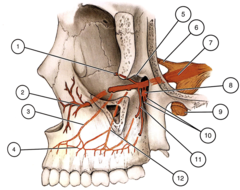
What is the maxillary artery?
What are the parts?
larger terminal branch with 3 parts- also called internal maxillary a
part 1- mandibular
part 2- pterygoid
part 3- pterygopalatine

What are the maxillary branches of the terminal ECA?
deep auricular
anterior tympanic
middle meningeal
inferior alveolar
accessory meningeal artery
What does the middle meningeal artery of the maxillary branch of the terminal ECA supply?
meninges of brain by way of foramen spinosum located in sphenoid bone
What does the inferior alveolar artery of the mandibular part of the maxillary artery of the terminal ECA supply?
dental branches-pulp of the mandibular posterior teeth byway of each tooth's apical foramen
alveolar branches- buccal perio and gingiva of mand post teeth
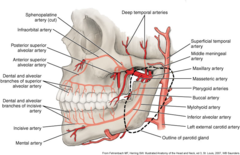
Where does the mylohyoid arise from?
inferior alveolar artery- stars before IAA goes into mandibular canal
- supplies floor of mouth and mylohyoid muscle
What does the inferior alveolar artery branch into?
Mental artery- exits by mental foramen, supplies chin tissue, joins inferior labial a
incisive artery
- Dental branch of incisive- supply pulp of mand ant by apical foramen
- alveolar branch- supply perio of mand ant teeth, including gingiva, and anastomose with alveolar branches of the incisive artery on other side

What are the branches of the Pterygoid part of the MA of the terminal ECA? Where do they supply?
Deep temporal- temporalis muscle
pterygoid- lateral and medial pterygoid muscle
masseteric- masseter muscle
buccal- buccinator muscle and cheek tissue
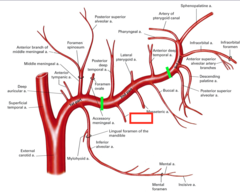
What does the pterygopalatine part of the maxillary artery of the of the terminal branch of the ECA include?
What do they supply?
Posterior superior alveolar artery
-dental branch- pulp max post teeth
-alveolar branch- buccal perio and gingiva of max post teeth including sinuses
infraorbital artery
-anterior superior
- dental branch- max ant teeth
-alveolar branch- perio of max ant teeth and gingiva
descending palatine artery
- greater p a- enters p via greater supply hard p
- lesser p a- lesser p foramen (lingual to max 3rd molars) soft p
sphenopalatine artery- end of max artery- supplies nasal cavity
What is atherosclerosis?
Disease caused by narrowing or blockage of the arteries because of plaque buildup inside the arteries
What is made up of mainly cholesterol, and some calcium, and fat?
Plaque
- buildup can lead to heart attacks, strokes, or death (cardiovascular disease)
Thrombus vs Embolus
T- blood clot on inner vessel wall
E- clot breaks loose and travels, can carry bacteria and cause bacteremia
Where does the facial vein drain?
Internal jugular vein
-begins at medial corner of eye, joins with supratrochlear and supraorbital vein from frontal region

What vein drains the orbit and anastomoses with supraorbital?
Ophthalmic vein

What veins anastomose with the cavernous sinus?
Facial
Supraorbital
Ophthalmic- supratrochlear

What are the several branches of the facial vein?
superior labial- drains upper lip
inferior labial- lower lip
submental- drains tissue of chin and subman region
What are the lingual vein branches?
Dorsal lingual- dorsal of tongue
Deeper lingual- ventral of tongue, very visible
Sublingual- floor of mouth
- rapid and direct topical absorption
What forms the retromandibular vein?
merging superficial temporal and maxillary vein
- emerges from parotid salivary gland and divides into 2 parts
- anterior division: joins facial vein
- posterior division: continues on surface of SCM
What vein begins in the infratemporal fossa by collecting blood from the pterygoid plexus? Where does it receive?
Maxillary vein
- middle meningeal, post superior alveolar, inferior alveolar and other veins from the palate and nasal cavity

What is the pterygoid plexus?
numerous, small anastomosing veins that surround the pterygoid muscles and pterygoid part of the maxillary artery
- protects max artery from compression during mastication
- drains veins from deep portions of face
What are potential complications with the pterygoid plexus?
accidental piercing of needle because of proximity to max tuberosity
- infection spread through needle tract
Facial veins have no valves, so retrograde blood flow cannot be prevented; t or f?
True
Posterior superior alveolar vein
dental branches- drain the pulp of the maxillary teeth by way of apical foramen
alveolar branches- drain the perio and gingiva of max teeth
Inferior alveolar vein
forms from the merging of its dental branches, alveolar branches, and mental branches
- drains into pterygoid plexus
Paired venous sinus most important to dental care
Cavernous sinus
-only anatomic location where an artery travels completely through a venous structure
Internal jugular vein
- drains most tissues of head and neck. does not have a one way valve
- runs alongside common carotid artery
- empties into subclavian vein
- posterior division of retromandibular vein becomes external jugular vein
External jugular vein
- drains small part of extracranial tissue
-ONLY one to have a one way valve
Desanguination- massive level
Hemorrhage
Hemorrhage with complete loss of blood
Exsanguination
Initial swelling of an extra oral hematoma near upper cheek
Vascular lesions
swelling more than 10mm in diameter. Result from incorrect administration of R post, superior alveolar block rom over insertion of needle
Ecchymosis
Tissue fluid that is not within blood vessels are called?
Extravascular fluid
Tissue fluid within the blood vessels are called?
Intravascular fluid
Tissue that drains from surrounding regions into lymphatic vessels are known as?
Lymph
What tissue fluid is colorless and contains WBC that helps rid the body of toxins, waste, and other unwanted material?
Lymph
The system of epithelial-lines channels that mainly parallel the venous blood vessels are?
-acts as highway for WBC to and from nodes
- one way flow of lymph with valves
Lymphatic vessels
What empties into the venous system in the chest area?
Lymph ducts
What are the main functions of the lymphatic system?
-Filter infection locally, then send filtered lymph regionally, then dump into vascular system
-Drain excess extracellular fluid keeping the body fluids in balance
What is the bean shaped bodies grouped in clusters along the connecting lymphatic vessels?
Lymph nodes