Unit 1
 Call Kai
 Learn
Learn Practice Test
 Spaced Repetition
 Match
Match Flashcards
 Knowt Play
1/81

There's no tags or description
Looks like no tags are added yet.
Name | Mastery | Learn | Test | Matching | Spaced | Call with Kai | Chat |
|---|
No analytics yet
Send a link to your students to track their progress
82 Terms
Cognitive psychology
The study of mental processes by which humans learn about and interact with world
Willhelm Wundt
The father of psychology (first psych. laboratory) who mainly focused on structuralism and introspection, with the latter being abandoned in modern practice
William James
An early psychologist whose main perspective was functionalism
Herman von Ebbinghaus
An early psychologist who was the first to popularize objective experimental observation
Immanuel Kant
A very early psychologist who developed the transcendental method that gained popularity later
Transcendental Method
A cognitive research approach that observes outward behavior and infers the mental processes behind it (developed by Kant)
Karl Popper
A psychologist who popularized making psychological hypotheses falsifiable to further advance theories
Gestalt psychology
A psychological perspective which argues that humans default to superimposing patterns, which led them to think about mental patterns holistically (the whole brain has different qualities than that of its individual components)
Behaviorism
A type of psychology popularized in the 1940s-60s as the preference for objective, observable outcomes increased
Edward Tolman
A psychologist who contested the behaviorism craze with his discoveries of internal representations and cognitive mapping
Noam Chomsky
A psychologist/linguist who severely challenged the behaviorist perspective by demonstrating how humans learn/create without direct imitation
Donald Broadbent
A during/post WWII psychologist who used computer-based comparisons when talking about the brain, which led to the mind being viewed as different parts of a task
Ulric Neisser
The father of cognitive psychology who defined the human mind as an active system that transforms, reduces, elaborates, stores, and recovers sensory input
Information Processing Approach
Breaking away from the computer metaphor: the realization that the brain is more like a neural network (not divided into specific parts/areas)
Cognitive Science
A 1970s perspective that blended computer science, linguistics, psychology, and philosophy and used computer simulation to compare human memory to artificial intelligence
Cognitive Neuroscience
A 1980s perspective that blended cognitive science and neuropsychology, using neuroimaging to track mental processes
Modern cognitive psychology
An approach that measures performance accuracy, speed, and brain activity using formal models and precise measurement
Synaptic Modification (Learning)
The more often connected-neurons send and fire, the more neurotransmitters and receptors form on either neuron, which strengthen that connection (aka long term potentiation)
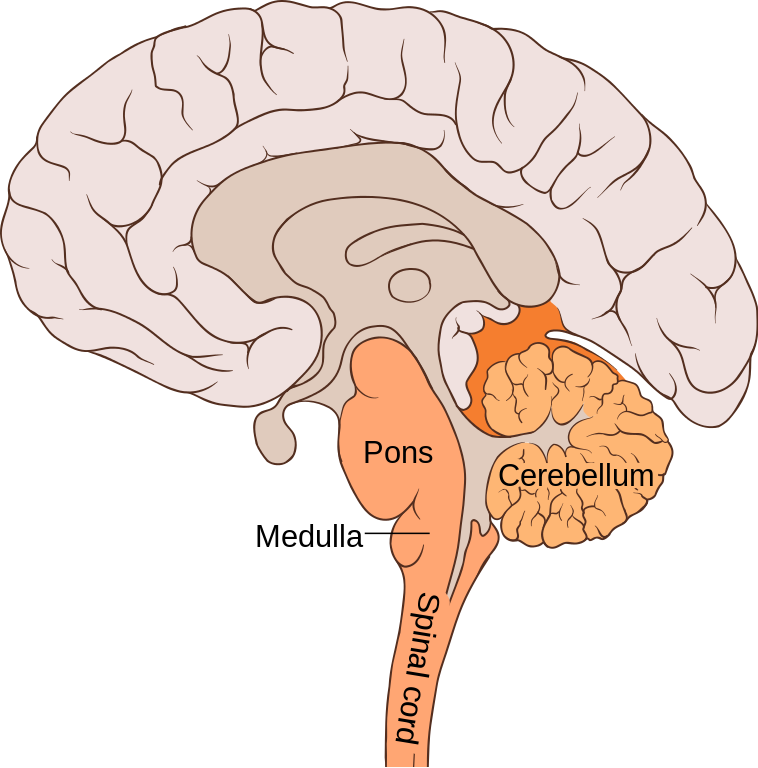
Medulla
A structure within the hindbrain that controls involuntary (life support) functions like heart rate, blood pressure, and breathing

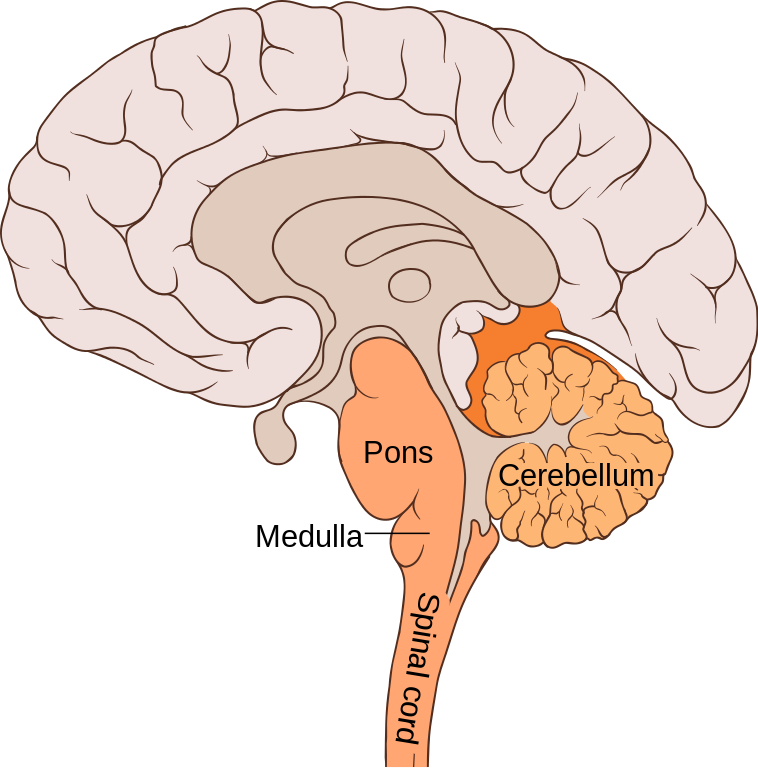
Pons
A structure in the hindbrain that manages unconscious processes like arousal, as well as processes sensory, visual, and auditory information


Cerebellum
The largest area in the hindbrain that controls balance and coordination, but also shows connections with executive functions like personality, spatial cognition, and language
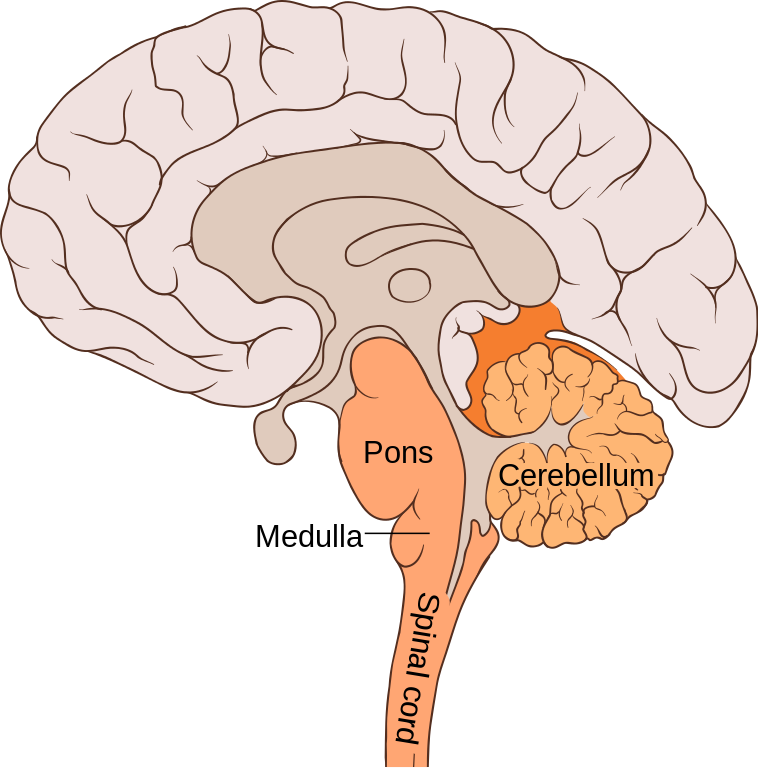

Thalamus
A critical structure located in the center of the brain that relays all sensory information and is active during working memory tasks

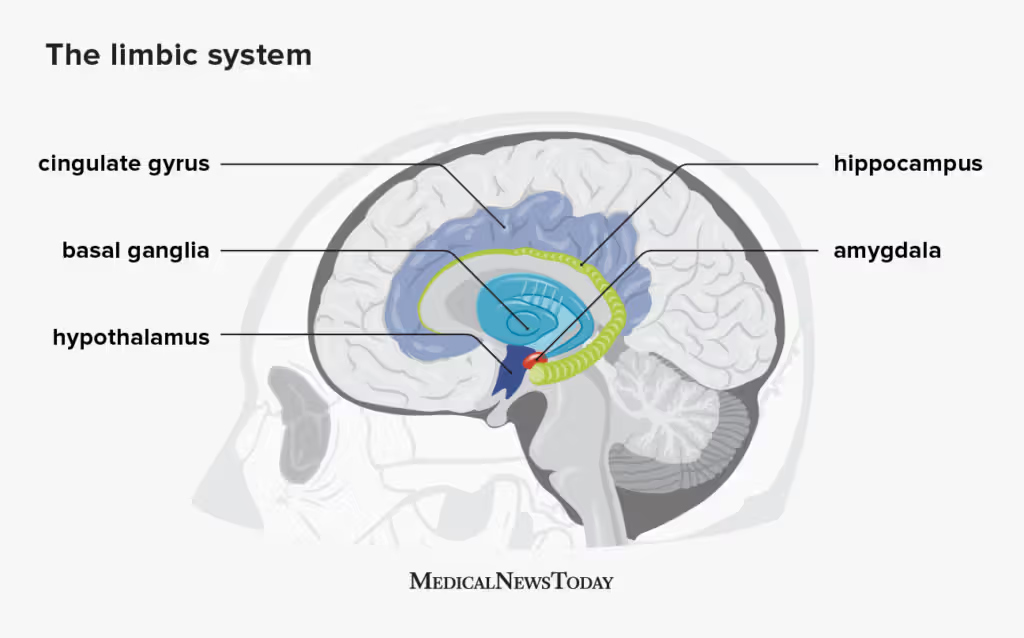
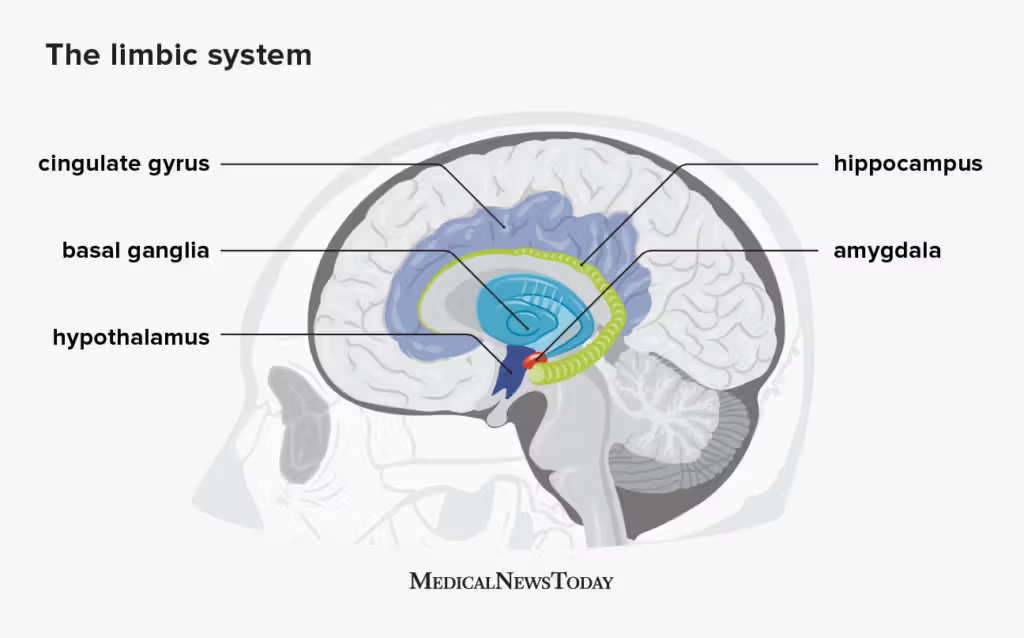
Basal Ganglia
A limbic system structure wrapped around the thalamus that produces dopamine and controls the sequencing of actions, habit learning, and language pattern learning
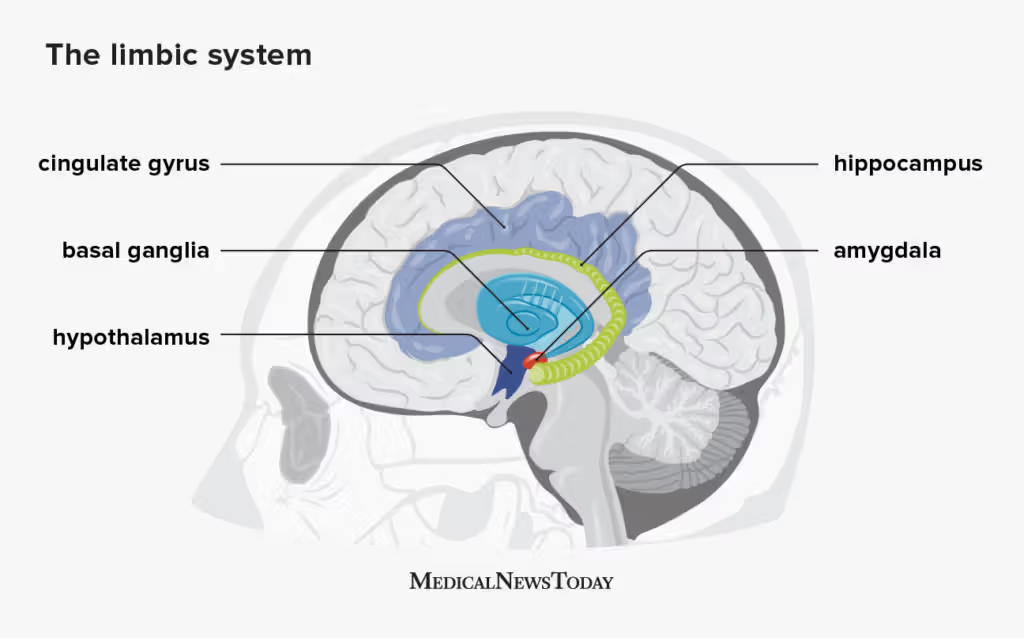
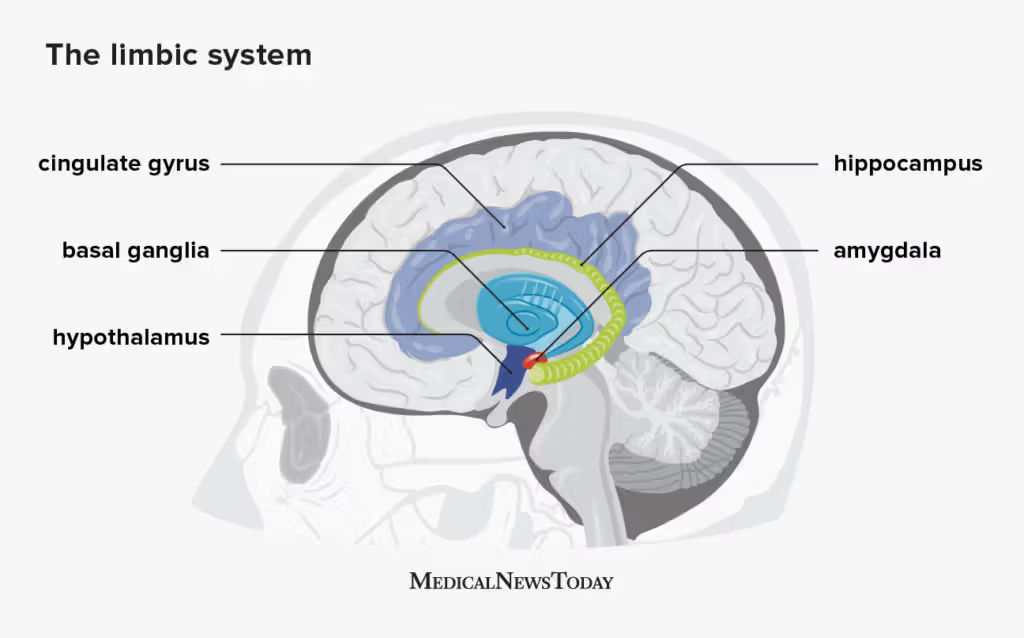
Cingulate Gyrus
Part of the limbic system, that controls attentional monitoring
Single-Unit Recording
A brain imaging technique where an electrode is deeply implanted in a small section of the brain to measure precise electrical activity
Electroencephalogram (EEG)
A non-invasive technique that measures changes in neural activity and ERP and characterizes wave patterns
Event-Related Potential (ERPs)
The average of changes in neural electrical activity over a short period of time in reaction to a particular stimulus that is presented many times
Positron Emission Topography (PET) Scan
The injection of (potentially harmful) radioactive substances into the brain to track the direction of blood flow during tasks
Functional Magnetic Resonance Imagining (fMRI)
The detection of magnetic properties in the blood to track what areas of the brain are most active (using oxygen) during tasks
Functional Near Infrared Spectroscopy (fNIR)
The measurement of optical properties of (de)oxygenated hemoglobin in blood to detect change sin oxygen levels
Neuropsychology
The study of the cognitive processing in individuals who have brain damage (lesion) or deterioration

Tectum
A structure in the midbrain that processes vital visual and auditory reflexes


Tegmentum
A complex, multi-synaptic core region of the midbrain that regulates vital homeostatic, motor, sensory, and arousal function


Reticular Formation
A midbrain net-like network of interconnected nuclei and neurons regulates arousal, sleep-wake transitions, and basic autonomic and motor functions


Central Sulcus
A forebrain feature that separates the frontal lobe from the parietal lobe and divides the primary motor cortex from the primary somatosensory cortex


Sylvian Fissure
A forebrain feature that separates the frontal and parietal lobes from the temporal lobe


Hypothalamus
A limbic system feature that acts as the primary master control center for maintaining homeostasis

Broca’s/Expressive Aphasia
Damage to the left frontal lobe that results in an inability to produce full grammatical sentences
Wernicke’s/Receptive/Fluent Aphasia
Damage to the temporal lobe that results in an inability to understand language and produce comprehendible speech
Empiricism
The perspective that human knowledge is acquired through meticulous observation of the world (Aristotle, John Locke)
Nativism
The perspective that human knowledge is acquired through the development of innate cognitive templates (Plato, Descartes)
Distal Stimulus
A stimulus as it occurs in a physical, real-world setting
Proximal Stimulus
The immediate pattern of energy—such as light waves or sound waves—that reaches your sensory receptors and triggers a neural response
Perception
The process of organizing, interpreting, and giving meaning to information gathered by our physical senses from the environment
Sensation
The physical process where your sensory organs detect environmental stimuli and convert them into electrical impulses for the brain
Percept
The interpretation/outcome of perceiving a stimulus
Constructionist View
A perception perspective stating that sensory stimuli is ambiguous and incomplete, so the brain builds perception using stored knowledge, expectations, etc.
Ecologist View
A perception perspective stating that stimuli is viewed based on their affordances (potential actions) with no cognitive processing
Modern View
A perception perspective that looks beyond stimuli’s affordances by incorporating emergent features and where our brain finds patterns within the whole
Visual Coding
The relationship between activity in the nervous system and a represented visual stimulus
Cones
Vision cells primarily located in the fovea that are insensitive to light, produce high acuity, and detect three types of wavelengths
Rods
Vision cells primarily in the periphery of the retina that are hypersensitive to light, produce low acuity, and detect the intensity (shade) of light

Primary Visual Cortex (V1)
The most posterior and simple area of the occipital lobe where visual information first reaches the cortex to detect line orientation, edges, contours, contrast, etc.
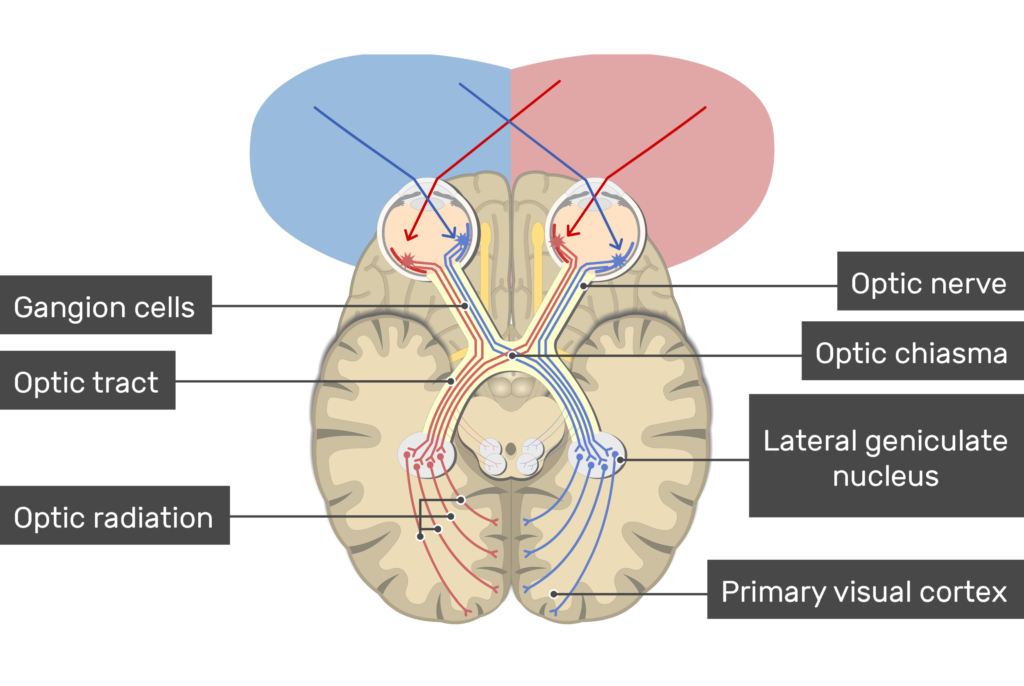
Ventral (Inferotemporal) Cortex Pathway
A visual stream that, if damaged, can lead to visual agnosia (What?)
Dorsal (Posterior parietal) Cortex
A visual stream that, if damaged, can lead to optic ataxia (Where? How?)
Sensory Edge Grouping
The first step to perceptual grouping: Low-level, bottom-up grouping that detects and connects primitive boundaries or lines to group objects together
Gestalt Grouping Principles
A higher-level, top-down perceptual grouping strategy where humans naturally perceives objects as unified structures
Parallel Processing
When many processing steps occur simultaneously and have mutual influence among multiple systems to allow for rapid information processing
Figure-Ground Organization
The processing step in which the perceiver determines which aspects of the stimulus belong to the central object (or “figure”) and which aspects belong to the background (or “ground”).
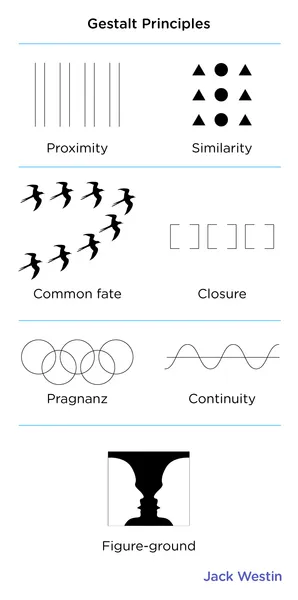
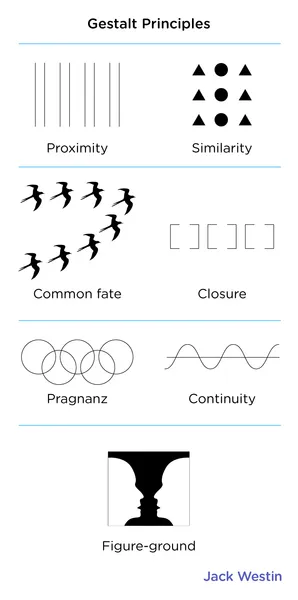
Pragnanz
Grouping Principle: Simpler, clearer forms are preferred, reducing complexity enhances clarity and comprehension
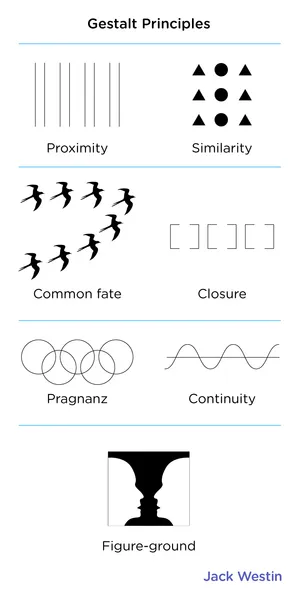
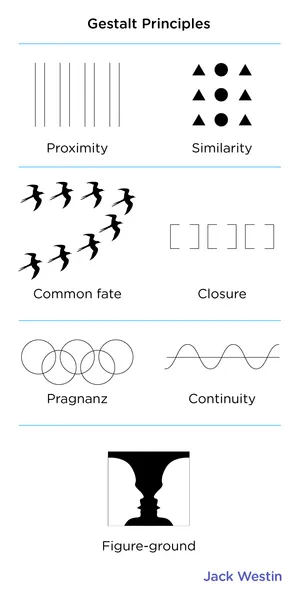
Common Fate
Grouping Principle: Elements moving together are perceived as part of a group, making motion a tool to show relationships
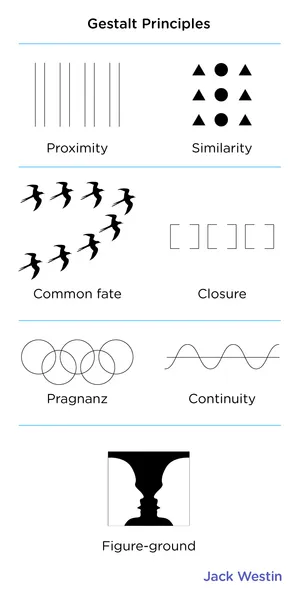
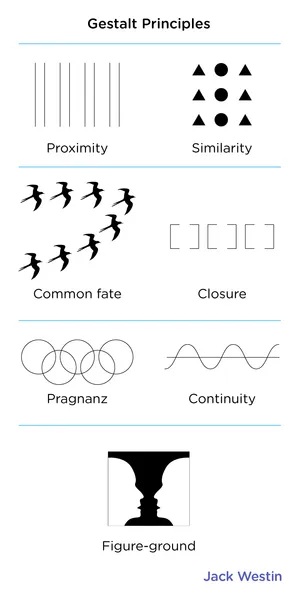
Continuity
Grouping Principle: Eyes naturally follow smooth paths, aligned or flowing elements guide attention effortlessly
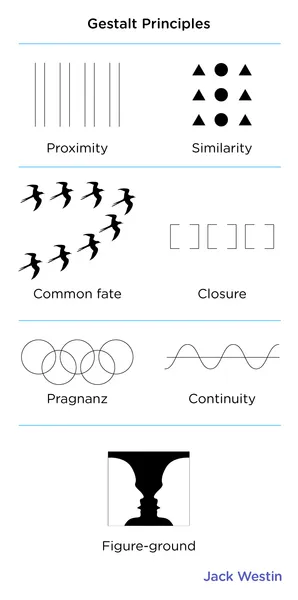
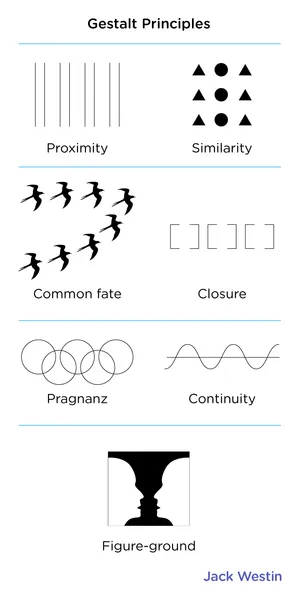
Proximity
Grouping Principle: Objects placed close together are perceived as related, making grouping and hierarchy clear
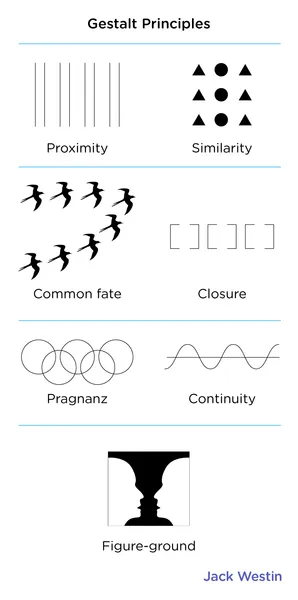
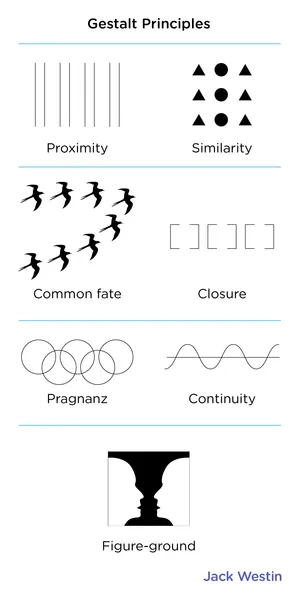
Similarity
Grouping Principle: Elements that look alike are perceived as related, helping to quickly identify patterns and groupings

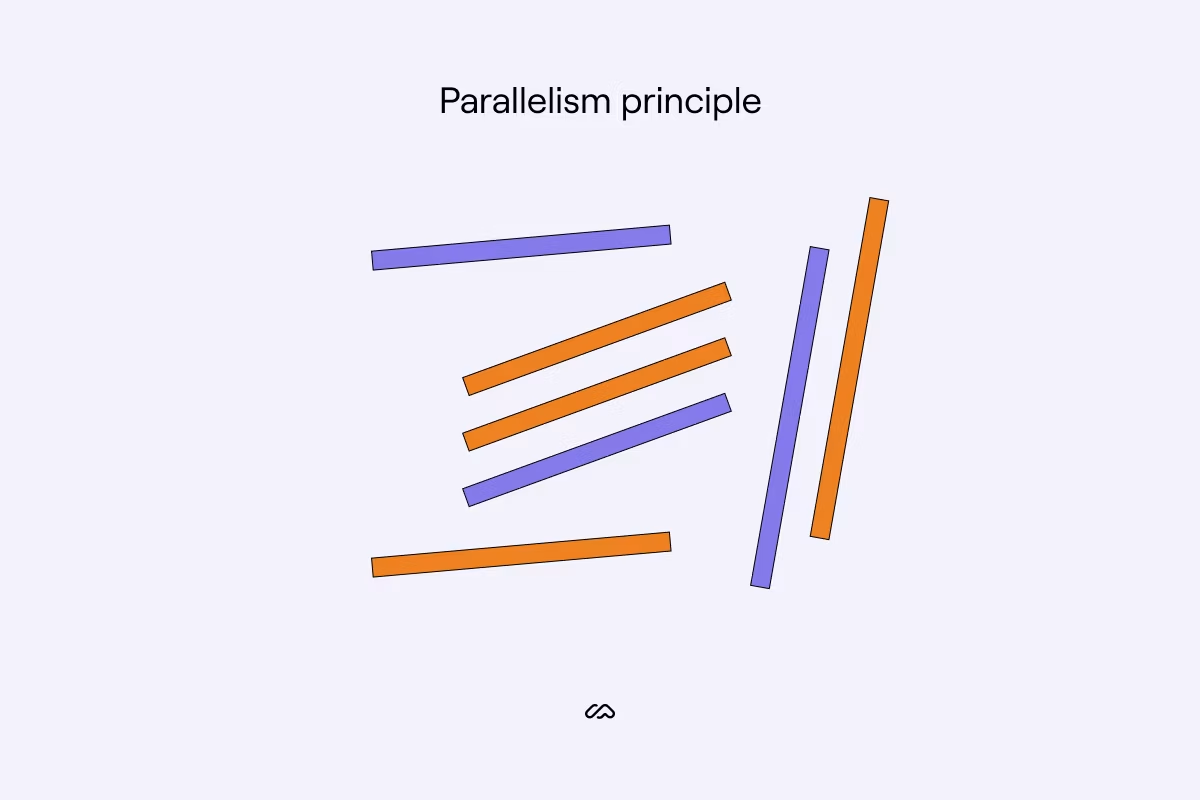
Parallelism
Grouping Principle: Objects with parallel contours are often grouped together
Symmetry
Grouping Principle: Symmetrical elements are seen as belonging together, creating cohesive and balanced groupings

Closure/Connectedness
Grouping Principle: Gaps are naturally filled to complete incomplete shapes, enabling communication with minimal detail
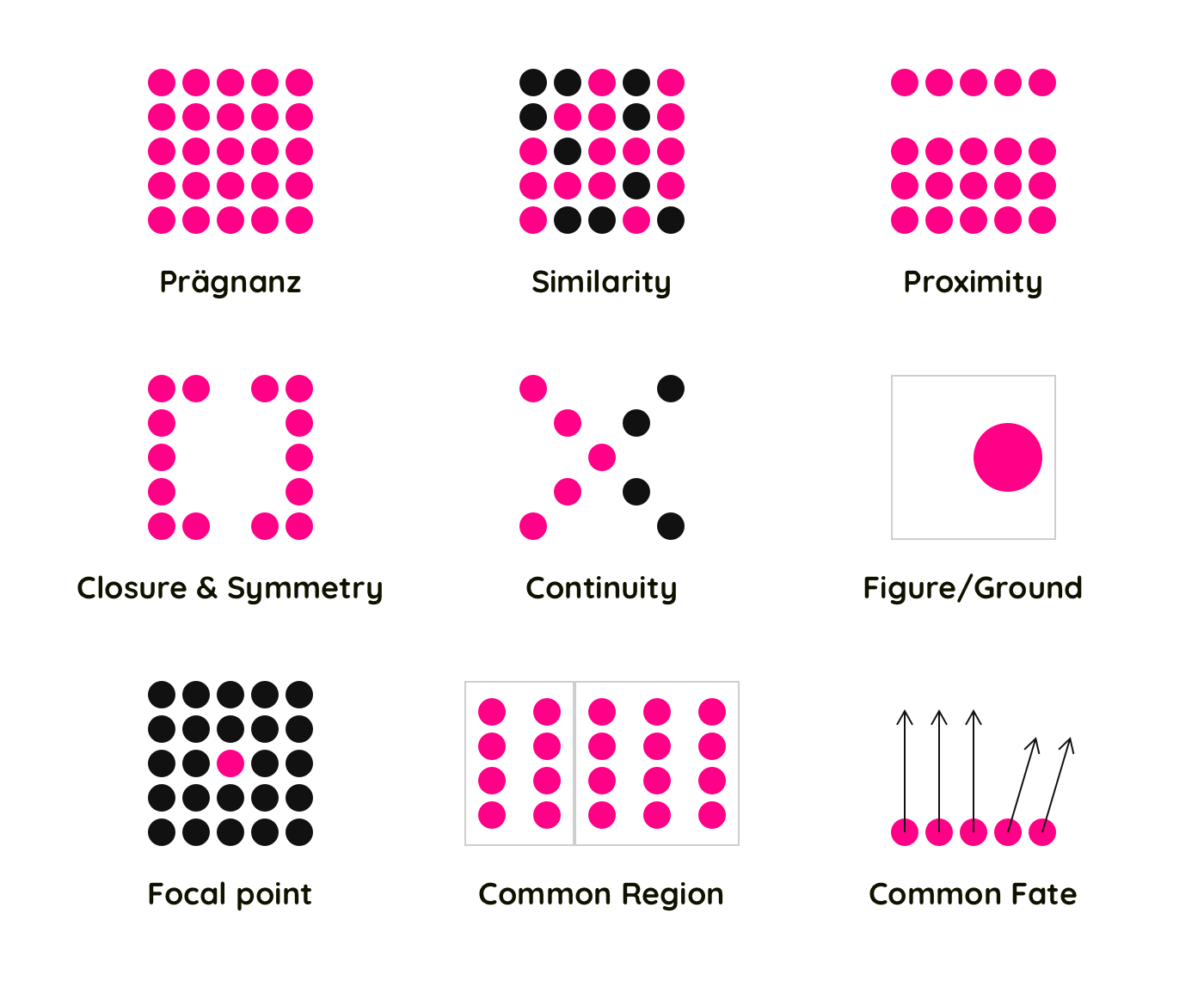
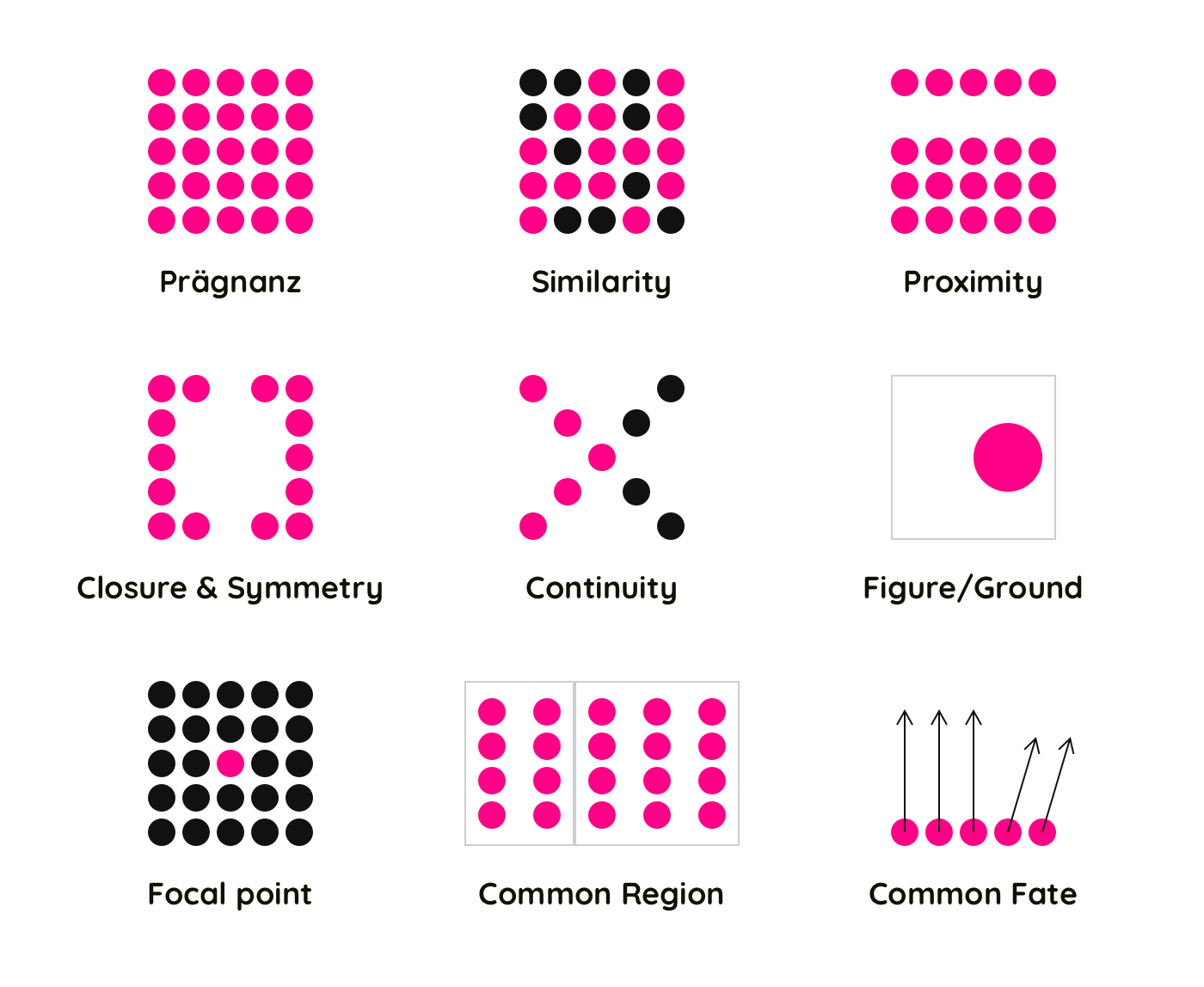
Common Region
Grouping Principle: Elements within a shared boundary or background are seen as related, aiding quick understanding of grouping

Convexity
Figure Ground Assignment: Convex features are perceived as figure
Parallelism
Figure Ground Assignment: Objects with parallel features are perceived as figure
Surroundedness
Figure Ground Assignment: Enclosed aspects of a scene are perceived as figure
Size
Figure Ground Assignment: Smaller regions in a scene are perceived as figure
Symmetry
Figure Ground Assignment: Symmetry across objects are perceived as figure
Lower Region
Geometric cue: stimuli in the lower/closer are perceived as figure
Familiarity
Geometric cue: perceive and group ambiguous visual elements into whole, familiar objects based on prior knowledge and pattern recognition
Template Matching
A theory of visual object recognition that claims people have stored, pictorial-like mental templates that are compared and contrasted to distal stimuli
Structural Description Theories
Visual object recognition theories that claim objects are represented abstractly as parts and relations
Feature Analysis
A structural description theory that claims people recognize objects by deciphering the prominent parts of a stimuli and comparing that to stored memories of already-known stimuli
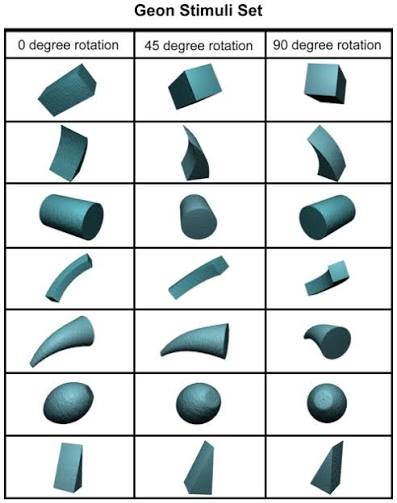
Recognition by Components
A structural description theory that claims objects are recognized by their primitive geons and the combinations of those geons

Viewpoint Variance
A property of geons that states they must be recognizable from any angle
Resistance to Visual Noise
A property of geons that states they must be recognizable even when they are obscured or part of an unclear image
Discriminability
A property of geons that states that each geon must have nonaccidental features that distinguishes them from each other