Module 3 Euk Exam 1
 Call Kai
 Learn
Learn Practice Test
 Spaced Repetition
 Match
Match Flashcards
 Knowt Play
1/49

There's no tags or description
Looks like no tags are added yet.
Name | Mastery | Learn | Test | Matching | Spaced | Call with Kai | Chat |
|---|
No analytics yet
Send a link to your students to track their progress
50 Terms
bioenergetics
the study of various types of energy transformations that occur in living organisms
energy
the capacity to do work
two different types of energy in a force field
potential energy
PE=mgh
determined by an object’s position in the force field
kinetic energy
KE=1/2(mv²)
object is moving
first law of thermodynamics
conservation of energy: closed system energy is conserved
energy can be converted into various types, never lost or created
closed system
no communication between the system and its surroundings
no energy exchange
it is difficult to find a closed system in the real world
systems vs surroundings
system: a certain space or certain amount of matter under study
surroundings: the remainder of the universe outside of the system
internal energy
the energy inside the system
ΔE=Q-W
Q is heat energy
W is work
ΔE represents change in internal energy
exothermic: reactions that lose heat (negative value)
endothermic: reactions that gain heat (positive value)
ΔE cannot predict the direction of the reaction
energy can increase if it enters the system, and vise versa
second law of thermodynamics
events in the universe tend to proceed “downhill” from a state of higher energy to a state of lower energy, which is a spontaneous event
entropy increases naturally, so energy spreads out and loses its ability to do work (low energy)
this law determines the direction of a reaction
energy input is required to go from a low energy to high energy state, which is a non-spontaneous event
entropy
spontaneous events lead to increase in randomness or disorder
going from highly organized to disorder
measure of randomness or disorder in the universe, a system, or its surroundings
energy of the system changes with an increase in entropy: ΔE=TΔS
enthalpy
the total energy content of a system
free energy
the thermodynamic laws indicate that the energy of the universe is constant, but the entropy continues to increase toward a maximum
part of the energy that can be used to do work
-ΔG means spontaneous reaction
free energy determines direction of the reaction
free energy equation
ΔH= ΔG + TΔS or ΔG= ΔH - TΔS
ΔH is the change in enthalpy or total energy of the system
ΔG is the change in free energy (change in useful energy)
T is temp
ΔS is change in entropy of the system (change in energy that is unavailable to do work)
when ΔG is negative, the reaction is exergonic/favorable
system used some of its free energy
when ΔG is positive, the reaction is endergonic/unfavorable
system gained free energy
energy had to be added to increase free energy of the system
free-energy changes in chemical reactions
K is a rate constant for each direction a reaction can proceed
view a reaction as a system
at equilibrium, the rate constants are equal to each other

equilibrium
no net change in the reaction, but the reaction does not stop
concentrations of products and reactants are equal
equilibrium constant is Keq
Keq= [product]/[reactant]
![<ul><li><p>no net change in the reaction, but the reaction does not stop </p></li><li><p>concentrations of products and reactants are equal</p></li><li><p>equilibrium constant is Keq</p></li><li><p>Keq= [product]/[reactant]</p></li></ul><p></p>](https://assets.knowt.com/user-attachments/648164a2-95aa-4d63-9b57-b973dc84e579.png)
standard conditions
25 degrees celsius (room temp), 298 K
pressure is 1 atm
concentrations are all 1 mol/L, except water which is present at 55.6 mol/L
pH=7
under these conditions, we can calculate the free energy of a reaction: ΔGo= RTlnKeq = -2.303 RTlogKeq (equation is not tested though)
just understand R is the gas constant (1.987 cal/mol K) and T is absolute temperature
ΔG and equilibrium
If ΔGo is negative, the reaction will go to the left
If ΔGo is positive, the reaction will go to the right
ΔGo is the driving parameter on which way the reaction goes
when ΔΔGo is negative, Keq is large, meaning a large concentration of products
when ΔGo is positive, Keq is small, meaning a large concentration of reactants
ΔGo vs ΔG
ΔG is used when the concentrations are different
ΔG= ΔGo + 2.303 RT log Keq
changing concentrations of the products or reactants changes ΔG
roles of ATP hydrolysis
promote reactions and activities inside the cell because ATP hydrolysis releases energy
separate charges across the membrane
pump ions into and out of the cell to create an electrical difference between the inside and outside of a cell
concentrate solute in the cell
move solutes against a concentration gradient (i think)
drive unfavorable reactions
slide filaments across one another
phosphorylation of proteins
kinases use ATP
2 ways cells achieve a negative ΔG
change the product and reactant ratio to change ΔG
reduce product concentration or remove product once its formed so the reaction drives forward
couple endergonic and exergonic reactions
steps of glycolysis and its free energy profile
glucose is the substrate
glucose oxidized in the cytosol and becomes pyruvate
10 steps, but 3 steps have a big energy release
the first step
the third step
the last step
these 3 steps drive the pathway forward
these 3 steps release so much energy, they are irreversible
the other steps have a small free energy change, so it can be reversed by changing product and reactant concentrations.
both ways are catalyzed by the same enzyme
equilibrium vs steady-state metabolism
as reactions reach eqilibrium, the free enegy available decreases toward a minimum, while entropy increases toward a maximum.
if ΔG=0, the reaction is at equilibrium
steady-state: can be or can not be at equilibrium. A condition where the concentration of substances remains constant because they are produced and consumed at equal rates, while the system continues to operate.
equilibrium: Forward reaction rate = reverse reaction rate → no net reaction. (balanced reactions)
Steady state: Rate of production = rate of consumption → constant concentration, but material is continuously flowing through the system. (balanced inputs and outputs)
open system
takes energy and releases waste
maintain ratio of ATP and ADP because food is available to make ATP
ATP / ADP is a steady state
enzyme
biological catalysts- speed up a reaction
proteins
many are conjugated proteins with nonprotein components (cofactors)
cofactors may be inorganic (metals) and organic (coenzymes)
enzyme properties
Are required only in small amounts
Are not altered irreversibly during course of reaction
Have no effect on reaction thermodynamics (does not determine reaction direction)
Are highly specific for their Substrates
Produce only appropriate metabolic products
Can be regulated to meet the needs of a cell
enzymes vs inorganic catalysts
enzymes are more effective
inorganic catalysts catalyze a reaction under extreme conditions, while enzymes catalyze under mild cnditions
enzymes are highly specific and will only catalyze one reaction, while inorganic catalysts can catalyze different kinds of reactions
enzymes are “metabolic traffic directors” which means one pathway in metabolism can branch into two pathways, and that pathway is determined by the enzyme
whichever enzyme is more active will determine what pathway it will channel the substrate into
enzyme activity can be regulated to meet particular cellular needs at particular time
activation energy
enzymes lower this energy to help the reaction proceed
more substrates will reach the threshold to convert to products
the energy required for a reaction to occur (to overcome the transititon state)
transition state
covalent bonds become weak and easily can be broken so the reaction can occur
once bonds are broken, new bonds will form
activation energy needs to be reached to exit transition state and make products
mechanisms used by enzymes and heat to increase rate of reaction
increasing temperature increases rate of reaction because energy of the substates increases
shifts energy diagram to the right (more enzymes in the threshold of high energy to overcome Ea)
this method leaves Ea unchanged
if enzymes are added while using this method, high temp might denature them
decreasing activation energy (adding enzyme)
enzyme-substrate complex
enzyme has an active site where it has a complementary shape with the substrate
substrate binds to active site
after bound, enzyme can catalyze the reaction and the product will be released. another subsrate can come in after product is released
active site
typically buried in a cleft or crevice that leads from the aqueous surroundings into the depth of the protein to create a hydrophobic environment within the protein
allows the substrate to interact with the enzyme instead of water molecules
where substrate binds to enzyme
noncovalent interaction between enzyme and its substrate
the enzyme’s active site and the substrate are complementary, which allows binding at a high degree of precision
this precise binding is performed by noncovalent bonds
a transient covalent bond between enzyme and substrate could also be formed
mechanisms of enzyme catalysis
substrate orientation
the enzyme positions the substrate(s) in the correct orientation so the reacting groups are close together and properly aligned, making the reaction easier and faster.
changing substrate reactivity
enzyme can help change the charge inside the substrate, allowing covalent bonds to be broken
enzyme changes the distribution of electrons at a specific position or specific bond so the enzyme can break the bonds within the substrate
inducing strain in a substrate
once the substrate is bound, it causes a conformational change of the enzyme, so it causes a strain inside the substrate, which can break covalent bonds
enzyme kinetics
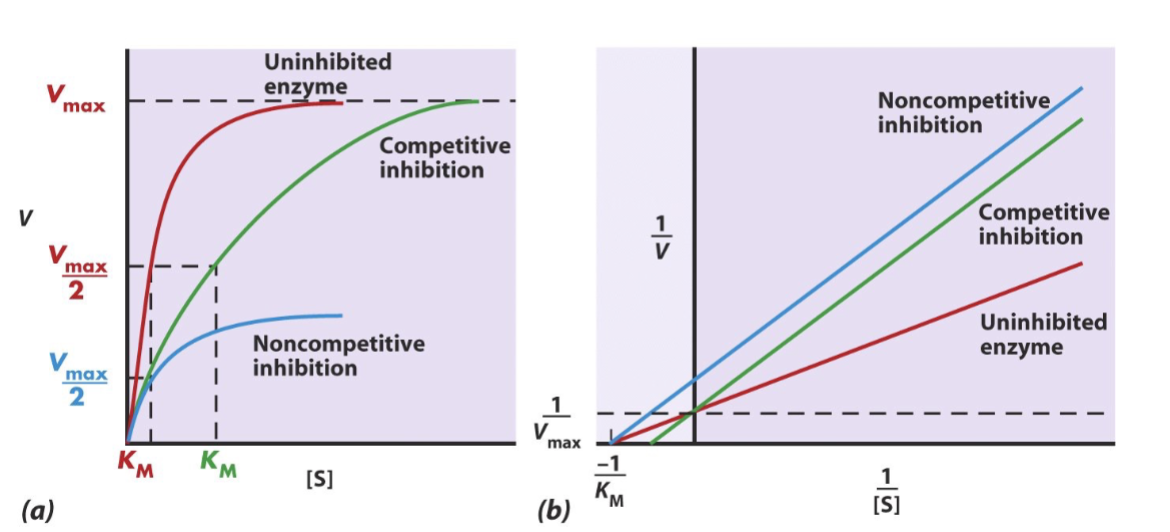
Vmax: the initial velocity when the enzyme approaches a state of saturation
Km (Michaelis constant): the substrate concentration when reaction velocity is one-half of Vmax. (substrate’s affiinity for the enzyme)
independent of substrate and enzyme concentration
for most enzymes, ranges between 10-1 M and 10-7 M, with a typical value around 10-4 M
when [S] is set at Km, V=Vmax/2
Km=[S] when V=Vmax/2
![<ul><li><p>Vmax: the initial velocity when the enzyme approaches a state of saturation</p></li><li><p>Km (Michaelis constant): the substrate concentration when reaction velocity is one-half of Vmax. (substrate’s affiinity for the enzyme)</p><ul><li><p>independent of substrate and enzyme concentration</p></li><li><p>for most enzymes, ranges between 10<sup>-1 </sup>M and 10<sup>-7 </sup>M, with a typical value around 10<sup>-4 </sup>M</p></li></ul></li><li><p>when [S] is set at Km, V=Vmax/2</p><ul><li><p>Km=[S] when V=Vmax/2</p></li></ul></li></ul><p></p>](https://assets.knowt.com/user-attachments/4663a73c-11dc-463e-9714-1d2af17789de.png)
effects of pH and temperature on enzyme-catalyzed reactions
enzymes only work in their specific pH level
enzymes only work in their specific temperature range
changing temperature will decrease activity
lineweaver burk plot
x-intercept: -1/Km
y-intercept: 1/Vmax
slope: Km/Vmax
useful because it makes it easier to determine enzyme kinetics parameters and the type of inhibition.
by comparing how the lines change with/without inhibitor can help us determine inhibitor type
enzyme inhibitors
molecules that are able to bind to an enzyme and decrease its activity
cells use inhibitors to regulate the activity of many enzymes.
researchers use inhibitors to study the properties of enzymes.
enzyme inhibitors can be used as drugs, antibiotics, or pesticides.
ireversible inhibitors: bind very tightly to an enzyme, often by
forming a covalent bond to one of its amino acid residues.
kills and removes enzymes from the system
antibiotics and pesticides are usually irreversible inhibitors
reversible inhibitors: bind only loosely to an enzyme, and thus are
readily displaced.
competitive inhibitors: compete with a substrate for access to
the active site of an enzyme.
noncompetitive inhibitors: act at a site other than the enzyme’s
active site.
changes conformation of active site/enzyme so substrate will not fit. enzyme reverts back to original conformation once noncompetitive inhibitor leaves
effects of inhibitors on enzyme kinetics
competitive inhibition:
increase substrate concentration; Vmax can still be reached, so it does not change
Km will increase because substrate concentration increases
noncompetitive inhibitor:
enzyme activity is reduced, so Vmax will decrease
Km is unchanged because same amount of substrate can be used to reach half of max speed
metabolism
collection of biochemical reactions occuring in a cell
all reactions are diverse, and they are different types of reactions
reactions function together to form a pathway
multiple enzymes catalyze these reactions so they can occur in one compartment
reactions occur in different locations, so they do not have to occur at the same time
enzymes can form a complex to increase efficiency of metabolic pathways
substrate enters complex and finishes pathway within it
metabolic intermediates/metabolite
molecules that are produced, consumed, or transformed during metabolic reactions; intermediates are the molecules between steps of a pathway.
no specific function
energy metabolism
catabolic pathway: the complex molecules are broken down into simpler products
provide raw materials for synthesis
provide energy for cell activities in the forms of high-energy phosphates (ATP) and high-energy electrons (NADPH)
anabolic pathways: synthesis of more complex compounds from simpler starting materials
3 stages of energy metabolism
big macromolecules are broken down into building blocks
building blocks are further degraded to common metabolites
small metabolites are completely oxidized or degraded to yield ATP
oxidation and reduction
“oxidized” means to lose electrons
the “reducing agent” is oxidized since it reduces the other molecule
“reduced” means to gain electrons
the “oxidizing agent” is reduced since it oxidizes the other molecule
in the organic world, electrons are not completely transferred, oxidation and reduction is based on the polarization of shared electrons
organic molecules have covalent bonds, so electrons cannot be transferred; the electrons polarize the bond instead (unequal sharing)
the more the electron is pulled away from the atom we are looking at, the more the molecule has been oxidized
the more hydrogen, the more reduced
the more nitrogen or oxygen, the more oxidized
oxidation of glucose
in glycolysis and TCA cycle, glucose is completely oxidized
energy is released
produces 36 molecules of ATP
step one and step three require ATP input
after glycolysis, there is a net of 2 ATP and 2 NADH
ΔG0 is different for each step
NADH/NAD+
coenzymes (organic compounds)
NAD+ can take two electrons and one proton to form NADH
NADH is a reduced form, NAD+ is an oxidized form
oxidative vs substrate level phosphorylation
two ways to make ATP
oxidative phosphorylation: energy released during electron transport is utilized to form ATP
substrate-level phosphorylation: a direct formation of ATP by a transfer of a phosphate group from substrates to ADP
high-energy phosphate group from a phosphorylated substrate to ADP.
cannot transfer a low-energy phosphate
anaerobic vs aerobic respiration
both oxidize glucose to pyruvate
aerobic respiration produces 36 ATP
anaerobic respiration produces 2 ATP
fermentation
oxygen is not present but we need ATP
yeast cells under anaerobic conditions
skeletal mucle cells undergoing strenuous contraction
goal of fermentation is to generate NAD+
produces ethanol (yeast)
NADH produces lactate to make NAD+, which makes our muscles burn
metabolic regulation
regulated by regulating enzymes
covalent modification
regulation of a protein or enzyme by adding or removing a chemical group through a covalent bond, which changes its activity.
ex: adding or removing a phosphate group
allosteric modification (site other than the active site)
allosteric inhibition
allosteric activation
an example is feedback inhibition, which helps save resources by turning off when product is not needed and turning on when product is needed
as product is produced, it binds to the allosteric site and changes the enzyme conformation, so substrate can no longer bind. substrate can bind once product unbinds and is used in the next pathway
quaternary structure and allosteric activation
one subunit binds to oxygen, causing a conformation change. other subunits will also have a conformationc change of their active site. the change in conformation increases the affinity for oxygen in all subunits.
regulation of catabolic and anabolic pathways
in opposite pathways (like glycolysis and gluconeogenesis), reversible steps use the same enzyme in each pathway
the irreversible steps must use a different enzyme
regulation of enzymes (especially in the irreversible steps) drives the reactions downward or upward (glycolysis or gluconeogenesis)