Clinical Lab Techniques Lecture 2 - Leukocytes
 Call Kai
 Learn
Learn Practice Test
 Spaced Repetition
 Match
Match Flashcards
 Knowt Play
1/63

There's no tags or description
Looks like no tags are added yet.
Name | Mastery | Learn | Test | Matching | Spaced | Call with Kai | Chat |
|---|
No analytics yet
Send a link to your students to track their progress
64 Terms
-cytosis
Suffix that refers to a condition of cells
Leukocytosis
Increase in white blood cells
Leukopenia
Decrease in white blood cells
Neutrophils
Which leukocyte is most common in dogs?
False! Horses have the same number of lymphocytes and neutrophils.
True or false? Horses have more lymphocytes than neutrophils.
True!
True or false? Dogs and cats have much more neutrophils than lymphocytes.
True!
True or false? Ruminants have more lymphocytes than neutrophils.
Bone marrow
Where do all leukocytes develop?
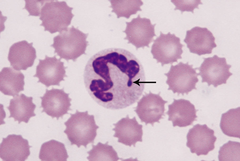
Neutrophil (looks like a sausage link)
Leukocyte that is 2-2.5x the diameter of a red blood cell, with a lobulated nucleus and fine granules in the cytoplasm
• 12-15 micrometers
• 2-2.5x diameter of a RBC
• Lobulated or partially segmented nucleus
• Fine granules in nucleus
• Pale pink or light blue cytoplasm
Describe the morphology of a neutrophil
Heterophils
Another term for neutrophils found in rabbits, guinea pigs, birds, and reptiles
Severe inflammatory disease or toxemia
Toxic neutrophils may be seen secondary to
• Diffuse cytoplasmic basophilia
• Foamy vacuolation of the cytoplasm
• Dohle bodies (RNA)
• Abnormal nuclear shapes
Describe the morphological changes associated with toxic neutrophils
• Primarily defensive
• Accumulate at sites of inflammation
• Phagocytic and microbicidal effects
Identify the functions of neutrophils
• Circulate for 8-10 hours
• Migration into tissue spaces is unidirectional
• Lifespan in tissues is 1-4 days
Describe the life cycle of a neutrophil
-philia or -osis
Suffix referring to a predominance or increased number of a certain cell
-penia
Suffix referring to a deficiency of a certain cell
Neutrophilia
What is the most common cause of leukocytosis?
• Epinephrine release due to fight or flight
• Stress response to corticosteroids
• Acute or chronic inflammation
Identify possible causes of neutrophilia
Neutropenia
What is the most common cause of leukopenia?
• Acute demand or consumption in tissues
• Decreased production in bone marrow
• Ineffective granulopoiesis
• Increased margination
Identify possible causes of neutropenia
Band cells
Immature neutrophils are known as
Left shift
An increase in number of band cells
Degenerative left shift
More immature cells than mature cells
A band cell has a C- or S-shaped nucleus
How can you distinguish a band cell from a mature cell?
Lymphocyte
A leukocyte with a round and eccentric nucleus
• 9-12 micrometers
• Round and eccentric nucleus
• Cytoplasm has scant rim of pale blue
Describe the morphology of a lymphocyte

Lymphocytes
B-cells, T-cells, and memory cells are associated with which type of leukocyte?
B-cells (involves bodily fluids)
Lymphocytes responsible for humoral immunity
T-cells (targets specific cells during infection)
Lymphocytes responsible for cellular immunity
Memory cells
Lymphocytes responsible for reducing lag time, or the time it takes the body to recognize an antigen and produce antibodies
B-cells in the bursa
T-cells in the thymus
Lymphocytes, like all white blood cells, are produced in the bone marrow. Where in the body do T- and B-cells become differentiated?
• Blood → lymph nodes → lymph → blood
• Transit time is 8-12 hours
• May survive for months to years
Describe the life cycle of a lymphocyte
• Excitement
• Antigenic stimulation
• Cancers like lymphosarcoma or lymphocytic leukemia
Identify possible causes of lymphocytosis
• Stress response to corticosteroids
• Disruption of lymphatic circulation
• Lymphosarcoma
Identify possible causes of lymphopenia
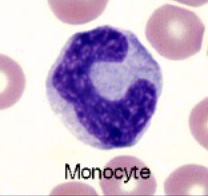
Monocyte (looks like a croissant)
Leukocyte with an irregularly shaped nucleus
• 15-20 micrometers
• Irregularly shaped nucleus
• Cytoplasm is abundant blue to blue-gray
Describe the morphology of a monocyte
• Phagocytosis (eats dead tissue)
• Regulation of inflammatory response
• Antigen processing
Identify the function of a monocyte
• Released into blood as immature cells
• Transported into tissues as macrophages
Describe the life cycle of a monocyte
• Inflammation
• Demand for phagocytosis
• Tissue necrosis
• Stress response to corticosteroids
Identify possible causes of monocytosis
Eosinophils (looks like a swaddled baby)
Leukocyte with a lobulated nucleus and prominent granules in the cytoplasm
• 12-20 micrometers
• Lobulated or partially segmented nucleus
• Prominent granules in cytoplasm (round in dogs, rod-shaped in cats, large/round in horses)
Describe the morphology of a eosinophil

• Major role in destruction of parasites
• Limited phagocytic and bactericidal activity
• May play a role in destroying neoplastic cells
Identify the function of a eosinophil
• Circulate in blood for a few hours
• Migration into tissue species is unidirectional
• Lifespan in tissues is several days to weeks
Describe the life cycle of a eosinophil
• The 3 W's
• Worms or parasites
• Wheezes or allergic conditions
• Weird diseases (cancer, rare fungal diseases)
Identify conditions associated with eosinophilia
Stress response to corticosteroids
Eosinopenia can be associated with
Corticosteroids
A stress leukogram refers to the results of
Lymphopenia
What is the most consistent change associated with a stress leukogram?
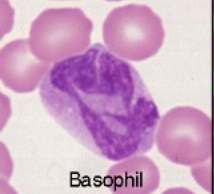
Basophil
Leukocyte with a lobulated nucleus and cytoplasm with dark purple granules
• 12-20 micrometers
• Lobulated or partially segmented nucleus
• Light purple or gray cytoplasm
• Most species have dark purple granules (lavender in felines)
Describe the morphology of a basophil
Hypersensitivity reactions and inflammation
Identify the function of basophils
• Circulate in blood for a few hours
• Migration into tissues is unidirectional
• Lifespan in tissues is several weeks
Describe the life cycle of a basophil
Allergies or parasites like dirofilaria immitis
Basophilia is associated with
Basophils and monocytes
Low counts of _____ and _____ are not clinically recognized
Progenitor cell
A biological cell that can differentiate into a specific cell type
Basophils
Which leukocyte shares a common progenitor cell with mast cells?
Neutrophils
Leukocyte that is primarily defensive and accumulates at sites of inflammation
Neutrophils
Which leukocyte is associated with band cells?
Monocytes
Which leukocyte is transported into tissues as macrophages?
Eosinophils
Which leukocyte plays a major role in the destruction of parasites?
Mast cells
Leukocyte similar to basophils with a round to oval nucleus that may be obscured by cytoplasmic granules
• Similar to basophils (12-20 micrometers)
• Round to oval nucleus
• Central to eccentric nucleus location
• Numerous small, round, dark purple granules that may obscure the nucleus
Describe the morphology of a mast cell
• Protects the body from external invaders
• Usually exist beneath the skin but travel to bloodstream when they metastasize
Identify the function of a mast cell
Review leukocyte morphology!
Review leukocyte morphology!
