(PAPER TWO) Corrosion, Raw Materials & Recycling Metals
 Call Kai
 Learn
Learn Practice Test
 Spaced Repetition
 Match
Match Flashcards
 Knowt Play
1/53

Earn XP
Description and Tags
Obtaining Raw Materials, Corrosion and its Prevention, Recycling Metals
Name | Mastery | Learn | Test | Matching | Spaced | Call with Kai | Chat |
|---|
No analytics yet
Send a link to your students to track their progress
54 Terms
In aqueous solutions, electrolysis is more complicated because
ions are made by water as it ionises
What must be present in order for iron to rust?
water, oxygen
On which electrode will a metal sometimes form during electrolysis?
The cathode (negative electrode)
How will the mass of an electrode change if a metal ion is discharged at that electrode?
The mass of the electrode will increase
Explain why alkali metals are stored under oil.
Alkali metals are stored under oil to prevent them from reacting with oxygen in the air.
Corrosion meaning
the destruction of materials by chemical reactions with substances in the environment.
Rusting is an example of…
corrosion
Corrosion can be prevented by…
putting a barrier on the surface of the metal
- painting, greasing or electroplating
Aluminium has an … that protects the metal from ….
oxide coating
further corrosion
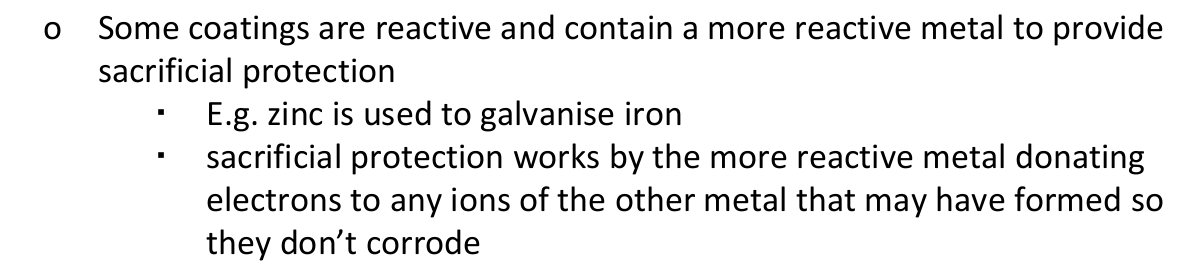
sacrificial protection meaning
What is the product of the corrosion of iron? (rusting)
iron oxide is the product of the rusting of iron
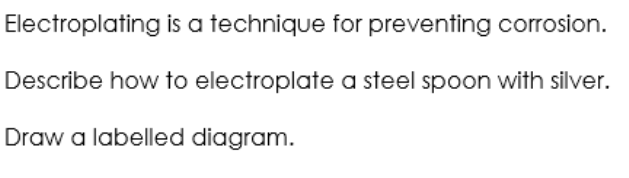
What process is used to electroplate a metal?
Which electrode is electroplated?
What separating technique is used to obtain metal from the solution which hasn’t attached to the cathode?
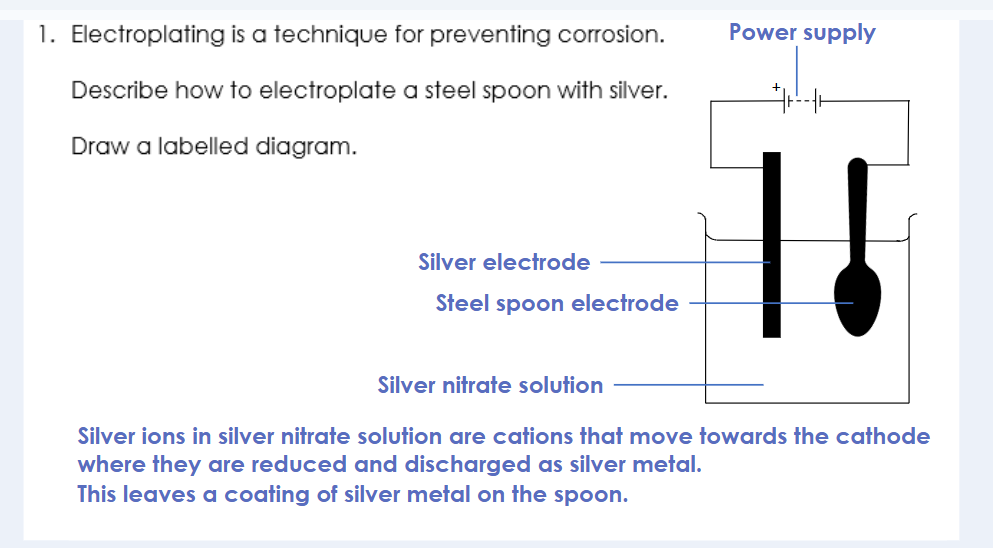
Electrolysis is used to electroplate a metal
The cathode is always electroplated
Filtration is used to obtain metal from the solution
What is greasing?
grease is insoluble so prevents chemicals coming into contact

explain how painting prevents corrosion
prevents other chemicals from contacting the object so corrosion cannot occur






Experiment to prove that air and water are necessary for rusting of iron
Take three test tubes and place one clean iron nail in each of them.
In the first test tube pour some water and close with a cork.
In the 2nd test tube pour boiled water which does not contain dissolved air. Also pour some oil in 2nd test tube to form a layer over boiled water. The layer of oil will prevent the entry of air in water.
In the 3rd test tube allow only air and no moisture. Keep these test tubes undisturbed for some days.
After some days, you will observe that the nail in2nd test tube does not rust because the nail was exposed only to water and no air was present in it. In the same way the nail present in 3rd test tube does not rust because in this tube air is dry and water is not present. But the nail present in 1st test tube rusts because in 1st test tube the nail was exposed to both air and water.
Define ‘potable’ water.
Water that is safe/clean enough to drink.
Soda-lime glass is made by heating a mixture of which 3 substances?
sand, sodium carbonate and limestone
What is meant by ‘sustainable development’?
Sustainable development is development that meets the needs of current generations without compromising the ability of future generations to meet their own needs
As the availability of high-grade copper ores dwindles, scientists are looking for…
more effective ways to use low-grade copper ores to obtain copper
Bioleaching
a method to extract metals from their ore using living organisms such as bacteria
Bacteria are added to low-grade ores.
They ‘feed’ on the ore, creating a solution of ions called leachate.
The copper solutions are then purified using displacement reactions or electrolysis.
This method produces around 20-25% of all copper extracted from ores.
However, there is a long way to go with bioleaching… Scientists are looking for ways to speed up this process which can take years!
Phytomining
a method to extract copper metal from low-grade copper ore in soil, using plants
Describe how copper compounds are obtained by phytomining.
grow plants on land containing copper ores
burn the plants to form ash (copper oxide)
dissolve the copper oxide in (sulfuric) acid to form copper sulfate (leachate) solution
carry out the electrolysis of this solution to form pure copper
State a use of copper metal.
Copper metal is used for electrical wiring.
Are copper ores renewable or non-renewable?
Copper ores are non-renewable: finite, formed over millions of years
What word is given to a copper ore containing a low percentage of copper?
Low-grade copper ores contain a low percentage of copper
State two disadvantages of mining copper ores.
massive environmental destruction including habitat destruction
significant noise/dust pollution from quarries
At which electrode will copper metal form in electrolysis?
Copper metal will form at the cathode (negative electrode)
Low-grade ores contain a very low percentage of the ______ to be extracted.
metal
2 similarities between phytomining and bioleaching
both use organisms
both used to obtain copper ore from low-grade ore
Explain why copper ores are becoming more expensive over time.
copper ore is becoming more scarce
methods used to extract copper ore are costly
describe 2 methods used to extract copper from copper compounds
reduction with carbon
electrolysis of copper compounds in solution
state a waste gas product made during the phytomining process and explain the environmental impact of this.
carbon dioxide is the waste gas produced which has an environmental impact because carbon dioxide is a greenhouse gas contributing to global warming
suggest one reason why phytomining is preferable to mining the land for obtaining copper ores
reduces the need for mining of rock which destroys habitats
3 reasons why copper should not be disposed of in landfill sites
copper ore is running out and so should be recycled / reused
landfill sites are filling up
copper compounds are toxic to organisms
State two properties of copper that make it ideal for electrical wiring
good electrical conductor
ductile (can be deformed: stretched, bent, or made into wires without breaking)
Define ‘leachate’
A solution of ions produced by bacteria in bioleaching
Phytomining is not used as frequently as bioleaching to extract copper ore; suggest 2 reasons why
land may not be available
takes a long time for plants to grow
Phytomining & bioleaching avoid…
traditional mining methods of digging, moving and disposing of large amounts of rock.
Glass is made from limited raw materials. Name three things that people can do to reduce the amount of raw materials we use for glass products.
People can reduce their use of glass, reuse glass products or recycle glass.
Name two metals that does not need to be extracted from an ore.
Gold, silver
Recycling metals
involves collecting used metal items and turning them into new metal items
1. Scrap metal is collected and transported to a sorting centre
Items are broken up, and sorted into different kinds of metals
Other materials such as plastic are removed
The metals are melted down
The metals are recast into new items
The effects of recycling metals: Social (advantages & disadvantages)
The recycling of metals provides jobs for people.
People have to make the effort to sort and recycle their metal waste.
The effects of recycling metals: Environmental (advantages)
Less damage to the environment as no quarries or mines are required.
Less noise pollution from heavy traffic.
Valuable raw materials preserved
The effects of recycling metals: economic (advantages & disadvantages)
It costs less to recycle metals than it does to extract new metals from ores.
Sorting and recycling metals costs a lot of money
Explain why copper should be recycled.
Copper should be recycled to preserve valuable natural resources (ores)
and because recycling is less expensive than extracting metal from its ore
Explain why people may not always recycle metals.
people might not be aware of the advantages of recycling
people might not be provided with facilities, bins or areas to recycle their old copper items
people might not know that items are recyclable
Recasting / reforming definition
When molten, recycled metals are used to form something new
2 reasons why aluminium should not be put in landfill waste
Landfill sites are filling up.
Aluminium ore is non-renewable so could run out

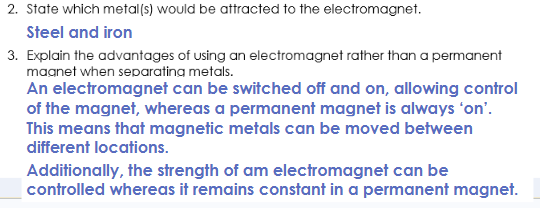
State which metal (s) would be attracted to the electromagnet
explain the advantages of using an electromagnet rather than a permanent magnet when separating metals
Separation of the mixture will allow pure metals to be extracted ready for melting and recasting.
Compare the composition of steel & iron, and explain why steel is harder than iron.
Iron is a pure metal whereas steel is an alloy containing both iron and carbon.
Alloys contain atoms of different sizes. This distorts the layers of atoms in a pure metal. This means that a greater force is required for the layers to slide over each other, creating a harder material.