Small Animal Tech Skills Final
 View linked note
 Call Kai
 Learn
Learn Practice Test
 Spaced Repetition
 Match
Match Flashcards
 Knowt Play
1/112

Earn XP
Description and Tags
Name | Mastery | Learn | Test | Matching | Spaced | Call with Kai | Chat |
|---|
No analytics yet
Send a link to your students to track their progress
113 Terms
60-120 bpm
What is the resting range of bpm for a dog?
120-140 bpm
What is the resting range of bpm for a dog?
10-34 bpm
What is the normal resting respiratory range for a dog?
16-40 bpm
What is the normal resting respiratory range for a cat?
100-102.5 degrees
What is the normal temperature range for both the dog and cat?
Grade 1
Which grade heart murmur is classified as very quiet, only audible after listening for several seconds?
Grade 2
Which grade heart murmur is classified as quiet, but can be heard immediately?
Grade 3
Which grade heart murmur is classified as moderate intensity, easily audible?
Grade 4
What heart murmur is classified as louder than the normal heart sounds?
Grade 5
What heart murmur is classified as loud, can be detected by feeling the chest wall (known as precordial thrill)?
Grade 6
What heart murmur is classified as very loud, audible without actually placing the stethoscope on the body wall?
Liver and kidneys
Which organs should you not be able to feel in a healthy dog when palpating the abdomen?
Submandibular
Prescapular
Axillary
Inguinal
Popliteal
Which lymph nodes should you feel for when performing a physical exam?
Rabies
DA2PP (distemper, hepatitis, canine parvovirus, and parainfluenza)
FVRCP (feline viral rhinotracheitis, calicivirus, and feline panleukopenia)
What are the core vaccines in dogs and cats?
Longer procedure times
Increased stress on the animal
Higher chance of injury for the animal and the team member
What are the consequences of improper restraint?
Irritable or pain induced aggression
Maternal aggression
Predatory aggression (usually not a problem for the animal handler)
Territorial aggression
Fear induced aggression
Inter male aggression
Dominance aggression
When assessing and perceiving the behavior of an animal what are the types of aggressive behavior?
Frontline plus
A preventative for fleas and ticks and is used for dogs and cats.
Advantage multi
A preventative for
Dogs: heart worms, fleas, roundworm, hookworm, whip worm, sarcoptic mange
Cats: heart worms, fleas, ear mites, roundworms, hookworms
Nextgard
A preventative that is for fleas and ticks for dogs.
Comfortis
A preventative that is for dogs and cats and only fleas.
Trifexis
A preventative for dogs that is for heart worms, fleas, hookworm, roundworm, whip worm
Heart gard
A preventative that is for
Dogs: heart worms, roundworms, hookworms
Cat: heart worms, hookworms
Revolution
A preventative that is for
Dogs: heart worms, fleas, ear mites, sarcoptic mange, ticks
Cat: heartworms, fleas, ear mites, roundworms, hookworms
The cat will not benefit from being vaccinated against the disease if it already has is. The FELV is an antigen test and will no interfere with the test. FIV is an antibody test, and the vaccine will interfere with the test. This is why we recommend microchipping the animal.
Why do test the cat before FELV or FIV?
Jugular venipuncture
Which venipuncture site should be avoided in patients with sever coagulopathy?
Monitor respiratory function
Assess oxygenation during the diagnostic evaluation of polycythemia
Assess acid-base status in seriously ill patient
Why do we collect blood from arteries?
Thoracic inlet
Where should you occlude for jugular venipuncture?
True
True or False: air bubbles will change blood gas volumes when collecting from an artery?
Medial saphenous vein
What is the preferred venipuncture sight for a cat?
Demodex Mites
This type of mange is found most likely in lesion on the face and feet in dogs, can be focal or generalized, lies deep in the hair follicles.
Sarcoptic Mange
This type of make is most likely to be found on the animal’s pressure points like the hocks, elbows, as well as the ear margins, most of the dogs that are affected are extremely pruritic.
So there is not as much contamination from the lower urinary tract and external genitalia
Why do we want to collect mid stream when performing a free catch?
To detect the stage of estrous in the female and DIFF QUICK Stain
Why do we do vaginal cytology and which stain do we use for it?
When there is discharge from the ears
When there is a large amount of black debris in the ears
When you have a patient with chronic ear infections
When you have an ear infection not responding to treatments
What are some indication for ear swab/cytology?
Animals that come in for a yearly physical
Puppies and kitten should get fecal exams at every check-up
Any dog or cat that comes in with GI symptoms
If the animal has a mass, traumatic injury, or anything questionable around the rectum it may be better to ask before you proceed
Who should we perform a fecal on?
Bleeding disorder
Potential pyrometers or prostatic abscess
Bladder cancer
Urinary outflow obstructions
What are some contraindications of a cystocentesis?
Jugular vein
Which blood collection site should you use when collection for a CBC, serum chem test?
10-20 mmHg
What is the normal intraocular pressure with a Tonopen?
5 mmHg
There should never be more than how many mmHg between eyes?
15 mm/min
What is the normal value of a Schiller test for a dog?
5 mm/min
What is the normal value of a Schiller test for a cat?
Yes it is normal it is a learned response
Is it normal for a puppy not to have a menace response?
Endothelium
This is the innermost layer of the cornea it is composed of one single layer of cells and it separates the cornea from the anterior portion of the eye?
Stroma
This accounts for 90% of total thickness of the cornea, the fibers in this layer contribute to the corneal transparency?
Proparacaine
This medication anesthetizes the eye.
Tropicamide
This medication diamantés the pupil.
Hyphema
This mean blood in the eye; bleeding in the front (or anterior chamber) of the eye between the cornea and the iris.
Ciliary body
This is the ring-shaped structure behind the iris.
Nicitating membrane
This is known as the third eyelid; responsible for producing at least 35-40% of the tears for the eye?
Cataracts: develop rapidly in diabetic patients, the lens absorbs glucose from the eye fluids, using most of this for its own energy needs. When there is excess sugar in the eye fluids, there is excess sorbitol produced. Sorbitol pulls water into the lens which in turn disrupts lens clarity and causes the cataract.
Lenticular sclerosis: caused by normal aging change
What is the difference in a cataract and lenticular sclerosis?
Yes, they are caused by diabetes
Is there a relationship between cataracts and endocrine disease?
Gingivitis
What does grade 1 for dental disease consist of?
Gingivitis and Plaque
What does grade 2 for dental disease consist of?
Gingivitis, Plaque, and Calculus
What does grade 3 for dental disease consist of?
Gingivitis, Plaque, Calculus, Root Exposure, and/or Mobile Teeth
What does grade 4 for dental disease consist of?
Liver, Heart, Kidneys
Which organs are related to periodontal disease?
Scissors bite
What is is called for a normal occlusion?
Crown
The portion of the tooth we see when we look in the mouth?
Cervical portion
Where the crown meets the gum (neck)?
Root
The portion of the tooth that is found in the bone of the maxilla and mandible?
Enamel
Hardest substance in the body 96% inorganic hydroxyapatite crystals, magnesium formed by ameloblasts
Dentin
Extends entire vertical length of tooth 70% inorganic/30% organic produced through-out lifetime?
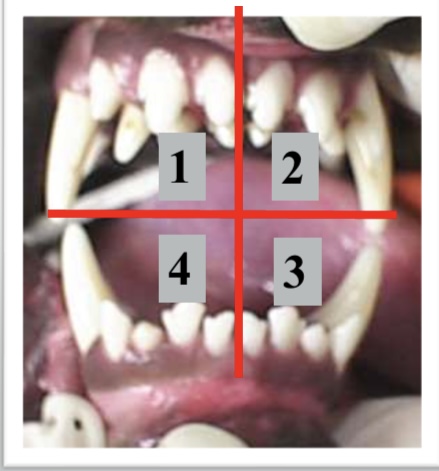
1: right maxillary
2: left maxillary
3: left mandibular
4: right mandibular
Name the quadrants of the mouth?
Class I malocclusions
Malocclusions: jaw length is correct, but one or more teeth are in abnormal position, which may result in attrition or palatial trauma.
Class II malocclusions
Malocclusions: mandible is shorter than maxilla
Class III malocclusions
Malocclusions: maxilla is relatively shorter then mandible
Crossbite
May be Rostral or caudal with one o r more incisors positioned incorrectly, not allowing normal occlusion
Boxers, Pugs, or Boston Terriers
Which 2 breeds have a normal malocclusion class III?
1-3 mm in a healthy mouth
What is the normal periodontal pocket depth in a dog?
1mm in a healthy mouth
What is the normal periodontal pocket depth in a cat?
Lymphocytic Plasmacytic Stomatitis
This is diffuse inflammation of the entire oral cavity and is most common in cats.
Resorptive Lesions
This is lesions that are found at cervical line/cementoenamel junction/neck; gingiva is inflamed over affected area of tooth.
Masticating Myositis
This is a disease where immune system form antibodies toward specific component of myosin found only in muscles of mastication: temporal, massager, and/or pterygoid muscles
Jaw Fractures
This is the most common type of jaw fracture in the cat and can be mended using cerclage wire around mandible directly caudal to canine teeth.
Type A
What blood type would you use on a patient with an AB blood type, but AB blood isn’t available? (Cat)
Type B being transfused with type A
Which blood type reaction is the most serious?
A (most common)
B (uncommon)
AB (very rare)
Mik (newly discovered in DSH)
What are the blood types for cats?
When blood typing is unavailable, and in dogs that have had previous transfusions
When is crossmatching recommended in cats?
Immunologic reaction
This reactions are associated with antibodies that are directed at the RBC antigens, and they can usually be avoided by appropriate blood typing/crossmatching before administration.
Nonimmunologic reactions
This reactions are typically due to inadequate donor screening; incorrect collection, storage, and/or administration of blood products.
every 4-8 weeks
450 mls
How often can a dog be used for blood donation?
How much can be taken?
every 4-8 weeks
40-60 mL
How often can a cat be used for blood donation?
How much can be taken?
Jugular vein
What is the preferred collection site for blood donation?
Every 5 minutes
How often should the patient be monitored within the first hour of transfusion?
every 6 hours with 1-2 mls
Heparinized 0.9% saline solution
How much and how often should you flush an intraosseous catheter? What should you flush it with?
True
True or False: a cat should only receive its specific blood type during a blood transfusion because of alloantibodies?
No longer than 72 hrs
How long should a catheter be left in for max?
Skin sloughing
What is a risk of using over 2.5% concentration of dextrose?
Patients with liver issues
Who do we NOT give LRS to?
Skin sloughing
What is a sign of over hydration?
Tibia
Femur
Humerus
Occasionally iliac wing or ischium
Where can you do intraosseous administration?
lumbosacral musculature
Lateral to dorsal spinous processes
What are the intramuscular administration sites?
Severely dehydrated or critically ill patients
Which patients should we not receive subcutaneous injections?
Immediate response is needed
When a drug is irritating to tissues
When a drug may not be absorbing by other routes of administration
When should you place an IV?
Obese animals
Which patients is subcutaneous administration slow in?
Patient condition and temperament
Type of medications or fluid
Urgency in administering the fluid or medication
Cost
Ease of administration
What systemic or local effect is desired
What are the routes of administration depends on?
Solution is given first 3-5 minutes before ointment and this is because it gives it time to penetrate the eye
When administering opthalmic medication and solution which comes first and why?
In the neck
Where should you never give IM injections?
Allergy testing or to desensitize skin with local anesthetic
What do we use intradermal administration used for?
LEAN (atropine, lidocaine, epinephrine, naloxone)
What drugs can you administer intratracheally?