UNIT 1
 View linked note
 Call Kai
 Learn
Learn Practice Test
 Spaced Repetition
 Match
Match Flashcards
 Knowt Play
1/140

There's no tags or description
Looks like no tags are added yet.
Name | Mastery | Learn | Test | Matching | Spaced | Call with Kai | Chat |
|---|
No analytics yet
Send a link to your students to track their progress
141 Terms
Paul Broca
scientist who performed an autopsy on a patient that couldn’t speak
Broca’s area
a region in the frontal lobe responsible for speech production and language comprehension
expressive aphasia
a condition characterized by difficulties in speech production, often resulting from damage to Broca's area
Carl Wernicke
a scientist known for his research on language comprehension, specifically identifying the area of the brain associated with language understanding
Wernicke’s area
a region in the temporal lobe involved in the processing of language comprehension
receptive aphasia
a condition characterized by difficulties in understanding spoken or written language, often resulting from damage to Wernicke's area
lesions
precise destruction of brain tissue; this enabled more systematic study of the loss of function after surgical removal, cutting of neural connections, or destruction by chemical applications
Roger Sperry and Michael Gazzaniga
Neuroscientists known for their research on the split-brain and lateralization of brain function, demonstrating how each hemisphere processes information differently
brain lateralization
the specialization of the left and right hemispheres of the brain for different cognitive tasks and functions.
electroencephalogram (EEG)
a recording of electrical activity in the brain through electrodes placed on the scalp, used to diagnose conditions such as epilepsy and sleep disorders.
evoked potentials
amplified tracings; when the recorded change in voltage results from a response to a specific stimulus presented to the subject
positron emission tomography (PET) scan
a medical imaging technique used to observe metabolic processes in the body by detecting gamma rays emitted from a tracer injected into the bloodstream.
functional MRI (fMRI)
shows the brain at work at higher resolution than the PET scanner; detects changes in oxygen in the blood of an active brain to identify brain regions involved in specific tasks or functions.
magnetoencephalography (MEG) scan
similar to an EEG, but able to detect the slight magnetic field caused by the electric potentials in the brain
central nervous system
brain and spinal cord
peripheral nervous system
includes two major subdivisions: your somatic and autonomic nervous system
peripheral nervous system (2)
lies outside the midline portion of your nervous system carrying sensory information to and away from your CNS via spinal and cranial nerves
somatic nervous system
has motor neurons that stimulate skeletal (voluntary) muscle
autonomic nervous system
has motor neurons that stimulate smooth (involuntary) muscle and is subdivided into the antagonistic sympathetic nervous system and the parasympathetic nervous system
sympathetic stimulation
the activation of the sympathetic nervous system, which prepares the body for 'fight or flight' responses by increasing heart rate, dilating airways, and redirecting blood flow to muscles
parasympathetic stimulation
the activation of the parasympathetic nervous system, which promotes 'rest and digest' responses by slowing heart rate, enhancing digestion, and conserving energy
spinal cord
protected by membranes called meninges and your spinal column of bony vertebrae, starts at the base of your back and extends upward to the base of your skull where it joins your brain
triune brain
the human brain has three major divisions, overlapping layers with the most recent neural systems nearest the front and top
reptilian brain
maintains homeostasis and instinctive behaviors, roughly corresponds to the brainstem (medulla, pons, cerebellum)
old mammalian brain
regulates emotions and memory, corresponds to the limbic system including structures like the amygdala and hippocampus
new mammalian brain (neocortex)
associated with higher-order functions, such as reasoning, problem-solving, and complex emotions; accounts for 80% of brain volume; sensation and perception
gyri
peaks on the cerebral cortex that increase the surface area for neurons, playing a crucial role in processing information
sulci
valleys in the brain's surface that separate the gyri and increase the brain's surface area
convolutions
the collective term for gyri and sulci that increase the surface area of the brain, allowing for more neurons and enhancing cognitive abilities
association areas
regions of the cerebral cortex that do not have specific sensory or motor functions but are involved in higher mental functions, such as thinking, planning, remembering, and communicating
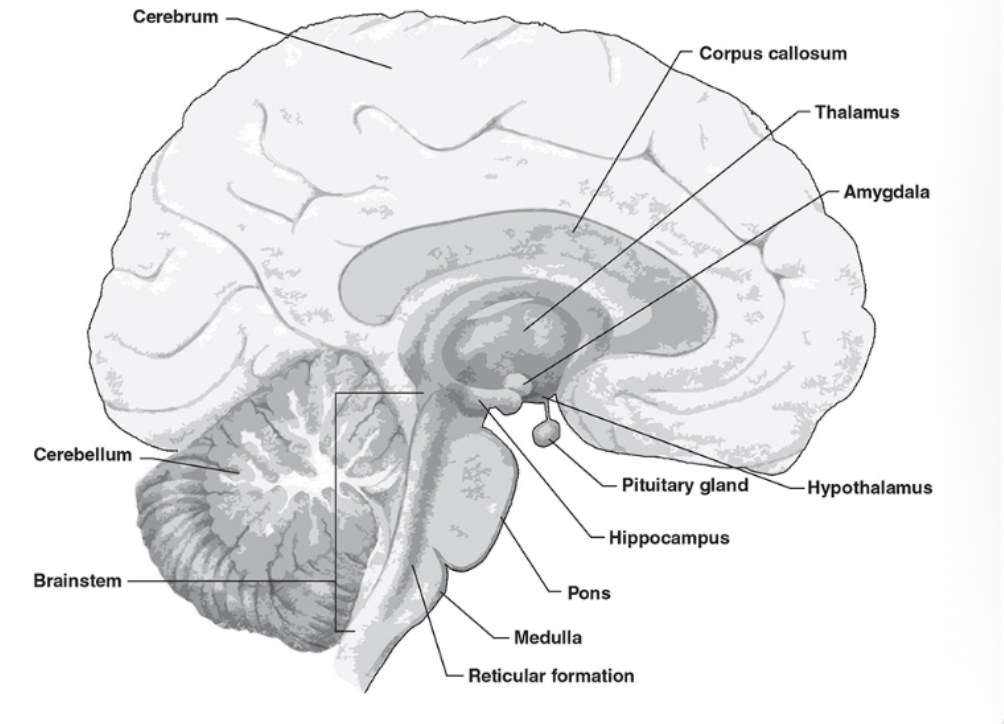
brain
study this diagram ho
medulla oblongata
a part of the brainstem that regulates vital functions such as breathing, heart rate, and blood pressure.
pons
includes portion of reticular activating system or reticular formation critical for arousal and wakefulness; sends information to and from medulla, cerebellum, and cerebral cortex
cerebellum
a part of the brain located at the back of the skull that is responsible for coordination, balance, and fine motor control.
basal ganglia
regulates initiation of movements, balance, eye movements, and posture, and functions in processing of implicit memories
thalamus
the brain's relay station, processing and transmitting sensory information to the appropriate areas of the cerebral cortex.
hypothalamus
a small region of the brain situated below the thalamus that plays a crucial role in regulating various bodily functions, including temperature, hunger, thirst, sex drive, fight-or-flight, and secretion of hormones of the pituitary
hippocampus
enables formation of new long-term memories
cerebral cortex
the outer layer of the brain that is involved in complex cognitive functions, such as perception, decision-making, processing sensory information, and directing movement
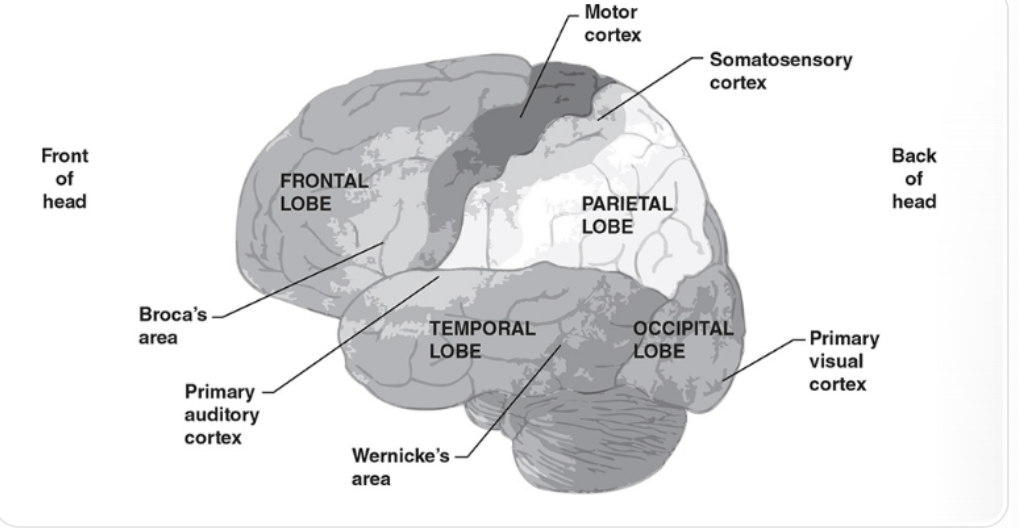
lobes and areas
frontal lobe, parietal lobe, temporal lobe, occipital lobe, motor cortex, somatosensory cortex, primary visual cortex, wernicke’s area, primary auditory cortex, Broca’s area
plasticity
if one region is damaged, the brain can reorganize to take over its function
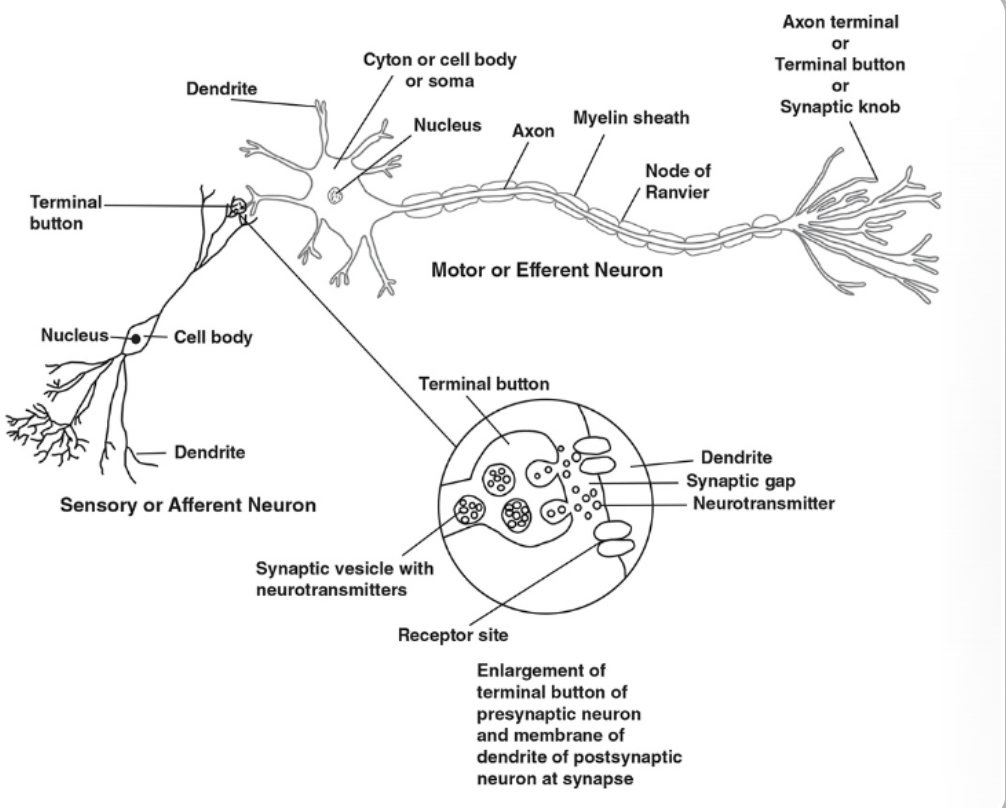
diagram of neuron
axon, myelin sheath, nucleus, soma, dendrite, terminal button, axon terminal or synaptic knob, etc.
glial cells
guide the growth of developing neurons, help provide nutrition for and get rid of wastes of neurons, and form an insulating sheath around neurons that speeds conduction
neuron
the basic unit of structure and function of your nervous system
cell body (cyton or soma)
contains cytoplasm and the nucleus, which directs synthesis of such substances as neurotransmitters
dendrites
branching tubular processes capable of receiving information
axon
emerges from the cell body as a single conducting fiber that branches and ends in tips called terminal buttons, axon terminals, or synaptic knobs; usually covered by an insulating myelin sheath
neurogenesis
the growth of new neurons
neurotransmitters
chemicals stored in structures of the terminal buttons called synaptic vesicles
dopamine
a neurotransmitter that stimulates the hypothalamus to synthesize hormones and affects alertness and movement
glutamate
the most abundant excitatory neurotransmitter in the brain, playing a key role in information processing throughout the cortex and memory formation in the hippocampus
serotonin
a neurotransmitter that contributes to mood regulation, anxiety, and happiness, playing a crucial role in the emotional state and well-being.
opioid peptides
the brain’s own painkillers; gamma-aminobutyric acid (GABA) inhibits firing of neurons
norepinephrine
also known as noradrenaline, is associated with attentiveness, sleeping, dreaming, and learning
agonists
substances that enhance the effect of neurotransmitters by binding to their receptors, mimicking their effects.
antagonists
block a receptor site, inhibiting the effect of the neurotransmitter or agonist
neuron at rest
more negative inside the cell membrane relative to outside of the membrane
resting potential
the state of a neuron when it is not actively sending a signal, characterized by a negative charge inside relative to the outside
action potential
a rapid change in potential across the membrane resulting from when a neuron is sufficient stimulated
all-or-none principle
the principle that a neuron either fires completely or does not fire at all, without partial responses.
depolarization
the process by which the membrane potential of a neuron becomes less negative and may lead to the generation of an action potential.
repolarization
the process by which the membrane potential of a neuron returns to a more negative value after depolarization, restoring the resting potential.
nodes of Ranvier
spaces between segments of myelin
saltatory conduction
when the axon is myelinated, conduction speed is increased since depolarizations jump from node to node
excitatory neurotransmitters
chemicals that promote the firing of neurons by increasing the likelihood of an action potential.
inhibitory neurotransmitters
chemicals that decrease the likelihood of an action potential by making the neuron less likely to fire.
reflex
A quick, automatic response to a sensory stimulus that occurs without conscious thought, often involving a neural pathway known as the reflex arc.
reflex arc
the pathway followed by nerve impulses in a reflex action that includes sensory input, processing in the spinal cord, and motor output.
afferent (sensory) neurons
neurons that transmit sensory information from receptors to the central nervous system for processing.
interneurons
neurons that connect sensory and motor neurons in the spinal cord and brain, facilitating communication between them.
efferent (motor) neurons
transmit impulses from your sensory or interneurons to muscle cells that contract or gland cells that secrete
effectors
muscle and gland cells that respond to motor signals
endocrine system
the system of glands that secrete hormones directly into the bloodstream to regulate various bodily functions.
endocrine glands
glands that produce and secrete hormones into the bloodstream; pineal gland, hypothalamus, pituitary gland (brain), thyroid and parathyroids (neck), adrenal glands (kidneys), pancreas (stomach), testes or ovaries
pineal gland
a small endocrine gland in the brain that secretes melatonin, which regulates sleep-wake cycles (circadian rhythm) and is associated with seasonal affective disorder
hypothalamus
portion of brain part that acts as endocrine gland and produces hormones that stimulate or inhibit secretion of hormones by the pituitary gland
pituitary gland
often referred to as the "master gland"; it controls other endocrine glands and regulates various bodily functions by secreting hormones: TSH (thyroid hormone), ACTH (adrenal gland hormone), FSH (egg or sperm production hormone), ADH (retaining water hormone), HGH (human growth hormone)
thyroid gland
endocrine gland in neck that produces thyroxin, which stimulates and maintains metabolic activities
parathyroids
small glands located behind the thyroid gland that regulate calcium levels in the blood by producing parathyroid hormone.
adrenal gland
endocrine glands above kidneys that produce hormones such as adrenaline, cortisol, and aldosterone, which regulate stress response and metabolism.
pancreas
large gland located behind the stomach that regulates blood sugar levels by producing insulin and glucagon; blood sugar levels fuels all behavioral processes
ovaries and testes
the primary reproductive organs in females and males, respectively, responsible for producing eggs and sperm, as well as sex hormones like estrogen and testosterone.
nature-nurture controversy
deals with the extent to which heredity and environment each influence behavior
evolutionary psychologists
examine how evolutionary principles, such as natural selection, influence human behavior and cognition; look at universal behaviors shared by all people
behavioral geneticists
study the influence of genetic and environmental factors on individual differences in behavior and traits.
identical twins
two individuals who share all of the same genes/heredity because they develop from the same fertilized egg or zygote; monozygotic twins
fraternal twins
two siblings who develop from two separate fertilized eggs; they share approximately 50% of their genes and are dizygotic.
heritability
is a statistical estimate that measures the proportion of variation in a trait attributable to genetic factors within a population.
gene
each DNA segment of a chromosome that determines a trait
chromosome
carry information stored in genes to new cells during reproduction; normal human body cells have 46 chromosomes except for eggs and sperm which have 23 chromosomes
Turner syndrome
a genetic disorder caused by a missing or incomplete X chromosome in females, leading to various developmental issues and physical features.
Klinefelter’s syndrome
a genetic condition affecting males characterized by an additional X chromosome (XXY), leading to physical and cognitive developmental issues; tend to be passive
Down syndrome
a genetic disorder caused by the presence of an extra 21st chromosome, resulting in developmental delays and physical characteristics.
genotype
the genetic makeup for a trait of an individual
phenotype
the expression of the genes (observable characteristics and traits)
dominant gene
a gene that expresses its effect even in the presence of a recessive allele, often masking its influence.
recessive gene
a gene that is not expressed in the phenotype unless two copies are present.
Tay-Sachs syndrome
produces progressive loss of nervous function and death in a baby
albinism
a genetic condition resulting in little or no production of the pigment melanin; also involves abnormal nerve pathways to the brain, resulting in quivering eyes and the inability to perceive depth or three-dimensionality with both eyes
phenylketonuria (PKU)
a genetic disorder that results in the inability to metabolize phenylalanine, leading to brain damage and developmental issues if untreated; infants have to be fed a special diet to manage phenylalanine levels and prevent complications.