Year 10 chem part 2
 Call Kai
 Learn
Learn Practice Test
 Spaced Repetition
 Match
Match Flashcards
 Knowt Play
1/9

There's no tags or description
Looks like no tags are added yet.
Name | Mastery | Learn | Test | Matching | Spaced | Call with Kai | Chat |
|---|
No analytics yet
Send a link to your students to track their progress
10 Terms
aim
To determine whether a sulfur precipitate will form quicker if the sodium thiosulfate’s temperature increases
hypothesis
if the temperature of the sodium thiosulfate solution increases then the time taken for the ‘x’ to be obscured by the sulfur precipitate decreases.
independent variable
the temperature of the sodium thiosulfate
dependent variable
time taken for the ‘x’ to be obscured by the sulfur precipitate
controlled variables
the volume of the flask used
the volume of sodium thiosulfate
the size of the cross drawn
Describe any patterns or trends in the graph. Refer to specific results
as the temperature increased, the time taken for the ‘x’ to disappear decreases, though seems to even out when it reaches x˚ (60)- y˚ (80) having a smaller difference of z (1s) between the temperatures compared to the x seconds (40s) between y˚ (10) and z˚ (20)
Explain, in terms of collision theory, why the rate of reaction is affected in this way when the temperature is increased.
Collision theory states that for a successful reaction to occur, there must be sufficient activation energy and a sufficient orientation of collision. Due to more kinetic energy from solutions of higher temperatures, the solutions will not only have sufficient energy for the reaction, but they will collide more frequently due to the activeness of the particles, increasing the likelyhood of them colliding with sufficient orientation
Why must the volumes of sodium thiosulfate and dilute hydrochloric acid remain constant for each part of the experiment?
the volumes of sodium thiosulfate and dilute hydrochloric acid must remain constant so that the experiment is fair and the results are accurate
If the sodium thiosulfate solution started to go cloudy before you added the acid what would the reason be for this?
left over HCL from the prior test
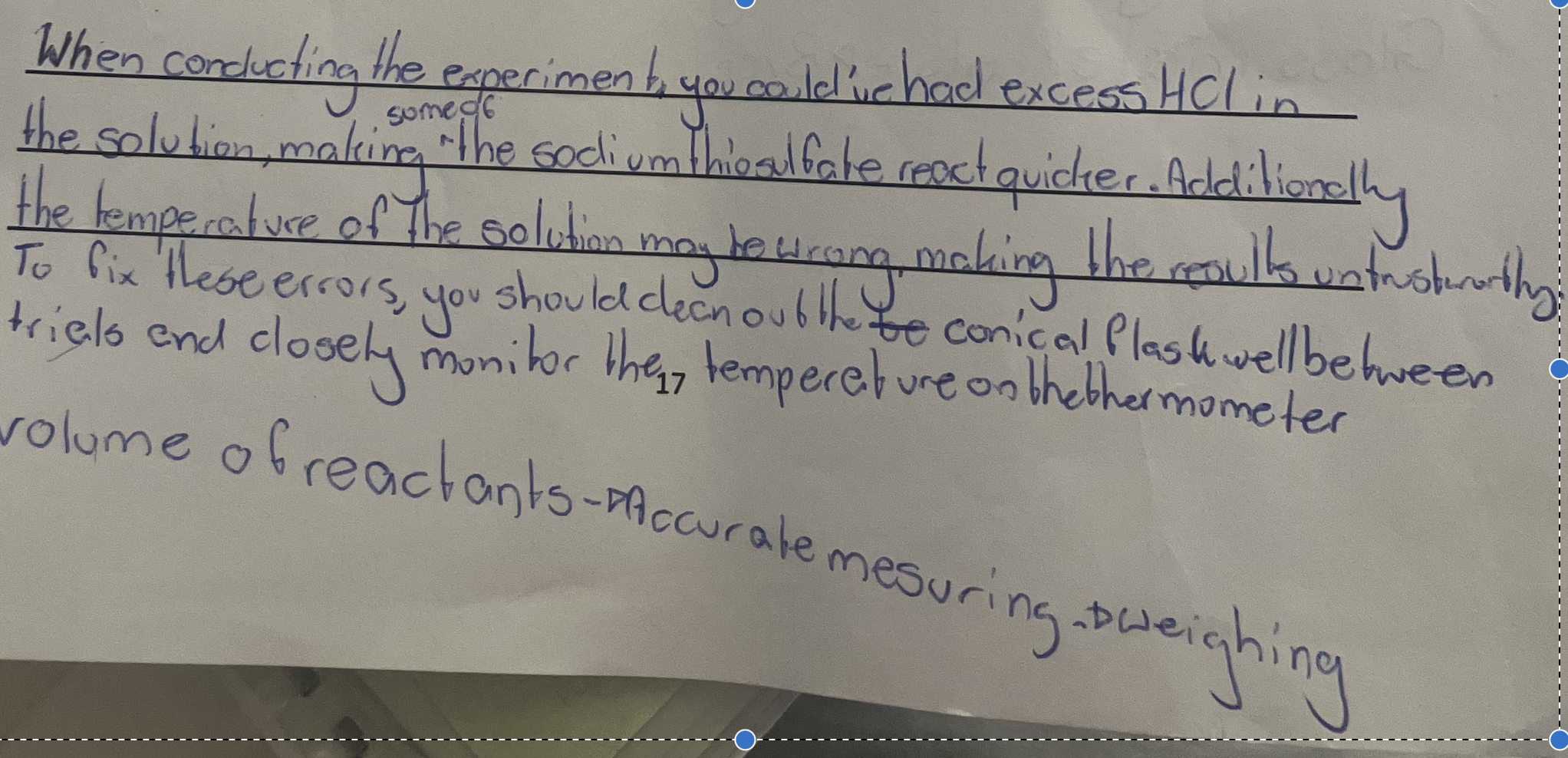
Describe any possible errors that may have occurred during the experiment and suggest improvements that could be made to the method of the experiment to produce more reliable results.