SHS 719 Exam 2: Feeding and Swallowing
 Call Kai
 Learn
Learn Practice Test
 Spaced Repetition
 Match
Match Flashcards
 Knowt Play
1/33

There's no tags or description
Looks like no tags are added yet.
Name | Mastery | Learn | Test | Matching | Spaced | Call with Kai | Chat |
|---|
No analytics yet
Send a link to your students to track their progress
34 Terms
What is Deglutition?
the act of swallowing and is just one process in the broader context of feeding
What is Feeding?
A broad term to encompass the process for getting food/liquid into the mouth
What is Dysphagia?
A swallowing deficit
What is Oral sensorimotor function?
all aspects of sensory and motor functions involving the structures in the oral cavity and pharynx related to swallowing
What is Nutrition?
The process by which all living organisms obtain the food and nourishment necessary to sustain life and support growth
What are the Risk Factors for Feeding and Swallowing Disorders?
- Birthweight and gestational age
- Neurodevelopmental factors
- Congenital Heart Disease
- Structural Anomalies
- Tracheostomy
- In Utero Constraint
Birthweight and Gestational Age
- Very Low (<1500 g) and Extremely Low (<1000 g) birth weight preterm infants are to be at much higher risk for feeding problems compared to the genreal population.
- 25% of low birth weight children are identified to have feeding problems.
This prevalence decreases to about 6% by the time they enter school.
- Birth gestation, invasive ventilation, and hypotonia at term mage are all linked to feeding problems in low birthweight babies at 2 years of age.
- 35% of surviving extremely low birthweight infants (born at 25 weeks or less) have feeding problems compared to their age-matched peers around 13%
Neurodevelopmental Factors
Cerebral Palsy is one of the major neurodevelopmental disabilities of children.
- Occurs in 2 of every 1,000 births.
- One study showed that 85% of children identified with CP had dysphagia (ages
18-36 months)
- Encephalopathy, lesions to the basal ganglia and thalamus have been closely linked to dysphagia in children.
Congenital Heart Disease
- Infants and children with CHD are more at risk for feeding and swallowing problems.
- Over 50% of children with univentricular congenital heart disease require feeding
tube placement following initial hospitalization.
- Growth failure, executive function difficulties are associated with CHD which can be further factors in feeding and swallowing difficulties.
Structural Anomalies
- Structural anomalies of the face, oral cavity or neck are at high risk for feeding and swallowing problems.
- When these are present, the clinician needs to look closely for any other coexisting health/neurodevelopmental conditions that might cause these structural anomalies.
- These could be contributors or primary etiologies for the swallowing and feeding problems.
Tracheostomy
- Tracheostomy dependence may be associated with developmental delays and feeding problems.
- 1-3% of infants in the NICU will have had a tracheostomy at some point.
- 80% of infants who had a tracheostomy presented with some form of dysphagia.
- These children are also at significantly higher risk for other neurodevelopmental
disorders and GERD.
- These children may have delays in the timing of the pharyngeal phase of their swallow.
In Utero Constraint
- Minimal fetal movement in utero can increase the risk of swallowing and feeding
problems.
- Disorders like club feet are an indication that in utero constraint was a factor in the child's gestation
Anatomical Differences to Consider:
- Overall the oral cavity is going to be smaller.
- Some children depending on age and development may have teeth.
In infants, you will see fat pads or sucking pads in the cheeks which
are very important for sucking and their lack of development or
continuation beyond developmentally appropriate age should be
considered.
- As growth and development occur, two important changes emerge:
1. the angle of the nasopharynx at the skull base becomes more
acute and approaches 90 degrees
2. The pharynx elongates so that an oropharynx is created.
Oral Cavity within an Infant
- tongue fills mouth
- edentulous
- tongue rests between lips and sits against palate
- cheeks have sucking pads (fatty tissue with buccinators)
- relatively small mandible
- sulci important in sucking
Oral Cavity within an Older Child
- mouth is larger
- dentulous
- tongue rests on floor of mouth
- tongue rests behind the teeth and is not against the palate
- buccinators are muscles for chewing only
- mandibular-maxillary relationship relatively normal
- sulci have little functional benefit
Pharynx within an Infant
-No definite/ distinct oropharynx
- obtuse angle at skull base in nasopharynx
Pharynx within an Older Child
-Elongated pharynx, so distinct oropharynx exists
- 90 degree angle at skull base
Larynx within an Infant
- One third adult size
- Half true vocal fold of cartilage
- narrow, vertical epiglottis
- high in the neck, re; cervical vertebrae
Larynx within an Older Child
- less than one-third true vocal fold of cartilage
- flat, wide epiglottis
- by 2 years of age, approximates adult position re: cervical vertebrae
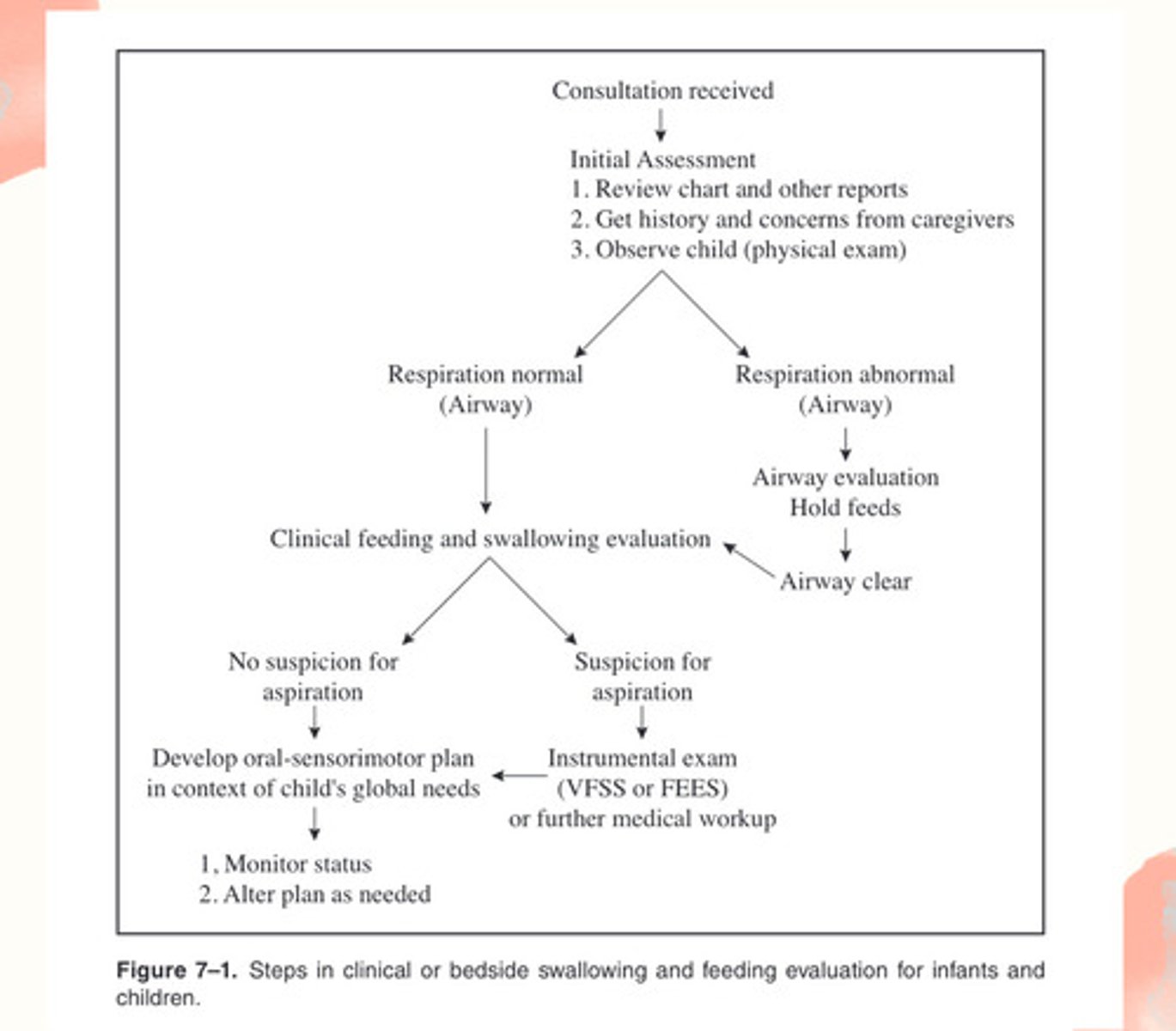
Feeding/Swallowing Evaluation Decision Tree
What is Critical Thinking?
refers to the cognitive processes for the analysis of information
derived from evidence and science rather than assumptions or conjectures
T/F: Clinicians need to judge the type and credibility of sources and recognize the
impact on behaviors
True
What is Clinical Reasoning?
refers to the application of the information to the clinical
situation for an individual patient.
T/F: Clinical reasoning requires integration of the best data and the ability to sort through a cluster of
features and accurately diagnose.
True
What are the elements of clinical reasoning?
1. Knowledge
2. skill or experience
3. context
What is Clinical Judgement?
refers to the decisions based on "knowing the patient.
T/F: Clinical Judgement may include interpretation or conclusion about patient's needs, concerns or
health problems as well as decision to take or not to take action.
True
What are the 3 types of Swallowing Functions?
1. Oral Preparatory or Bolus Formation
2. Oral Transit
3. Pharyngeal
Signs or Symptoms of Oral Preparatory or Bolus Formation
- food falls out of the mouth
- pooling in anterior sulci
- lack of tongue action to form bolus
- lack of chewing
Signs or Symptoms of Oral Transit
- pooling in lateral sulci
- food pushed out of the mouth
- slow bolus formation
- piecemeal deglutition
- delayed swallowing
Signs or Symptoms of Pharyngeal
- pooling in valleculae and pyriform sinuses
- residue in pharyngeal recesses after swallow
- gurgly voice quality
- aspiration on liquids, safe for thicker textures
- aspiration on paste, safe with liquids
- choking on mixed textures in the same bite
- swallow delayed a few seconds for best texture
- aspiration for all textures (frequent)
Possible Treatment Options for Oral Preparatory or Bolus Formation
- posture and seating
- sensory aspects of food
- lip closure
- rotary tongue and jaw action
Possible Treatment Options for Oral Transit
- lip closure and buccal tension
- tongue exercises to to reduce thrusting
- tongue manipulation
- lateral tongue action and rotary jaw action
- initiate tongue action quickly
Possible Treatment Options for Pharyngeal
- posture and seating; improve timing of swallow production
- multiple swallows per bite; alternate textures
- improve vocal fold closure with voice therapy
- change utensils (e.g. after nipple flow rate, try spoon for discrete boluses) or thicken liquids
- Make food thinner texture
- make each bite of a consistent texture; alternate per bite
- nonoral feedings
- nonoral feeding; oral stimulation without food expect for tastes