Equip Unit 1-Week 1, Math & Rad Concepts
 Call Kai
 Learn
Learn Practice Test
 Spaced Repetition
 Match
Match Flashcards
 Knowt Play
1/85

Earn XP
Description and Tags
Chapters 1 & 2
Name | Mastery | Learn | Test | Matching | Spaced | Call with Kai | Chat |
|---|
No analytics yet
Send a link to your students to track their progress
86 Terms
What happens when projectile electrons hit the anode?
They produce x-rays.
What are the two main interactions of x-rays in radiography?
Tissue and with the image receptor (IR).
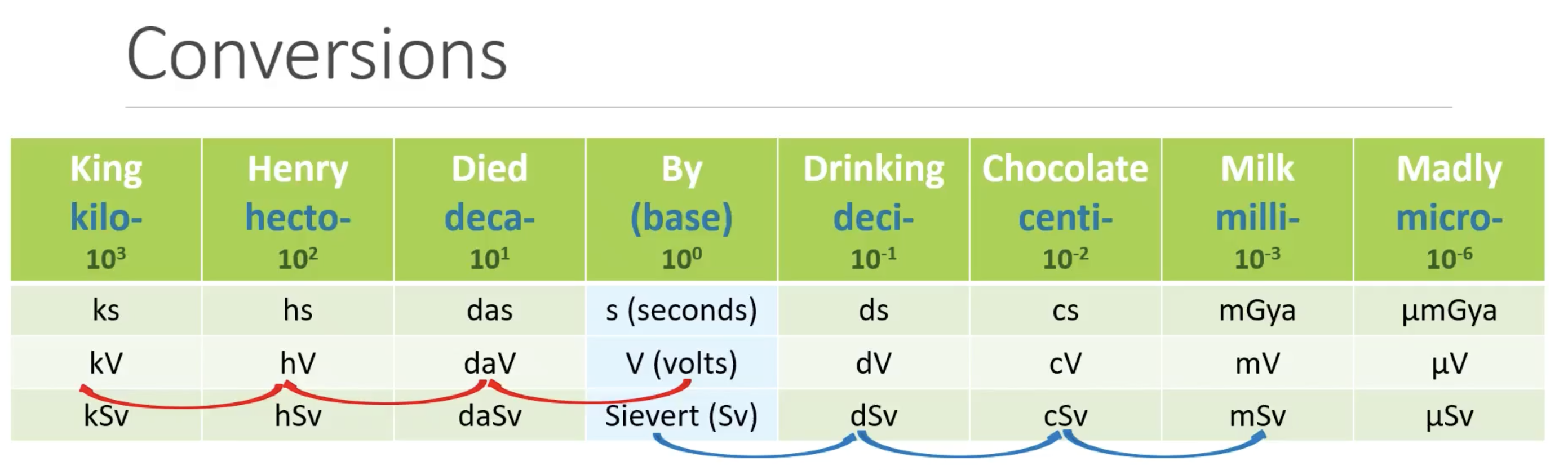
King Henry Died By Drinking Chocolate Milk Madly
What does King, Milk and Madly stand for?
King=kilo
Milk=milli
Madly=micro
What is the significance of SI units in radiology?
They provide a standardized system of measurement for radiation and other quantities.
What is the SI unit for mass?
Kilogram (kg).
What is the SI unit for length?
Meter (m).
What is the SI unit for time?
Second (s).
What is the SI unit for exposure?
Gray (Gya) “grays in air”
What is the SI unit for absorbed dose?
Gray (Gyt) “grays in tissue”
What is the SI unit for effective dose?
Sievert (Sv)
How does a positive exponent affect a number in the decimal system?
It indicates multiplication, moving the decimal point to the right.
How does a negative exponent affect a number in the decimal system?
It indicates division, moving the decimal point to the left.
What is the conversion for 120,000 V in kV?
120 kV (by moving the decimal left 3 places).
What is the conversion for .3568 Sv in mSv?
356.8 mSv (by moving the decimal right 3 places).
200 mA is equal to _____ amperes
2
20
.002
0.20
25,000 V is equal to _____ kV
25,000,000
2.5
25
0.025
What are the two branches of science relevant to radiography?
Physical science (xray production) and biological science (human anatomy).
What is the definition of a substance?
A material that has a definite and constant composition.
What is a mixture?
When two or more substances are combined.
What is matter?
Substance that comprises all physical objects, having shape, form, and occupying space.
What is mass?
The quantity of matter contained in an object, also known as weight.
What is the unit of mass?
Kilogram (kg) or 1,000 grams.
What is an element?
A substance that cannot be broken down into simpler substances by ordinary means.
What is an atom?
The smallest particle of an element that still possesses the chemical properties of that element.
When 2 or more atoms are chemically united, they form a _____?
molecule
How are substances determined to be a gas, solid, or liquid?
Degree of attraction between atoms or molecules
What is atomic theory?
A theory that states that all matter is composed of tiny particles called atoms.
What is a molecule?
The smallest particle of a compound that still possesses the characteristics of the compound, formed when two or more atoms are chemically united.
What is energy defined as?
The ability to do work. (joule=j)
What is the unit of energy?
Joule (J).
What is radiation?
The emission and transfer of energy (heat, light, x-rays) through matter.
What does Einstein's Law of Conservation state?
all matter and energy in the universe is constant; they cannot be created or destroyed, only converted from one form to another.
What are the three basic subatomic particles of an atom?
Protons (positive charge), neutrons (neutral charge), and electrons (negative charge).
What is the nucleus of an atom?
The small, dense center of the atom containing protons and neutrons.
What is the atomic number (Z)?
The number of nuclear protons in an atom
What happens when an atom loses or gains a proton?
It becomes a different element.
Isotope
Atoms of the same element with different numbers of neutrons
What is ionization?
The process of adding or removing an electron from an atom, resulting in an ion.
What is the unit of radiation dose?
Millisievert (mSv).
What is the average natural radiation dose per person in the U.S.?
3 mSv/year.
Chest xray approximate effective radiation dose
0.1 mSv =10 days background
Writing technique
kVp @ mAs
EX. (Skull = 85@8)
What is the speed of light?
186,400 miles per second
What components make up exposure factors?
mA
time (seconds)
kVp
True of False: the common SI unit of mass in radiology is cubic centimeters
False
(correct answer is kilograms)
What is the atomic mass number?
The sum of protons and neutrons in the nucleus.
What is the mass number of a proton and neutron? (not the sum of both)
1
What is the mass number of an electron?
0
What is the binding energy of an electron?
The amount of energy needed to remove the electron from the atom.
List each shell in order of strongest to weakest binding energy?
K shell
L shell
M shell
N shell
The closer an electron is to the ______, the more tightly it is bound and the ____ energy is required to remove it.
Nucleus, More
What happens to binding energy as the number of electrons and protons increases?
Binding energy increases.
What is the relationship between distance from the nucleus and binding energy?
Binding energy of an electron decreases as the distance from the nucleus increases.
What are valence electrons?
Electrons in the outermost shell of an atom.
What type of energy is the ability to do work?
Energy.
What is mechanical energy?
Energy that includes potential and kinetic energy.
What is potential energy?
Stored energy due to an object's position.
What happens to potential energy when a bus rolls down a hill?
It is converted to kinetic energy.
What is chemical energy?
Energy released during a chemical reaction.
What is thermal energy?
Energy resulting from the motion of atoms and molecules.
What is nuclear energy?
Tremendous energy stored in the nucleus of an atom that holds nuclear particles in a tight bond
What is electromagnetic energy?
result of electric and magnetic disturbances in space
What types of electromagnetic radiation are capable of ionization?
Ultraviolet, x-ray, and gamma radiations.
Under what conditions can electromagnetic radiation behave as a wave or a particle?
Under certain circumstances, such as with x-rays.
Wavelength
distance between any two successive points of a wave
Amplitude
intensity of the wave defined by its maximal height
Frequency
number of waves that pass a particular point in a given time frame, or the number of cycles per second
Period
time required to complete one cycle of the wave
What is the formula for the wave equation relating velocity, frequency, and wavelength?
Velocity (C) = frequency (v) x wavelength (λ)
What happens to wavelength when frequency increases?
Wavelength decreases; they are inversely proportional.
What is the relationship between energy, frequency, and wavelength?
Energy increases with frequency and decreases with wavelength.
What is a photon?
A small bundle of energy or a discrete quantum of electromagnetic energy.
How does the energy of a photon relate to its frequency?
Photon energy and frequency are directly proportional.
Who discovered X-rays and when?
Wilhelm Röntgen discovered X-rays on November 8, 1895.
What unusual phenomenon did Röntgen observe during his experiments?
He noticed that a material outside a covered cathode tube glowed, indicating the presence of unknown rays.
What significant image did Röntgen create during his experiments?
He created a flickering skeletal hand image when his hand was between the X-rays and the screen.
What was the title of Röntgen's original paper on X-rays?
The paper was titled 'On a New Kind of Rays.'
What happens to X-rays when they pass through matter?
They can ionize matter and produce chemical and biological changes.
Are X-rays affected by electric or magnetic fields?
No, X-rays are electrically neutral
What is the relationship between the frequency of X-rays and their energy?
If the frequency of an X-ray is doubled, the energy is also doubled.
What is the effect of X-rays on photographic film?
Causes them to darken.
What is the significance of the term 'polyenergetic' in relation to X-rays?
It refers to X-rays being produced over a wide variety of energies and wavelengths.
What is the consequence of X-rays producing secondary and scatter radiation?
It can lead to additional exposure and effects on surrounding matter.
X-ray properties identified by Roentgen
Highly penetrating, invisible form of electromagnetic radiation
Electrically neutral (not affected by electric or magnetic fields)
Polyenergetic and heterogeneous (wide variety of energies, unpredictable)
Release small amounts of heat (pt doesn’t feel anything)
Travel in straight lines (linear fashion & dissapear)
Travel at the speed of light (186,400 miles/second)
Can ionize matter (mess with electrons)
Can cause certain crystals to glow (fluorescence)
Cannot be focused by a lens (do what they want)
Affect photographic film (bc he was originally practicing photography)
Produce chemical and biological changes in matter through ionization
Produce scatter radiation (why we protect ourselves)
True of False: x-rays are focused by a lens and projected down to the patient
False
Which of the following are properties of x-ray? select all that apply
are electrically neutral and therefore, not affected by electric or magnetic fields
can be produced over a wide variety of energies and wavelengths
travel at the speed of sound
cannot ionize matter