2.1.2 structure of prokaryotic cells and viruses
 Call Kai
 Learn
Learn Practice Test
 Spaced Repetition
 Match
Match Flashcards
 Knowt Play
1/13

There's no tags or description
Looks like no tags are added yet.
Name | Mastery | Learn | Test | Matching | Spaced | Call with Kai |
|---|
No analytics yet
Send a link to your students to track their progress
14 Terms
What are the distinguishing feature of prokaryotic cells
cytoplasm doesn’t contain membrane bound organelles
So genetic material is not enclosed in a nucleus
Describe the general structure of prokaryotic cells (always present)
cell surface membrane
Cell wall: contains murein (glycoprotein)
Cytoplasm
Small ribosomes
Circular DNA: free in cytoplasm, not associated with proteins
Describe the structure of prokaryotic cells (sometimes present)
capsule
Plasmids (small rings of DNA)
Flagella
Eukaryotic or prokaryotic: membrane bound organelles vs no membrane bound organelles
eukaryotic = membrane bound organelles
Prokaryotic = no membrane bound organelles
Eukaryotic or prokaryotic: No nucleus vs nucleus
Eukaryotic = has nucleus
Prokaryotic = no nucleus, DNA is free in cytoplasm
Eukaryotic or prokaryotic: DNA is long+linear+associated with histones vs DNA is short+circular+not associated with histones
Eukaryotic = DNA is long, linear and associated with histones
Prokaryotic = DNA is short, circular and not associated with histones
Eukaryotic or prokaryotic: Larger 80s ribosomes, smaller 70s ribosomes
Eukaryotic = larger 80s ribosomes
Prokaryotic = smaller 70s ribosomes
Eukaryotic or prokaryotic: Cell wall in all cells, contains murein (glycoproteins) vs cell wall only in plant cells, contains cellulose or chitin
Eukaryotic = cell wall only in plant cells, contains cellulose or chitin
Prokaryotic = cell wall in all cells, contains murein (a glycoprotein)
Eukaryotic or prokaryotic: Plasmids/ capsule never present (sometimes flagella) vs plasmids, flagella and a capsule sometime present
Eukaryotic = plasmids/ capsule never present (sometimes flagella)
Prokaryotic = plasmids, flagella and a capsule sometimes present
Eukaryotic or prokaryotic: smaller overall size vs larger overall size
Eukaryotic = larger overall size
Prokaryotic = smaller overall size
Why are viruses described as acellular
As they are not made of cells, no membrane/ cytoplasm/ organelles
Why are viruses described as non-living
As they have no metabolism, so cannot independently move/ respire/ replicated/ excrete
Draw the structure of a virus particle
.
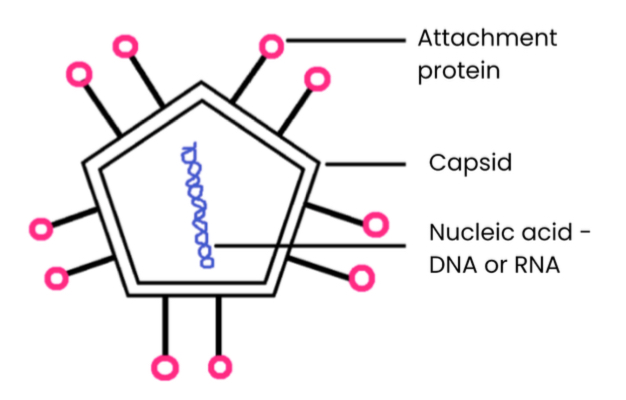
Describe the general structure of a virus particle
Nucleic acids surrounded by a capsid (protein coat)
Attachment proteins allow attachment to specific host cells
No cytoplasm, ribosomes, cell wall or cell surface membrane
Some also surrounded by a lipid envelope (e.g HIV)