PR2155 IC5 med chem (reactive metabolite.)
0.0(0)
Studied by 1 person Call Kai
 Learn
Learn Practice Test
 Spaced Repetition
 Match
Match Flashcards
 Knowt Play
Card Sorting
1/29

Earn XP
Description and Tags
Last updated 5:04 PM on 2/2/23
Name | Mastery | Learn | Test | Matching | Spaced | Call with Kai | Chat |
|---|
No analytics yet
Send a link to your students to track their progress
30 Terms
1
New cards
What are some types of RM?
1. Reactive metabolite funcitonal groups (specific ones)
2. electrophiles (C centred or hetero)
3. radicals (C centred or hetero)
2
New cards
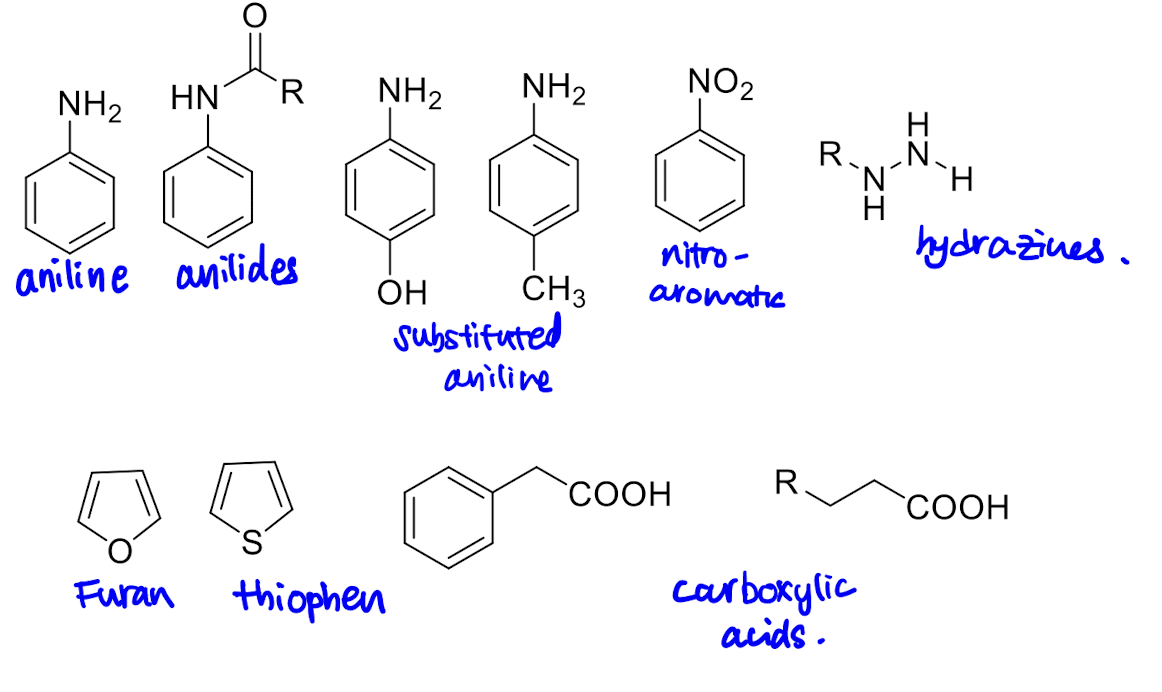
What are the functional groups that are mostly related with RM"?
3
New cards
How do RM cause harm?
1. Inhibit metabolising enzymes (P450) via irreversible metabolism based inhibition
2. Induce adverse drug reaction (hapten formation, immune activation)
3. React with DNA (forming adduct, mutagen)
4
New cards
How do we make RM harmless?
1. Electrophile
1. Glutathione (GSH)
2. Epoxides
1. H2O
2. GSH
3. Induction of protective enzyme
1. NQO1
5
New cards
what are some of the processes that can form RM?
1. P450 oxidation reaction (Phase I)
2. Glucoronidation (Phase II)
1. glucoronosyl transferase
3. Heme peroxidase using H2O2 for oxidation
4. Sulfation (phase II)
1. sulfotransferase
5. Reduction (Phase I)
1. Reductase
6
New cards
Where is P450 ususally found in the liver?
Smooth ER
7
New cards
What are the three components of the P450?
1. P450
1. contains the binding site
2. not specific, can bind to most things lipophilic
2. Cytochrome P450 Reductase (CPR)
3. Membrane matrix
8
New cards
Are oxy ferryl species electron deficient or electron rich?
electron deficient
The O is electron deficient, it is then transferred to the substrate to leave the active site.
The O is electron deficient, it is then transferred to the substrate to leave the active site.
9
New cards
What do P450 need in order to carry out oxidation?
Oxygen
NADPH
NADPH
10
New cards
How will P450 oxidation process possibly generate RM?
1. Reduction
1. the substrate if very reducible, may be reduced instead of the oxygen
2. Radical formation
1. since the reduction occurs as single electron transfers
3. Oxygen rebound
1. potentially resulting in electrophilic metabolite. O2\* might leave.
11
New cards
What are the substrates that P450 can transfer the activated O to?
1. Sp3 carbons
2. sp2 carbons in alkene
3. sp2 carbons in aromatic rings
4. carbon-heteroatom oxidation
12
New cards
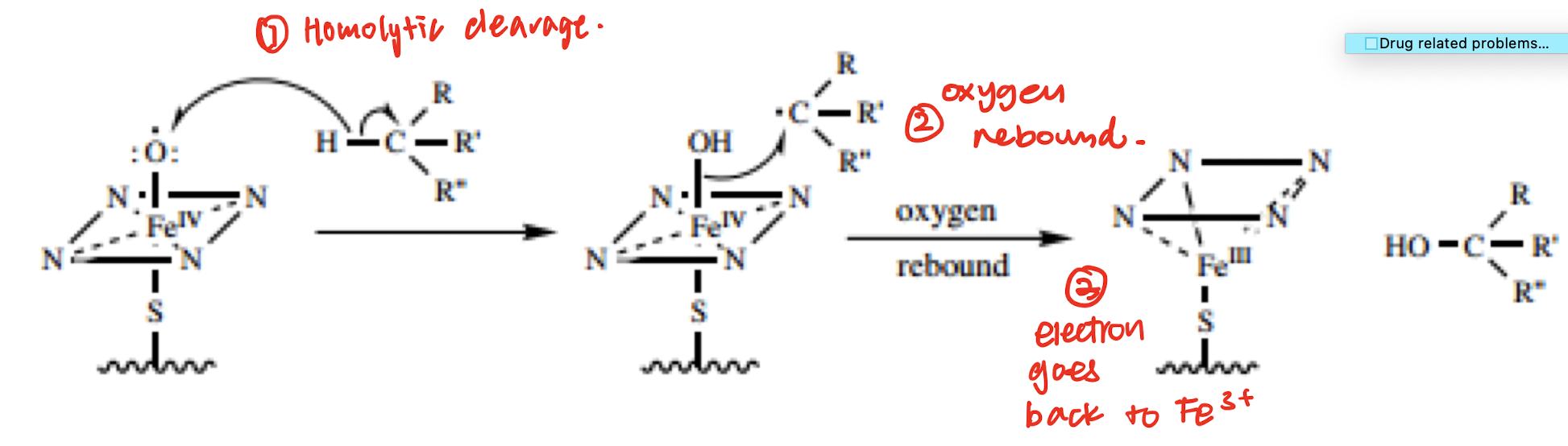
What happens during the hydroxylation of sp3 carbon by P450?
Carbon radical is formed
carbon radical stability affects how likely it is formed
carbon radical stability affects how likely it is formed
13
New cards
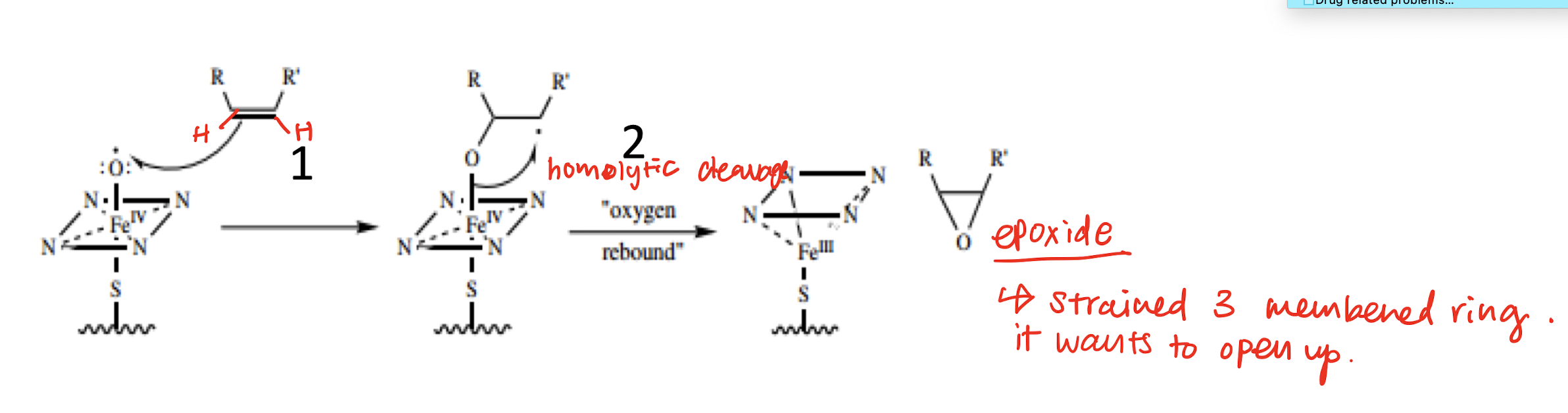
What happens during the hydroxylation of sp2 carbon alkene by P450?
Radical addition to the pi bond in the alkene C=C bonds
oxygen rebound occurs and epoxide is formed.
epoxide ring opens and forms an electrophilic carbon
oxygen rebound occurs and epoxide is formed.
epoxide ring opens and forms an electrophilic carbon
14
New cards
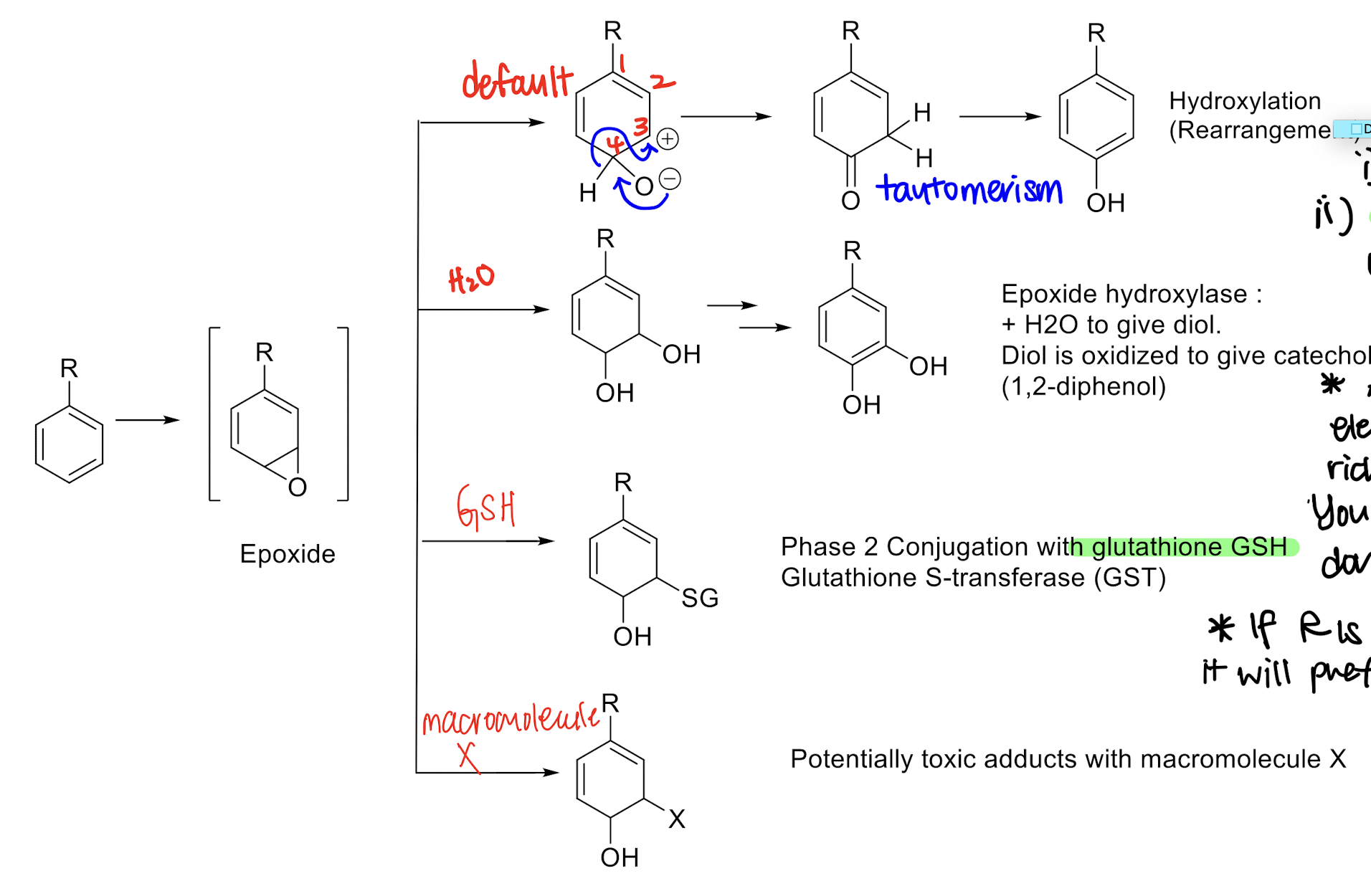
what are the fates of epoxide from alkene?
1. spontaneous reaction with H2O to form diol
2. reaction with GSH
3. forming adducts with macromolecules (bad)
15
New cards
What are the fates of epoxide from aromatic rings?
1. spontaneous reaction with water to form diol
2. GSH
3. forming adducts
16
New cards
What determines the position of the hydroxylation in aromatic ring?
The R group.
If R group is electron donating, it will prefer to go to para
If R group is electron donating, it will prefer to go to para
17
New cards
What determines the rate of the hydroxylation in the aromatic ring?
The R group.
The attacking group is looking for electron rich carbon centre. You want the R group to be electron donating to increase the rate.
The attacking group is looking for electron rich carbon centre. You want the R group to be electron donating to increase the rate.
18
New cards
What are the reactions P450 has on carbon-heteroatoms?
oxidations
1. oxidation of heteroatoms
2. Dealkylation of the side chain attached to heteroatom
1. oxidation of heteroatoms
2. Dealkylation of the side chain attached to heteroatom
19
New cards
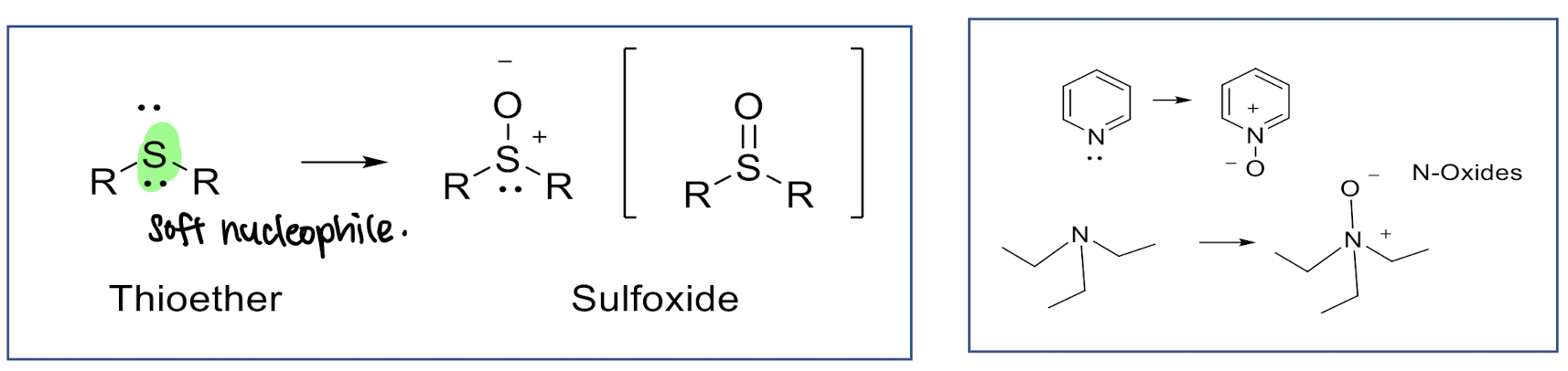
What happens in the P450 oxidation of heteroatoms?
Heteroatom has to be soft nucleophile for the reaction to occur
\
O cannot, it is a hard nucleophile
\
O cannot, it is a hard nucleophile
20
New cards
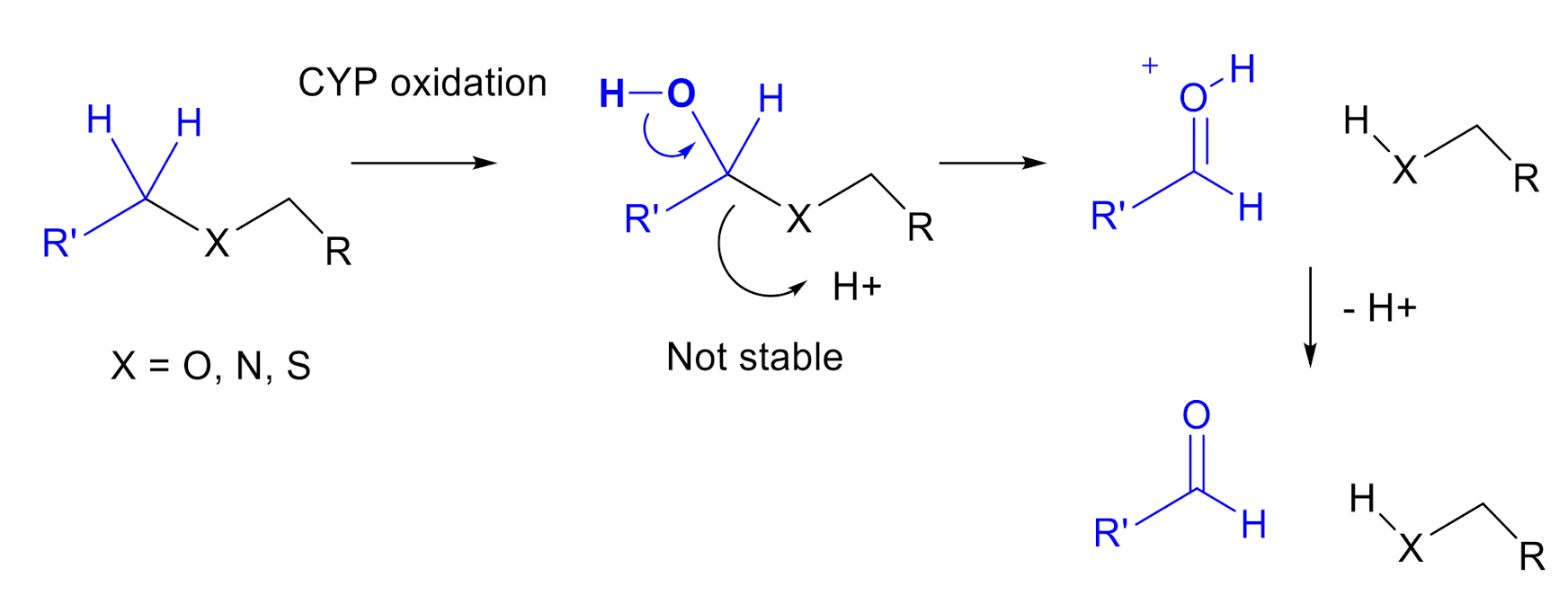
What happens during the dealkylation of side-chains
21
New cards
Dealkylation of ethers.
Hemiacetal is formed and is broken down into alcohol and aldehyde
22
New cards
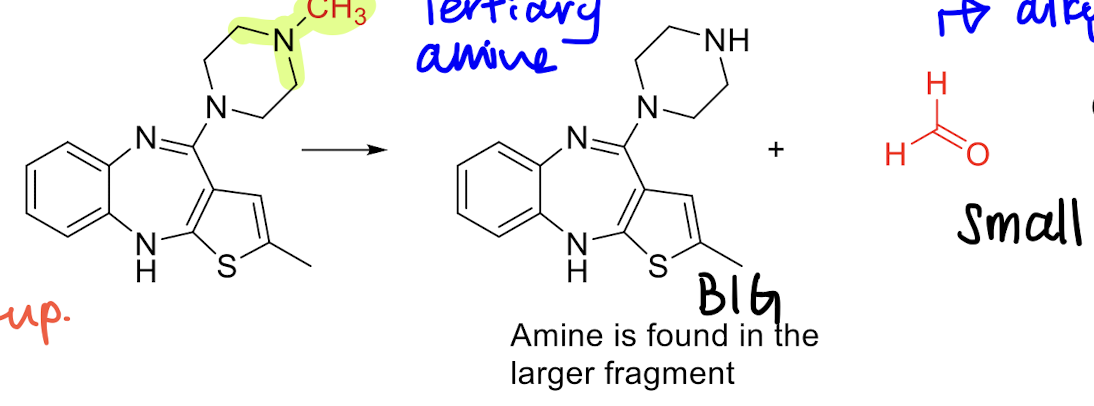
oxidative N-Dealkylation
product: aldehyde + amine
generally second or thrid degree amines
Amine: Big
Aldehyde: small
generally second or thrid degree amines
Amine: Big
Aldehyde: small
23
New cards
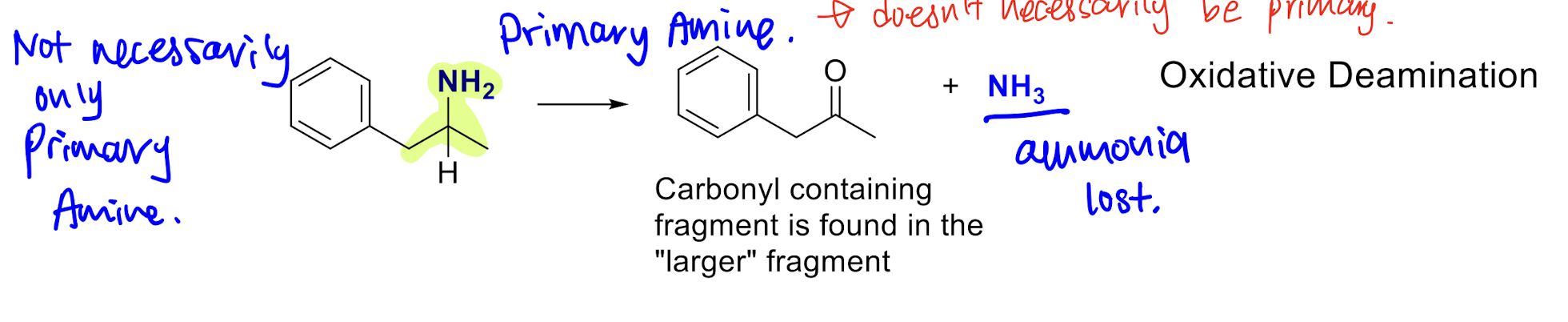
Oxidative deamination
Product: small amine + big aldehyde/carbonyl
usually primary, but not necessarily
\
usually primary, but not necessarily
\
24
New cards
What are the functional groups that can undergo glucoronidation?
COOH
OH
NH2
SH
OH
NH2
SH
25
New cards
Comment on the stability of glucoronides.
Acyl glucoronides formed from COOH is unstable
* susceptible to hydrolysis
Ether glucoronides formed from phenolic OH is stable
* susceptible to hydrolysis
Ether glucoronides formed from phenolic OH is stable
26
New cards
what kind of reaction does formation of glucuronides involve?
Sn2 reactions
\
\
27
New cards
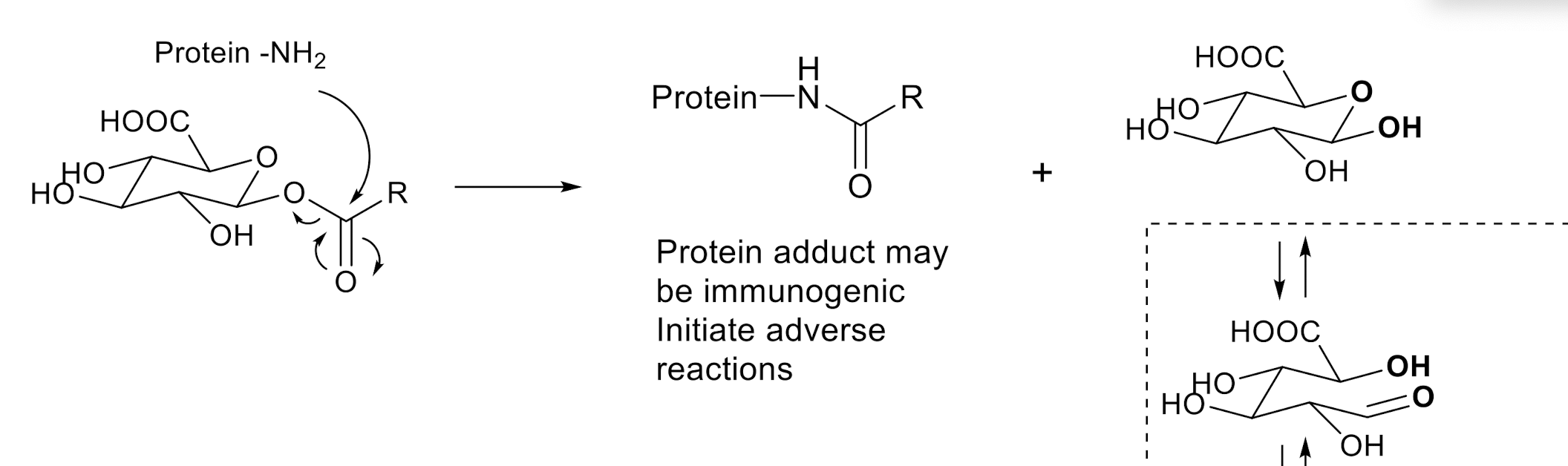
What are the fates of O-acyl-glucuronides?
1. Hydrolysis
2. Intramolecular rearrangement
3. transacylation
28
New cards
Which enzyme hydrolyses O-acyl-glucoronides?
Carboxyesterases (CES)
Beta glucoronidases
\
Acyl glucoronides MW>500 undergo enterohepatic cycling
Beta glucoronidases
\
Acyl glucoronides MW>500 undergo enterohepatic cycling
29
New cards
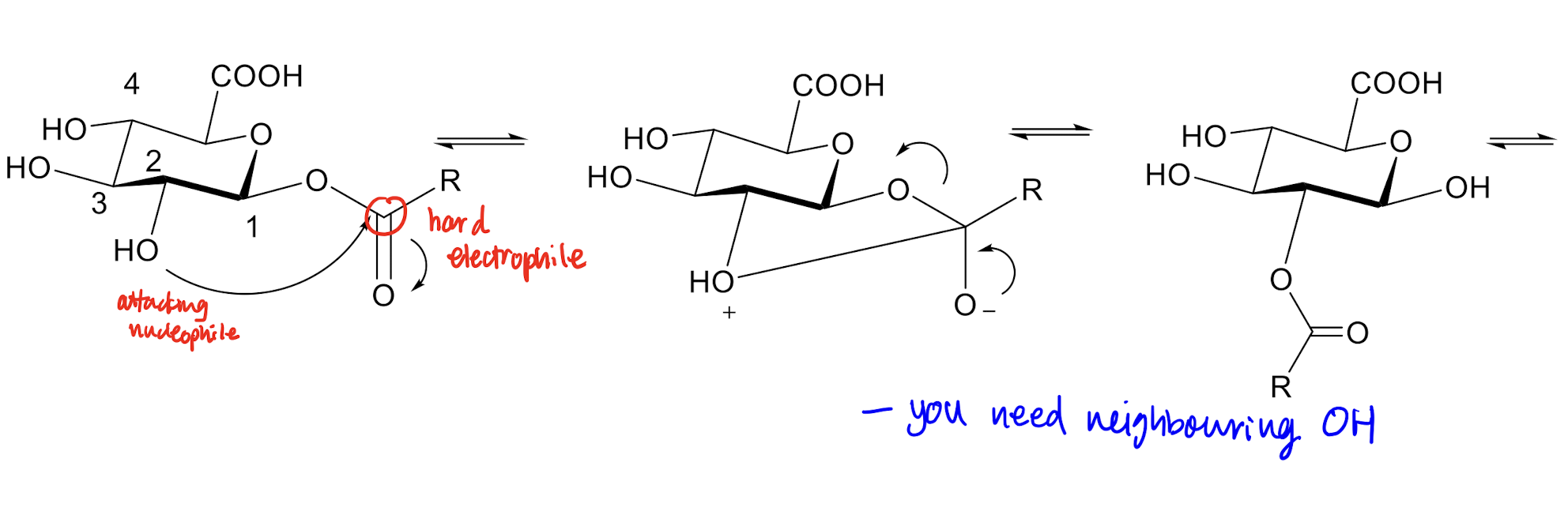
What is the mechanism behind the intramolecular rearrangement?
Nucleophilic OH attacks the electrophilic carbonyl C in ester
30
New cards
What happens in transacylation?
Acyl group is transferred to an incoming nucleophile
lysine NH2
Cysteine SH
Serine OH
lysine NH2
Cysteine SH
Serine OH