Bio 1107 Chapter 3 Adaptive quizzing
 Call Kai
 Learn
Learn Practice Test
 Spaced Repetition
 Match
Match Flashcards
 Knowt Play
1/29

There's no tags or description
Looks like no tags are added yet.
Name | Mastery | Learn | Test | Matching | Spaced | Call with Kai | Chat |
|---|
No analytics yet
Send a link to your students to track their progress
30 Terms
The genetic material of a prokaryotic cell is located in its:
nucleoid

Which lettered part of the space-filling molecular model in the figure represents the hydrophilic portion? Click to view full size.
Y : this is the polar, water-soluble portion of the molecule. it contains the charged phosphate group (represented by the bright yellow/orange spheres) and the choline head group (labeled v). because it is polar, it interacts favorably with water.
The term homeostasis refers to:
the active maintenance of a constant environment within the cell.
What is glycosylation?
the addition of sugars to lipids or proteins
Where are the light-capturing pigments located in a chloroplast?
thylakoid membrane
Which one of the answer choices is most closely genetically/molecularly related to Archaea?
eukaryotes
Which part of a cholesterol molecule is polar?
the OH group: The Hydroxyl (-OH) group attached to the first ring is polar and interactive with water.
How is a carrier protein different from a channel protein?
Carrier proteins undergo conformational change so that they are open alternately to one side of the membrane or the other.
A proton pump is needed in the lysosomal membrane because:
all of these are correct.
the interior of the lysosome needs to be acidic.
Protons are being moved from low to high concentration.
Protons cannot move across a membrane on their own.
Mitochondria and chloroplasts both have inner and outer membranes.
True: They are double-membraned organelles involved in energy production.
Researchers seldom find prokaryotic cells that are greater than 100 micrometers in diameter. Why would the size of prokaryotic cells be restricted?
Prokaryotic cells must absorb all of their nutrients from their environment and therefore require a high surface area to volume ratio.
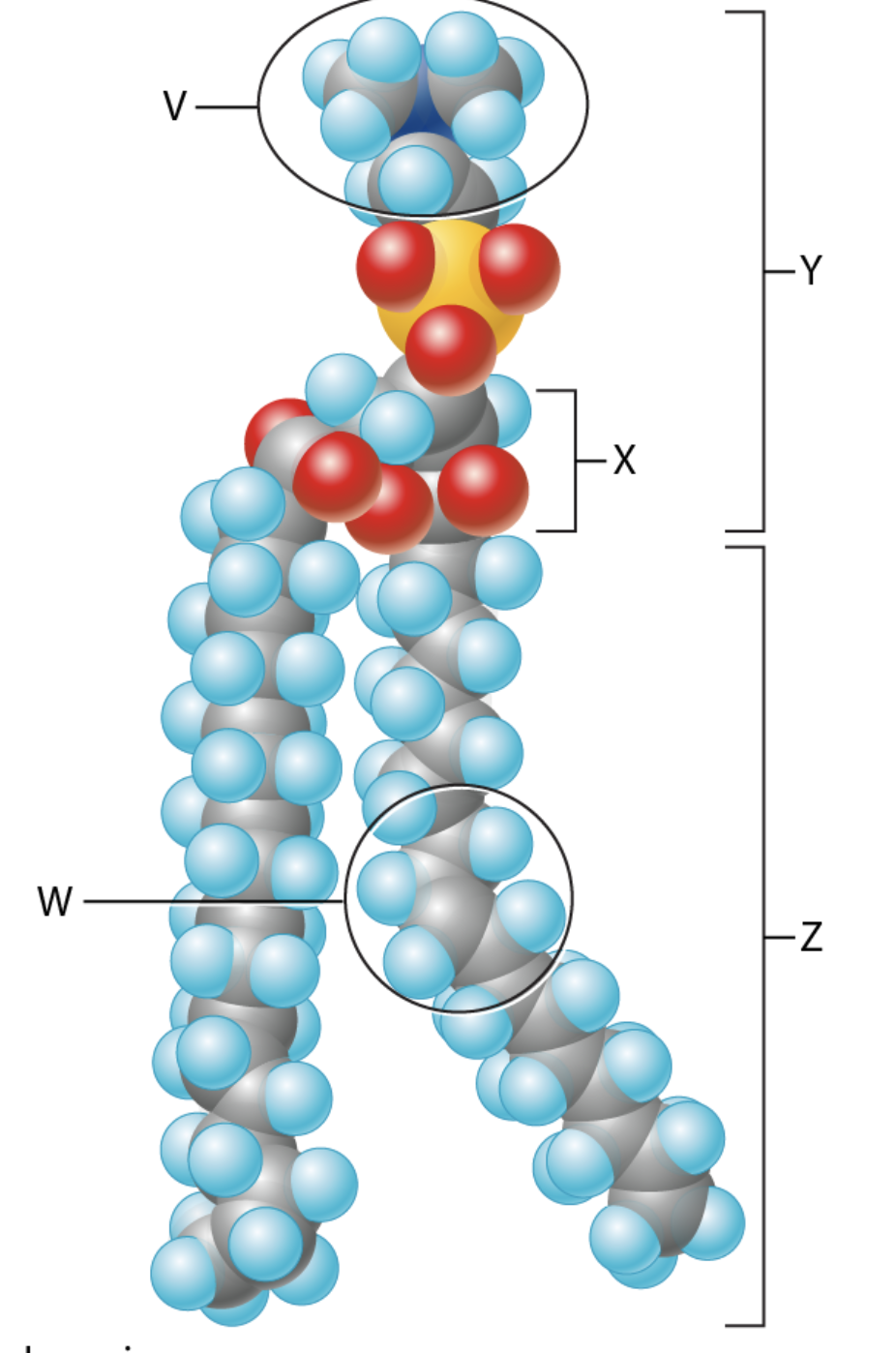
The circled region labeled "W" in the figure is the site of a(n) _____ that results in _____ flexibility or fluidity of a biological membrane. Click to view full size.
double bond; increased
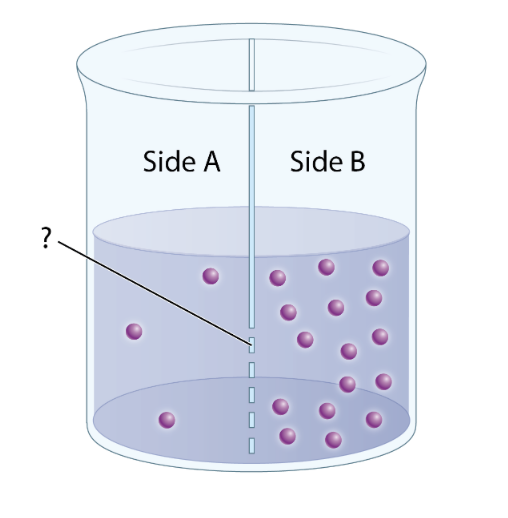
In the system depicted in the figure, the membrane is permeable to water but not to the solute. Based on this and on what you see in the figure, which statement is correct?
This image represents the starting conditions.
Imagine that you have two blades of grass. One is from a normal plant, and the other is from a mutant plant that cannot absorb water into its vacuoles. How will the structures of these two blades of grass compare?
The grass blade from the mutant plant will appear limp compared to that from the normal plant.
Mitochondria use a simple sugar called pyruvate and ADP when they function. What do mitochondria produce from those substrates?
ATP and Carbon Dioxide
Prokaryotes absorb their nutrients from the environment. However, many prokaryotes have cell walls. What can you conclude from this information?
Cell walls are permeable, allowing nutrients to pass through.
Slime molds are studied by biologists because of their ability to change from a diffused state, where individual parts are separated, to a unified slimy mass of protoplasm that forms fruiting bodies that produce spores. According to cell theory, what must be true of slime molds?
The diffused state occurs when slime mold cells separate, and the protoplasm stage occurs when slime mold cells cluster together to form spores.
During osmosis, water moves down its own concentration gradient. How is it possible to reduce the concentration of a solvent?
When more solutes are dissolved in solvents, the concentration of the solute increases, but per unit volume, the concentration of the solvent decreases
All of the answer choices are properties of at least some prokaryotic cells except:
the presence of a nucleus.
Enzymes present in the lumen of the Golgi apparatus are responsible for modifying proteins and lipids. Where must these proteins have been before they entered the Golgi apparatus?
in the rough endoplasmic reticulum

Based on the two-step model of glucose transport, what would happen if the supply of ATP was depleted from the cell?
The sodium-potassium pump would make less of a sodium gradient, so less glucose could be transported across the membrane.

Which statement is true regarding chloroplasts?
Chloroplasts utilize carbon dioxide as a reactant.
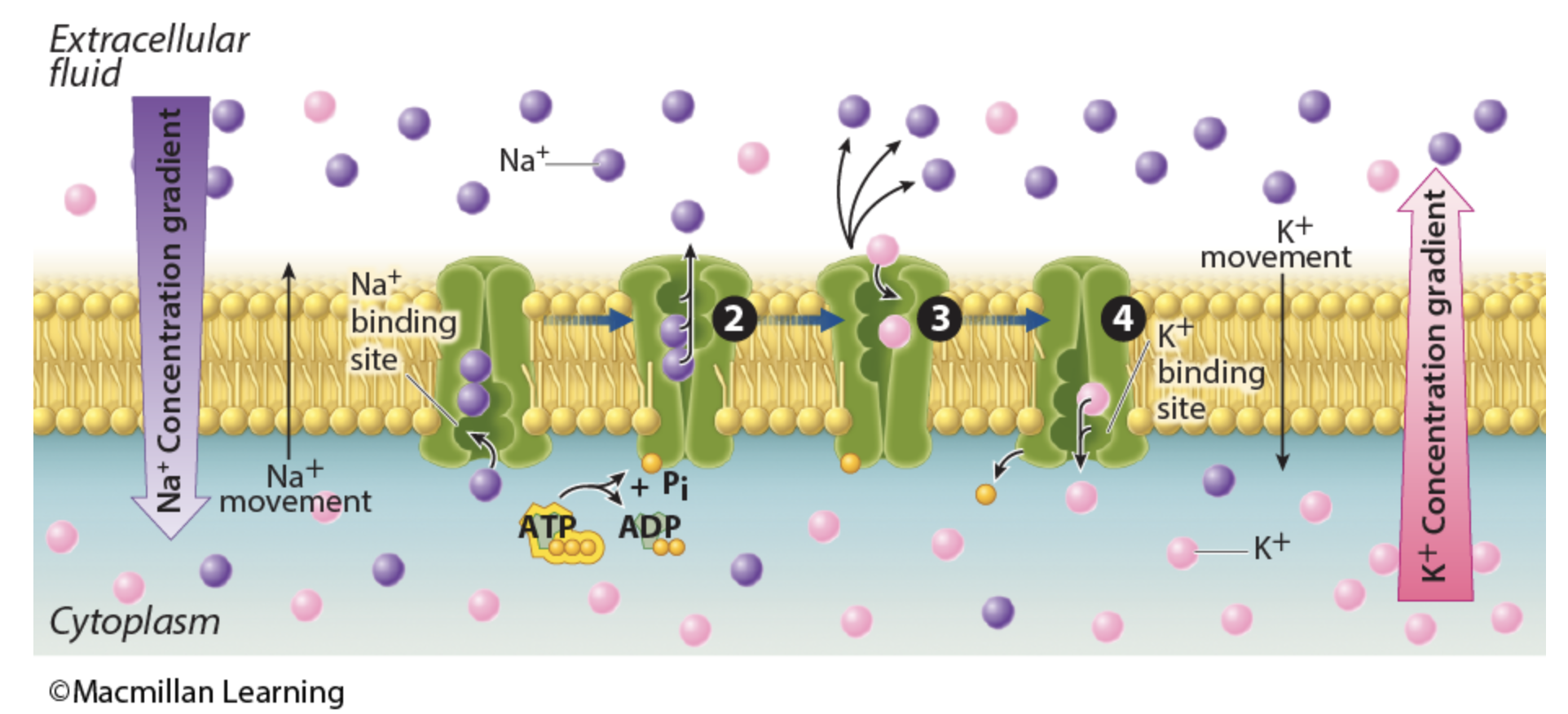
In the kidney, glucose transport across the cell membrane is the result of a combination of two steps of active transport. Refer to the figures shown. The first step involves a primary active transport system performed by the sodium-potassium pump. It uses the energy from ATP hydrolysis to move sodium ions out of the cell and potassium ions into the cell. The second step involves a secondary active transport symporter that uses the energy in the sodium gradient created by the first step. This second step moves glucose, as well as sodium ions that move down their concentration gradient, into the cell. Based on the two-step model of glucose transport, what would happen if the rate of function of the sodium-potassium pump increased?
The sodium-potassium pump would make a stronger sodium gradient, so more glucose could be transported across the membrane.


In the system depicted in the figure, the structure labeled "?" is permeable to water but not to the solute. Based on this and on what you see in the figure, and the assumption that some time will be allowed to pass, which of the following predictions would you make?
The solution level on side A would go down, and that on side B would go up.
Some broad-spectrum proteases (protein hydrolyzing enzymes) and nucleases (nucleic acid hydrolyzing enzymes) that function in eukaryotic cells have an optimum pH close to 5.0, whereas the cytosol of most cells is closer to pH 7.0. Which part of a eukaryotic cell might you predict to have a low pH suited to maximizing the activity of these enzymes?
lysosome

Complete the following sentence from the choices provided: The portion of the molecule labeled "Z" in the space-filling model in the figure is composed of blue _____ atoms linked to gray _____ atoms by covalent bonds that are _____, which results in this part of the molecule being _____. Click to view full size.
hydrogen; carbon; nonpolar; hydrophobic
In which eukaryotic organelle would you expect to find high levels of the enzymes capable of breaking down proteins and nucleic acids?
lysosome
Turgor pressure is the result of:
water accumulation in a cell with a rigid cell wall.

The molecule shown in the figure was synthesized to test some ideas about the early origins of life. What idea could be tested, in part, by mixing this substance into an aqueous (watery) environment and observing the outcome? Click to view full size.
spontaneous assembly of pre-biological lipid structures into membrane structures
How do eukaryotic plant and animal cells differ from one another?
Animal cells do not have chloroplasts and cell walls, and plant cells do.
Eukaryotic plant cells contain chloroplasts and a cell wall, while animal cells do not; instead, animal cells have centrioles and lysosomes.