Chapter 6
 View linked note
 Call Kai
 Learn
Learn Practice Test
 Spaced Repetition
 Match
Match Flashcards
 Knowt Play
1/51

Earn XP
Description and Tags
Chapter 6 in exam 1 for microbiology
Name | Mastery | Learn | Test | Matching | Spaced | Call with Kai | Chat |
|---|
No analytics yet
Send a link to your students to track their progress
52 Terms
Psychrophiles
Microbes that thrive in cold environments.
Mesophiles
Microbes that prefer moderate temperature ranges for growth.
Thermophiles
Microbes that grow best at high temperatures.
Minimum growth temperature
The lowest temperature at which a species can grow.
Optimum growth temperature
The temperature at which a species grows best.
Maximum growth temperature
The highest temperature at which growth is possible.
pH range for bacteria
Most bacteria grow best at a pH between 6.5 and 7.5.
Plasmolysis
The process where microbes lose water in a hypertonic solution.
Halophiles
Microbes that can tolerate high salt concentrations.
Chemoheterotrophs
Organisms that use organic molecules as a carbon source.
Autotrophs
Organisms that typically use carbon dioxide as a carbon source.
Nitrogen
An essential element for protein and nucleic acid synthesis.
Obligate aerobes
Organisms that require oxygen for growth.
Facultative anaerobes
Organisms that can grow with or without oxygen.
Obligate anaerobes
Organisms that cannot grow in the presence of oxygen.
Aerotolerant anaerobes
Organisms that do not require oxygen but can tolerate it.
Microaerophiles
Organisms that require low levels of oxygen for growth.
Superoxide dismutase
An enzyme required by aerobes and some anaerobes to detoxify superoxide radicals.
Biofilms
Communities of microbes that adhere to surfaces and can cause infections.
Chemically defined medium
A culture medium with a known exact chemical composition.
Complex medium
A culture medium with a variable chemical composition.
Reducing media
Media that chemically remove molecular oxygen to support anaerobic growth.
Anaerobic jar
A device used to create an oxygen-free environment for culturing anaerobes.
Enrichment culture
A culture technique used to promote the growth of a specific microorganism in a mixed culture.
Colony
A visible mass of microbial cells that originated from a single cell.
Streak plate method
A technique used to isolate pure cultures by spreading a sample across a solid medium.
Deep-freezing
A method of preserving microorganisms by storing them at very low temperatures.
Lyophilization
A preservation method that involves freeze-drying microorganisms.
Binary fission
The normal reproductive method of bacteria where one cell divides into two identical cells.
Generation time
The time required for a cell to divide or for a population to double.
Lag phase
The initial phase of microbial growth with little change in cell number but high metabolic activity.
Log phase
The phase of rapid bacterial multiplication.
Stationary phase
The phase where cell division and death rates are equal.
Death phase
The phase where the number of deaths exceeds the number of new cells formed.
Heterotrophic plate count
A method to estimate the number of viable microbes based on colony formation.
Spectrophotometer
An instrument used to measure the turbidity of a microbial suspension.
Classify microbes into five groups on the basis of preferred temperature range
high temp - hyperthermophiles (65-110)
Thermophiles (40-72)
Mesophiles (10-50)
Psychrotrophs (0-20)
low temp-Psychrophiles (-10-20)
identify how and why the pH of culture media is controlled
most bacteria grow between pH 6.5 and 7.5
Mold and yeasts grow between pH 5 and 6
Acidophiles grow in acidic environments
explain the importance of osmotic pressure to microbial growth
hypertonic environments cause plasmolysis due to high osmotic pressure
Extreme or obligate halophiles require high osmotic pressure (high salt)
Facultative halophiles tolerate osmotic pressure
Name a use for each of the four elements (carbon, nitrogen, sulfur, and phosphorus) needed in large amounts for microbial growth
carbon- structural backbone of organic molecules
Nitrogen- components of proteins, DNA, and ATP
Sulfur- Used in amino acids, thiamine, and biotin
Phosphorus- used in DNA, RNA, and ATP
Anaerobes
unable to use oxygen and most are harmed by it
Desribe the formation of biofilms and their potential for causing infection
microbes adhere to surfaces and accumulate as biofilms on sild surfaces in contact with water
most bacteria live in biofilms
microbes in biofilms are more resistant to antibiotics than are free-swimming microbes
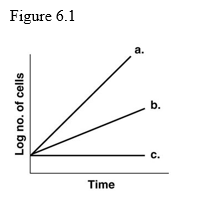
In Figure 6.1, which line best depicts an obligate anaerobe in the presence of O2?
c
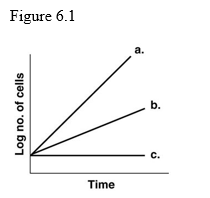
In Figure 6.1, which line shows the growth of an obligate aerobe incubated anaerobically
c
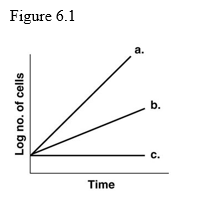
In Figure 6.1, which line best illustrates the growth of a facultative anaerobe incubated aerobically?
a
The addition of which of the following to a culture medium will neutralize acids?
heat
sugars
buffers
pH
carbons
buffers
Salts and sugars work to preserve foods by creating a
hypotonic environment
hypertonic environment
depletion of nutrients
lower pH
hypertonic enviroment
The term aerotolerant anaerobe refers to an organisms that
is killed by oxygen
tolerates normal atmospheric nitrogen gas levels
requires less oxygen than is present in air
does not use oxygen but tolerates it
requires more oxygen than is present in air
does not use oxygen but tolerates it
Most bacteria reproduce by
mitosis
budding
aerial hyphae
binary fission
fragmentation
binary fission
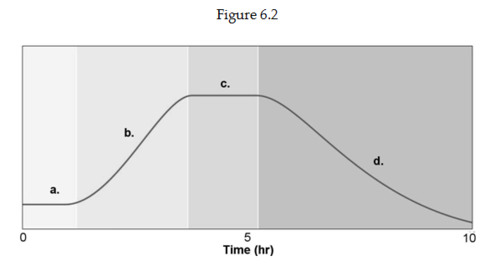
Figure 6.2 shows a typical bacterial growth curve with the y-axis indicating the lod of the number of bacteria and the x-axis indicating time in culture. Which letter represents a growth phase where the number of cells dying equals the number of cells dividing?
c
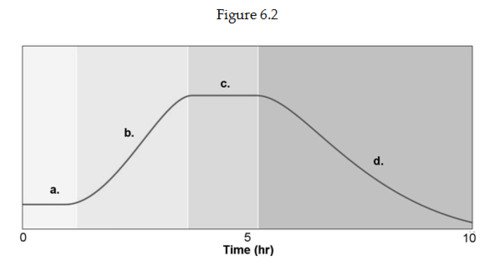
Which letters of the graph illustrate a logarithmic change in cell numbers?
b and d
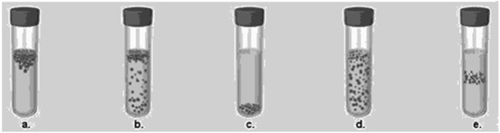
In figure 6.3, which tube shows the expected growth patterns for a microaerophile?
e