Pulm PE
 Call Kai
 Learn
Learn Practice Test
 Spaced Repetition
 Match
Match Flashcards
 Knowt Play
1/175

There's no tags or description
Looks like no tags are added yet.
Name | Mastery | Learn | Test | Matching | Spaced | Call with Kai | Chat |
|---|
No analytics yet
Send a link to your students to track their progress
176 Terms
The number of the intercostal space between two ribs is the same as the rib (above/below) it
above
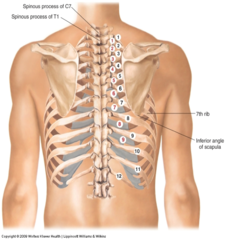
When flexed forward, prominent spinous process is C__?
7
The inferior tip of the scapula is the (#)th rib/intercostal space
7
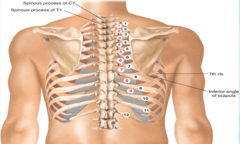
The apex of the lung runs (above/below) the clavicle
above
Which intercostal space is for needle insertion for decompression of tension pneumothorax?
2nd
Which intercostal space is for chest tube insertion?
4th
Which rib is the lower margin of a well-placed ET tube on CXR?
4th
Which rib is the superior aspect as a landmark for thoracentesis?
8th
Neurovascular structures run along the ____ margin of each rib so needles and tubes should be places just at the ____ rib margins.
inferior;superior
If an ET was placed incorrectly, which lung is it most likely to inflate: left, right, both, neither
right

Inspiration: Intrapulmonary pressure (</>) atmospheric pressure
<
What accessory muscles are involved with (deep) breathing?
SCM, pec minor, scalene, serratus, traps
Expiration: Intrapulmonary pressure (</>) atmospheric pressure
>
Pulmonary arteries carry oxygen (poor/rich) blood
poor
Pulmonary veins carry oxygen (poor/rich) blood
rich
Define ventilation
exchange of air between environment and lungs; includes inspiration and expiration
Define perfusion
Delivery of blood to pulmonary capillaries
Define Diffusion
Gas exchange between alveoli and pulmonary capillaries
What controls breathing: O2 or CO2?
CO2
Which dermatomes mostly cover the neck?
C3-8

Which dermatomes mostly cover the chest?
T1-12
Which dermatome is at nipple level?
T4
Which dermatome is at the belly button?
T10
Define apnea
lack of spontaneous breathing
define dyspnea
difficulty breathing/SOB; requires detailed questioning, cause may be heart/lung disease or other reason
define orthopnea
SOB with lying down, # of pillows required to breath comfortably during sleep
define PND
sudden SOB while sleeping
define platypnea
dyspnea improves with lying down
define cyanosis
bluish discoloration caused by decreased oxygenation
define stridor
audible high pitched whistling - upper airway obstruction
what conditions can cause a dry cough?
GERD, irritant, post viral infection, ILD
what conditions can cause a productive cough?
pneumonia, asthma, bronchitis, PND syndrome, sinusitis
The MCC of a cough is a _____
viral URI
conditions that can cause an acute cough
bronchitis, pneumonia, CHF, asthma, foreign body, smoking, ACE-inhibitor
conditions that can cause a subacute cough
post-infections, pertussis, acid reflux, asthma
conditions that can cause a chronic cough
postnasal drip, asthma, GERD, chronic bronchitis, bronchiectasis
Alarm sx of a cough
hemoptysis, fever + purulent sputum production, wheezing + SOB, chest pain, excessive chronic sputum production, unintentional weight loss, dyspnea, lower extremity weakness
Alarm sx! Cough with hemoptysis can indicate:
lung cancer, TB, PE, pneumonia
Alarm sx! Cough with fever + purulent sputum production can indicate:
pneumonia, lung abscess
Alarm sx! Cough with wheezing and SOB can indicate:
asthma, COPD exacerbation, heart failure
Alarm sx! Cough with chest pain can indicate:
PE, ACS
Alarm sx! Cough with excessive chronic sputum production can indicate:
bronchiectasis, lung abscess, lung cancer
Alarm sx! Cough with unintentional weight loss can indicate:
lung cancer, TB, lung abscess
Alarm sx! Cough with dyspnea, lower extremity edema can indicate:
CHF, PE
Alarm sx of dyspnea
pleuritic CP, lip swelling, hives, wheezing, substernal CP, pink frothy sputum, fever, signs of serious infection/shock, dysphagia, ascending weakness, generalized weakness
CHLORIDE PPAT for hemoptysis is similar to cough, but must add on questions about the ____
blood
Alarm sx for hemoptysis
Quantity: massive (> 1 cup in 24h), submassive (
What are some important personal and social history factors that can lead to pulmonary conditions?
tobacco use, alcohol, drug use, travel, hobbies, employment, home environment, exercise tolerance
in older adults, the chest wall becomes _____
stiffer
in older adults, respiratory muscles _____
weaken
in older adults, gas exchange ability ____
declines
in older adults, coughing is (more/less) effective, increasing risk of pneumonia and atelectasis
less
What can cause tactile fremitus to decrease?
excess air in lungs (effusion or pneumothorax), increase thickness of chest wall
What can cause tactile fremitus to increase?
lung consolidation (air replaced with exudate, blood, pus, etc.)
How would you describe a normal lung sound?
resonant
What conditions would you feel a hyper-resonant lung?
hyperinflated lung, COPD, pneumothorax
What conditions would you feel a dull/flat lung?
fluid filled space: large pleural effusion, pneumonia, solid organ, muscle (solids)
what conditions would you feel tympany?
large pneumothorax, normal stomach (air filled)
vesicular, bronchovesicular, bronchial, tracheal are all (normal/abnormal) breath sounds
normal
Vesicular breath sounds
low pitch, heard over most lungs. Soft and short expiration
bronchovesicular breath sounds
medium pitch, heard over main bronchus area. Inspiration = Expiration
bronchial breath sounds
high pitched, loud/harsh and long expirations
tracheal breath sounds
loud, harsh; heard only over trachea
crackles (rales), rhonchi, wheeze, stridor, friction rub are all (normal/abnormal) breath sounds
abnormal
Crackles (rales)
discontinuous, discrete sounds, most often heard during inspiration, caused by disrupted airflow in smaller airways -- NOT usually cleared by cough

Rhonchi
deeper, rumbling, sounds like "snore" caused by obstruction/secretion in larger airways. Often clears with cough
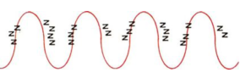
Wheeze
High pitched, continuous, caused by high velocity airflow through narrowed/obstructed airways

stridor
high pitched, piercing, most often heard during inspiration (often from tracheal obstruction)

friction rub
grating, sandpaper-like, machine-like; inspiration and expiration from roughened surfaces

What is the difference between a cardiac and pleural friction rub?
You can still hear a cardiac friction rub if the patient holds their breath
Cheyne-Stokes breathing
periods of deep breathing alternating with periods of apnea (no breathing)

Ataxic Breathing (Biot's Breathing)
Irregular breathing -- alternating periods of apnea and regular deep breaths

Sighing Respiration
Breathing punctuated by frequent sighs - suggests hyperventilation syndrome—a common cause of dyspnea and dizziness. Occasional sighs are normal
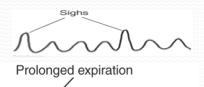
Obstructive breathing
expiration is prolonged because of narrowed airways

What are transmitted voice sounds useful for?
hearing areas of consolidation
If consolidation is present doing egophony, "e" will sound like
a
If consolidation is present doing whispered pectoriloquy, "123" will sound
louder
If consolidation is present doing bronchophony, "99" will sound
louder
what conditions might you find barrel chest in?
arthritis, COPD, asthma
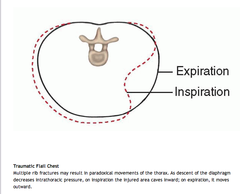
Flair chest can indicate
multiple rib fractures
subjective asthma sx
PND, nocturnal sx, chest pain/tightness, may last minutes-days
When inspecting asthma, you may find:
tachypnea, nasal flaring, retractions
When palpating asthma, you may find:
tachycardia, diminished fremitus
When percussing asthma, you may find:
occasional hyperresonance, occasional limited diaphragmatic descent
When auscultating asthma, you may find:
prolong expiration, wheezes, possible crackles, diminished lung sounds
subjective acute bronchitis sx
cough, fever, CP -- burning retrosternal discomfort
When inspecting acute bronchitis, you may find:
occasional tachypnea; often normal
When palpating acute bronchitis, you may find:
tactile fremitus unchanged
When percussing acute bronchitis, you may find:
resonance
When auscultating acute bronchitis, you may find:
occasionally prolonged breath sounds, crackles, expiratory wheezes, and rhonchi
prominent COPD sx
cough, chronic excessive sputum, dyspnea
When inspecting emphysema, you may find:
tachypnea, deep breathing, pursed lips, barrel chest, thin, underweight, tripod, clubbing
When palpating emphysema, you may find:
decrease fremitus and decreased chest expansion
When percussing emphysema, you may find:
hyperresonance
When auscultating emphysema, you may find:
decreased breath sounds, prolonged expiration, wheezing
When inspecting chronic bronchitis, you may find:
cyanosis, clubbing, JVP in advance disease
When palpating chronic bronchitis, you may find:
normal/ decreased fremitus, normal/decreased chest expansion
When percussing chronic bronchitis, you may find:
resonant
When auscultating chronic bronchitis, you may find:
decreased breath sounds, prolonged expiration, diffuse rhonchi, crackles and wheezing due to bronchospasm
When inspecting bronchiectasis, you may find:
tachypnea, clubbing, resp distress