To prepare ethyne and examine its properties
 Call Kai
 Learn
Learn Practice Test
 Spaced Repetition
 Match
Match Flashcards
 Knowt Play
1/20

There's no tags or description
Looks like no tags are added yet.
21 Terms
Theory
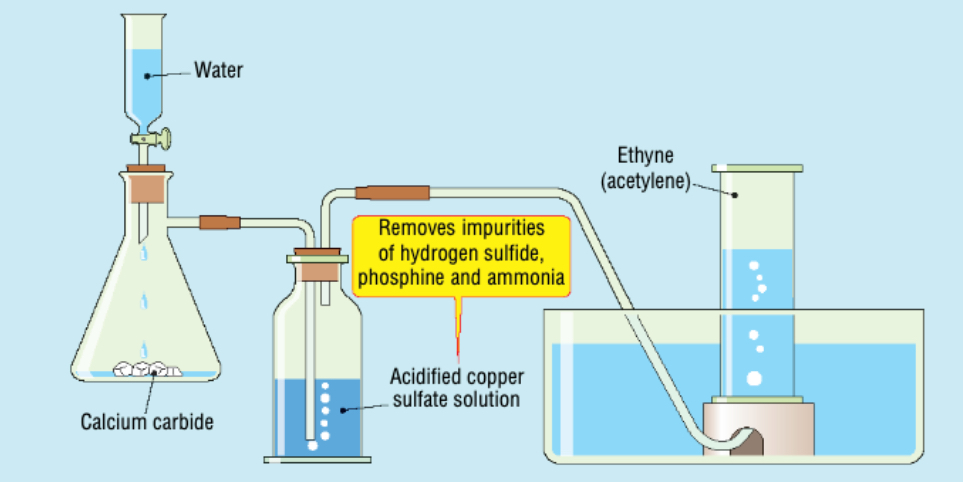
Ethyne is prepared by reacting calcium carbide (CaC2) with water
Equation
CaC2 + 2H2O → Ca(OH)2 + C2H2
Procedure
1. Place calcium carbide in a bunker flask and attach a delivery tube to it.
2. Ensure acidified copper sulfate container is in between the calcium carbide and water trough.
3. Acidified copper sulfate captures the impurities (hydrogen sulfide, ammonia and phosphine) as ethyne is bubbled through it.
4. Calcium carbide forms bubbles (ethyne) when water reacts with it. The solution goes white because of calcium hydroxide forming.
5. Fill several test tubes of ethyne. The first test tube will contain air and can be disposed of.
6. Test ethyne test tubes to examine properties.
Physical properties
• Ethyne is a colourless gas with a sweet smell
• It is insoluble in water but dissolves in non-polar solvents Example: Cyclohexane
Combustion
Procedure:
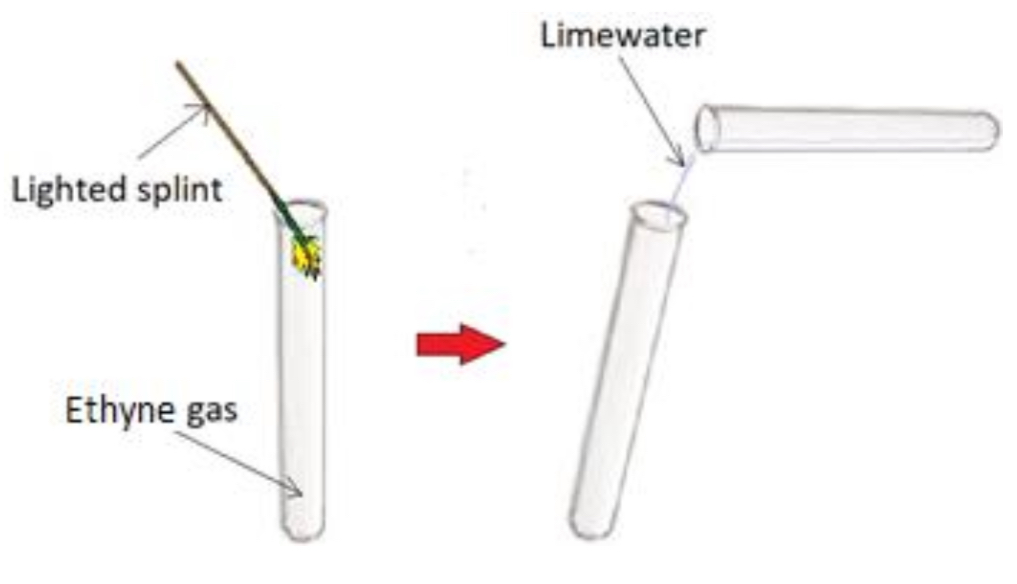
- Place a lighted splint into a test tube of ethyne gas
- Add limewater to the test tube, stopper and shake
Result:
- Ethyne burns with a very bright, very smoky yellow flame, with a lot of soot formed as a result of unburnt carbon
- Limewater turns milky white proving carbon dioxide was formed in the combustion
Compare the flame observed when combusting ethene and ethyne
The flame observed when burning ethyne is brighter and smokier than when burning ethene
How does the flame used in oxyacetylene welding, where ethyne is burned in pure oxygen, differ from the flame observed when ethyne was burned in air in a combustion test?
In pure oxygen: flame is hotter, cleaner (no smoke)
Combustion test: burns with a very bright yellow smoky flame
Write a balanced chemical equation for the complete combustion of ethyne?
2C2H2 + 5O2 → 4CO2 + 2H2O
Testing for unsaturation – Method 1: Using bromine water
Procedure:
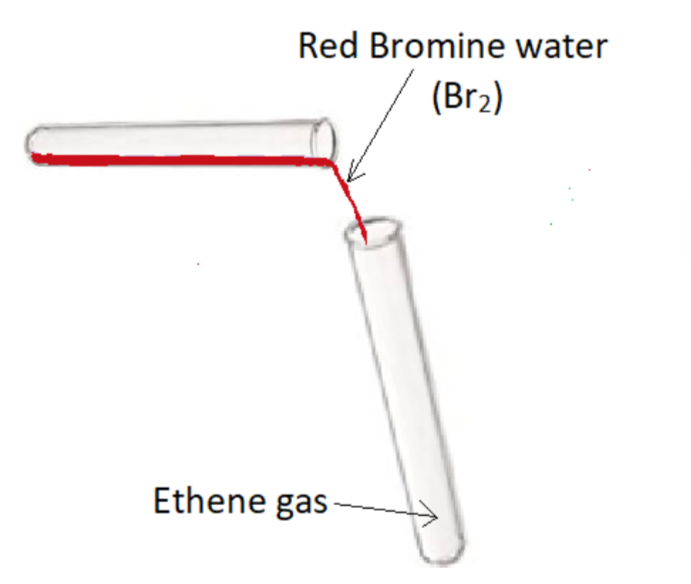
- Add red bromine water to a test tube of ethyne gas, stopper and shake
Result: Red bromine water turns colourless – ethyne is unsaturated
Testing for unsaturation – Method 2: Using acidified potassium manganate (VII) (KMnO4)
Procedure:
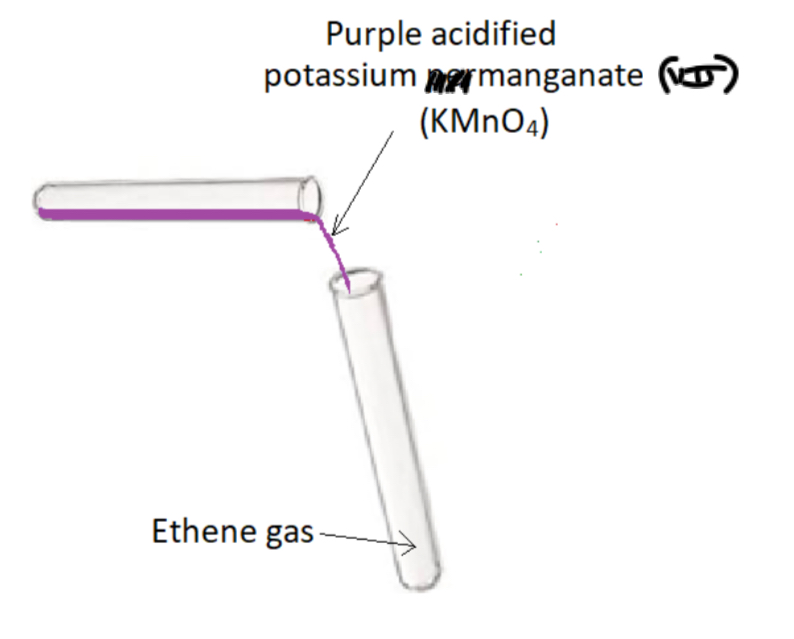
- Add purple acidified potassium manganate (VII) to a test tube of ethene gas, stopper and shake
Result: Purple acidified potassium manganate (VII) turns colourless - ethyne is unsaturated
Outline two safety precautions in this experiment
1) Ethyne is explosive with air- keep any naked flame away from the apparatus
2) Use a spatula and gloves to place calcium carbide into the flask- can be an irritant to skin
Describe the appearance of calcium carbide
Calcium carbide is a grey-black solid
Give three observations in the reaction flask as the reaction proceeds
1. Effervescence/Fizzing is observed
2. A white substance forms
3. The reaction flask gets hot
Explain why fizzing/effervescence occurs in the reaction flask
Ethyne gas is produced
Explain the white substance that forms in the flask as the reaction proceeds
The white substance forms as a result of the production of calcium hydroxide Ca(OH)2
Explain why the flask gets warm as the reaction proceeds
The reaction between calcium carbide and water is exothermic (gives out heat)
Why must the products of the reaction be passed through acidified copper sulfate?
The ethyne formed will not be pure, passing it through acidified copper sulfate removes impurities
Name three impurities that could be present in the ethyne gas produced that are removed by
the acidified copper sulfate?
1. Hydrogen sulfide (H2S)
2. Phosphine (PH3)
3. Ammonia (NH3)
Explain why these impurities may be present in the ethyne gas produced
Calcium carbide is often contaminated with calcium sulfide, calcium phosphide and calcium nitride
Why are the first few test tubes of gas collected discarded?
The first few test tubes consist mostly of displaced air and not ethyne gas
Give an industrial application of ethyne
Ethyne is a gas that is used in oxyacetylene welding and cutting – when ethyne is burned in oxygen it burns at extremely high temperatures (> 3000°C)