DNA, genes and chromosomes
 Call Kai
 Learn
Learn Practice Test
 Spaced Repetition
 Match
Match Flashcards
 Knowt Play
1/12

There's no tags or description
Looks like no tags are added yet.
Name | Mastery | Learn | Test | Matching | Spaced | Call with Kai | Chat |
|---|
No analytics yet
Send a link to your students to track their progress
13 Terms
DNA in prokaryotic cells
short
circular
not associated with proteins
DNA in eukaryotic cells
in nucleus
long
linear
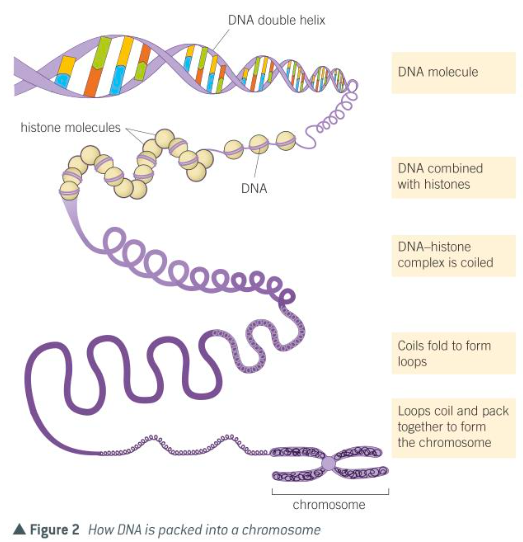
associated with histones (proteins)
What is a chromosome
A DNA molecule and its associated proteins form a chromosome
What is a homologous pair/chromosome?
Two chromosomes that carry the same genes but not necessarily the same alleles of the genes
What is an allele?
One of a number of alternative forms of a gene
In eukaryotic cells what also contains DNA apart from the nucleus?
mitochondria
chloroplasts
short, circular and not associated with proteins
What is a gene?
A base sequence of DNA that codes for:
the amino acid sequence of a polypeptide
a functional RNA (including ribosomal RNA and tRNAs)
What is a locus
A genes fixed position on a particular DNA molecule
What is a triplet
a sequence of three DNA bases
codes for a specific amino acid
Genetic code - universal
each triplet codes for the same amino acid in all organisms
Genetic code - non-overlapping
each base in the sequence is read once only
Genetic code - degenerate
most amino acids are coded for by more than one triplet
Exons and introns
in eukaryotes, much of the nuclear DNA does not code for polypeptides
there are non-coding multiple repeats of base sequences between genes
within a gene, only some sequences - exons - code for amino acid sequences
exons are separated by one or more non-coding sequences - introns