Exam 1 - Ecology
 Call Kai
 Learn
Learn Practice Test
 Spaced Repetition
 Match
Match Flashcards
 Knowt Play
1/138

Earn XP
Description and Tags
Chapters 1 - 8
Name | Mastery | Learn | Test | Matching | Spaced | Call with Kai | Chat |
|---|
No analytics yet
Send a link to your students to track their progress
139 Terms
Ecology
The scientific field that studies interactions between organisms and their biological and physical environments.
Abiotic environment
Sunlight, water, temperature, air, soil, salinity, nutrients
Biotic environment
Predators, prey, parasites, pathogens, symbionts
Organismal ecology
Interactions between individuals and their environment
Population ecology
Dynamics of a group of individuals of a single species
Community ecology
Interactions among coexisting populations of different species
Ecosystem ecology
Interactions between ecological communities and their abiotic environment
Concept 1: Ecology and Evolution
Species seem suited to their environment
result of natural selection
Concept 2: Equilibrium and Stochasticity
Many organisms exhibit equilibrium for a given biological parameter (homeostasis)
many ecological systems do not achieve equilibrium
Concept 3: Importance of Mathematics, Modeling and Networks
Interpreting graphs and tables
Concept 4: Scale Matters
Scale of what you are looking at (mice, biosphere, etc.)
Concept 5: Microcosms and “Natural Experiments”
Ex. Lakes and ponds (easy to study)
Measure what happens after a disturbance in nature
Concept 6: Plants are Central to Ecology
Plants have the biggest biomass ecosystems
Producers
Define biomes
Concept 7: Tension between general rules and diversity of biological systems
Concept 8: Scientific Reasoning
Ecologist search for factors that explain patterns in/of living things
Proximate factors
Immediate causes or direct causes
Ultimate factors
Higher order causes, with an evolutionary basis
Species
A group of potentially interbreeding individuals that is reproductively isolated from other such groups
Natural selection
Environmental factors create selective pressure on populations
Lamarck
Developed a now-rejected theory of evolution
Lyell (geologist)
Advocated the theory of uniformitarianism
Key Points of Darwin’s Argument
There is variation among living populations
Species have huge reproductive potential but do not achieve maximum population growth
Competition for limited resources
Surviving competitors for resources pass on those better fit genes
Evolution
Change in allele frequencies over time
Mutation
A change in the nucleotide sequence of DNA
The ultimate source of genetic variation.
Most are harmful
Only mutations in gametes (sex cells) will be passed to offspring
Relative fitness
The contribution an individual makes to the gene pool of the next generation relative to the contributions of other individuals
Directional Selection
The distribution of phenotypes in the original population is a bell curve

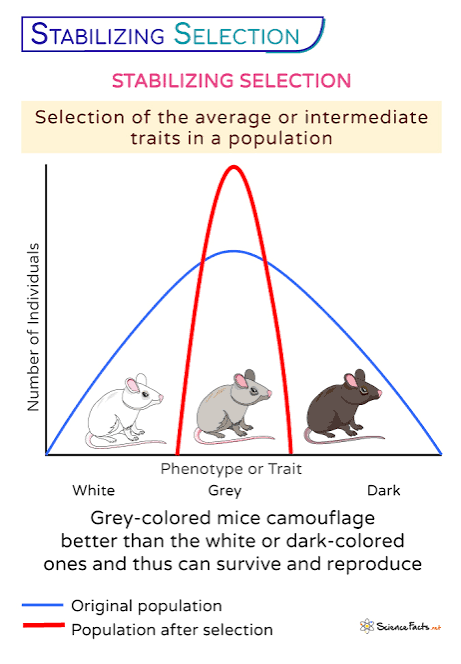
Stabilizing Selection
Disruptive Selection
Selection pressure is applied to the center of bell curve; intermediate phenotypes are negatively selected
Extreme phenotypes are favored

Genetic Drift
A change in gene pool (allele frequencies) in a population due to chance
When will drift have the biggest influence?
Small populations
Bottleneck Effect
A natural disaster un-selectively kills most individuals in a population which leads to a loss in genetic diversity
Inbreeding
Homozygous increases, heterozygous decreases due to loss of diversity
Can cause harmful mutations
Gene Flow
Migration between populations can change allele frequencies
Hardy-Weinberg Equilibrium
Mathematical representation of genotype frequencies in a population in which allele frequencies are not changing through time
Hardy-Weinberg Equilibrium Assumptions
No selection
No genetic drift
No gene flow
No new mutations
Breeder’s Equation
R = h²S
R = response to selection
h² = Narrow sense heritability
S = selection differential
Temporal Variations
Some environments show temporal variations in their physical/chemical factors
Challenging conditions for species
Strategies of Adaptation
Avoidance of harsh conditions
Tolerance: match organism tolerance limits with environmental conditions
Principle of Allocation
Resources are not infinite
Adaptation to one challenge may preclude adaptation to others
Constraints to Adaptations
Fundamental laws of physics apply
Evolution is limited by historical constraints. Evolution co-opts existing structures and adapts them to new situations
Temperature affects
Function of enzymes
Properties of cell and organelle membranes
Water loss and availability
Macroclimate
Large-scale, long-term weather variation
Microclimate
Small spatial scale weather variation
Factors that affect Microclimates
altitude
aspect
albedo
shading by vegetation and other structures
burrows
Temperature of Organisms
Determined by exchanges of energy with the external environment
balance between gains and losses of energy
Conduction
Two bodies in contact
Emissivity
Ability to emit radiation
Convection
Transfer of heat between an object and a moving fluid
Evaporation of Water
Heat evaporation decreases the temperature of an object
Poikilotherms
Body temperature varies with external temperature (most ectotherms)
Homeotherms
Body temperature maintained within narrow limits (almost exclusively birds and mammals)
Adaptations for Thermoregulation
Behavioral responses
Insulation
Circulatory adaptations
Countercurrent heat exchange
Cooling by evaporative heat loss
Adjusting metabolic heat (shivering)
Countercurrent Circulation
Close to an organ that show a large surface
Veins and arteries are close together
Warm blood will pass heat to cold blood flowing in the opposite direction
Antifreeze Molecules
Slows formation of bonds between water molecules, prevents the formation of ice crystals
Surviving extreme temperatures: Avoidance
migration
seek shelter during extreme periods
inactivity
reducing metabolic rate
hibernation
Torpor
Voluntary, reversible condition of low body temperature and inactivity
Thermogenic plants
Metabolic heat production (metabolic activity)
Water Vapor Density (WVD)
Is measured as the water vapor per unit volume of air
Saturation Water Vapor Density (SWVD)
Is measured as the quantity of water vapor air can potentially hold
changes with temperature
Relative Humidity =
Water vapor density/saturation water vapor density x 100
Strategies of adaptation
Avoidance
Tolerance
Factors that affect microclimates
Altitude, Aspect, Albedo
Morphological adaptations to dry environment
Reduced leaf area, deep roots, water storage, thick leaves, suberization, few stomata
Isosmotic
external environment and body fluids have the same solute
concentration
Osmoconformers
allows its internal water balance and solute concentration
to vary with the environment
Hyperosmotic
external environment has a higher concentration of solutes
than body fluids
Hypoosmotic
external environment has a lower concentration of solutes
than body fluids
Osmoregulators
maintain internal water balance and solute concentration within narrow limits
Stenohaline
tolerates a narrow range of salinity
Euryhaline
can tolerate a broad range of salinities
Weather
atmospheric conditions within small geographic areas, over short time periods
Climate
long term patterns of temperature and precipitation across regions
_____ energy is a major driver of earth systems
Major solar
Projection effect
The same amount of light is received over a larger surface
Absorption effect
The same amount of light passes through more of the atmosphere
Earths four atmospheric layers have different
Temperatures, densities, composition
Troposphere
Bottom most layer
Responsible for earth’s weather
Stratosphere
Above the troposphere
11-50km above sea level
Mesosphere
Above the Stratosphere
Low air pressure
Thermosphere
Uppermost layer
What causes wind?
The movement of air from a region of high pressure to a region of low pressure
Wind
Temperature drives air pressure, so ultimately wind comes from unequal heating of the Earth
Terrestrial biomes
Large scale
Determined by climate
Distinguished by plants
Turnover time
the time required for the entire volume of a reservoir to be renewed
Atmosphere 9 days
Rivers 12–20 days
Oceans 3,100 years
Hadley Cell
Drives global air circulation patterns and latitudinal variation in precipitation
Air heated at equator
Coriolis Effect
Due to the Earth’s rotation these winds appear to move E/W
Thermohaline circulation
Transports heat from equator towards the poles and oxygen and nutrients throughout the oceans
Eutrophication
Enrichment of water with nutrients leads to an increase in algae production
Why is the ocean blue?
Long and short wavelengths are absorbed first (red and UV)
Blue light is absorbed least and strongly scattered, reflected to our eyes
The maximum density of water is at
4
Thermal stratification
Warm water is less dense, floats on top of cooler water
Open ocean salinity
Varies from 34ppt to 36.5 ppt
Lowest: near equator
Highest: subtropics
Littoral Zone
shallow, along shore.
Includes intertidal
Neritic Zone
To continental shelf
Oceanic Zone
Beyond continental shelf
open ocean
Benthic Ocean
bottom
Pelagic Ocean
Above the bottom
Deep sea vents
Chemoautotrophic organisms
Rocky intertidal: adaptations
Wave action: strong anchor to the substrate
Low tide: protections in refuge, heat-shock proteins
Open ocean: adaptations
Strong current: directional motion is challenging, fish predators usually have a torpedo shape