I1: General Principles of Anatomy
 Call Kai
 Learn
Learn Practice Test
 Spaced Repetition
 Match
Match Flashcards
 Knowt Play
1/54

There's no tags or description
Looks like no tags are added yet.
Name | Mastery | Learn | Test | Matching | Spaced | Call with Kai | Chat |
|---|
No analytics yet
Send a link to your students to track their progress
55 Terms
Anatomy
branch of knowledge concerned with structure or morphology
anatomy greek
ana = apart
tomy= cut
*need to know this*
dissect greek
dis =apart
sectare = cut
*need to know this*
surface anatomy
study of surface structures
developmental anatomy (embryology)
development of the body prior to birth
comparative anatomy
The comparison of body structures and how they vary among species
radiology
use of radiation to visualize internal body structure
Anatomical Pathology
study of tissue that departs from the normal and thus is diseased
Organization of the body
cell, tissue, organ, organ system, body

Microanatomy
Study of microscopic structures
cells and tissue
Gross Anatomy
structures that can be seen without a microscope
organs, organ system, body

cell
the smallest unit of living matter and the characteristic building block of all plant and animal tissue
cytology
study of cells
kytos = cell
logos = knowledge of
*need to know this*
Histology
study of tissues
histos=tissue
logos= knowledge of
*need to know this*
tissue
A collection of similar cells that perform a particular function.
organ
consist of one/more tissues
blended in such a way as to form a structure, which can perform one function
or related functions. (for example, the kidney)
organ system
consists of one/more organs that act together in performing a major function of the body. (for example, the right and left kidneys, right and left ureters, urinary bladder, and urethra make up the Urinary System)
body
composed of 12 organ systems
methods of study for the human body
regional or systemic
regional
according to the natural subdivisions of the body.
1. Head: facial region, cranium
2. Neck
3. Thorax (chest)
4.Abdomen
5.Pelvis
6.Back (posterior aspect thorax, abdomen, and pelvis)
7.Trunk (combination of thorax, abdomen, pelvis, and back)
8.Upper limb (extremity): pectoral region, arm, forearm, and hand
9.Lower limb (extremity): gluteal region, thigh, leg, and foot
Systemic
according to the major body systems; collections of organs that perform related functions.
12 organ systems of the body
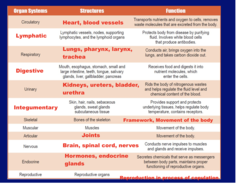
LOOK AT CHART
Circulatory or Cardiovascular
Lymphatic
Respiratory
Digestive
Urinary
Integumentary
Skeletal
Muscular
Articular
Nervous
Endocrine
Reproductive
articular system
joints
integumentary system
skin, hair, nails, sebaceous glands, sweat glands, subcutaneous tissue
endocrine system
hormones, endocrine glands
lymphatic system
lymphatic vessels, nodes, supporting lymphocytes and lymphoid organs
respiratory system
lungs, pharynx, larynx, trachea
circulatory system
heart, blood vessels
digestive
mouth, tongue, teeth, salivary glands, pharynx, esophagus, stomach, liver, gallbladder, pancreas, small and large intestines
urinary system
kidneys, ureters, urinary bladder, urethra
skeletal system
bones
Muscular system
muscles
nervous system
brain, spinal cord, nerves
reproductive system
reproductive organs
anatomical position and 5 criteria
refers to the position the body must be in when using anatomical planes and terms of reference
Its important when we communicate with others about our patients.
It has 5 criteria:
Body Longitudinal
Upper Limbs By Side
Eyes Directed Forward
Palms Directed Forward
Toes Directed Forward
planes of reference
planes that subdivide the total body or organs
4 types
median (midsagittal)
sagittal
frontal (coronal)
transverse (horizontal)
Median Plane (midsagittal plane)
divides body into two equal parts (right and left)

sagittal plane
vertical division of the body into right and left portions
UNEQUAL LEFT AND RIGHT
infinite amount!
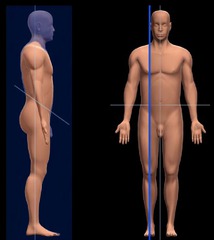
frontal plane (coronal plane)
Divides the body into front and back portions.
infinite amount!

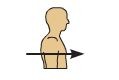
Horizontal Plane (transverse)
plane that divides the body into upper and lower halves
infinite amount!

terms of reference
must always be used with the body in anatomical position
6 pairs of terms
1. medial and lateral
2. anterior and posterior
3. superior and inferior
4. proximal and distal
5. internal and external
6. Superficial and deep
others
supine and prone
medial
toward the midline
ex. the neck lies medial to the shoulder

Lateral
away from the midline
ex. the shoulder lies lateral to the neck
Anterior (ventral)
front of the body
ex. our umbilicus lies anterior to our spine or back
Posterior (dorsal)
back of body
ex. our umbilicus lies ventral to our spine or back

superior (cephalic)
toward the head
ex. the neck is superior to the umbilicus

Inferior (caudal)
nearer the lower (tail) end
ex. the umbilicus is inferior to the neck

proximal
Closer to the point of attachment
ex. our shoulder lies proximal to our elbow

distal
away from the point of attachment
ex. our elbow lies distal to our shoulder

internal
nearer the center of an organ or cavity
external
farther away from the center or an organ or cavity
superficial
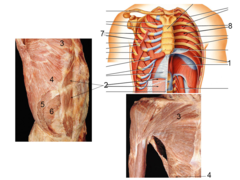
near the surface
In our forearm we have 2 muscles that flex the digits.
One is "Flexor digitorum
superficialis" (superficial refers to closer to the surface).
The deeper one is "Flexor digitorum profundus" (profundus means deep and refers to closer to the bone and further from the skin).

deep
farther from the body surface
In our forearm we have 2 muscles that flex the digits.
One is "Flexor digitorum
superficialis" (superficial refers to closer to the surface).
The deeper one is "Flexor digitorum profundus" (profundus means deep and refers to closer to the bone and further from the skin).

supine position
lying on back, facing upward

prone position
lying on abdomen, facing downward
