Consumer Behavior Exam 1
 Call Kai
 Learn
Learn Practice Test
 Spaced Repetition
 Match
Match Flashcards
 Knowt Play
1/126

Earn XP
Description and Tags
MKTG 35503
Name | Mastery | Learn | Test | Matching | Spaced | Call with Kai | Chat |
|---|
No analytics yet
Send a link to your students to track their progress
127 Terms
consumer behavior
reflects the totality of consumers’ decisions with respect to the acquisition, consumption, and disposition of goods, services, activities, experiences, and ideas by human decision-makers over time
acquisition/choice
the stage of the consumption process where a consumer selects, purchases, or otherwise gains possession of a product or service
usage
the process by which a consumer actually uses, consumes, or interacts with a product, service, or experience after acquiring it
disposition
the process by which a consumer discards, gets rid of, or parts with an offering (such as a product, service, or packaging) after purchase or use
marketing
creates mutually beneficial exchanges by offering a combination of product, price, place, and promotion that has value to consumers
marketing concept
discover and satisfy wants/needs of customers
General Electric’s marketing concept
the concept introduces marketing at the beginning rather than the end of the production cycle and integrates marketing into each phase of the business
market segmentation
the process of dividing a market into distinct subsets with common needs and characteristics that are different from those shared by other groups
targeting
consists of selecting the segments that the company views as prospective customers and pursing them
positioning
the process by which a company creates a distinct image and identity for its products, services and brands in consumers minds
value
reflects what is important to us or what we consider good or bad
terminal values
desired end states
instrumental values
values held/actions taken to achieve terminal values

the means end chain model
people link product attributes to terminal values (laddering technique)
individual difference variables
individual consumers differ in specific traits and behaviors
personality
an individual’s distinctive pattern of relatively permanent differences called traits and characteristics that guide behavior, useful at individual level, but marketers tend to look at segments
personality traits
the identifiable characteristics that define a person
trait
a single consistent individual difference/characteristic described by facets
trait theory
this approach to personality focuses on the quantitative measurement of personality traits
five factor model (big 5)
openness, conscientiousness, extraversion, agreeableness, neuroticism; consumer’s personalities are a combination of these traits
openness to experience
creative, open to new ideas v. resistant to change
conscientiousness
precise, attention to detail v. impulsiveness, efficient
extroversion
talkative, outgoing v. introverted
agreeableness
patient, sympathetic, less competitive
stability/neuroticism
even keeled, avoids mood swings v. more emotional
need for closure
desire for definite knowledge to reduce ambiguity
need for uniqueness
highly relevant to consumer behavior; people buy things to distinguish themselves
need for perfection
perfectionists are driven by dichotomous thinking, a type of black and white cognitive thinking stylef
frugality
frugal people deny short term purchasing whims; they choose instead to resourcefully use what they already own
risk aversion
people who are risk averse avoid the unknown or taking chances
measurable
quantifiable data about consumers and their characteristics
accessible
ability to reach your target audience
substantial
your market should be a substantial number and clearly defined
differentiable
create tailored strategies number for all segments within your market
actionable
is the marketing strategy practical, profitable, and assessable
segmentation by demographic
grouping consumers based on shared demographics characteristics to create better marketing campaigns
why segmentation by demographic works
requires few data points to implement, collecting data is easy, most cost effective method
psychographic segmentation in marketing
method of market segmentation that involves sorting consumers into groups based on shared psychological characteristics, such as their values, personality traits, activities, interests, and opinions
personas
a fictional, research based profile that represents a specific group of buyers or users
brand personality
separated into sincerity, excitement, competence, sophistication, and ruggedness
sincerity
down to earth, honest, wholesome, cheerful
excitement
daring, spirited, imaginative, up to date
competence
reliable, intelligent, successful
sophistication
upper class, charming
ruggedness
outdoorsy, tough
sensory stimuli
sights, sounds, smells, tastes, textures
sensory receptors
eyes, ears, nose, mouth, skin
information processing order
sensory stimuli → sensory receptors → exposure → attention → interpretation
sensory threshold
the minimum intensity or change in a physical stimulus that an organism can detect
absolute threshold
the minimum amount of stimulus energy needed for a person to detect that stimulus at least 50% of the time
differential threshold (JND)
the smallest change in intensity between two stimuli that a person can detect 50% of the time
exceed, below
to be most effective, price discounts have to _______ the JND, while price increases should be _______ the JND
downsizing
the strategy of using an unnoticeable decrease in packaging size or contents while maintaining the same price to combat the rising costs of ingredients
adaptation
becoming desensitized to stimuli we are exposed to through high repetition, simplicity, and low intensity
mere exposure
the more often we see it the more we like it if our feelings towards it were positive or neutral to begin with (Apple product placement)
selective exposure
ad avoidance by fast forwarding through ads, changing channels, muting, using ad blockers, etc.
input variation
as sensory input decreases, our ability to detect change increases and vice versa
perceptual overloading
the inability to perceive all stimuli competing for one’s attention
perceptual vigilance
the ability to disregard much of the stimulation one receives
attention
devoting cognitive resources to a stimulus; it is limited, selective (involuntary/voluntary), can be divided
cognitive misers
the human tendency to use mental shortcuts and simple rules instead of deep, logical analysis when making purchasing choices
difference between exposure and attention
exposure reflects whether a consumer encounters the stimulus, attention reflects how much mental activity they devote to processing it
perception
the process by which people select, organize, and interpret information to form a meaningful picture of the world, constructive
what interpretation of stimulus is affected by
hard wired features of the brain, context, individual differences, motivations, expectations
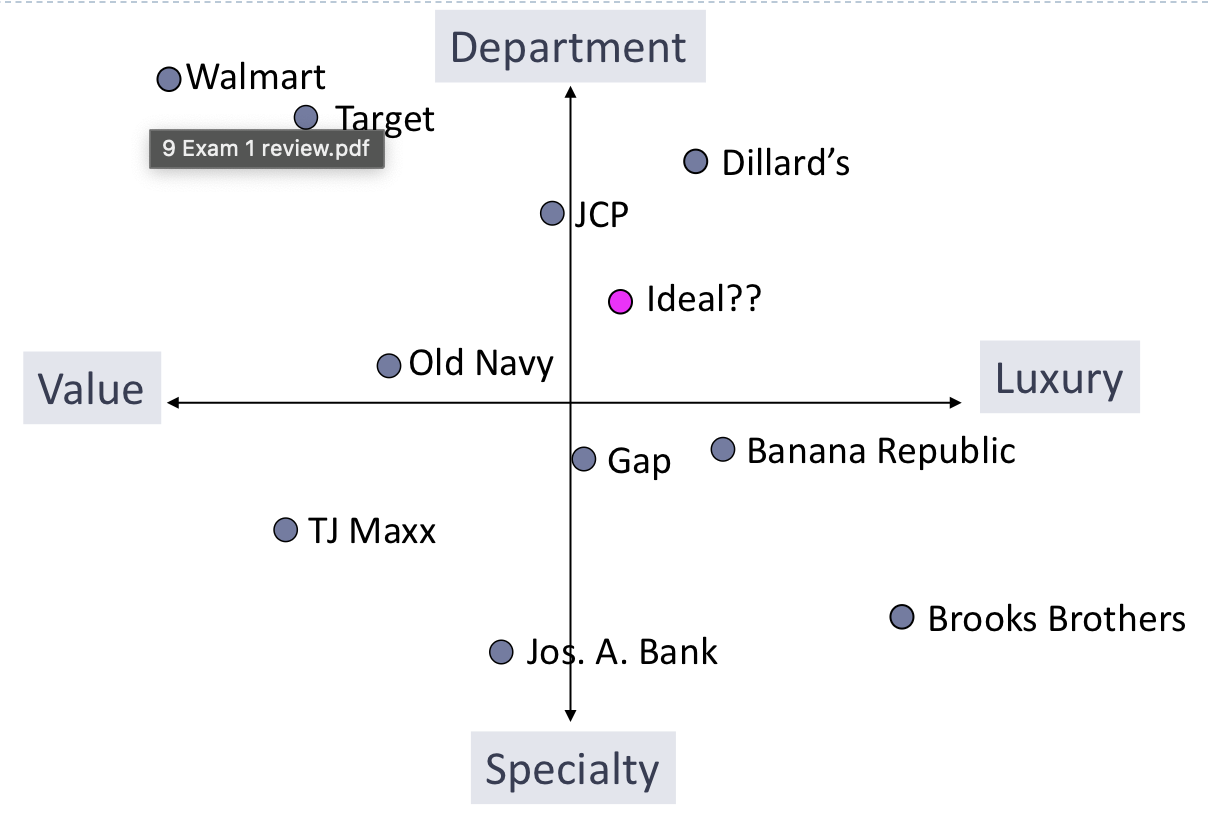
perceptual maps
a graphical representation of how customers perceive brands in order to learn what is desired by consumers and whether those desires are already being fulfilled and to construct a model for predicting consumer preferences and market share for new or modified products
similarity based perceptual map

attribute based perceptual map
motivation
internal processes that lead people to behave as they do; occurs when a need that someone wants to satisfy is activated
arousal
a tension state resulting from some unmet, unfulfilled need or some unresolved conflict that is causing tension for the individual
direction
what a person wants to achieve or that desired state
intensity
the strength of the motivation manifests in the level of effort we put forth to achieve a goal, or how they will go about it
need
either something a person must have to live or to achieve a goal or a discrepancy between an actual and a desired state
involvement
a person’s perceived personal relevance of an object based on their inherent need, values, and interests
promotion focus
motivated to achieve positive outcomes, focus on hopes, wants, desires, accomplishments
prevention focus
motivated to avoid negative outcomes, focus on responsibilities, safety, avoiding risk
physiological cues
involuntary bodily responses triggered by external marketing stimuli, environments, or product interactions
emotional cues
subtle sensory, visual, or contextual signals that trigger subconscious feelings and steer a buyer's decision-making process, often bypassing strict logic
cognitive cues
specific informational stimuli that trigger mental processing, shape perception, and guide purchasing decisions
environmental cues
external sensory or situational stimuli in a physical or digital setting that subconsciously or consciously influence a consumer's perceptions, emotions, evaluations, and purchasing decisions
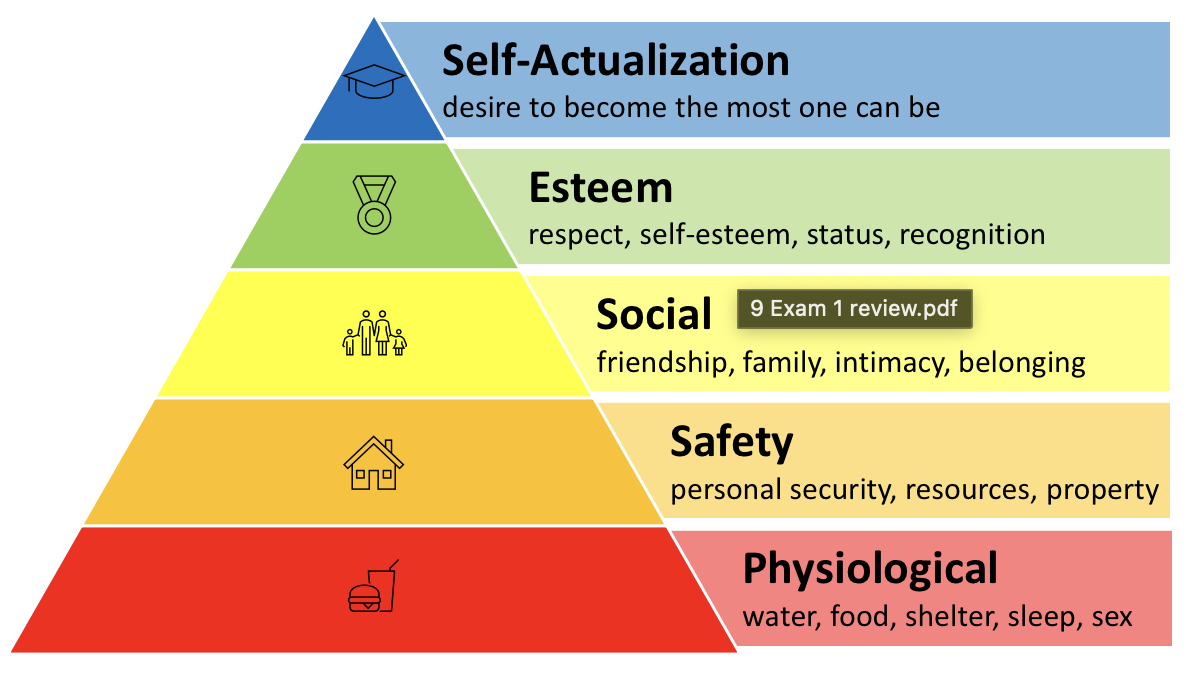
Maslow’s hierarchy of needs
congruent rewards
if baseline motivation is high, continued motivation = continued behavior
incongruent rewards
if baseline motivation is low, generates motivation = generates behavior
classical conditioning
use existing associations to create positive or negative associations for product or brand
conditions for classical conditioning
repetition, contiguity, contingency, congruity
repetition
the frequency of pairing a conditioned stimulus and an unconditioned stimulus
contiguity
the spatial or temporal nearness of objects
contingency
the conditioned stimuls should precede the unconditioned stimuluscon
congruity
sequentially presented cues should be related
positive punishment
adding something bad/unpleasant/unenjoyable to decrease behavior
positive reinforcement
adding something good/enjoyable/of value to increase behavior
negative punishment
subtracting something good/enjoyable/of value to decrease behavior
negative reinforcement
subtracting something bad/unpleasant/unenjoyable to increase behavior
vicarious learning
learning contingencies without directly experiencing them through modeling, observational learning, imitative learning
vicarious learning in marketing
development of new responses and inhibition of unwanted responses
inhibition of unwanted responses
modeling wanted behaviors in your marketing avoids problems of direct punishment
structural/orthographic (shallow) processing
encoding only the physical qualities of something (the visual look of a word or string of letters
phonological (medium) processing
the ability to see or hear a word, break it down to discrete sounds, and then associate each sound with letters that make up the word
semantic (deep) processing
occurs after we hear a word and encode its meaning. this causes us to relate the word to other words with similar meanings, research shows this is the superior type of processing
memory
a storage facility like a file cabinet of knowledge about products, services, shopping trips and experiences
encoding
transferring information into memory