Combination Vehicle and Air Brakes Test
 Call Kai
 Learn
Learn Practice Test
 Spaced Repetition
 Match
Match Flashcards
 Knowt Play
1/73

There's no tags or description
Looks like no tags are added yet.
Name | Mastery | Learn | Test | Matching | Spaced | Call with Kai | Chat |
|---|
No analytics yet
Send a link to your students to track their progress
74 Terms
Which of the following statements is true?
A) It takes longer to stop a loaded vehicle
B) It takes longer to stop an empty vehicle
C) It takes the same amount to stop a loaded vehicle as it does to stop an empty one.
D) None of the above are true
It takes longer to stop an empty vehicle
Jackknife will occur once the angle between the tractor and trailer reaches:
A) 10 degrees
B) 25 degrees
C) 15 degrees
D) 5 degrees
15 degrees
Your 60-foot vehicle is traveling 45 mph; what is the proper following distance?
A) 7 seconds
B) 5 seconds
C) 5 seconds
D) 6 seconds
7 seconds
How far down the road should you look when driving? (this is called eye-lead time)
A) 5-8 seconds
B) 12-15 seconds
C) 3-5 seconds
D) 17-20 seconds
12-15 seconds
The trailer air supply control:
A) is used for parking for short periods of time
B) connects the trailer air tank to the trailer air brakes
C) Connects the tractor air supply to the trailer
D) Operates the tractor protection valve, in the event of a rapid air loss, will cause the emergency brakes on the trailer to be applied
Operates the tractor protection valve, in the event of a rapid air loss, will cause the emergency brakes on the trailer to be applied
The emergency air line is:
A) Also called the supply line which supplies air to the trailer and controls the trailer emergency brakes
B) Always painted blue for easy identification
C) A red 8-sided push/pull knob
D) Used only in emergency situations
Also called the supply line which supplies air to the trailer and controls the trailer emergency brakes
You should use wheel chocks when:
A) Trailer is not equipped with spring brakes
B) You are not sure if trailer has spring brakes
C) Always
D) Both A and B
Both A and B
Name the two types of jackknives
Tractor and trailer
Which is true concerning the use of the trailer hand valve?
A) It should be used in order to save wear and tear on tractor brakes
B) It should be applied with a light stead pressure when going down a long grade
C) It should never be used for braking when driving
D) Both A and B
It should never be used for braking when driving
If you are using the proper eye-lead time, the distance down the road at which you will be looking, at highway speeds will be approximately:
A) two blocks
B) ½ mile
C) 800 feet
D) ¼ mile
¼ mile
In order to prevent rollover, which of the following is most helpful?
A) Go slow around turns
B) Never accept high center-of-gravity loads
C) Load cargo as close to the ground as possible
D) Both A and C
Both A and C
Passengers may carry gasoline onto the bus:
A) If it is in an approved container and securely sealed
B) Never
C) Only in case of emergencies
D) If you secure the gasoline contained immediately behind the driver’s seat
Never
Which of the following emergency equipment is required on your bus?
A) First-aid kit, tire chains, and tire changing equipment
B) Fire extinguisher, tire chains, and fir-aid equipment
C) Fire extinguisher, 3 reflective triangles, spare electric fuses, unless bus is equipped with circuit breakers
D) Fire extinguisher, accident reporting kit, 3 reflective triangles
Fire extinguisher, 3 reflective triangles, spare electric fuses, unless bus is equipped with circuit breakers
Speed limits on curves are standardized for:
A) Automobiles
B) Buses
C) Tractor-trailers
D) Small straight trucks
Automobiles
If your bus is not carrying farm workers, how many aisle sets are you permitted?
A) 4
B) 8
C) 12
D) 0
0
Which of the following hazardous materials are you permitted to transport?
A) Emergency shipment of drugs
B) Emergency shipment of hospital supplies
C) Small arms ammunition (ORM-D)
D) All of the above
All of the above
You are driving at night and you must dim your headlights from high to low. What should you do with your speed?
A) Slow down
B) Speed up
C) Drop 5 mph until your eyes adjust
D) Nothing; how well you can see should not affect speed
Slow down
Which of these should be considered a hazard?
A) An ice-cream truck
B) A blind intersection
C) A driver signaling a turn
D) All of the above
All of the above
You are driving a 40-foot bus at 45 mph. The road is dry and visibility is good. You should keep a safety space in front of your bus that is at least ________ seconds.
A) 8
B) 7
C) 5
D) 3
5
When should you check your mirrors for a lane change?
A) Before and after signaling the change
B) Right after starting the lane change
C) After completing the lane change
D) All of the above
All of the above
Which of these will result in the best control on curves?
A) Brake all the way through curves
B) Slow to a safe speed before entering curves, then accelerate slightly through the curves
C) Speed up slightly before the curves, then keep speed constant through the curves
D) Slow to a safe speed before entering curves, then coast through them
Slow to a safe speed before entering curves, then accelerate slightly through the curves
When going down long or steep downgrades you should always:
A) Apply light brakes on and off
B) Use the braking effects of the engine
C) Use light steady braking pressure
D) Shift to lower gears when speed is too fast
Use the braking effects of the engine
The application air gauge shows:
A) Total air pressure in air system
B) Amount of pressure currently being applied by brake pedal
C) How much air has been used since beginning the trip
D) None of the above
Amount of pressure currently being applied by brake pedal
The low air pressure warning will activate at approximately:
A) 60 psi
B) 30 psi
C) 20 psi
D) 80 psi
60 psi
If you experience a severe air loss and the service braking system is no longer working, which brake system is used to stop the vehicle?
A) Parking-brake system
B) Interlock air lock system
C) Service brake system
D) Emergency brake system
Emergency brake system
Air tanks should be drained at least:
A) Daily
B) Weekly
C) After each dispatch
D) Every four hours
Daily
An alcohol evaporator:
A) Injects alcohol into the air lines to help prevent freezing
B) Is used instead of an air dryer
C) Removes alcohol from air lines
D) Should be used only on hydraulic brake system
Injects alcohol into the air lines to help prevent freezing
The air compressor governor determines:
A) Amount of air sent to brakes when brake pedal is depressed
B) How fast the air compress is allowed to run
C) The cut-in and cut-out pressure
D) All of the above
The cut-in and cut-out pressure
If you experience a sudden drop in the air system you should:
A) Continue driving and say an effective prayer
B) Continue driving but only to the next repair shop
C) Keep your eye on the gauge and hope it will build the pressure back up
D) Stop immediately when safe to do so
Stop immediately when safe to do so
At approximately 20-45 psi:
A) the low air pressure buzzer will activate
B) spring brakes will apply automatically
C) nothing usual will happen
D) the air compressor governor will quit working
spring brakes will apply automatically
Vehicles equipped with air brakes must have:
A) at least two air tanks, one on tractor and one on trailer
b) an air pressure gauge
C) a dual air brake system
D) automatic air drains
an air pressure gauge
When a driver depresses the brake pedal, what air brake system is he using?
A) Service brakes
B) Emergency brakes
C) Parking brakes
D) Both A and B
Service brakes
Emergency brakes are activated:
A) By the brake pedal
B) By the “S”- Cam
C) By a loss or air pressure
D) All of the above
By a loss or air pressure
Which of the following is the most common foundation brake found on commercial vehicles?
A) Wedge and drum
B) Disc
C) “S”- Cam drum
D) None of the above
“S”- Cam drum
If the air system ruptures, which of the following prevents the air from escaping out of the system?
A) Air compressor
B) Emergency brake system
C) The emergency relay valve
D) The one-way check valve
The one-way check valve
The spring brakes, or emergency braking system:
A) Will always work
B) Will work only if the brakes are adjusted properly
C) Cannot be tested by one person during a pre-trip inspection
D) Will work properly, regardless of the brake adjustment
Will work only if the brakes are adjusted properly
A vehicle with a dual-air system:
A) Must have two supply pressure gauges
B) Must have two sets of brake controls
C) Will have only one set of controls
D) Will have at least two low air warning buzzers
Must have two sets of brake controls
When driving down the road and the air brake system is working properly, the brakes are held away from the drum by:
A) Spring pressure
B) Air pressure
C) Hydraulic pressure
D) Any of the above
Air pressure
When air pressure is lost or leaks off:
A) The vehicle will always roll away
B) Strong springs are released which apply the brakes automatically (these are known as spring brakes)
C) Brakes are always released
D) The trolley valve can be used to apply brakes
Strong springs are released which apply the brakes automatically (these are known as spring brakes)
A dual parking control valve means:
A) You can use air pressure from a separate tank to move your vehicle to a safe location
B) You have two parking brakes
C) You are required to have two separate brake controls
D) None of the above
You can use air pressure from a separate tank to move your vehicle to a safe location
If you have a dual air brake system and a low air pressure warning is activated, you:
A) Don’t have to worry since you have two systems and you can proceed on your trip and get the problem fixed after unloading
B) Should just reduce speed and don’t use your brakes unless absolutely necessary
C) Can turn off the buzzer if only one system affected
D) Stop immediately and get air system repaired
Stop immediately and get air system repaired
The front brake limiting valve should be used:
A) Never
B) On dry roads only
C) On wet roads
D) Whenever the driver feels it is necessary
Never
A combination vehicle air brake system, with engine off and brakes applied should not leak more than :
A) 2 psi in one minute
B) 3 psi in one minute
C) 3 psi in 30 seconds
D) 4 psi in one minute
4 psi in one minute
With brakes applied and engine off, air loss in a straight truck or bus should not exceed:
A) 3 psi in one minute
B) 2 psi in one minute
C) 4 psi in one minute
D) 4 psi in 45 seconds
3 psi in one minute
To check for play in the slack adjusters you must:
A) Have two people to do it
B) Park vehicle on flat ground, chock wheels, release brakes and pull hard on slack adjusters
C) Drain all air from system and then pull-on slack adjusters
D) Pump air pressure to 20 psi and then look at brake lining gap between drum
Park vehicle on flat ground, chock wheels, release brakes and pull hard on slack adjusters
Combination vehicles with air brakes, engine off and brakes released, cannot lose more than:
A) 10 psi in one minute
B) 4 psi in one minute
C) 2 psi in one minute
D) 3 psi in one minute
3 psi in one minute
Stab braking means:
A) Brake hard until wheels lock up then release until wheels begin to roll again
B) Brake hard, but not enough to lock wheels
C) Light, steady pumping action
D) None of the above
Brake hard until wheels lock up then release until wheels begin to roll again
A supply pressure gauge is:
A) Seldom found on straight trucks or buses
B) Required on all equipment with air brakes
C) Usually not found on combination vehicles
D) Not required
Required on all equipment with air brakes
On long downhill grades, experts recommend using a low gear and only enough braking pressure to reduce vehicle speed to 5 mph below the “safe speed” for hill, why?
A) Air usage is less when vehicle is in the proper low gear and brakes are applied only when needed to reduce to speed under the “safe speed”
B) Brake linings should not overheat if in the proper gear
C) Using this method allows you to maintain control of the vehicle
D) All of the above are true
All of the above are true
When is “snubbing” the brakes on a long downgrade acceptable?
A) If brakes are properly adjusted
B) If brake linings are made out of asbestos
C) If brakes are properly adjusted and vehicle is in proper gear
D) When your company authorizes it
If brakes are properly adjusted and vehicle is in proper gear
Air brakes take more time to work than hydraulic brakes due to:
A) Brake lag
B) Driver’s perception time
C) The working of the one-way check valve
D) None of the above
Brake lag
You lose steering control when:
A) You have a front tire blowout
B) Your steering tires lock up
C) You use the controlled braking method
D) You have more than 9000 lbs. on the front axle
Your steering tires lock up
Effective braking distance is:
A) The distance your vehicle travels after you see the hazard
B) The distance your vehicle travels after you react to the hazard
C) The distance your vehicle travels after you step on the brake pedal
D) The distance your vehicle travels after brakes have been applied
The distance your vehicle travels after brakes have been applied
The most common type of foundation brake found on heavy vehicles is the:
A) Disc
B) Wedge drum
C) '“S”-Cam drum
D) None of the above
“S”-Cam drum
A supply pressure gauge shows:
A) Air available in the air tanks
B) Pressure being applied by foot brake
C) Amount of air in brake chamber
D) Amount of air in hydraulic system
Air available in the air tanks
When going down a long downgrade and you’re driving a “KW” with a 425 “Cat” the gear should be in:
A) the same one you went up the grade in
B) A higher gear than the one used going up the grade
C) a lower gear than the one used going up the grade
D) it doesn’t make any difference if your truck is equipped with an engine retarder
a lower gear than the one used going up the grade
The brake pedal in an air brake system:
A) controls the speed of the air compressor
B) is seldom used, compared to hydraulic systems
C) controls the air pressure applied to put on the brakes
D) is connected to slack adjusters by a series of rods and linkages
controls the air pressure applied to put on the brakes
Parking and emergency brakes of trucks and buses can be legally held by _________ pressure.
A) Spring
B) Fluid
C) Air
D) Atmospheric
Spring
The driver must be able to see a low air pressure warning which comes on before pressure in the service air tanks falls below____ psi.
A) 20
B) 40
C) 60
D) 80
60
All air brake equipment vehicle have:
A) An air use gauge
B) A supply pressure gauge
C) At least one brake heater
D) A backup hydraulic system
A supply pressure gauge
The braking power of the spring brakes:
A) Increases when the service brakes are hot
B) Depends on the service brakes being in adjustment
C) Is not affected by the condition of the service brakes
D) Can only be tested by highly-trained brake service people
Depends on the service brakes being in adjustment
The service air line:
A) Allows air travel from air compress governor to the air compressor
B) Pops off when air pressure falls below 20 psi
C) Is used only when pulling doubles
D) Is operated by the brake pedal and trailer hand valve
Is operated by the brake pedal and trailer hand valve
When coupling to the trailer, the fifth wheel must
A) Be properly lubricated
B) Be titled down towards rear of tractor
C) Have unlocking handle in automatic lock position
D) All of the above
All of the above
It is OK to use the trailer hand valve to straighten out a jackknifing trailer:
A) Only if on dry roads
B) Never
C) If used with slight, steady pressure
D) Only if you are an experienced driver
Never
When cranking up the landing gear, which statement is true?
A) Landing gears should be cranked up just high enough to clear the ground
B) Landing gears should be cranked up as high as they will go and crank handle secure
C) Landing gears should be cranked up as high as they will go
D) Landing gears should be cranked up and the removed for safekeeping
Landing gears should be cranked up as high as they will go and crank handle secure
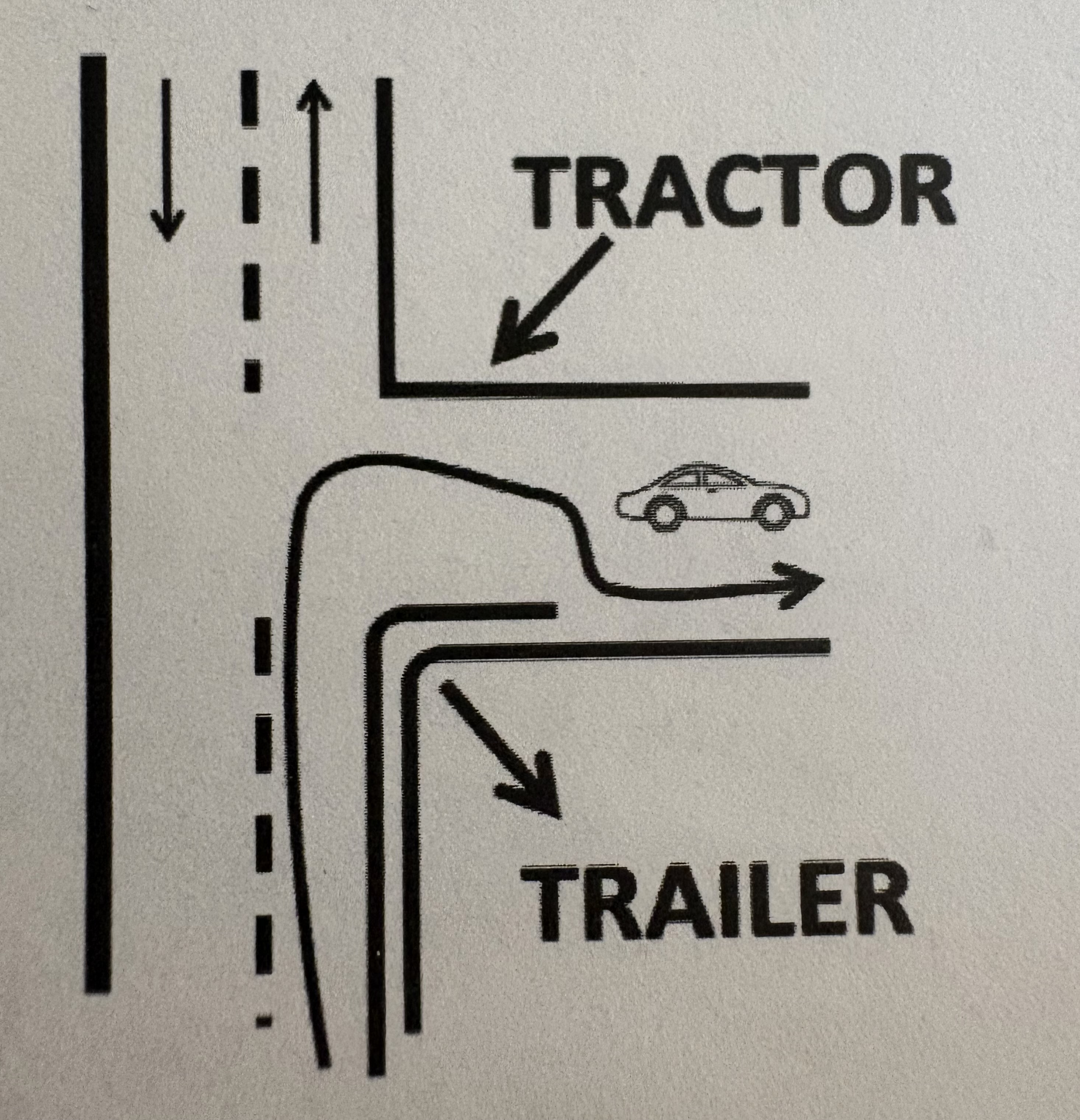
Off-tracking can best be described as:
A) The rear wheels of the trailer will track further to the inside of a turn than the wheel of the tractor (see diagram)
B) The rear wheels of the tractor will track further to the outside of a turn than the wheels of the tractor
C) The tractor wheels will track further to the outside of a turn than the wheels of the trailer
D) The tractor wheels will track further to the inside of a turn than the wheels of the trailer
The rear wheels of the trailer will track further to the inside of a turn than the wheel of the tractor
If trailer is carrying a load, when you crank down the landing gear, you should:
A) Lower it until it just touches the ground
B) After it has touched ground crank a few extra turns
C) Lower it until it almost touches the ground
D) None of above
After it has touched ground crank a few extra turns
When uncoupling and you are pulling tractor away from trailer, you should:
A) Pull out quickly
B) Pull out slowly
C) Pull out smoothly and slowly, stop when fifth wheel is free but tractor frame is still under trailer
D) Pull out as fast as possible so that if landing gear collapses, the trailer will not crush the tractor tires
Pull out smoothly and slowly, stop when fifth wheel is free but tractor frame is still under trailer
When bobtailing, the glad hands should be secured in such a way as to:
A) Prevent water from getting in them
B) Prevent dirt from getting in them
C) Prevent rubbing and chafing against other tractor parts
D) All of the above
All of the above
If glad hands, after connected properly to trailer, leak air, you should:
A) Replace them
B) Sand or grind down the metal parts in order to form a better connection
C) Hook-up to a different trailer
D) Check and clean the rubber grommets and then re-connect and test
Check and clean the rubber grommets and then re-connect and test
It is OK to use the trailer hand valve to park when:
A) It is only for a short time
B) If the trailer does not have spring brakes
C) If the tractor brakes are not working
D) Never
Never
Air tanks should be drained:
A) Daily
B) Hourly
C) Weekly
D) Once each trip
Daily
After coupling to a trailer, you should:
A) Raise landing gear slightly off the ground and then tug gently with the tractor to test connection
B) Not check coupling since you head the jaws latch
C) Crawl under trailer and visual check the connection
D) Both A and C
Both A and C
How much space is permitted between the upper and lower fifth wheel plates?
A) None
B) Up to ¼ inch
C) Up to ½ inch
D) Up to 1 inch
None