Anatomy & Physiology Hearing/Speech Mechanics
 Call Kai
 Learn
Learn Practice Test
 Spaced Repetition
 Match
Match Flashcards
 Knowt Play
1/77

There's no tags or description
Looks like no tags are added yet.
Name | Mastery | Learn | Test | Matching | Spaced | Call with Kai | Chat |
|---|
No analytics yet
Send a link to your students to track their progress
78 Terms
Stage 1 of spoken communication
Neural
Stage 2 of Spoken Communication
Muscular
Stage 3 of spoken communication
Structural
Stage 4 of spoken communication
Aeromechanical
Stage 5 of spoken communication
acoustic
stage 6 of spoken communication
auditory mechanical
Stage 7 of Spoken communication
sensory
stage 8 of communication
neuroperceptual
Another word for anterior is…
ventral
another word for posterior is
dorsal
Define ipsilateral
on the same side of the body
The plane that divides the body into right and left parts is ..
sagital plane
The plane that divides the body into front and back parts is called the..
coronal
The anatomical plane that cuts the cerebral hemispheres into upper and lower halves is called the..
horizontal
A tendon is a type of….
connective tissue
The tissue that moves structures of the speech (and swallowing) mechanism is called…
skeletal
The tissue that covers internal and external surfaces of the body is called….
epithelial tissue
The two components of a motor unit are the…and it’s associated….
nerve….muscle fibers
A laryngeal muscle would be expected to have what type of innervation ratio?
small
A respiratory muscle would be expected to have what type of innervation ratio?
large
Clusters of cell bodies in the cerebral hemispheres in a fixed brain have what color?
gray
Bundles of axons in the brain have what color?
white
Bundles of axons within the central nervous system are called what?
tracts
Bundles of axons within the peripheral nervous system are called what?
nerves
Define ganglion
A cluster of cell bodies in the peripheral nervous system, typically the first synapse for sensory information from the body prior to entering the central nervous system (e.g., the dorsal root ganglia of the spinal cord)
Define nucleus
A cluster of cell bodies within the central nervous system that usually shares functional properties (e.g., all cell bodies related to control of facial muscle contraction)
Angular gyrus
processes high-level language functions and mathematical concepts
Broca’s area
plans articulatory sequences
Primary auditory cortex
Contains basic auditory frequency analysis cells projected from the hair cells
Primary motor cortex
contains cells that control muscle contraction
Primary somatosensory cortex
contains cells that receive sensory information via ascending tracts, and ultimately from the thalamus
Supramarginal gyrus
integrates speech sounds and word meaning
Wernicke's area
Language-reception center of the cerebral hemispheres

What is A?
sylvain (lateral) fissure

What is B?
Broca’s area
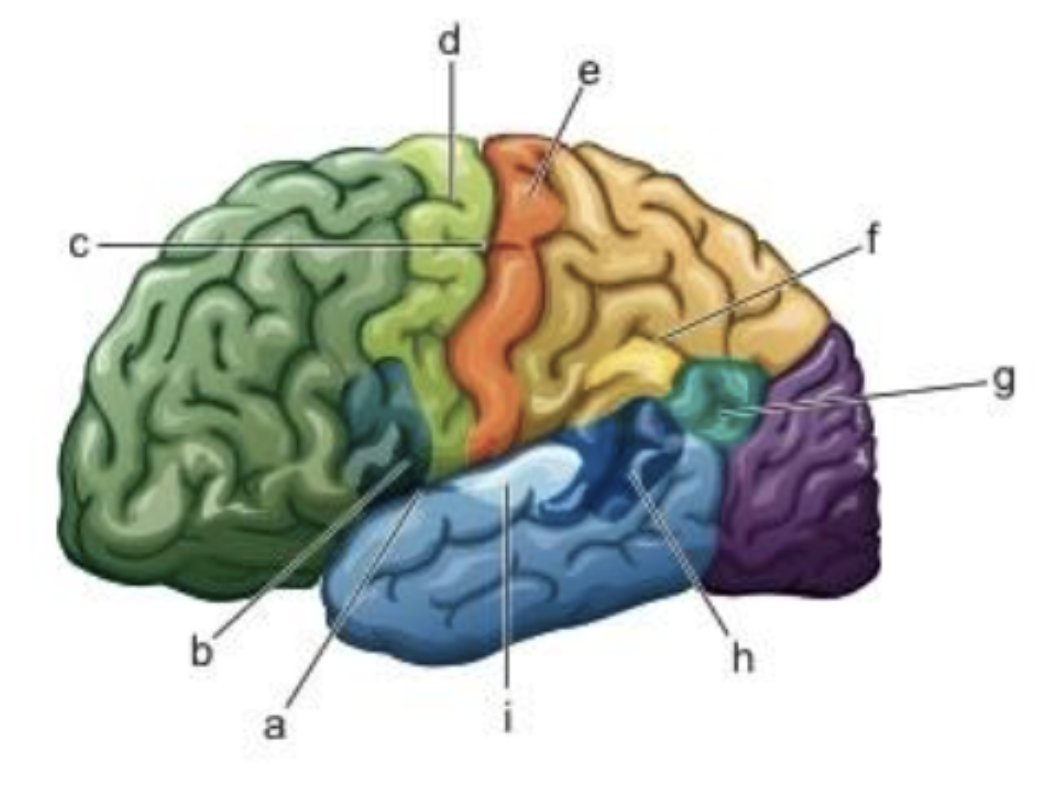
what is C
Central fissure (fissure of Rolando)

What is D?
Primary motor cortex

What is E?
Primary somatosensory cortex
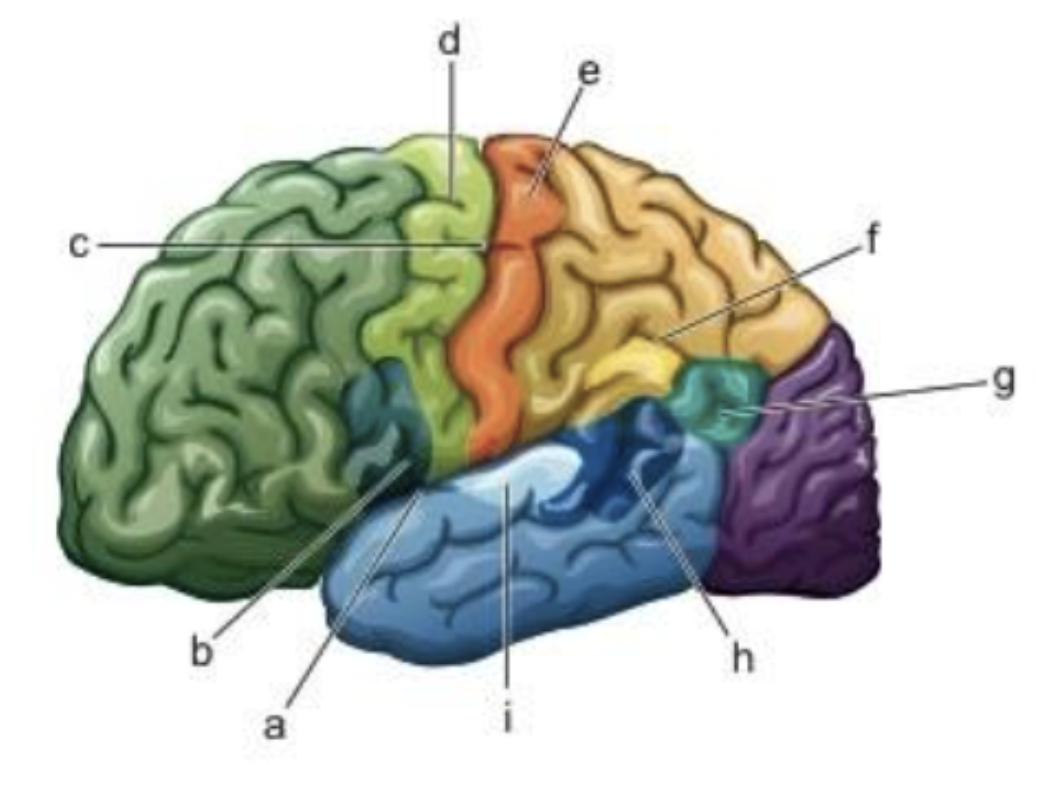
What is F?
Supramarginal gyrus

What is G?
angular gyrus

What is H?
Wernicke’s area
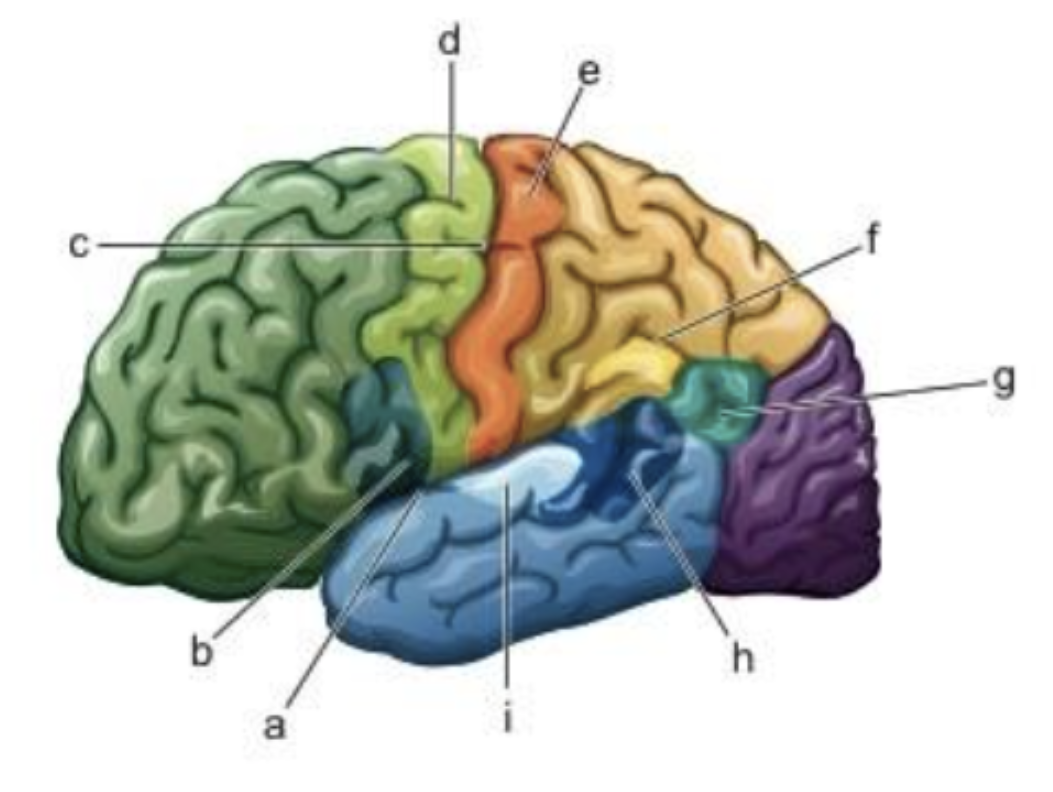
What is I?
Primary Auditory cortex
What are the descending tracts that course through the internal capsule ?
Corticobulbar tract, corticospinal, cortico-thalamic
The ascending tract that courses through the internal capsule is the…
thalamocortical fibers
The basal ganglia includes several subcortical nuclei, some of which are grouped together. Among these grouped nuclei, the lentiform nucleus includes what?
putamen, globus pallidus
What does the striatum include?
putamen and caudate
Where is the facial motor nucelus?
pons
Inferior colliculus location
midbrain
nucleus ambiguus location
medulla
motor nucleus of V location
Pons
Hypoglossal nucleus location
Medulla
The fiber tracts that connect the cerebellum to the spinal cord, brainstem, and thalamus are collectively called the
cerebellar peduncles
The cells that send signals to each other in the nervous system are called…
Neurons
The cells that serve a supporting function but do not send signals are called
glial cells
True or False?: Terminal segments of neurons typically contain only a single type of neurotransmitter
False
True or False?: A single postsynaptic membrane may have neurotransmitter receptors for many different neurotransmitters
True
True or False?:When a presynaptic membrane “dumps” neurotransmitter into the synaptic cleft, the neurotransmitter that does not bind to a post-synaptic receptor cannot be reused
False
True or false?:A postsynaptic membrane may be exposed to many excitatory and inhibitory inputs at the same time
True
True or false:The resting membrane potential of a neural cell is positive.
False
True or false: The cell is depolarized when sodium (Na+) channels open and allow sodium into the cell
True
True or false: At the peak of the action potential, sodium (Na+) channels close and potassium (K+) channels open
True
True or false:When a cell is hyperpolarized, it primed to trigger another action potential
False
Is the Vestibulocochlear VIII motor, sensory or both?
Sensory only
Is the hypoglossal XII nerve motor, sensory or both?
Motor only
Is the accessory XI nerve motor, sensory, or both?
Motor only
Is the trigeminal V nerve sensory, motor or both?
Both
Is the Glossopharyngeal IX nerve sensory, motor or both?
both
Is the facial VII nerve sensory, motor or both?
Both
Is the vagus X nerve motor, sensory or both?
both
Trigeminal-V functions
sensation from face, teeth, palate, gums and anterior 2/3 of tongue
contraction of jaw openers/closers, contraction of mylohoid and tensor veli palatini muscles
Facial - VII
contraction of facial and stapedius muscles / control of salivatory glands
taste to anterior 2/3 of tongue and sensation of external ear
Vestibulocochlear -VIII function
sense audition and vestibular information
Glossopharyngeal IX- function
Taste to posterior 1/3 of tongue; sensation from parts of ear
Contraction of stylo-pharyngeus muscle -a slender, long muscle in the head and neck that helps lift and widen the throat and voice box during swallowing and speech
Vagus-X function
Contraction of pharyngeal muscles, intrinsic laryngeal muscles, and smooth muscle of the pharynx, larynx, and heart
Sensation from pharynx (throat), meninges, heart, gut, and esophagus
Acessory- XI function
contraction of sternocleidomastoid and trapezius muscles
Hypoglossal XII
contraction of all extrinsic muscles of tongue (except glossopharyngeus muscle) and all intrinsic muscles of tongue
Which cranial nerves are innervated from the cortex bilaterally?
IX- Glossopharyngeal
V- Trigeminal
VII- facial (upper)
X- Vagus
XI- accessory
Which cranial nerves are innervated from the cortex contralaterally?
VII- facial(lower)
XII- hypoglossal