BioPsy: Finals L1 - Genetics, Evolution, Development, and Plasticity
 Call Kai
 Learn
Learn Practice Test
 Spaced Repetition
 Match
Match Flashcards
 Knowt Play
1/55

Earn XP
Description and Tags
Name | Mastery | Learn | Test | Matching | Spaced | Call with Kai | Chat |
|---|
No analytics yet
Send a link to your students to track their progress
56 Terms
Genes
Units of heredity that maintain their structural identity from one generation to another.
Chromosomes
Strands of genes.
Homozygous
Having the same genes on your two copies of some chromosome.
Heterozygous
Having an unmatched pair of genes.
Allele
Alternative forms of a gene; represented by a letter.
Human eye color
Comes in two alleles:
B for brown and b for blue.
Genotype
Reflects the genetic makeup of an individual. Represented as a pair of alleles in letters.
Greek: genos=birth; typos=mark
BB
Homozygous dominant
Bb
Heterozygous dominant
bb
Homozygous recessive (or simply, recessive)
Phenotype
The expressed trait of the individual.
Greek: phainein=to appear; typos=mark
BB - The human will have brown eyes.
Bb - The human will have brown eyes.
bb - The human will have blue eyes.
Dominant Gene
Shows a strong effect in either the homozygous or heterozygous condition.
Recessive Gene
Shows its effect only in homozygous condition.
Gregor Johann Mendel
His experiments showed that the inheritance of certain traits in pea plants follows patterns, subsequently becoming the foundation of modern genetics and leading to the study of heredity.
The father of Modern Genetics
Punnet Square
Helps us predict certain outcomes of traits in an organism.
Reginald Punnet and William Baterson.
Creators of the Punnet Square.
Deoxyribonucleic acid (DNA)
Long-term storage of genetic information; transmission of genetic information to make other cells and new organisms.
The hereditary material of an organism; it contains the codes for our physical traits such as eye color, hair color, etc.
Nucleus
DNA is tightly packed into chromosomes, which are located inside our cell’s _______.
Ribonucleic Acid (RNA)
Used to transfer the genetic code from the nucleus to the ribosomes to make proteins.
Used to transmit genetic information in some organisms and may have been the molecule used to store blueprints in primitive organisms.
Structural Features: DNA
B-form double helix
A double-stranded molecule consisting of a long chain of nucleotides.
Structural Features: RNA
A-form helix
Usually a single-strand helix consisting of shorter chain of nucleotides.
Propagation: DNA
Is self propagating.
Propagation: RNA
Is synthesized from DNA on an as-needed basis.
Base Pairing: DNA
AT (Adenine-Thymine)
GC (Guanine-Cytosine)
Base Pairing: RNA
AU (Adenine-Uracil)
GC (Guanine-Cytosine)
Sex Linkage
A special mode of inheritance influenced by sex chromosomes.
Sex-linked
The trait is carried in either X or Y chromosome.
Ex. Color-blindness
Sex-influenced
The heterozygous genotype’s phenotype is influenced by the sex of the individual.
Ex. Baldness
Sex-limited
The trait is carried only by either male or female, but not both.
Ex. Lactation (possible only in females.)
Evolution
A change over generations in the frequencies of various genes in a population.
Evolutionary Psychology
Concerns how behaviors evolved. The emphasis is on evolutionary and functional explanations— that is, how our genes reflect those of our ancestors and why natural selection might have favored the genes that promote certain behaviors.
Altruistic Behavior
An action that benefits someone other than the actor. A gene that encourages altruistic behavior would help other individuals survive and spread their genes, at a possible cost to the altruistic individual.
Kin Selection
Selection for a gene that benefits the individual’s relatives. A gene spreads if it causes you to take great efforts, even risking your life, to protect your children.
Homeobox Genes
Found in vertebrates, insects, plants, even fungi and yeast – regulate the expression of other genes and control the start of anatomical development.
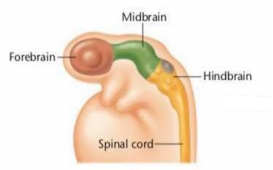
Stage 1: Brain at 3 Weeks
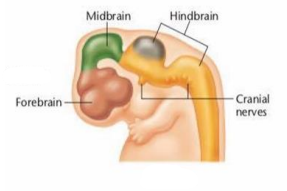
Stage 2: Brain at 7 Weeks
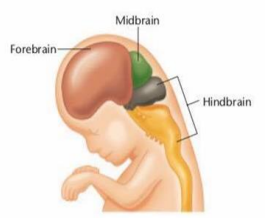
Stage 3: Brain at 11 Weeks
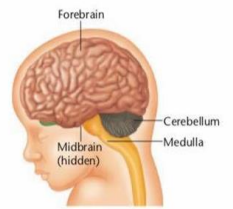
Stage 4: Brain at Birth
Proliferation
The production of new cells. Early in development, the cells lining the ventricles of the brain divide. Some cells remain where they are as stem cells, continuing to divide, whereas others migrate of the migration occurs before birth.
Synaptogenesis
The formation of synapses, begin long before birth, but it continues throughout life, as neurons form a new synapses and discard old ones. The process generally slows in older people, as does the formation of new dendritic branches.
Myelination
Slower stage of neuronal development, the process by which glia produce the insulating fatty sheaths that accelerate transmission in many vertebrate axons.
Myelin
Forms first in the spinal cord and then in the hindbrain, midbrain, and forebrain.
Neuroplasticity
Brain’s ability to change and adapt.
Structural Plasticity
Experiences or memories change a brain’s physical structure.
Functional Plasticity
Brain functions move from damaged area to undamaged area.
Possible Causes of Brain Damage
Includes:
Tumors
Infections
Exposure to radiation
Toxic substances
Parkinson’s Disease
Alzheimer’s Disease
Concussion
A traumatic brain injury that changes the way your brain functions.
The brain is made up of soft tissue. When the skull is jolted too fast or is impacted by something, the brain shifts and hits against the skull.
Can lead to bruising and swelling of the brain, tearing the blood vessels and injury to nerves.
Most are mild and can be treated with appropriate care. But left untreated, it can be deadly.
Cerebrovascular Accident (Stroke)
Temporary interruption of normal blood flow to a brain area.
Ischemia
The result of a blood clot or other obstruction in an artery.
The neurons deprived of blood lose much of their oxygen and glucose supplies.
Hemorrhage
The result of a ruptured artery. Effects of strokes vary from barely noticeable to immediately fatal.
They are flooded with blood and excess oxygen, calcium and other chemicals.
Thrombotic Strokes
Are caused when a blood clot forms in an artery leading to the brain.
Intracerebral Hemorrhage
A weak blood vessel breaking inside the brain.
Embolic Strokes
Begin with a clot forming elsewhere in the body — such as the heart or neck — that breaks loose and travels to the brain.
Subarachnoid Hemorrhage
A weak blood vessel breaking on the surface of the brain
Edema
Increases pressure on the brain and the probability of additional strokes.
Edema and Sodium
The combination of _____ and excess _____ provokes excess release of the transmitter glutamate which overstimulate neurons, damaging both the neurons and synapses.