CAns Organic chem general
 Call Kai
 Learn
Learn Practice Test
 Spaced Repetition
 Match
Match Flashcards
 Knowt Play
1/16

There's no tags or description
Looks like no tags are added yet.
Name | Mastery | Learn | Test | Matching | Spaced | Call with Kai | Chat |
|---|
No analytics yet
Send a link to your students to track their progress
17 Terms
Why is reflux necessary for the preparation of many covalent organic compounds?
Organic compounds contain strong covalent bonds
Heating is needed to provide energy to break these bonds as Ea is high and reaction would be slow -> time is needed for reaction to go to completion
Reflux is necessary to avoid losing volatile reactants and products due to vapourisation during heating
Recrystallisation: explain why a mixture of ethanol and warm water is used to dissolve the aspirin
Mixture of ethanol and warm water can dissolve aspirin and the impurities
When the solution cools, only aspirin will form crystals due to its low solubility in cold water -> this is recrystallisation
Check WHAT attacks (dnt just anyhow pls)
Eg. Free radical sub: CH3CH2CH2CH3 radical is a trigonal planar about electron-deficient C atoms, so the chlorine can attack it from top or bottom with equal probability…
KMnO4: BOTH CO2 and decolourisation!
If the question gives R1 and asks you to deduce structure -> give some random R (Eg. CH3)
Benzene
Liquid at room temperature
C trigonal planar (Bond angle: 120)
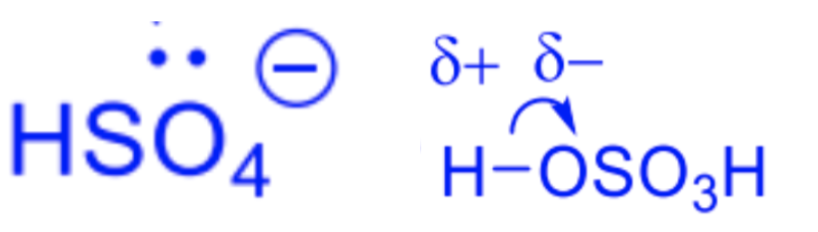
Draw H2SO4
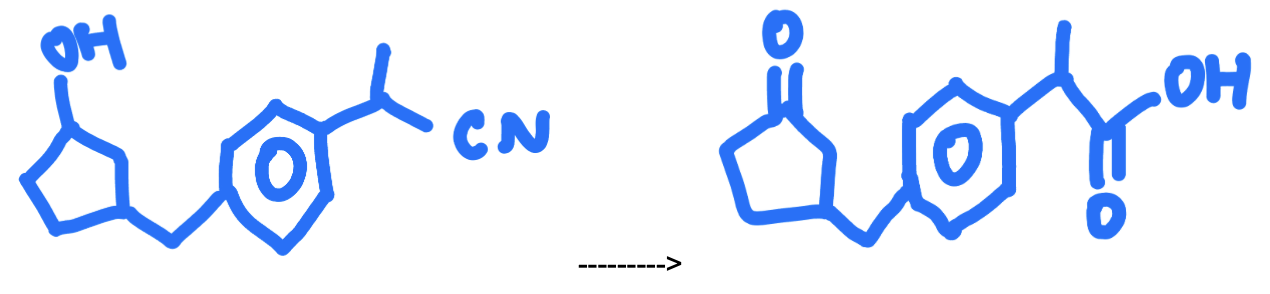
State condition for this reaction
K2Cr2O2 (aq) (NOT KMnO4 -> entire side-chain will become benzoic acid!), H2SO4 (aq), heat
Why phenoxide ion needs to be generated
OH- ion is needed to generate phenoxide ion which is a stronger nucleophile as it is -ve charged
A lone pair of electrons on O is more easily delocalised into the benzene ring -> richer in electrons -> ring can attract electrophiles more easily
Suggest structure of product = include SIDE PRODUCTS
Name the function group
Primary amine, chloroalkane (-CI)
State what H2, Ni + LiAIH4 + NaBH4 can reduce
H2, Ni can reduce C=C (+2H), CN (+4H), RCOR (+2H)
LiAlH4 can reduce CN (+4H), RCOR (+2H), CONH2 (+2H), COOH
NaBH4 can reduce RCOR (+2H)

Draw mechanism
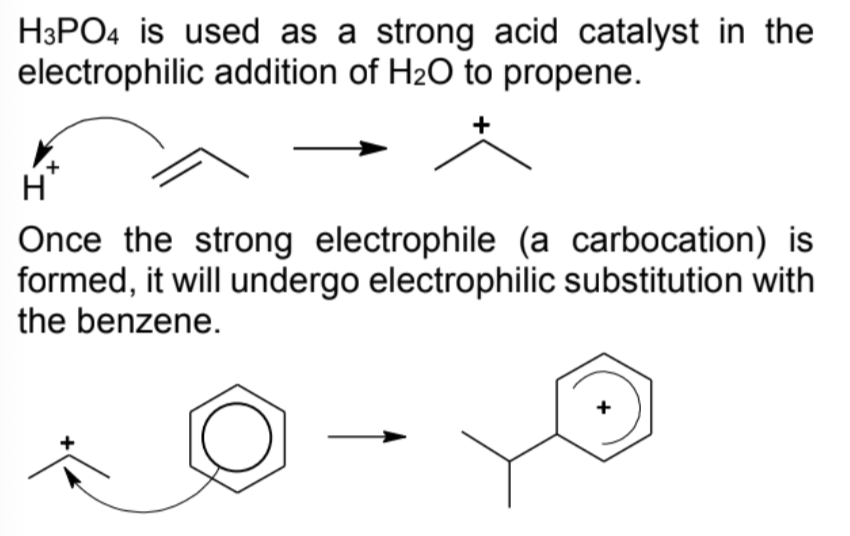
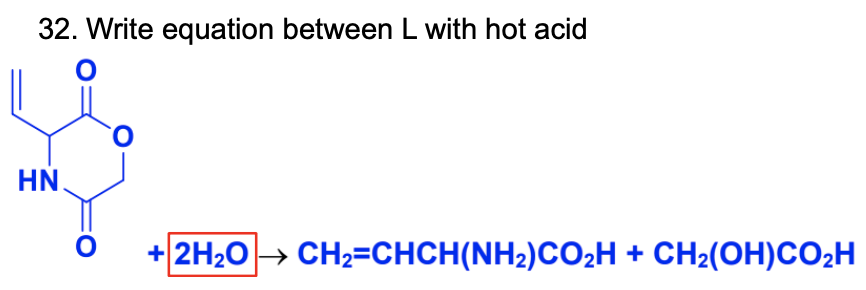
Draw benzene attack CO2 nucleophile

Nucleophilic attack on C atom by another Cl− ion AND simultaneous P=O bond formation and P−Cl bond cleavage to form the products
Starting molecule: CICHROPCI3

Protonation
Starting molecule: OH(CH2)2CHO
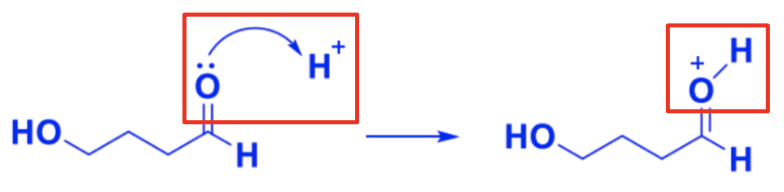
B does not contain aldehyde as there is no oxidation with Fehling’s solution
Compound C:H = 1:1 -> benzene ring
State deduction for “B forms two possible mono-nitro compounds”
B forms two possible mono-nitro compounds -> B is a symmetrical molecule and is 1,4-disubstituted -> D is formed according to the orientating effect of groups already present on the benzene ring