Cognition and language 1
 Call Kai
 Learn
Learn Practice Test
 Spaced Repetition
 Match
Match Flashcards
 Knowt Play
1/25

There's no tags or description
Looks like no tags are added yet.
Name | Mastery | Learn | Test | Matching | Spaced | Call with Kai | Chat |
|---|
No analytics yet
Send a link to your students to track their progress
26 Terms
Thinking
Manipulating mental representations (images or words) for a purpose
Contextual: remembering, reasoning, believing, concentrating, imagining, problem solving
Cognition involves using internal representations to work toward a goal
Problem solving
Transforming an initial problem state into a goal/solution state using operators (actions or steps)

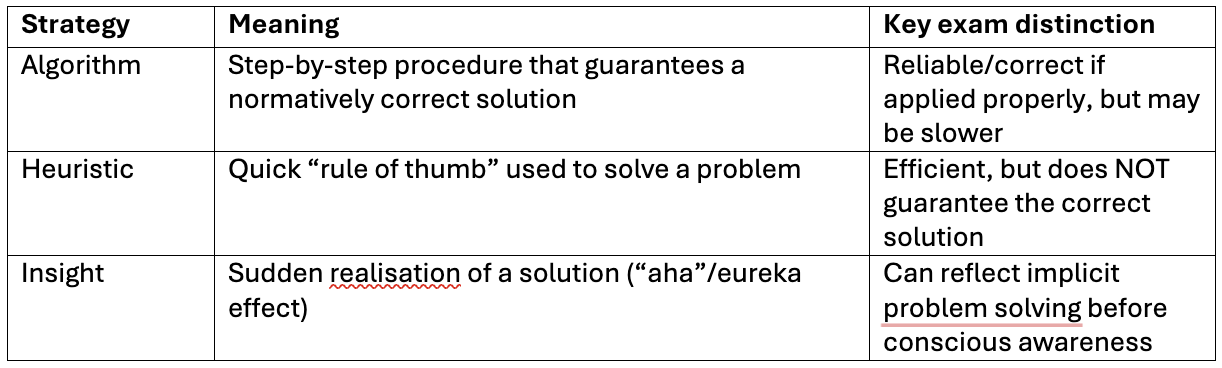
Types of problem solving

Problem-Solving strategies
Obstacles to Problem Solving
Fixation
Mental set
Functional fixedness
Negative transfer
Focusing on irrelevant info
Fixation
Inability to see a problem from a new perspective
Mental set
Continuing to use a strategy that worked before even when it is not suitable for the current problem
Functional fixedness
Seeing an object only in terms of its usual function, making alternative uses harder to notice
Negative transfer
Prior learning makes learning, remembering, or solving a new problem more difficult
Focusing on irrelevant info
Failing to separate info that matters for the solution from info that does not
Aids to Problem Solving
Positive transfer
Analogy
Incubation
Positive transfer
Previous learning or experience helps solve a new problem
Analogy
Recognising that a current problem is similar in structure to a problem solved previously
Incubation
Temporarily stepping away or ‘clearing your head’
Returning later may help a solution emerge
Heuristics
Reduce cognitive effort by allowing fast judgments but their shortcuts can produce systematic errors
Types of heuristics

Decision-making biases

Cognitive economy
Reducing cognitive effort through efficient mental shortcuts/simplified processing
Heuristics allow quick decisions without analysing every possible piece of info
Trade-off: efficiency saves time and mental resources, but can increase bias and judgment errors
Objects
Classified into groups based on their properties
Category
Collection of objects, actions and characteristics that share core properties
Concept
Knowledge you have about a particular category
Defining features
Qualities that are essential for membership
Characteristic features
Qualities that are typical of members
Prototype
An abstraction across many instances of a category of things
Categorisation
Recognising an object as a member of a category
Schema
Complex mental representations of people objects and situations that influence world-processing