[PHARMACEUTICAL MANUFACTURING] PACOP VIOLET
 Call Kai
 Learn
Learn Practice Test
 Spaced Repetition
 Match
Match Flashcards
 Knowt Play
1/299

There's no tags or description
Looks like no tags are added yet.
Name | Mastery | Learn | Test | Matching | Spaced | Call with Kai | Chat |
|---|
No analytics yet
Send a link to your students to track their progress
300 Terms
Active Pharmaceutical Ingredients (API)
or bulk drug substance may be
discovered or obtained by
I. Synthetic biotechnology
II. Isolation from natural sources
III. Serendipitous new drug effect
discovery
a. I only b. III only c. I & II d. II & III e. I, II & III
e. I, II & III
Rx product life cycle phases that
involves regulatory submission for
additional dosage forms or new
therapeutic indications;
a. Discovery
b. Development
c. Commercialization
d. Termination
e. None of these
c. Commercialization
Which of the following phases of human
clinical testing match with their
prescription?
I. Phase I - testing the product in
larger groups in patients with
the disorder or disease
II. Phase II - testing may also take
place with special populations
such as renal or hepatic
impairment, pediatrics or
elderly subjects
III. Phase III - randomized,
controlled testing on large
patient populations to make
definitive assessment of drug
efficacy
a. I only
b. III only
c. I & II
d. II & III
e. I, II & III
b. iii only
4. Practice of pharmacy that involved
primarily with government regulations
and policies associated with all aspects
of products: a. Marketing Manager
b. Medical Information Specialist
c. Public Policy Specialist
d. Regulatory Affairs Manager
e. Product Representative
d. Regulatory Affairs Manager
Phase of human clinical trial testing that
assess dosing requirements:
a. Phase II
b. Phase IIA
c. Phase IIB
d. Phase III
e. Phase IV
b. phase iia
Particle size is a basic property of a
powder. Which of the following
expression of diameter that describes
the distance between pairs of parallel
tangents to the projected outline of the
particle in some fixed direction?
a. Martin's diameter, dm
b. Sieve diameter, da
c. Perimeter diameter, dp
d. Feret's diameter, df
e. Aerodynamic diameter, daero
d. feret's diameter
7. Expression of diameter that represents
the particle size of a powder having the
length of a chord equally dividing the
projected outline of the particle in some
fixed direction;
a. Martin's diameter, dm
b. Feret's diameter, df
c. Stokes diameter, dst
d. Equivalent volume diameter, dv
e. Sieve diameter, da
a. martin's diameter
8. This method is used to determine the
diameter of a sphere having the same
volume (V) as the particle (Equivalent
volume diameter, dv);
a. Sedimentation method
b. Anderson impactor method
c. Microscopic method
d. Coulter counter method
e. Light scattering method
d. Coulter counter method
9. Which method is widely used to
determine the crystallinity of a solid
powder?
a. Xray diffraction (XRD)
b. Angle of repose (a)
c. Photo correlation spectroscopy
(PCS)
d. None of these
e. All of these
- a. Xray diffraction (XRD)
10. If the % compresability of a powder is
23-35%, the powder flowability is ____
a. Extremely poor
b. Poor
c. Fair
d. Good
e. Excellent
B. POOR
11. The function of Material Inspection
Section in a manufacturing plant is:
I. To validate existing and
tentative procedures of testing
II. To sample and examine all raw
materials received
III. To maintain periodic
examination on the quality of
inventories throughout all
phases of storage, shipping and
distribution
a. I only
b. III only
c. I & II
d. II & III
e. I, II & III
D
12. A classification of defect which may
affect the function of the object and
therefore, may render the product
useless (eg.,presence of a crack in a
bottle):
a. Internal defect
b. Major defect
c. Minor defect
d. Critical defect
e. Variable defect
B.
13. A classification of defect which is not
seen although present:
a. Internal defect
b. Major defect
c. Minor defect
d. Performance defect
e. Attributable defect
A
14. A suppository that does not melt at body
temperature, is an example of what
defect? a. Attribute defect
b. Variable effect
c. Performance defect
d. Internal defect
e. Critical defect
C
15. The maximum percent defective of the
maximum number of defects per
hundred units that for purposes of
sampling inspection, can be considered
satisfactory as a process average;
a. Acceptable quality level
b. Risk of error
c. Consumer's risk
d. Producer's risk
e. None of these
A
16. The process of optimizing a drug
through the determination and/or
definiton of those physical and chemical
properties considered important in the
formulation of a stable, effective and
safe dosage form;
a. Batch formula
b. Master formula
c. Formulation
d. Preformulation
e. None of these
D
17. Purified water, USP is water obtained
by;
I. Distillation
II. Ion-exchange treatment
III. Reverse osmosis
a. I only
b. III only
c. I & II
d. II & III
e. I, II & III
E
18. Which of the following may be added in
syrup to retard crystallization of sucrose
or to increase the solubility of added
ingredients?
I. Glycerin
II. Sorbitol
III. Honey
a. I only
b. III only
c. I & II
d. II & III
e. I, II & III
C
19. Brady and whisky are example of spirits
that are prepared by:
a. Distillation
b. Maceration
c. Chemical reaction
d. Simple solution
e. Admixture
A
20. The emulsion is prepared by adding
water and oil alternately to the
emulsifying agent. This method of
preparation is:
I. Alternate addition method
II. English method
III. Soap method
a. I only
b. III only
c. I & II
d. II & III
e. I, II & III
C
21. The equipment used in the preparation
of emulsion wherein the dispersion of
two liquids is achieved by forcing the
mixture through a small inlet orifice at
high pressures.
a. Agitator or mechanical stirrers
b. Homogenizers
c. Ultrasonifiers
d. Colloid mills
e. Both A and C
B
22. A basic desirable property of a
suspension wherein the dispensed
phase should settle slowly without
forming a hard cake:
a. Slow sedimentation rate
b. Resuspendable or redispersible
c. Pourable
d. Chemical stable
e. Acceptable to the consumer
A
23. Mechanical properties of plastic
packaging material that has the ability to
withstand shock-loading, where a
specimen receives a blow from a
swinging pendulum as an example:
a. Tear strength
b. Flex resistance
c. Fatigue resistance
d. Impact strength
e. creep failure
D
24. The plastic processing method
employed for pharmaceutical packaging
components that is being heated to a
melted or viscous state and forced
under pressure through a die, resulting
in a configuration of desired shape:
a. Blow molding
b. Injection molding
c. Compression molding
d. Solvent casting
e. Extrusion
e
25. The selection and approval of a polymer
type is as important as the need to
check it routinely against the criteria
used in its selection. Which of the
following basic areas of control and/or
procedures are recommended?
I. Tissue-cell toxicity testing
II. Characterization analysis
III. Routinely inspect for
dimensional and attribute
variables
a. I only
b. III only
c. I & II
d. II & III
e. I, II & III
e
26. Which of the following is to be added to
make a flexible collodion?
I. Glycerin
II. Camphor
III. Castor oil
a. I only
b. III only
c. I & II
d. II & III
e. I, II & III
d
27. This refers to the quantity of dosage
form in the final packaging (excluding
the shipping carton) of a drug product
bearing the required labeling
information:
a. Pack size
b. Net content
c. Primary label
d. Lot number
e. Dosage strength
a
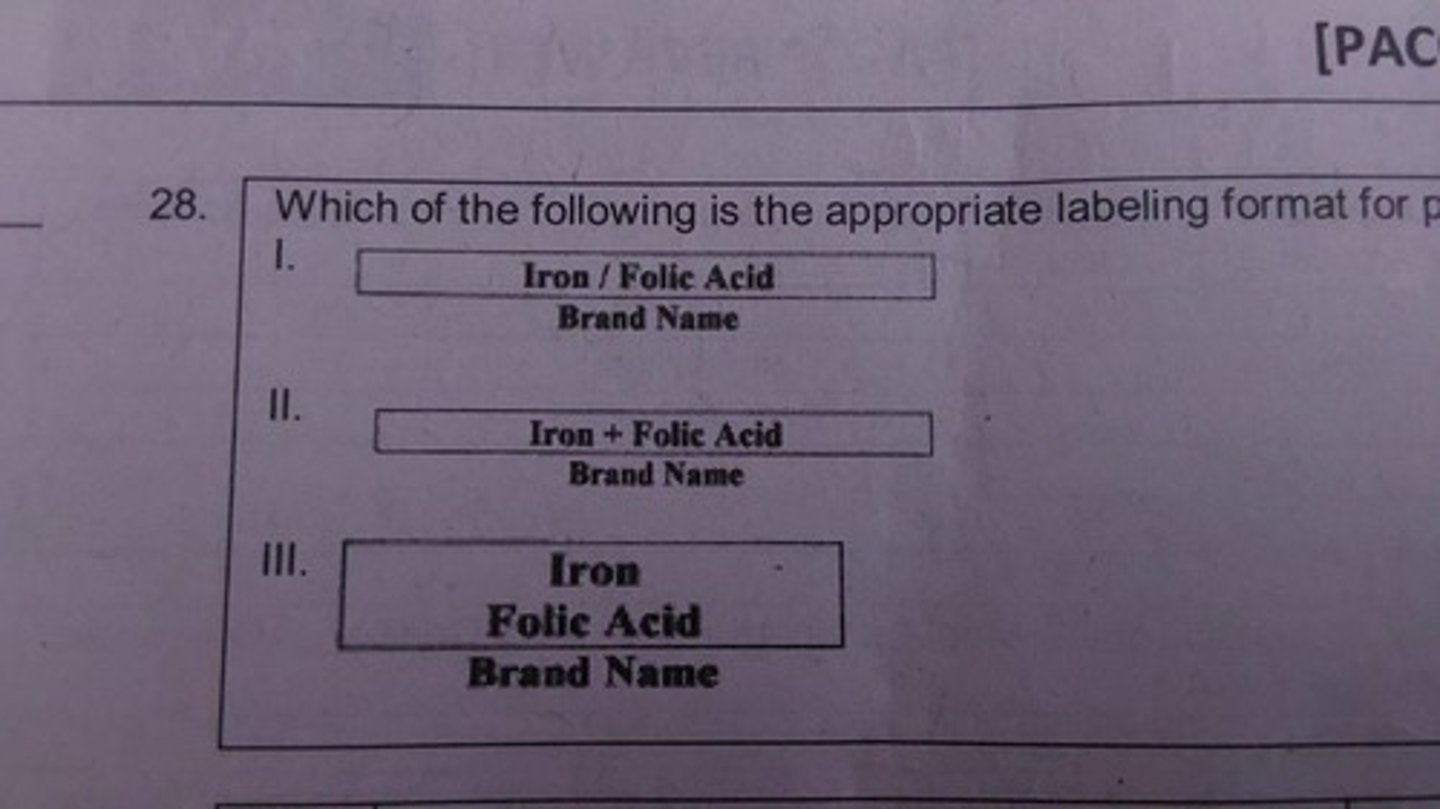
28. Which of the following is the appropriate
labeling format for products with multiple
API's?
I.
[Iron / Folic Acid]
Brand Name
II. [Iron +Folic Acid]
Brand Name
III. [ iron ]
[Folic Acid]
Brand Name
a. I only
b. III only
c. I & II
d. II & III
e. I, II & III
e
29. Which of the following special labeling
instructions is/are correctly paired with
their properties?
I. "Do not refrigerate or freeze" -
cannot tolerate excessive heat
II. "Store and transport not above
30ºC" - cannot tolerate freezing
III. "Store in dry conditions" -
hygrodcopic
a. I only
b. III only
c. I & II
d. II & III
e. I, II & III
b
30. Which of the following is/are correct
labeling format for product's
manufacturing and expiration date?
a. 03 Jun 2007
b. June 2007
c. 06/07
d. Both A and B
e. Both B and C
d
31. The caution statement, "Food, Drugs,
Devices, and Cosmetics Act prohibits
dispensing without prescription" shall
always be included in the:
I. Primary label including blister
pack and foil strip
II. Package insert
III. Unit carton
a. I only
b. III only
c. I & II
d. II & III
e. I, II & III
d
32. A pharmaceutical form of an active
ingredient or placebo being tested or
used as reference in a clinical trial:
a. Generic product
b. Investigational product
c. Formulation
d. Herbal products
e. Traditional products
b
33. For products that are intended for
external use, the statement "For
external use only" shall appear on all
labeling materials. Which of the
following is the correct format?
a. Capital letters against a red
background or printed in red font
b. Capital letters against a red
background or printed in black font
c. Capitalized each word and printed in
red font
d. Capitalized each word against a
black background and printed in
white font
e. Capitalized each word and printed in
black font
a
34. Which of the following is extremely to
the requisites provided by AO 2016-
0008?
I. Veterinary products
II. Drug products manufactured for
export
III. Investigational products
a. I only
b. III only
c. I & II
d. II & III
e. I, II & III
c
35. Which of the following is/are mandatory
information for blister packs/foil strips
packaging?
I. Name and/or logo of the MAH
on each unit for single API, or
every two (2) units for multiple
APIs II. Name and address of the
Manufacturer
a. I only
b. III only
c. I & II
d. II & III
e. I, II & III
c
36. Erweka testes, Schleuniger tester, and
Strong-Cobb tester are example of
devices used to test:
a. Tablet weight variation
b. Tablet hardness
c. Tablet disintegration
d. Tablet dissolution
e. Tablet content uniformity
b
37. These are synthetic derivatives (eg.,
esters and amides) of drug molecules
that may have intrinsic pharmacological
activity but usually must undergo some
transformation in vivo to liberate the
active drug molecule:
a. Molecular optimization
b. Prodrug
c. Preformulation
d. Investigational new drug
e. None of these -b
38. Which of the following factors can
directly contribute to content uniformity
problems in tablets?
I. Segregation of the powder
mixture or granulation during the
various manufacturing
processes
II. Non uniform distribution of the
drug substance throughout the
powder mixture or granulation
III. Tablet weight variation
a. I only
b. III only
c. I & II
d. II & III
e. I, II & III
e
39. The partial or complete separation of the
top or bottom crowns of a tablet form the
main body;
a. Lamination
b. Capping
c. Sticking
d. Picking
b
e. Mottling
40. The unequal distribution of color on a
tablet, with light or dark areas standing
out in an otherwise uniform surface;
a. Capping
b. Picking
c. Lamination
d. Mottling
e. Sticking
d
41. A term used to describe the surface
material from a tablet that is sticking and
being removed from the tablet's surface
by a punch:
a. Lamination
b. Sticking
c. Picking
d. Capping
e. Mottling
c
42. Tablet lamination or capping problems
are often aliminated by:
I. Addition of colloidal silica to the
formula
II. Slowing the tablet rate
III. Reducing the final compression
pressure
a. I only
b. III only
c. I & II
d. II & III
e. I, II & III
d
43. To overcome the mottling problem, the
preventive measure is:
I. The formulator may change the
solvent system
II. Change the binder system
III. Reduce the drying temperature
a. I only
b. III only
c. I & II
d. II & III
e. I, II & III
e
44. "Arching" or "bridging" and "rat-holing"
are problems associated with weight
variation of tablets, specifically:
a. Granule size and size distribution
before compression
b. Poor flow c. Punch variation
d. Hardness variation
e. Double compression
b
45. Granule density may influence the
following:
a. Compressibility
b. Tablet porosity
c. Surface tension
d. Both a & b
e. Both b & c
d
46. When the initial blend of powders is
forced into the dies of a large-capacity
tablet press and is compacted by means
of a flat-faced punches, the compacted
masses are called:
a. Slugs
b. Compaction rolls
c. Tablet presses
d. Both a & b
e. Both a & c
a
47. Which of the following tablet excipients
match with their example?
I. Binders - gelatin
II. Disintegrants - PEG
III. Diluents - stearic acid
a. I only
b. III only
c. I & II
d. II & III
e. I, II & III
a
48. Maillard reaction is:
a. Low concentrations of unbound
moisture
b. Forming a eutectic mixture
c. Form insoluble complexes and salts
d. Lead to browning and
discoloration with certain drugs
e. Containing tightly bound water but
having a low remaining moisture
demand
d
49. Advantage of mannitol as a talet diluent:
I. It is widely used in chewable
tablets
II. Relatively non hygroscopic
III. Excellent flow characteristics
a. I only
b. III only
c. I & II
d. II & III
e. I, II & III
-c
50. Dipac is a sucrose-based diluent
containing __ sucrose plus __ modified
dextrins:
a. 7%, 10%
b. 97%, 3%
c. 95%, 4%
d. 50%, 74%
e. 10%, 25%
b
51. The following are used as tablet
disintegrants, except:
a. Ethyl cellulose
b. Starch, USP
c. Primogel
d. Explotab
e. Ac-Di-Sol
a
52. Lubricants differs with anti-adherents
because lubricants are:
a. Reducing the sticking of any of the
tablet granulation or powder to the
faces of the punches or to the die
wall
b. Intended to promote flow of the
tablet granulation or powder
materials by reducing friction
between the particles
c. Intended to reduce the friction
during tablet ejection between the
walls of the tablet and the walls of
the die cavity in which the tablet
was formed
d. Both a & b
e. Both b &c
c
53. Syloid and Aerosil are materials used
as;
a. Glidants
b. Lubricants
c. Antiadherents
d. Flavors
e. Sweeteners
a
54. The purpose of this type of tablet is to
prevent the multiplication of bacteria in
the empty socket following a tooth
extraction by employing a slow releasing antibacterial compound or to
reduce bleeding:
a. Implantation tablets
b. Effervescent tablelts
c. Troches
d. Dental cones
e. Lozenges
d
55. The purpose of this tablet is to provide
prolonged drug effects, ranging from
one month to a year.
a. Sustained-release tablets
b. Implantation tablets
c. Dental cones
d. Vaginal tablets
e. Tablet triturates
b
56. Components of an effervescent tablets,
except:
a. Carbolic acid
b. Sodium bicarbonate
c. Citric acid
d. Tartaric acid
e. None of these
a
57. Vaginal tablets are also called ____
a. Packets
b. Implants
c. Inserts
d. Both a & b
e. Both b &c
c
58. The following type of tablets are rarely
used today, except:
a. Tablet triturates
b. Dispensing tablets
c. Hypodermic tablets
d. Effervescent tablets
e. None of these
d
59. Objectives of tablet coating include:
I. To control the release of the
drug from the tablet
II. To mask the taste, odor, or color
of the drug
III. To provide physical and
chemical protection for the drug
a. I only
b. III only
c. I & II
d. II & III
e. I, II & III
e
60. The following are the general types of
equipment used in most coating
processes, except:
a. The fluidized bed
b. The standard coating pan
c. The perforated coating pan
d. Day-Nauta processor
e. Air suspension
d
61. The basic sugar coating process
involves steps, except:
a. Syruping
b. Polishing
c. Bending
d. Subcoating
e. Sealing
c
62. The step in coating process that cover
and fill in the imperfections in the tablet
caused by subcoating step:
a. Polishing
b. Syruping
c. Subcoating
d. Bending
e. Sealing
b
63. The following are properties of an ideal
enteric coationg material, except:
a. Ease of application without
specialized equipment
b. Formation of a continuous film
c. Resistance to gastric fluids
d. Stability alone and in coating
solutions
e. Inability to be applied to
debossed tablets
e
64. Which of the following plasticizers is
used primarily for organic-based coating
solutions?
I. Spans
II. Castor oil
III. Propylene glycol
a. I only
b. III only
c. I & II
d. II & III
e. I, II & III
c
65. A commercially available colorants of
coating solution without additional milling equipment that gives opaquant
color concentrate for sugar coating:
a. Opalux
b. Opasparay
c. Opadry
d. Opagangnam
e. Opaquant-Extenders
a
66. These are very fine inorganic powders
used in the coating solution formulations
to provide more pastel colors and
increase film coverage:
a. Opagangnam
b. Opadry
c. Opaquant-extenders
d. Opaspry
e. Opalux
c
67. A film defect that caused by over wetting
or excessive film tackiness causes
tablets to stick to each other or to the
coating pan giving a "picked"
appearance to the tablet surface:
a. Roughness
b. Blistering
c. Cracking
d. Sticking and Picking
e. Orange-Peel Effects
d
68. A film defect that has a gritty surface
often observed when the coating is
applied by a spray:
a. Cracking
b. Sticking and picking
c. Roughness
d. Bridging and filling
e. Orange-Peel Effects
c
69. A film defect that resulted from
inadequate spreading of the coating
solution before drying causes a bumpy
effect on the coating:
a. Orange-Peel Effects
b. Hazing/Dull film
c. Roughness
d. Blistering
e. Bridging and filling
a
70. During drying, this film defect may
shrink and pull away from the sharp
corners of an intagliation or bisect and
results in a thick film that fills and
narrows the monogram or bisect that is
caused by applying too much solution.
a. Hazing/Dull film
b. Cracking
c. Blistering
d. Color variation
e. Bridging and filling
e
71. When coated tablets require further
drying in ovens, too rapid evaporation of
the solvent from the core and the effect
of high temperature on the strength,
elasticity and adhesion of the film may
result this defect.
a. Cracking
b. Bridging and Filling
c. Roughness
d. Blistering
e. Color Variation
d
72. This film defect is sometimes called
bloom because it can occur when too
high a processing temperature is used
for a particular formulation:
a. Blistering
b. Hazing/Dull film
c. Cracking
d. Orange-Peel Effects
e. Sticking and Picking
b
73. The film defect problem can be caused
by processing conditions or the
formulation:
a. Color variation
b. Bridging and Filling
c. Cracking
d. Roughness
e. Blistering
a
74. This film defect occurs if internal
stresses in the film exceed the tensile
strength of the film:
a. Cracking
b. Color variation
c. Roughness
d. Blistering
e. Orange-Peel Effects
a
75. The specialized coating is an efficient
method of applying coating to
conductive substrates:
a. Vacuum Film Coating
b. Dip Coating
c. Electrostatic Coating
d. Compression Coating
e. None of these
c
76. This type of specialized coating requires
a specialized tablet machine:
a. Vacuum film coating
b. Dip coating
c. Electrostatic coating
d. Compression coating
e. None of these
d
77. This specialized coating is applied to the
tablet cores by dipping them into the
coating liquid:
a. Vacuum film coating
b. Dip coating
c. Electrostatic coating
d. Compression coating
e. None of these
b
78. This is a new specialized coating
procedure that employs a specially
designed baffled pan:
a. Vacuum film coating
b. Dip coating
c. Electrostatic coating
d. Compression coating
e. None of these
a
79. This component is added to most tablet
formulation to facilitate the breakup of
the tablet when it comes in contact with
water in the GIT:
a. Lubricant
b. Disintegrants
c. Binders
d. Diluents
e. Glidants
b
80. Thia is tablet component that make up
the major portion of the tablet:
a. Binders
b. Diluents
c. Disintegrants
d. Lubricants
e. Dyes
b
81. PVP in alcohol, ethylcellulose, methyl
cellulose in chloroform will bind what
characterisics of drugs?
a. Heat-sensitive
b. Heat-resistant
c. Water-sensitive
d. Water-resistant
e. Both a and d
c
82. A maximum of ___ of soluble dye is the
"rule of the thumb" in concentration of
colorants to be used:
a. 0.01%
b. 0.02%
c. 0.03%
d. 0.04%
e. 0.05%
c
83. The dry method for preparing tablet
is/are composed of:
a. Direct Compression
b. Granulation of Compression
c. Wet Granulation
d. Both a and b
e. Both b and c
d
84. A tablet processing problem that
resulted from the removal of edges of
tablet:
a. Capping
b. Lamination
c. Chipping
d. Mottling
e. Picking
c
85. A type of mechanical hardness tester
that operates with the same principle as
applies:
a. Eureka instrument
b. Stokes Monsato
c. Strong Cobb
d. Pfizer Hardness tester
e. None of these
d
86. The USP limit for content uniformity:
a. 70-100%
b. 65-95%
c. 50-100%
d. 100-120%
e. 85-115%
e
87. The general advantages of multilayered
tablets are, except:
a. Two incompatible drugs may be
kept separate by interposing an inert
substance between them
b. Each layer may have a separate
color for identity
c. Accurate control of the delayed
action portion of tablets is possible
d. All of these
e. None of these
e
88. The general method of preparing
effervescent tablets:
a. Wet fusion
b. Heat fusion
c. Cold fusion
d. Both a and b
e. Both c and d
d
89. The sustained release tablets are
intended to provide:
I. Absorption through the oral
mucosa for immediate release
of the medication
II. Immediate release of an amount
of drug that promptly produces
desired therapeutic effect
III. Gradual and continual release
of the other amounts of drug to
maintain this level of effect
a. I only
b. III only
c. I & II
d. II & III
e. I, II & III
d
90. The essential property to be possessed
by tablet granulation is:
I. Fluidity
II. Compressibility
III. Plasticity
a. I only
b. III only
c. I & II
d. II & III
e. I, II & III
c
91. This additive/s and component/s added
to formulation of tablets:
a. Binders
b. Disintegrants
c. Diluents
d. Lubricants
e. All of these
e
92. Method of preparing components for
tablet comprpession include:
I. Heat methods
II. Wet methods
III. Dry methods
a. I only
b. III only
c. I & II
d. II & III
e. I, II & III
d
93. Component of film coating solution that
provides water permeability
a. Cellulose acetate phthalate
b. Polyethlylene glycol
c. Plasticizer
d. Surfactant
e. Colorants
b
94. Polyoxyethylenesorbitian is an example
of ___ that enhance spreadability of the
film during application:
a. Plasticizer
b. Cellulose acetate phthalate
c. Colorants
d. PEG
e. Surfactant
e
95. The function of this component of
coating solution is to form a smooth thin
film under ordinary coating process:
a. Surfactant
b. Polyethylene glycol
c. Cellulose acetate phthalate
d. Plasticizer
e. Colorants
c
96. Castor oil is an example of ____ that
produce flexibility and elasticity of the
tablet coating:
a. Plasticizer
b. Colorants
c. Cellulose acetate phthalate
d. Surfactant
e. PEG
a
97. These are added to film coating to make
the tablet elelgant and distinctive:
a. PEG
b. Cellulose acetate phthalate
c. Plasticizer
d. Colorants
e. Surfactant
d
98. According to USP, it is a state in which
any residue of the tablet, except the
fragments of insoluble coating remains
on the screen is a soft mass having no
firm core:
a. Friability
b. Weight variation tolerance
c. Content uniformity
d. Disintegration time
e. Tablet thickness
d
99. Disintegration apparatus:
I. Constant heat
II. Basket
III. A motor with lever
a. I only
b. III only
c. I & II
d. II & III
e. I, II & III
e
100. The equipment used in
spheronization:
a. Homogenizer
b. Agitator machine
c. Colloid mills
d. Marumerizer machine
e. Mechanical stirrer machine
d