Chpt 21 Microevolution
 Call Kai
 Learn
Learn Practice Test
 Spaced Repetition
 Match
Match Flashcards
 Knowt Play
1/83

There's no tags or description
Looks like no tags are added yet.
Name | Mastery | Learn | Test | Matching | Spaced | Call with Kai | Chat |
|---|
No analytics yet
Send a link to your students to track their progress
84 Terms
A group of individuals of a single species that live together in the same place and time is referred to as a(n) ____.
c. population
The development of penicillin-resistant bacteria represents an example of ____.
d. microevolution
What is the most accurate definition of microevolution?
a. heritable changes in the genetics of a population
Bacterial resistance to penicillin began to appear ____.
e. within a few years of its introduction into general use
Characters that exist in two or more discrete states are described as exhibiting ____.
b. qualitative variation
The existence of discrete variants of a particular character is known as ____.
d. a polymorphism
Mendel inferred the genetic basis of ____, such as flower color in peas, by crossing plants with different phenotypes.
e. qualitative traits
- John G. Swallow and his colleagues used ____ techniques to demonstrate that the observed differences in activity levels of house mice have a genetic basis.
a. artificial selection
- Researchers study the inheritance of particular human traits by ____.
c. analyzing genealogical pedigrees
- Most new alleles probably arise from ____.
d. small-scale mutations in DNA
- In the 1960s, evolutionary biologists identified protein polymorphisms using ____, which allowed them to infer how much genetic variation exists within populations.
b. gel electrophoresis
- The Hardy-Weinberg formula is used to calculate changes in ____.
c. allele frequencies
- In humans, a diploid organism, an individual's genotype includes ____ of each autosomal gene.
b. two copies
- The sum of all gene copies at all gene loci in all individuals in a population defines a ____.
d. gene pool
- The gene locus governing flower color in snapdragons exhibits ____ because heterozygous individuals appear pink while homozygous individuals are either white or red.
e. incomplete dominance
- For an autosomal gene locus, there are ____ possible genotypes and ____ possible alleles.
c. three; two
- In some studies that use observational rather than experimental data, investigators develop ____, which conceptually predict what they would see if a particular factor had no effect.
b. null models
- The Hardy-Weinberg principle specifies the conditions under which a population of diploid organisms achieves ____.
e. genetic equilibrium
- According to the Hardy-Weinberg principle, microevolution occurs when ____.
a. a population experiences a shift in allele frequencies
- In an isolated population of fruit flies, 4 percent of the individuals have pink eyes, a homozygous recessive condition, and 96 percent have the dominant black eye phenotype. What percentage of the population are heterozygotes?
a. 32%
- Which circumstance violates the conditions of the Hardy-Weinberg model?
e. nonrandom mating with respect to genotypes occurs between individuals
- The agent of microevolutionary change that is most likely to introduce genetic variation from another population is referred to as ____.
b. gene flow
- Microevolutionary change resulting from the differential survivorship or reproduction of individuals with different genotypes is known as ____.
d. natural selection
- If there are two alleles for a gene in a population, and the frequency of the dominant allele (p) is .5, then the frequency of the recessive allele (q) is ____.
a. .5
In humans, ____ mutations cause forms of Ehlers-Danlos syndrome, a disruption of collagen synthesis that may result in loose skin or weak joints.
b. deleterious
If a lethal mutation occurs in a dominant allele, ____ individuals will die from its effects
d. both homozygous dominant and heterozygous
Dispersal agents, such as pollen-carrying wind or seed-carrying animals, are responsible for ____ in most plant populations because they often introduce novel alleles into a population.
a. gene flow
The phenomenon of chance events causing the allele frequencies in a population to change unpredictably is known as ____.
a. genetic drift
- On occasion, a stressful factor such as disease, starvation, or drought kills a large proportion of the individuals in a population, producing ____ that dramatically reduces the population size.
e. a population bottleneck
- The contribution an individual makes to the gene pool of the next generation compared to the contributions of other individuals is called ____.
c. relative fitness
Microevolution is ____.
d. a change in allele frequencies within a population
- The high incidence of Ellis-van Creveld syndrome among the Old Order Amish population is caused by ____.
d. inbreeding
- The source of new alleles within a population is ____.
b. mutation
- The only survivors of a colony on Venus are a man and a woman, who both happen to originally be from southern Ukraine. Their descendants will show the effect of ____.
a. genetic drift
- The process by which successful traits become more common in subsequent generations is called ____.
c. natural selection
- Natural selection acts upon the ____ to create microevolutionary change.
e. phenotype of an individual organism
- Dog breeders produced the long body and short legs of a dachshund by employing ____ selection.
b. directional
- With ____ selection, the frequency of the mean phenotype decreases while the frequencies of extreme phenotypes increase.
c. disruptive
- Directional selection favors ____.
b. phenotypes at one end of the distribution
- Natural selection that shifts the adaptation of an entire population is known as ____.
b. directional selection
- Natural selection results in ____.
a. adaptation
- Changing environmental conditions would most likely cause an existing species to undergo ____.
c. directional selection
- Genetic drift is most likely to lead to ____.
c. the founder effect
- Natural selection exerts little or no effect on traits that appear during an individual's ____.
d. postreproductive life
- When a few individuals colonize a distant locality and start a new population, the allele frequencies of the gene pool may be different than those in the original population. This is known as ____.
a. the founder effect
- Very small and very large human newborns are less likely to survive than those born at an intermediate weight due to ____.
e. stabilizing selection
- Genetic drift will have a progressively larger impact on allele frequencies in a population as ____.
b. population size decreases
- Andrew P. Hendry and colleagues discovered that Galapagos ground-finches with small bills and ground-finches with large bills were more common and had higher fitness than birds with bills of intermediate size, a demonstration of ____ selection.
a. disruptive
- When male moose engage in their annual battles, butting heads with their oversized antlers, they are exhibiting ____ selection.
d. intrasexual
- Inbreeding is primarily due to ____.
b. nonrandom mating
- In many species, sexual selection is the most probable cause of ____, differences in the size or appearance of males and females.
e. sexual dimorphism
- Research by Malte Andersson suggests the long tail feathers of male African widowbirds are a product of ____ selection because females are more strongly attracted to males with long tails than to males with short tails.
b. intersexual
- Snow geese usually select mates of their own color, an example of ____.
d. nonrandom mating
- Disadvantageous recessive alleles are protected from natural selection due to ____.
b. diploidy
- The stable presence of two or more phenotypes in a population is called a ____.
a. balanced polymorphism
- Sometimes the most abundant color form of an animal is preyed upon more extensively than less common forms. This illustrates the phenomenon of ____ selection.
d. frequency-dependent
Individuals with one sickle cell allele and one normal hemoglobin allele are not affected by the malaria parasite because of ____.
b. heterozygote advantage
Genetic variations that confer no apparent selective advantage or disadvantage in a particular environment are said to be selectively ____.
c. neutral
The success of camouflage from predatory birds drives the predominant phenotypes in snail color. This is an example of ____.
a. predation as an agent of natural selection
With frequency-dependent selection, highest mortality can be expected in ____.
a. the most abundant genotype
Most copies of rare recessive alleles exist in ____.
b. heterozygotes
The accumulation of traits that increase the relative fitness of organisms in their environment over time results in ____.
b. adaptation
Which of the following evolution-related events is in the correct cause-and-effect sequence?
a. mutation → variation → natural selection → adaptation → speciation
Any product of natural selection that increases the relative fitness of an organism in its environment is called a(n) ____.
b. adaptive trait
Hybridization between different species is rare because it ____.
a. requires the breakdown of a barrier preventing interbreeding
A scientist could test how the traits of desert plants are adaptive by ____.
e. comparing them to traits in related species from moister habitats
The fossil record reveals that the structure of shoulder joints in birds, which is essential for flight, is an adaptation that originated in ____.
d. nonflying dinosaurs
Seeds of many plants fall to the ground when they mature. This is an example of a characteristic that is influenced by ____.
a. basic physical laws
The bipedal posture of humans evolved from ____.
c. quadrupedal ancestors
As adults, female ground finches on the Galapagos island of Daphne Major choose their mates according to characteristics they learned as young birds, a process known as ____.
d. sexual imprinting
Matching — heritable change in DNA
d. mutation
Matching — change in allele frequencies as individuals join a population and reproduce
a. gene flow
Matching — random changes in allele frequencies caused by chance events
c. genetic drift
Matching — differential survivorship or reproduction of individuals with different genotypes
e. natural selection
Matching — choice of mates based on their phenotypes and genotypes
b. nonrandom mating
Hardy-Weinberg: p
b. frequency of the dominant allele
Hardy-Weinberg: q
c. frequency of the recessive allele
Hardy-Weinberg: q²
e. frequency of homozygous recessive genotypes
Hardy-Weinberg: p²
f. frequency of homozygous dominant genotypes
Hardy-Weinberg: 2pq
a. frequency of heterozygotes
Hardy-Weinberg: p + q
d. the total gene pool for a gene with two alleles
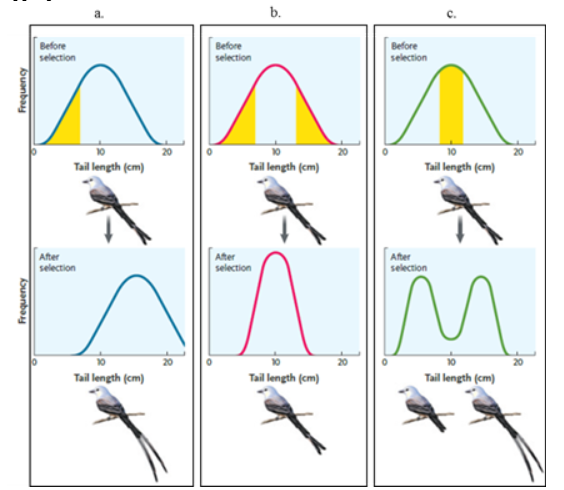
Figure 21.1 — disruptive selection
c. C
Figure 21.1 — directional selection
a. A
Figure 21.1 — stabilizing selection
b.