Lab 1 cards
 Call Kai
 Learn
Learn Practice Test
 Spaced Repetition
 Match
Match Flashcards
 Knowt Play
1/49

There's no tags or description
Looks like no tags are added yet.
Name | Mastery | Learn | Test | Matching | Spaced | Call with Kai | Chat |
|---|
No analytics yet
Send a link to your students to track their progress
50 Terms
Term: Anatomy
The study of the structure of the human body.
The standard frame of reference used to describe the human body is known as _____.
anatomical position
In anatomical position, the body is standing erect with the feet placed _____.
flat on the ground about shoulder-width apart
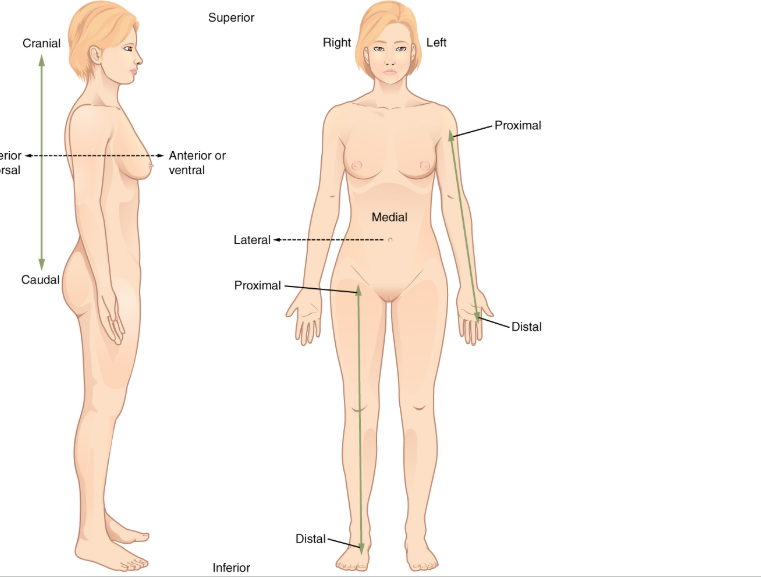
In anatomical position, what is the orientation of the palms?
Anterior position
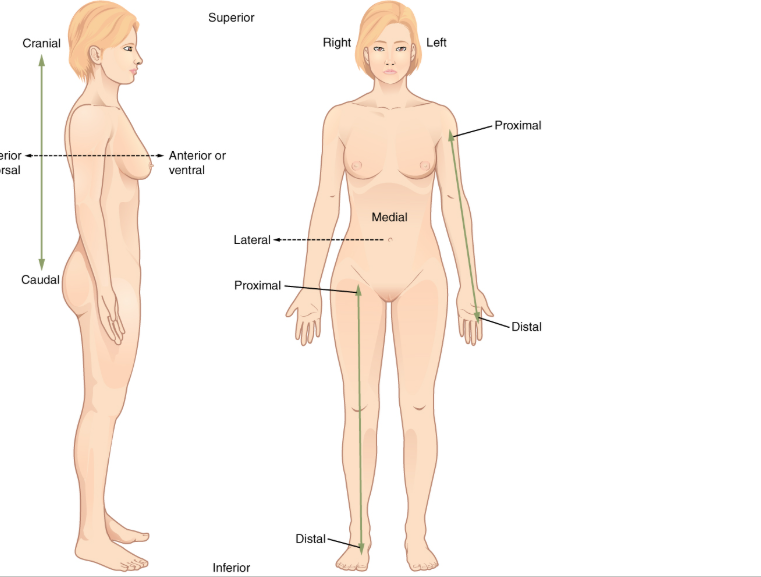
In anatomical position, describe the position of the head and eyes.
The head is up and the eyes are looking forward.
Why are directional terms considered "relative terms"?
They describe where one body part is compared to another body part.
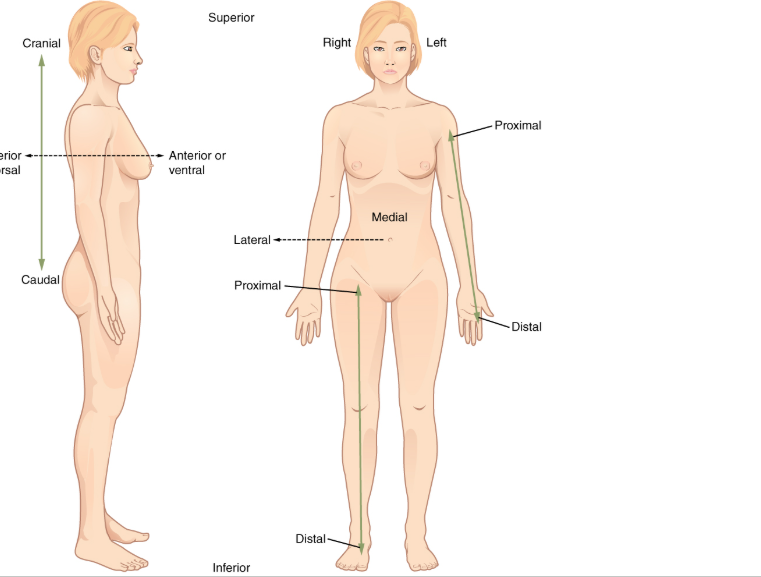
Term: Superior
A position located up higher or closer to the head.
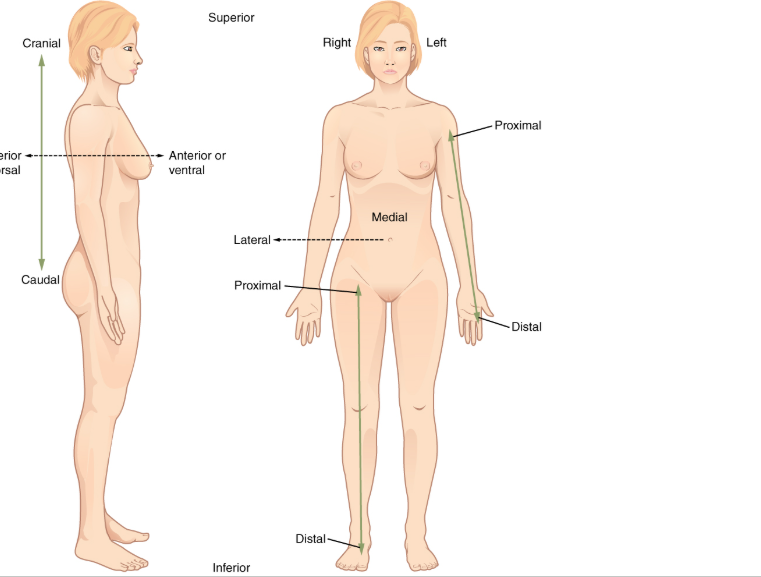
Term: Inferior
A position located down lower or closer to the feet.
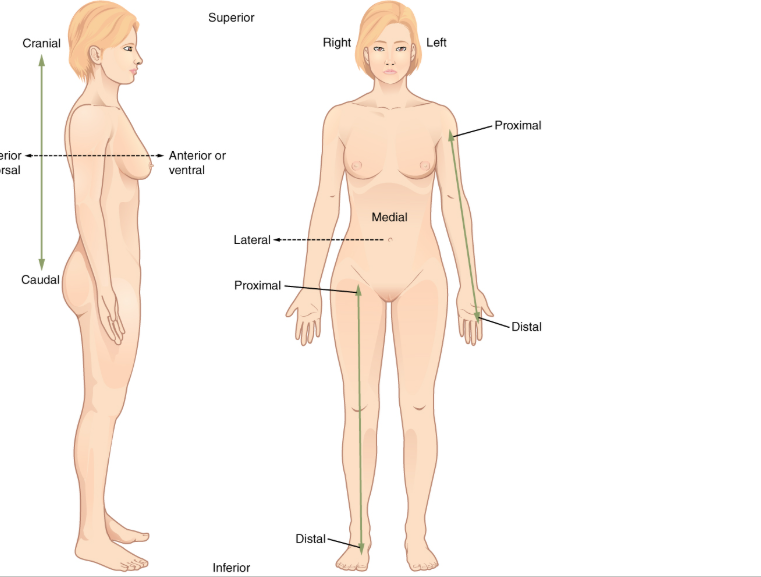
Using directional terminology, the eyes are _____ to the chin.
superior
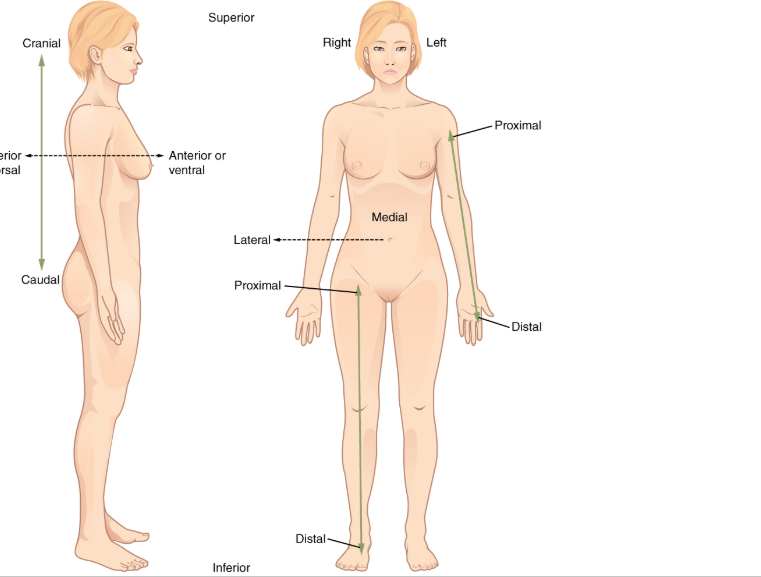
Using directional terminology, the chin is _____ to the nose.
inferior
The umbilical region is _____ to the sternal region.
inferior
Term: Biped
An organism that stands and walks on two feet.
Term: Quadruped
An organism that stands and walks on four feet.
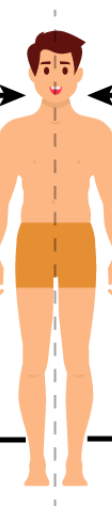
The imaginary dashed line running down the middle of the body is called the _____.
midline
Term: Medial
A position that is closer to the body's midline.
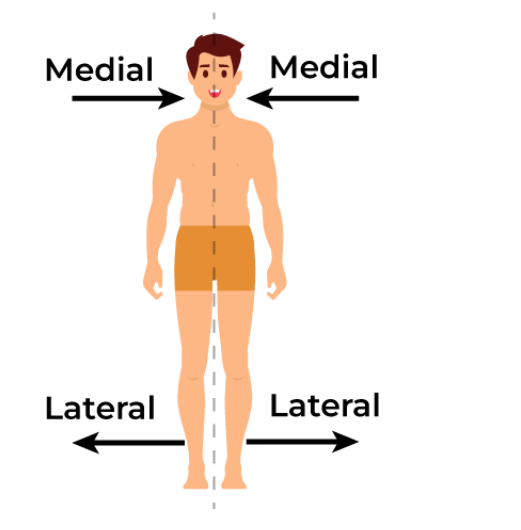
Term: Lateral
A position that is farther away from the body's midline.
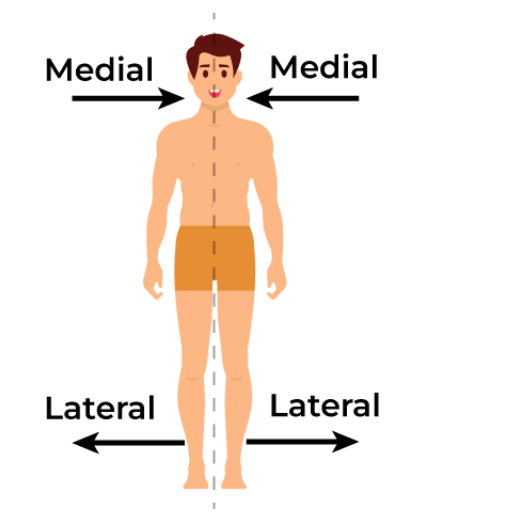
Regarding the midline, the eye is _____ to the ear.
medial
Regarding the midline, the ear is _____ to the eye.
lateral
Term: Proximal
Closer to the point of attachment, such as the shoulder or hip.
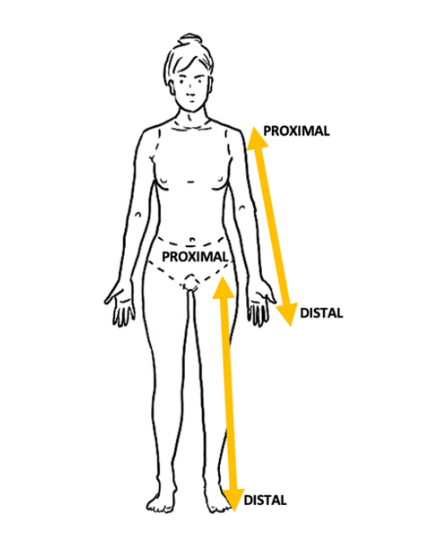
Term: Distal
Farther from the point of attachment, such as the shoulder or hip.
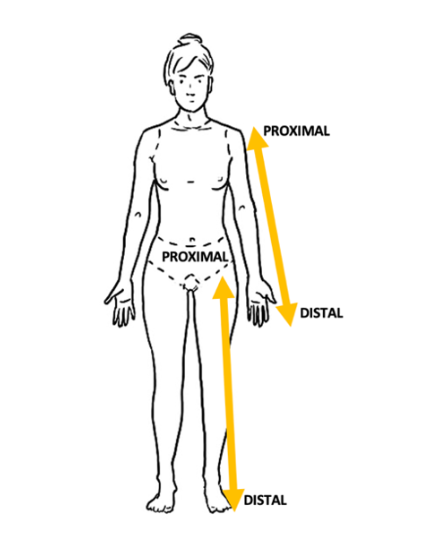
Within the upper limb, the elbow is _____ to the wrist.
proximal
Within the upper limb, the wrist is _____ to the elbow.
distal
In a biped, the term "anterior" refers to the _____ surface of the body.
front
In a biped, the term "posterior" refers to the the _____ surface of the body.
back
Which directional term literally translates to "belly side"?
Ventral
In humans, the terms anterior and _____ are synonymous.
ventral
In humans, the terms posterior and _____ are synonymous.
dorsal
How do the synonyms for "anterior" and "posterior" change when describing a quadruped compared to a biped?
In quadrupeds, anterior/ventral and posterior/dorsal are no longer synonymous.
Term: Superficial
Closer to the body surface.
Term: Deep
Farther from the body surface.
In relation to the skin, skeletal muscles are considered _____.
deep
In relation to skeletal muscles, the skin is considered _____.
superficial
Comparing the layers of the skin, the epidermis is _____ to the dermis.
superficial
Comparing the layers of the skin, the dermis is _____ to the epidermis.
deep
Term: Ipsilateral
Located on the same side of the body.
Term: Contralateral
Located on opposite sides of the body.
The right arm and the right leg are _____ to each other.
ipsilateral
The right arm and the left leg are _____ to each other.
contralateral
A cut made along the short axis of a tubular organ is called a _____.
transverse section (or cross-section)
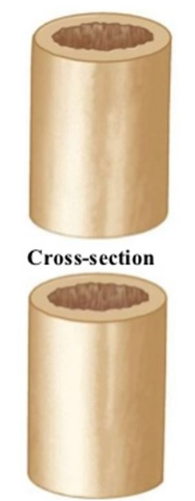
A cut made along the long axis of a tubular organ is called a _____.
longitudinal cut
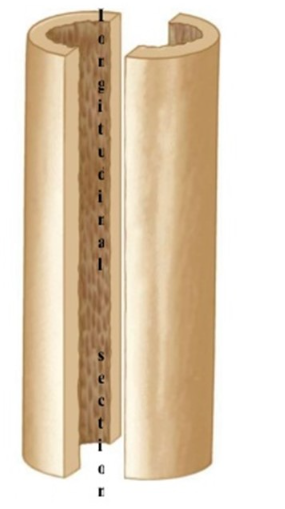
Which anatomical plane divides the bipedal body into superior and inferior portions?
Transverse plane
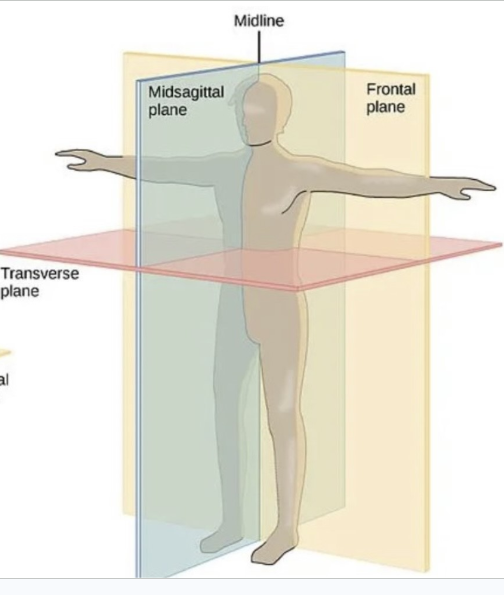
Which longitudinal plane divides the body into equal left and right halves?
Midsagittal plane
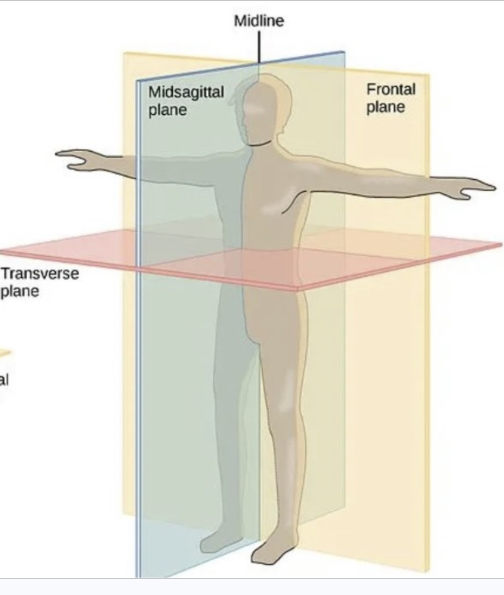
Which anatomical plane divides the body into anterior (front) and posterior (back) portions?
Frontal plane
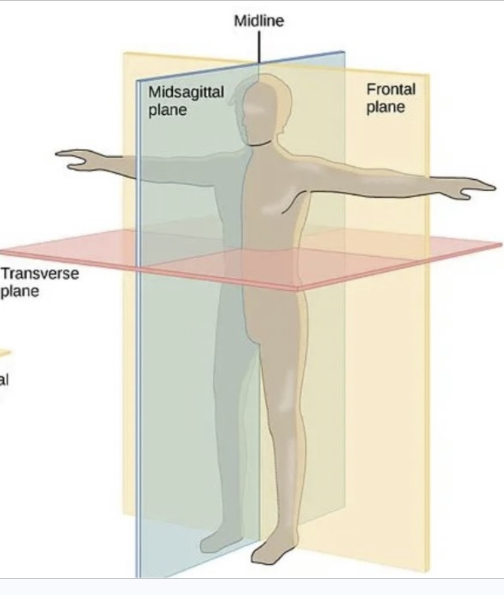
Why is the "equality" of a midsagittal cut considered approximate rather than perfect?
Internal organs are not perfectly symmetrical (e.g., the heart is left-leaning and the liver is on the right).
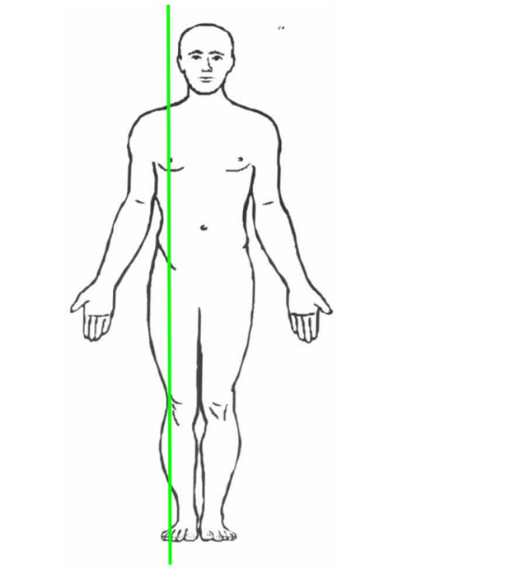
Term: Parasagittal plane
A longitudinal cut that divides the body into unequal left and right portions.
What type of cut is typically used to view the internal structures of the brain along the midline?
Midsagittal cut
A cut through the heart that maintains both the right and left sides in one section is a _____ cut.
frontal
In the neck, the trachea is located _____ to the esophagus.
anterior (or ventral)
In the neck, the esophagus is located _____ to the trachea.
posterior (or dorsal)
If a blood vessel appears as a ring under a microscope, what type of cut was likely made?
Transverse cut