Biology Chapter 6 review
 Call Kai
 Learn
Learn Practice Test
 Spaced Repetition
 Match
Match Flashcards
 Knowt Play
1/61

Earn XP
Description and Tags
Energy and Metabolism
Name | Mastery | Learn | Test | Matching | Spaced | Call with Kai | Chat |
|---|
No analytics yet
Send a link to your students to track their progress
62 Terms
Thermodynamics
The study of energy transformations and transfers that occur in molecules and collections of matter, ranging from a single cell to a full ecosystem
Branch of chemistry concerned with energy changes
Cells are governed by the laws of physics and chemistry
Bioenergetics
The study of how energy flows and transforms through living systems
The energy that sustains most of the earth’s life forms comes from the sun

Metabolism
All chemical reactions of a cell or organism
the total set of chemical reactions that happen inside a living cell or organism to keep it alive
Metabolic pathway
A series of biochemical reactions that converts one or more substrates into a final product
a series of enzyme-catalyzed chemical reactions in a cell where a starting molecule is changed step by step into a product, either building larger molecules or breaking them down to release energy
Example of metabolic pathway
A series of biochemical reactions that converts one or more substrates into a final product
Example, energy from the sun captured during photosynthesis converts CO2 and H2O into glucose (C6H12O6)
The energy stored in glucose is released during cellular respiration, regenerating CO2 and H2O

Types of metabolic pathways
Two types of reactions/pathways are required to maintain the cell’s energy balance
Anabolic
Catabolic

Anabolic reaction
A metabolic pathway that builds complex molecules from simpler ones and requires an input of energy (endergonic)
require energy and synthesize larger molecules

Catabolic reactions
A metabolic pathway that breaks down complex molecules into simpler ones, releasing stored chemical energy in an exergonic process
Those that release energy and break down large molecules
into smaller molecules

Anabolic and catabolic examples
Anabolic: dehydration synthesis (joins monomers into polymers and requires energy)
Catabolic: hydrolysis (breaks polymers down into individual monomers and releases energy)
Dehydration synthesis: endergonic
Hydrolysis: exergonic

Energy
The capacity to do work or cause change, and living systems require a constant input of it to maintain organization and fight increasing disorder
The ability to do work
Many forms – mechanical, heat, sound, electric current, light, or radioactivity
Types of energy
Potential: stored energy; energy of objects with the potential to move
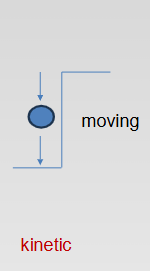
Kinetic: energy of moving objects
Energy is classified as kinetic or potential

Kinetic energy
The energy of moving objects
the energy of motion; any time something is moving, it has kinetic energy
Potential energy (stored energy)
The energy of objects with the potential to move
stored energy based on an object's position, location, or the structure of its chemical bonds

Potential and kinetic energy in cells
Energy of chemical/electrochemical gradients across the
plasma membraneChemical energy – Energy stored in chemical bonds (potential); energy released (kinetic)
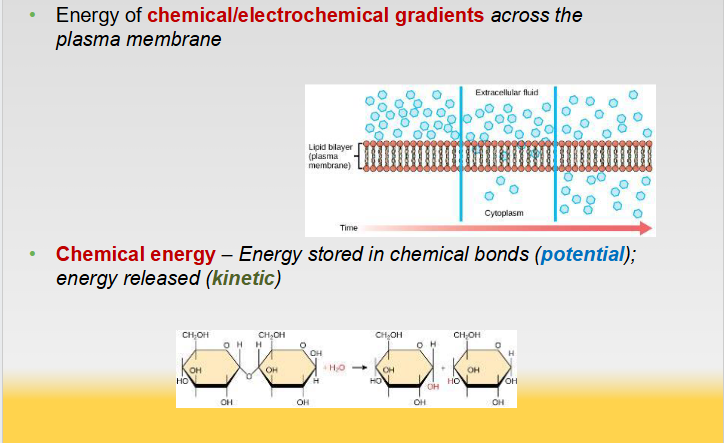
Chemical/electrochemical gradients
The combined force of a chemical (concentration) gradient and an electrical charge difference across a cell membrane that dictates the net direction an ion will move

Chemical energy
A form of potential energy stored in the arrangement of atoms and the bonds within molecules, which can be released or absorbed during a chemical reaction
Energy stored in chemical bonds (potential); energy released (kinetic)

Potential energy - gasoline
The potential energy stored in the chemical bonds of gasoline can be transformed into kinetic energy that allows a car to race

Gibb’s Free Energy
The amount of energy available to do work (usable energy)
The measure of usable energy in a system that is available to do work after accounting for entropy
Chemical reactions affect G; change in G after a reaction = ∆G
ΔG = ΔH − TΔS
Gibb’s free energy equation
ΔG=ΔH−TΔS
Amount of energy available to do work (usable energy)
Chemical reactions affect G; change in G after a reaction = ∆G
ΔH is change in total energy
T is Temperature
ΔS is change in entropy (energy lost to disorder)

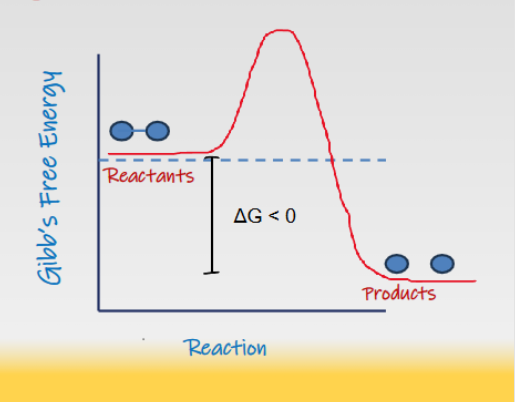
Free energy: when energy released
If energy is released in a chemical reaction, then ΔG<0
Products have less free energy than the reactants
These reactions are exergonic
When energy is released in a chemical reaction, the change in Gibbs free energy (Delta G) is negative (Δ𝐺<0) and the process is exergonic
Reactants have more free energy than the products, meaning the system loses free energy
Free energy: when energy is required
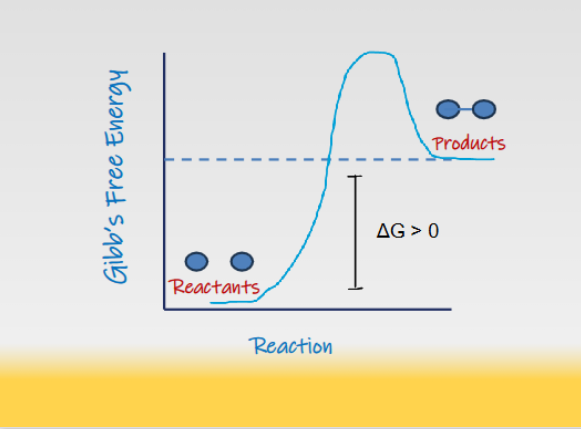
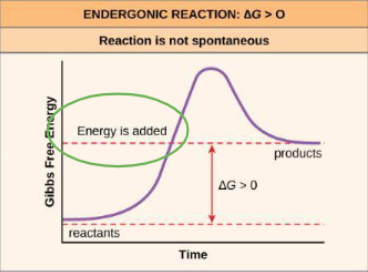
If a chemical reaction requires energy, thenΔG>0
Products have more free energy than the reactants
These reactions are classified as endergonic
Positive 𝚫𝑮: the change in Gibbs free energy is greater than zero because the products have more free energy than the reactants.
Non-Spontaneous: the reaction cannot happen on its own without a net input of outside energy
Which chemical reaction is exergonic?
Hydrolysis
Exergonic reactions release free energy, meaning they have a negative Δ𝐺 (change in free energy) and are energetically favorable/spontaneous
During hydrolysis, a water molecule is consumed to break covalent bonds within large biological macromolecules (like polymers into monomers)
Breaking these bonds releases energy into the cellular environment

Activation energy
The energy required for a reaction to go forward (go over the
“hump” in the diagram)
the minimum amount of energy required to start a chemical reaction
Heat energy is the main source for activation energy in a cell
Heat helps reactants reach their transition state

Exergonic reaction
A chemical reaction that releases free energy, resulting in a negative change in Gibbs free energy (Δ𝐺<0)
Gibbs Free Energy (𝚫𝑮) is negative because the products have less free energy than the starting reactants
These reactions are considered spontaneous, meaning they release energy and are energetically favorable without requiring an ongoing energy input from the surroundings

Endergonic reaction
A chemical reaction that absorbs free energy from its surroundings and has a positive change in Gibbs free energy (Δ𝐺>0)
Non-spontaneous: the reaction will not happen on its own without an external input of energy
The products end up with more free energy than the starting reactants
Anabolic Nature

Exergonic reaction example
The breakdown of gasoline is an example of an exergonic reaction
A spark is required to provide heat to exceed the activation energy
Once the reaction begins, enough heat is released to drive
additional reactions

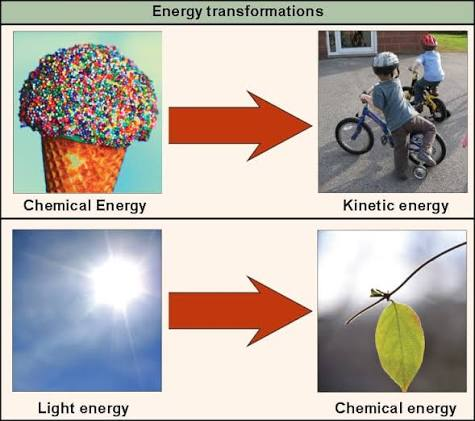
First law of thermodynamics
States that energy cannot be created or destroyed. It changes from one form to another
energy cannot be created or destroyed, but it can be transferred or transformed from one form to another
Second law of thermodynamics
In each transfer of energy some energy is lost as heat
This results in increased entropy (disorder)
Entropy (S): a quantitative measure of disorder or unusable energy in a system. In every energy transfer, some usable energy is lost as unusable heat energy, which disperses into the surroundings
What provides the energy for a cell’s endergonic reactions?
The breakdown of ATP
Adenosine Triphosphate (ATP)
The primary energy-carrying molecule used by all living cells to store, transfer, and rapidement release energy for cellular work
ATP structure
ATP is composed of an adenosine backbone with three phosphate groups attached
Adenosine consists of the base adenine and a five-carbon sugar ribose
The bonds that link the phosphate groups are high-energy bonds
A chain of three phosphate groups (labeled alpha, beta, and gamma from closest to furthest)

ATP hydrolysis
The cellular process where a water molecule is used to break the terminal phosphate bond of an ATP molecule, releasing free energy and producing ADP plus an inorganic phosphate
ATP + H2O → ADP + Pi + free energy
ΔG = -7.3 kcal/mol
Provides energy for the cell
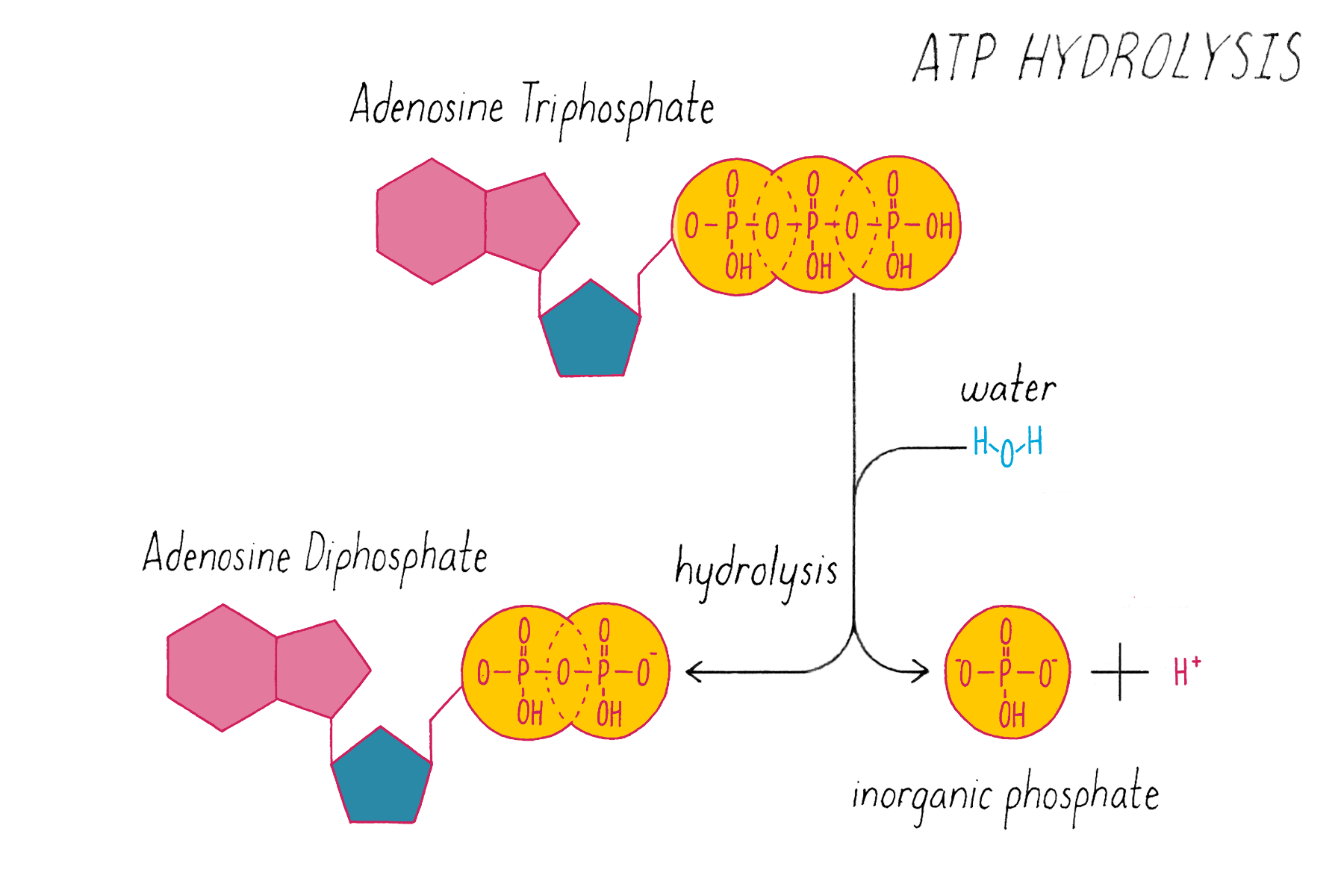
ATP hydrolysis provides energy for the cell
ATP + H2O → ADP + Pi + free energy
ΔG = -7.3 kcal/mol
ATP is an unstable molecule and will hydrolyze quickly
If it is not coupled with an endergonic reaction this energy is lost as heat
If it is coupled with an endergonic reaction, much of the energy can be transferred to drive that reaction
ATP Hydrolysis is reversible

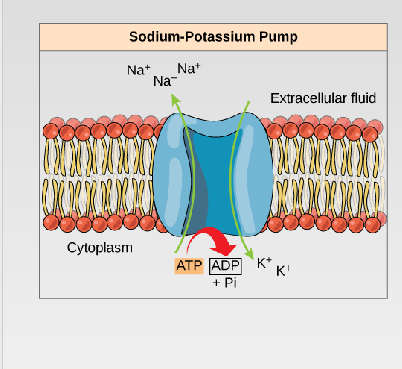
Sodium-potassium pump
An example of energy coupling. The energy derived from ATP hydrolysis is used by the protein to pump 3 sodium ions out of the cell and 2 potassium ions into the cell
a transmembrane protein in animal cell membranes that uses ATP energy to actively transport 3 sodium ions (Na⁺) out of the cell and 2 potassium ions (K⁺) in against their concentration gradients
Enzymes
Biological catalysts—mostly proteins—that accelerate chemical reactions in cells by lowering the activation energy barrier without being consumed or permanently altered in the process
Enzymes bind with the reactants
Are very specific, catalyzing a single type of reaction

Substrate
The specific reactant molecule that binds to an enzyme's active site to undergo a chemical reaction and form a product
the shape and charge of the substrate must be fully compatible with the active site (following the induced fit model). If they do not match, the reaction will not happen

Enzyme-substrate specificity
The shape of the enzyme and substrates determines specificity
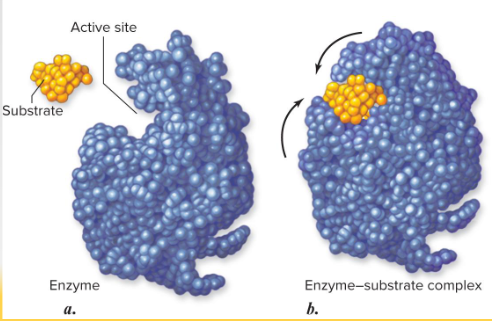
Substrate molecules interact at the enzyme’s active site
Enzymes can catalyze many reactions. In some cases, two substrates form a larger molecule; in others one molecule breaks down into smaller products

Active site
The specific region on an enzyme where substrate molecules bind and undergo a chemical reaction

The catalytic cycle of an enzyme
The catalytic cycle of an enzyme is a repeating, four-step process where a reusable biological catalyst binds specific reactants, lowers the activation energy to convert them into products, releases those products, and returns to its original form
a repeating sequence of steps where an enzyme binds to a reactant (substrate), converts it into a product, and releases it unchanged so it can be reused

3D structure of enzyme active site
The specific 3D pocket or cleft on an enzyme's surface where reactant molecules, known as substrates, bind and undergo a chemical reaction
Protein structure: scaffold to support and position active site
Active site
Binding sites: bind and orient substrate(s)
Catalytic site: reduce chemical activation energy

Induced fit
Describes how an enzyme's active site changes shape slightly to mold tightly around a substrate upon binding
At the active site, a shift in shape that optimizes reactions
The slight changes at the active site maximizes the catalysis
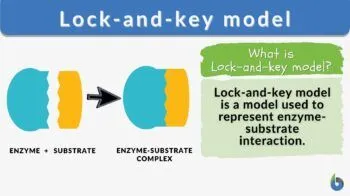
The substrate (key) fits into the active site of enzyme (the lock) like a “lock-and-key” model
Lock-and-key model
A model proposing that an enzyme's active site and a specific substrate possess rigid, complementary geometric shapes that fit together perfectly, much like a key fitting into a lock
explains how an enzyme interacts with a specific target molecule, known as a substrate, to speed up a chemical reaction
Protein structure is determined by 3D shape of protein
Remember the 3-D shape of a protein is determined by the amino acid sequence of the protein
The amino acids at active site are important for the enzyme’s function - allow binding with substrate
The specific amino acid R-groups (side chains) inside an enzyme's active site determine its precise shape and chemical properties, allowing it to selectively bind with compatible substrates

Cellular environment
The cellular environment is also important for enzyme function:
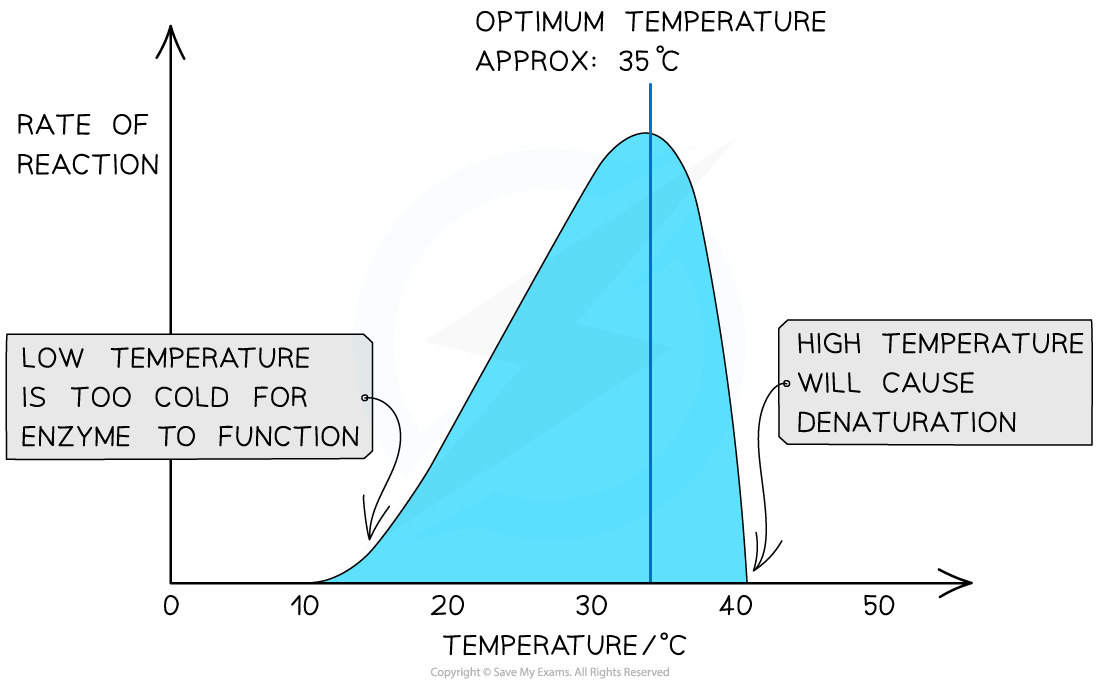
Non optimal temperatures can denature the enzyme (loss of shape)
Acidic and basic environments can reduce substrate enzyme binding
Optimal temperature
The specific temperature at which an enzyme exhibits its maximum catalytic activity and efficiency
Excessive heat breaks the weak non-covalent interactions (such as hydrogen bonds) holding the three-dimensional protein structure together, causing denaturation (loss of shape and function)
How enzymes lower activation energy
The enzyme can help the substrate reach its transition state in one of the following ways:
Position two substrates so they align perfectly for the reaction
Provide an optimal environment, i.e. acidic or polar, within the active site for the reaction
Contort/stress the substrate so it is less stable and more likely to react
Temporarily react with the substrate (chemically change it) making the substrate less stable and more likely to react
After a catalyzed reaction, the product is released and the enzyme becomes available to catalyze another reaction
Denatured enzyme
An enzyme that has lost its specific three-dimensional shape and functional active site due to environmental changes, which stops it from catalyzing reactions
Structure Disruption: Denaturation breaks the weak bonds that maintain secondary, tertiary, and quaternary protein structures
Primary structure intact
Loss of function
Causes of denaturation
Temperature (high heat): excessive thermal energy breaks weak hydrogen bonds and hydrophobic interactions holding the folded structure together
pH changes: extreme acidity or alkalinity
Cold temperatures slow down reactions by reducing collisions, but they do not denature the enzyme
What happens to an enzyme after it has catalyzed a reaction?
An enzyme releases its products and returns to its original shape and state, remaining completely unchanged and ready to be reused for another reaction
after a catalyzed reaction, the product is released and the enzyme becomes available to catalyze another reaction
Catalyze
Means to speed up a chemical reaction by lowering its activation energy, using a substance called a catalyst (usually an enzyme) that is not consumed by the reaction itself
Activation Energy: every chemical reaction requires a certain amount of energy to get started. Enzymes catalyze reactions by lowering this energy barrier, allowing the reaction to happen much faster
Enzyme function is regulated
Regulation of enzyme activity helps cells meet their specific needs
For example, digestive cells in your stomach work more after a meal than when you sleep
The control of when and how fast an enzyme catalyzes a chemical reaction, allowing cells to coordinate metabolic pathways and maintain homeostas
Enzymes can be regulated by
Changes in temperature and/or pH
Molecules that inhibit or promote enzyme function
Competitive inhibitors
Have a similar shape to the substrate and compete with the substrate for the active site
a molecule that mimics the natural substrate and binds directly to an enzyme's active site, blocking the actual substrate from entering
slow reaction rates but do not affect the maximal
rate

Non-competitive inhibitors
Bind to the enzyme at a different location but affect shape of enzyme. This causes a slower reaction rate
a molecule that binds to an enzyme at an allosteric site (a location other than the active site), reducing the enzyme's activity without blocking the substrate from binding
binding changes the shape (conformation) of the enzyme, which prevents it from effectively catalyzing the chemical reaction
slow rates and reduce the maximal rate

Maximal rate
The highest possible speed at which an enzyme-catalyzed reaction can run when the enzyme is completely saturated with its substrate
speed of a reaction when substrate is not limited
Competitive inhibitors slow reaction rates but do not affect the maximal rate
Non-competitive inhibitors slow rates and reduce the maximal rate

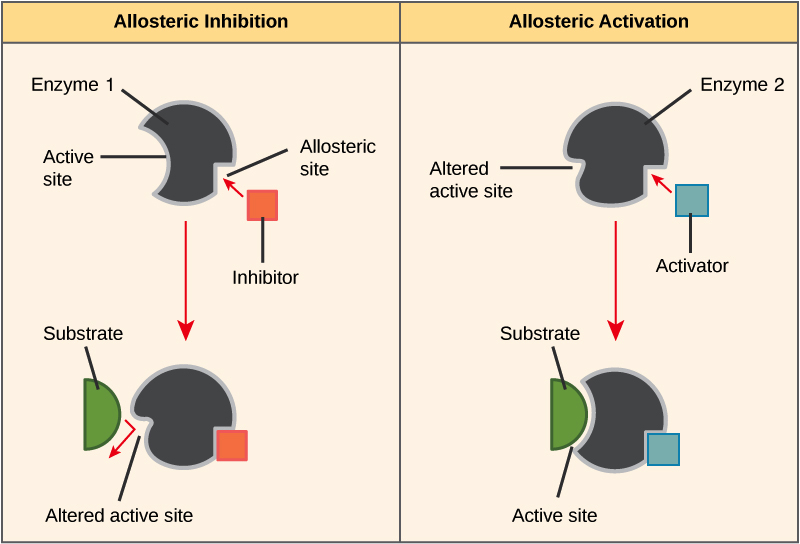
Allosteric inhibitors
Modify the active site of the enzyme so that substrate binding is reduced or prevented
a molecule that binds to an enzyme at a site other than the active site (called the allosteric site), which induces a conformational shape change that reduces the enzyme's activity
modify the active site indirectly by changing the overall shape of the enzyme

Allosteric activators
Modify the active site of the enzyme so that the affinity for the substrate increases
a regulatory molecule that binds to an enzyme at a site other than the active site (the allosteric site) and stabilizes or shifts the enzyme into an active shape that increases its affinity for the substrate and speeds up the reaction rate
Enzyme cofactors
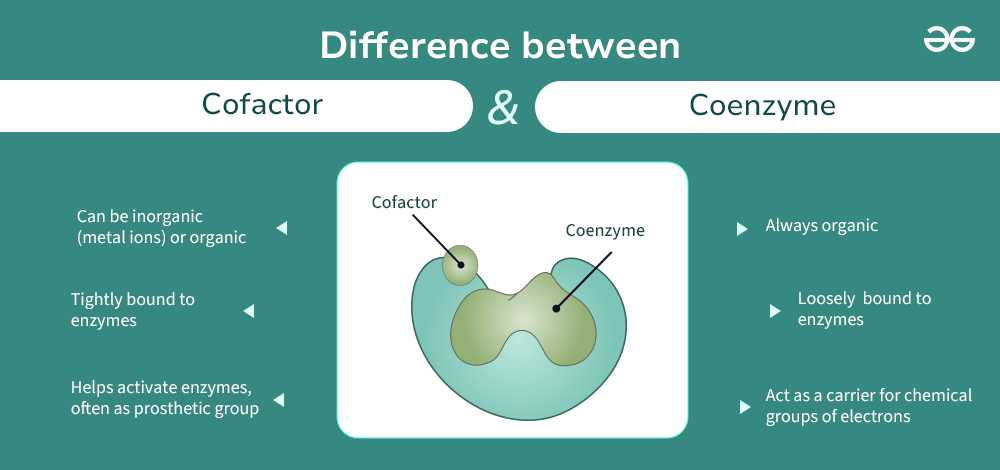
Non-protein chemical components required for an enzyme to achieve optimal catalytic activity and proper conformational shape
Some enzymes require one or more cofactors or coenzymes to function
Cofactors are inorganic ions, i.e. Fe++, Mg++, Zn++
DNA polymerase requires Zn++
Coenzyme
A small, organic, non-protein molecule that binds to an enzyme's active site to help it catalyze biochemical reactions
Some enzymes require one or more cofactors or coenzymes to function
Coenzymes are organic molecules, including vitamins
These molecules are provided primarily from the diet

Coenzymes vs. Cofactors
Cofactors are non-protein helper molecules required by enzymes to catalyze chemical reactions, while coenzymes are a specific organic subset of cofactors
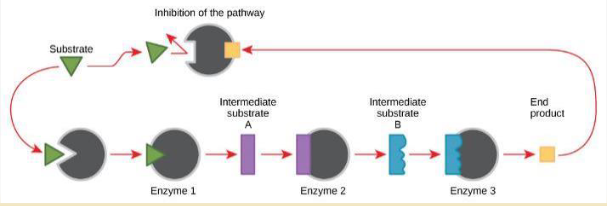
Metabolic pathways
A series of interconnected, enzyme-catalyzed chemical reactions in a cell that starts with a specific molecule and modifies it step-by-step through intermediate products to yield a final product
are a series of reactions catalyzed by multiple enzymes
Feedback inhibition
The final product of the pathway inhibits one of the first steps of the pathway (happen if too much product accumulates)
a cellular control mechanism where the end product of a metabolic pathway binds to an enzyme earlier in that same pathway to slow down or stop further production
The final product attaches to a secondary location on an early enzyme in the pathway, called an allosteric site