C1.3 Photosynthesis and light
 Call Kai
 Learn
Learn Practice Test
 Spaced Repetition
 Match
Match Flashcards
 Knowt Play
1/18

There's no tags or description
Looks like no tags are added yet.
Name | Mastery | Learn | Test | Matching | Spaced | Call with Kai | Chat |
|---|
No analytics yet
Send a link to your students to track their progress
19 Terms
Light dependent reaction
Light energy splits water into oxygen and H+ ions and electrons. Oxygen released as waste
Light independent reactions
Carbon dioxide combines with H+ to form glucose
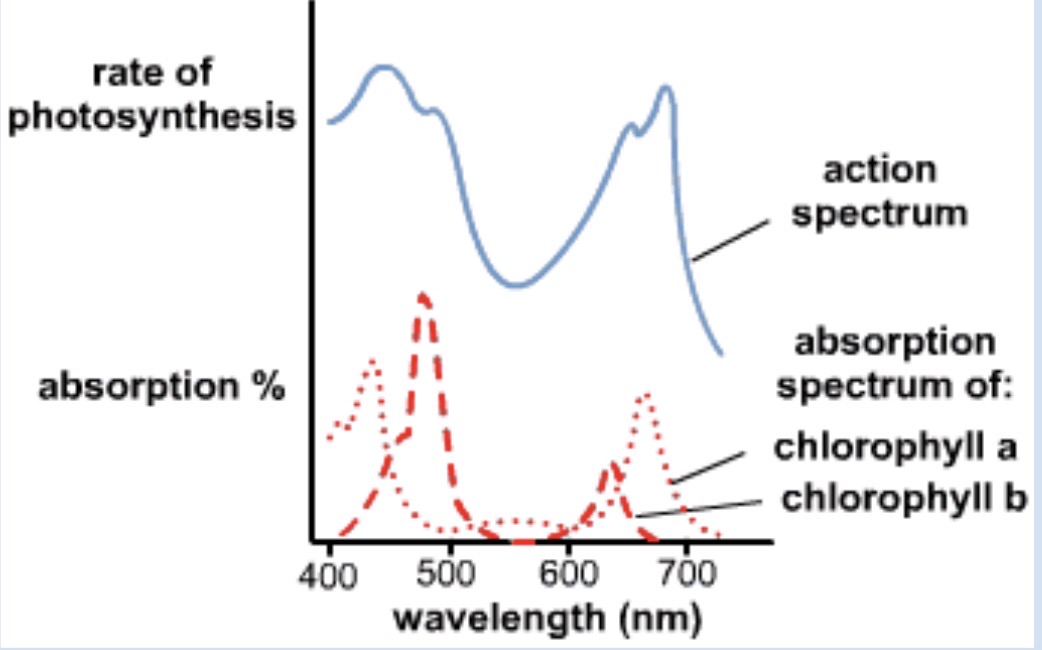
Why do different chloroplast give different amounts of photosynthesis
They have different photosynthetic pigments so absorb light at different wavelengths
Draw the absorption spectrum of chlorophyll a, b and the action spectra
Chlorophyll a - peaks at 400 and 700
Chlorophyll b - peaks at 500 and 650
The first peak in a and b should be higher than the second
Thylakoids
Form stacks (grana), ETC is here, thylakoid membrane holds pigments
Photosystems
Molecular arrays of chlorophyll pigments that can generate and emit excited electrons
Stroma
Sight of light independent reaction (full of enzymes), Calvin cycle is here
Lumen
Inside a thylakoid
How does temp affect rate of photosynthesis?
As temp increases, rate increases due to more KE so MSC. Above 35 degrees - denture reaction slows and stops
How does light intensity affect rate of photosynthesis?
As light intensity increases, rate increases, then plateaus when CO2 conc or temp become limiting
How does CO2 concentration affect rate of photosynthesis?
As CO2 conc increases, rate increases since more conc = more collisions, then plateaus when light intensity or temp become limiting
Primary reaction centre
Chlorophyll molecule at the centre of the photosystem array (p680 or p700). It excites electrons
The ETC (in chloroplasts)
Light hits pigments in PS2, exciting a pair of electrons, which are released to a higher energy level.electrons are ejected by primary reaction centre. Loss of electrons causes water to split (photolysis). Electrons flow through ETC, energy is used to pump H+ from stroma to lumen, generating a chemical gradient. 2 electrons from PS1 and an H+ ion reduce NADP+ to NADPH. NADPH carries the hydrogen into light independent reactions.
Non-cyclic phosphorylation
H+ ions from lumen chemiosmose via ATP synthase
Cyclic phosphorylation
Only occurs at PS1 (p700). Some electrons do not have the energy to be ejected so fall back down within the molecular array transferring energy into the ETC
What is the final electron acceptor in the ETC in chloroplasts
NADP+
Chemiosmosis
Coupling of ATP synthesis to the electron transport and proton movement
Process of the Calvin cycle
RuBP undergoes carboxylation with CO2 facilitated by enzyme rubisco. This creates unstable 6C complex that splits into 2 3C compounds called GP. GP is converted to TP by phosphorylation (ATP → ADP) and reduction (NADP+ → NADPH). Some GPs are taken before this to form amino acids or fatty acids. Some TP are taken to form heroes sugars, others are then used to regenerate RuBP (ATP→ADP)
Products of the Calvin cycle
Carbohydrates, amino acids, fatty acids, nucleic acids, RuBP