chem exam 2
 Call Kai
 Learn
Learn Practice Test
 Spaced Repetition
 Match
Match Flashcards
 Knowt Play
1/44

There's no tags or description
Looks like no tags are added yet.
Name | Mastery | Learn | Test | Matching | Spaced | Call with Kai | Chat |
|---|
No analytics yet
Send a link to your students to track their progress
45 Terms
Amplitude:
height of peak
Wavelength (λ)
distance between two identical points (units: m)
Frequency (ν)
number of wavefronts per second (units: Hz = s -1 )
Claim: Light is a Wave
-diffraction: Diffraction is the bending and spreading out of waves when they encounter an obstacle or pass through a narrow slit. Because light travels as a wave, it can bend around the edges of objects rather than just casting a perfectly sharp, dark shadow
-Interference: If waves are in-phase the wave reinforces/the amplitude gets bigger, out of phase crests/troughs cancel
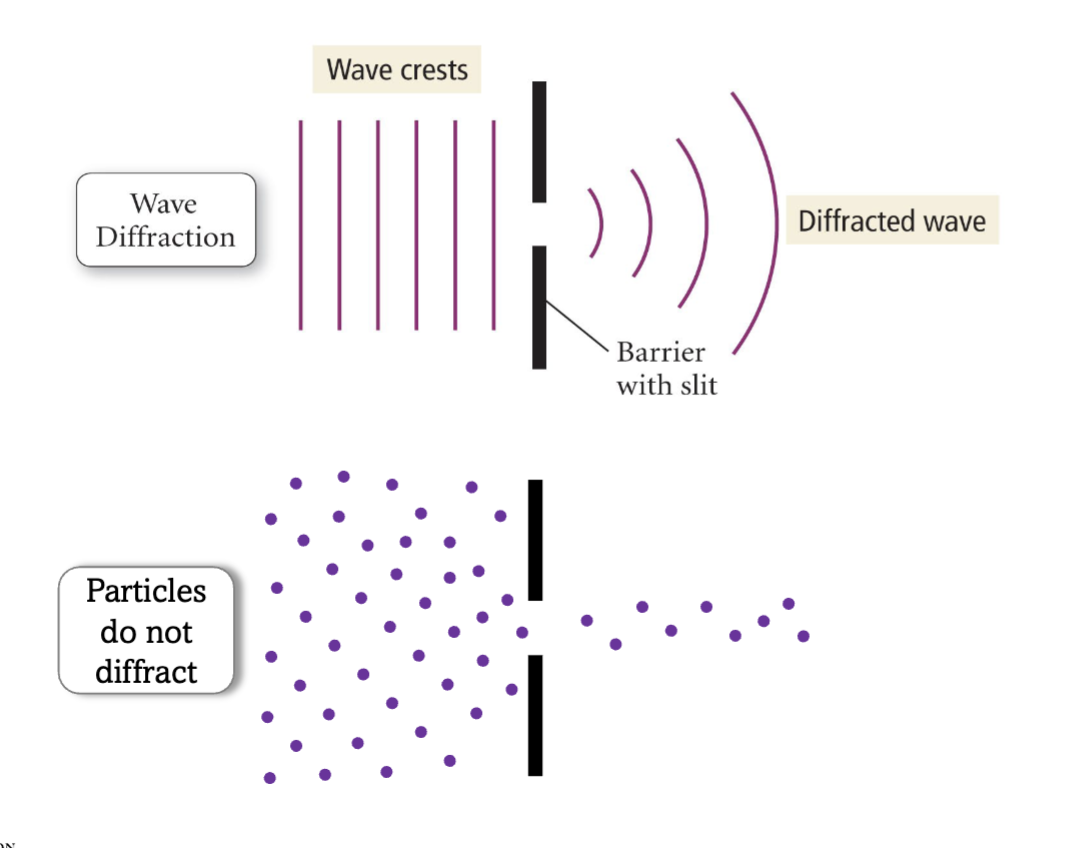
why is light not just a wave?
-we know the amplitude of a wave is related to the energy of
that wave
-The energy of electromagnetic radiation does NOT simply depend on the
amplitude of the wave
Light is a Particle
photoelectric effect: Metals can emit electrons when certain electromagnetic radiation (light)
shines on the surface
-Electromagnetic radiation transfer energy to the electrons in the metal, where
the electrons gain enough energy to leave the metal.
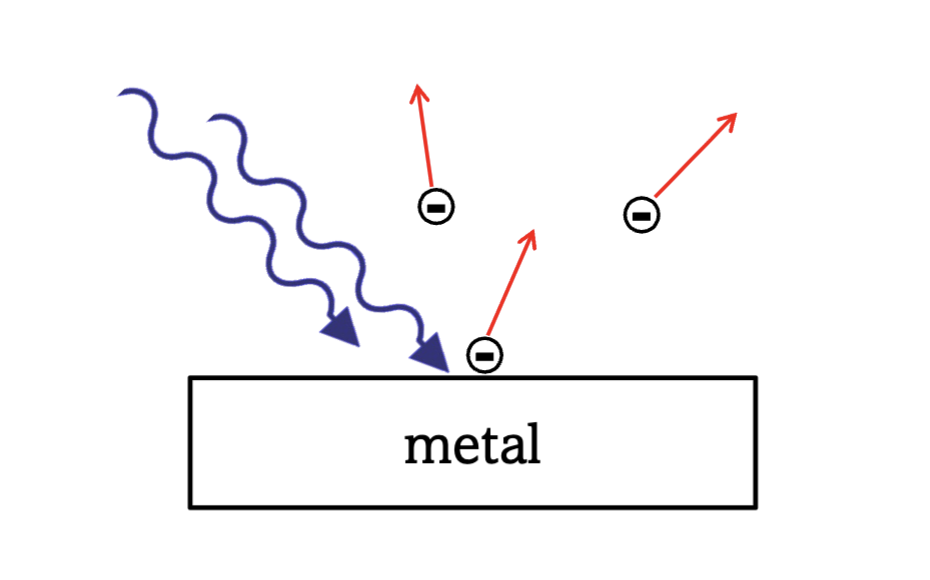
photoelectric effect observations
-When we increase the intensity of the light, more electrons are
emitted
-When we decrease the wavelength (increase the frequency) of the
light, the speed (kinetic energy) of the electrons increases.
is light simply a wave?
NO!!!! increasing its intensity should
increase its energy, meaning:
– with bright enough light of any frequency, electrons should be emitted.
– increasing the intensity of light should increase the speed of the
emitted electrons.
• This is not what is observed!
– Light does not just behave like a wave. It also behaves like a particle!
photons:packets of energy
energy of a photon depends on
frequency (and wavelength), not on the intensity of the light
ntensity (brightness) of light relates to
the number of photons
If the photon does not have enough energy,
no electron is ejected
regardless of how many photons (intensity of light) hit the metal
why is ruthford wrong? (Electrons circling the nucleus like planets around the sun)
-Charged particles circling in an electric field would decay
energetically. leading to a continuous emission spectrum
-Also would have led to the atom imploding
The Bohr Model
Electrons move in orbits around the nucleus.
• These orbits have definite energies and are at definite
distances from the nucleus.
• The energies of electrons in atoms are quantized
the photoelectric effect,
-an atom absorbs a photon resulting in the ejection of an electron
-electron completely leaves the atom (the equivalent of moving to energy level n=∞) (ionization)
Limitations of the Bohr Model… only works on
hydrogen and other one electron systems
𝜆
wavelength
h
-numerator
-planck’s constant
mv
-denominator
-mass, velocity
Particles with more mass have
larger momentum (𝑚v) and shorter
wavelengths (𝜆𝜆)
-definate position
Particles with less mass have
-smaller momentum (𝑚v) and longer
wavelength (𝜆𝜆):
-uncertain position
Electron Density Distribution
-illustrate where that electron is likely to be found
-electron density distribution for the atom; the electron density (probability) is highest near the nucleus for a ground state H atom.
-90% of atom
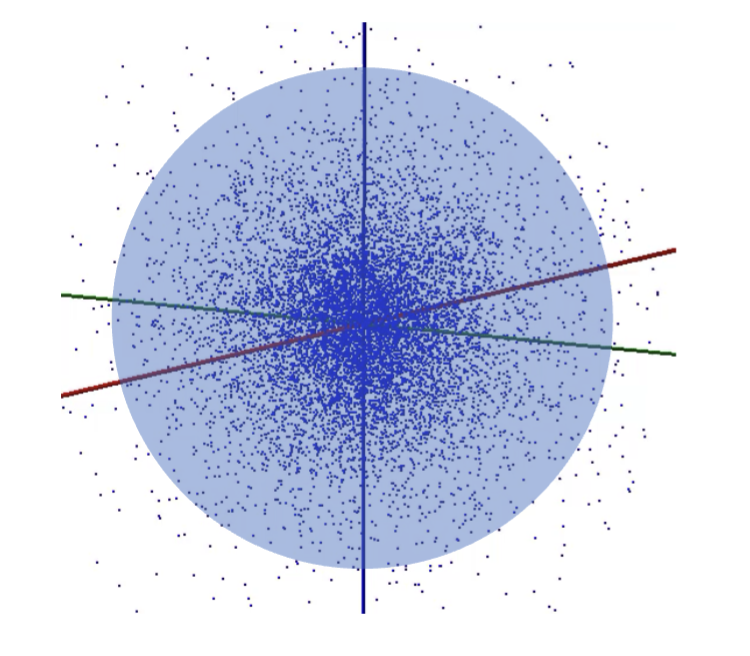
Atomic orbital and three quantum numbers
wave function (ψ) describing an electron in an atom
(|ψ|2 : its probability distribution). N, L, M
Atomic orbital n
relates to energy/size
principle quantum number
atomic orbital l
shape
azimuthal quantum number
mℓ
-orientation
-magnetic quantum number
s orbitals
are spheres (ℓ = 0)
• have 1 orientation (mℓ = 0)
-can have 2 electrons
• have 0 angular node
• have n-1 spherical nodes
• Orbital size increases as n increases
• Electron spends more time further away from nucleus
p orbitals
• are dumbbells shaped (ℓ = 1)
• have 3 orientations (mℓ = −1, 0, +1)
• There are three p orbitals in a shell (e.g.
three 2p orbitals: 2px, 2py, 2pz).
-can have up to 6 electrons
• have 1 angular node
• have n-2 spherical nodes
• Orbital size increases as n increases
• Size of 2p < 3p
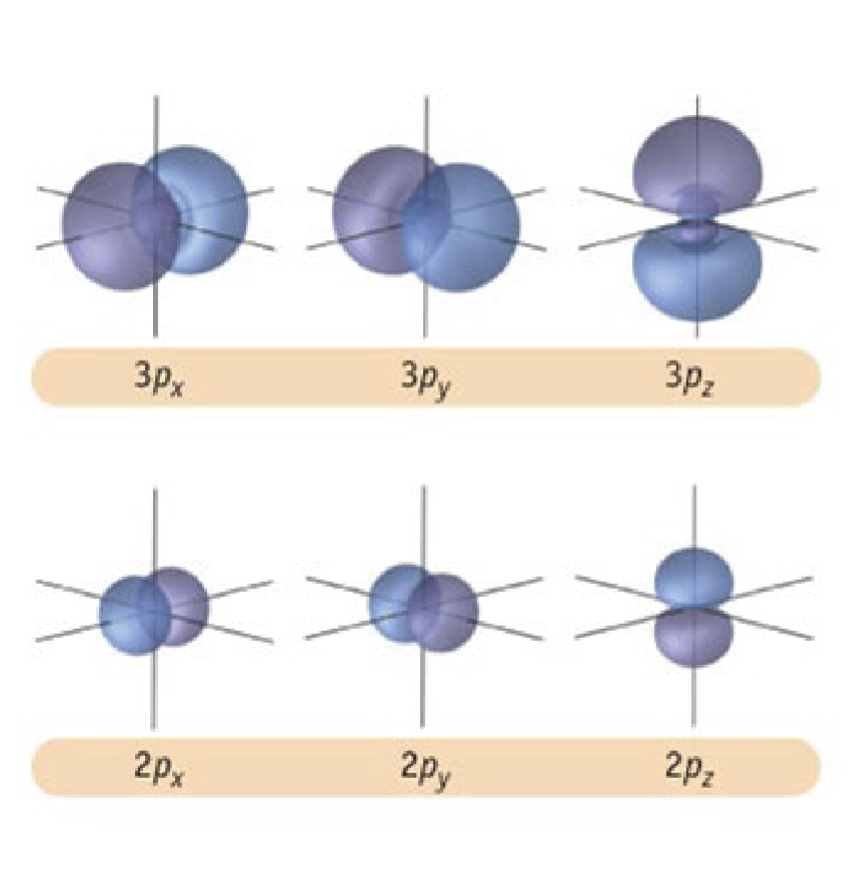
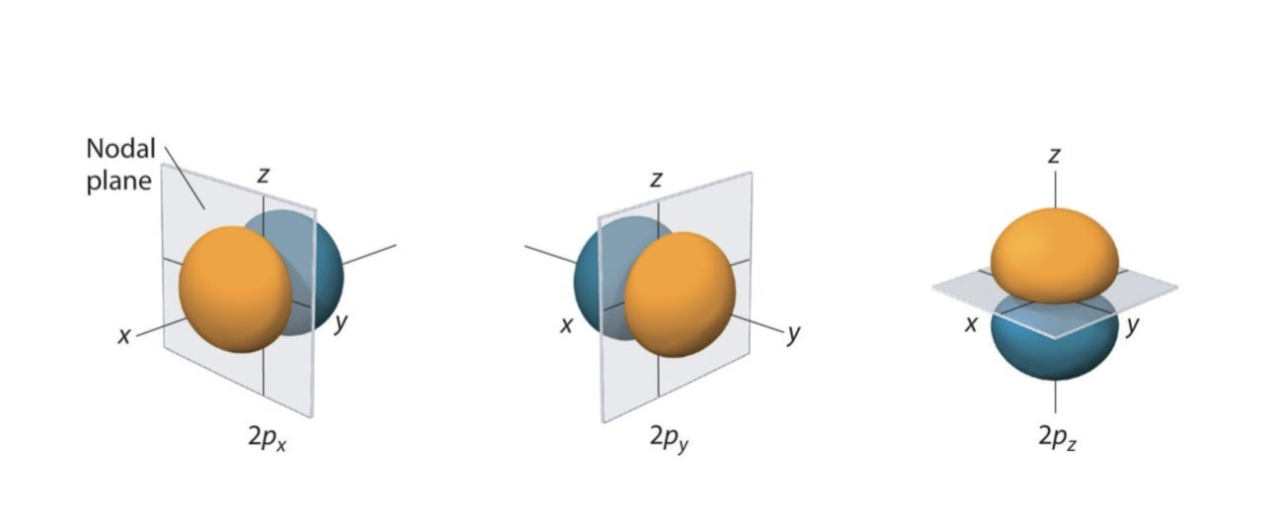
What is the probability of finding a 2p electron within a
nodal plane?
0%
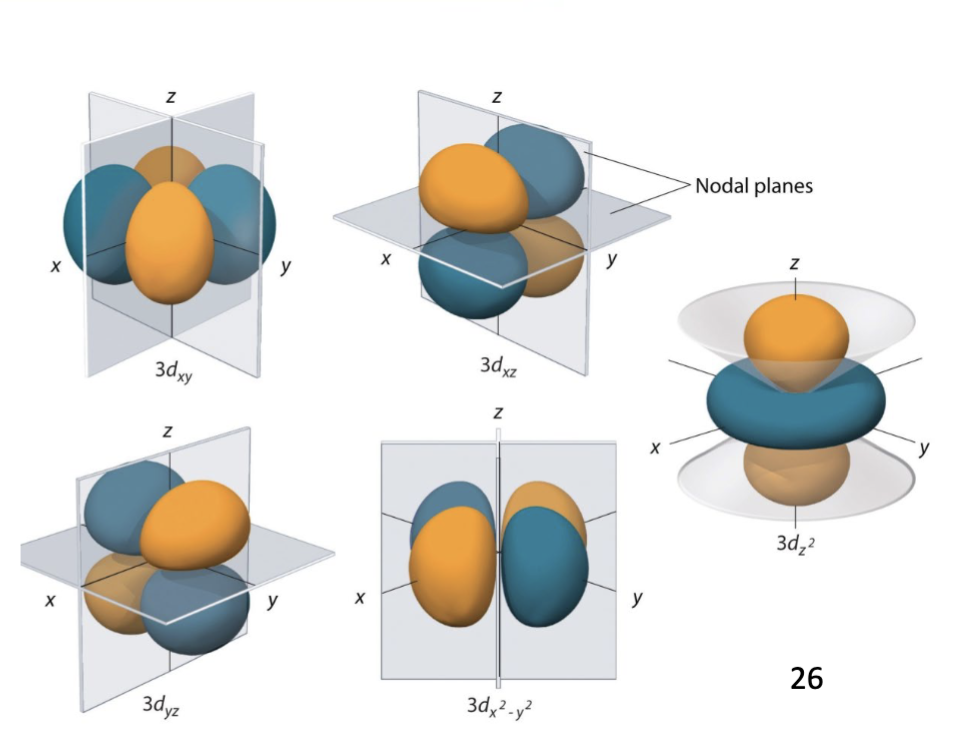
d orbitals
have ℓ = 2
• shape: two dumbbells or a torus with a dumbbell
• have 5 orientations (mℓ = −2, −1, 0, +1, +2)
-can have up to 10 electrons
• There are five d orbitals in a shell
• have 2 angular nodes
• have n-3 spherical nodes
Fourth Quantum Number Ms
• Spin magnetic quantum number, ms
• It describes the electron rather than the atomic orbital
• Spin is a property of the electron
• ms can take on either of two values: +½ or -½
• Referred to as “spin up” or “spin down”
• Electrons are not spinning – this is
outdated terminology.
Pauli exclusion principle
no two electrons in an atom can have the same
set of four quantum numbers
Core electrons
in inner shell
Valence electrons
-are in the highest-energy occupied orbitals
-These electrons participate in forming chemical bonds!
Atomic radius
• A measure of the size of the atom
• Half the distance between the two nuclei
• Depends on how it is determined (e.g. via covalent interaction)
• Experimentally measured or calculated
What determines the size of the atom?
The atomic radius represents the state
where the forces of attraction between the
electrons and protons are equal to the
forces of repulsion between the electrons.
Effective nuclear charge increases across a row, What happens to the attractive force across a row?
the force INCREASES
As you move left-to-right across a period (row), what
happens to the atomic radius?
-it decreases
-stronger attractive force makes radius smaller
As you move down across a group (column), what happens
to the atomic radius?
-atomic radius increases
Monoatomic Ions
electrons have been added to or removed from a
neutral atom
Cations are
-pos charged
-outermost electron removed
-smaller than neutral
anions
-negatively charged
-e- added to next available orbital
-bigger than neutral
Which has a larger radius?
A. Li
B. Li+
Li because Li+ is positive because it lost an electron, making it smaller
Which has a larger radius?
A. F
B. F ̶
F- because it has another electron
Isoelectronic
Exact same electron configuration/same number of e-
ionization energies generally
-increase across a period
• decrease down a group