OCR A LEVEL BIOLOGY - 6.5 & 6.6: Ecosystems, Populations + Sustainability
 Call Kai
 Learn
Learn Practice Test
 Spaced Repetition
 Match
Match Flashcards
 Knowt Play
1/37

There's no tags or description
Looks like no tags are added yet.
Name | Mastery | Learn | Test | Matching | Spaced | Call with Kai | Chat |
|---|
No analytics yet
Send a link to your students to track their progress
38 Terms
What is an ecosystem?
A community of living organisms (biotic factors) interacting with the non-living physical environment (abiotic factors)
What is a habitat?
The place where an organism lives
What is a population?
All of the organisms of one species in a habitat
What is a producer?
An organism that produces organic molecules using sunlight energy, e.g. plants
Materials in the environment are converted into glucose, a carbohydrate
What is a consumer?
An organism that eats other organisms e.g. animals/birds
What is a decomposer?
An organism that breaks down dead/undigested organic material, e.g. bacteria
What is a trophic level?
A stage in a food chain occupied by a particular group of organisms, e.g. producers are the first trophic level in a food chain
What are abiotic vs biotic factors?
Biotic → living features of an organism
Abiotic → non-living features of an ecosystem
What does it mean by an ecosystem being dynamic?
Constantly changing
What are 7 abiotic factors?
Temperature
Light
Water availability
O2 concentration
CO2 concentration
pH
Mineral ions
What are 4 biotic factors?
Competition
Predation
Disease
Food availability
What are 3 examples of ecosystems?
Rock pools
Playing field
Large tree
Describe the rock pool ecosystem in terms of both abiotic + biotic factors
Biotic factors
seaweed - food source for consumers, e.g. limpets that graze on this producer
intense competition for food (e.g. seaweed) - limits number of organisms present in a small rock pool ecosystem
Abiotic factors
rock pools - heavily influenced by tides
high tide → completely submerged by the ocean so experience similar abiotic factors (e.g. pH/salinity/temp, etc.)
low tide - more extreme abiotic conditions (e.g. higher salinity + temperatures) → only some organisms can tolerate their conditions
Describe the playing field ecosystem
Biotic factors
producers include grass + other plants, e.g. daises, clover + dandelions → large amount of these plants attract a large number of organisms that use them as a food source, e.g. rabbits/caterpillars
Abiotic factors
rainfall + sunlight affect growth of producers in ecosystem
very wet conditions → soil may become waterlogged - plants struggle to grow
poor plant growth - decreases number of consumers the ecosystem can support
Describe the large tree ecosystem
Biotic factors
Insects, e.g. caterpillars can use the leaves of a tree as a source of food
if all leaves on a tree are consumed entirely → tree growth is slowed + death comes to tree
Abiotic factors
Drought conditions (e.g. prolonged periods of very low rainfall) → negatively impacts tree growth → whole tree/part of tree can die
What is the main route by which energy enters an ecosystem? What is another less common way?
Photosynthesis
Bacteria uses chemicals from deep sea vents as an energy source
What is biomass?
Mass of living materials, e.g. mass of plant material
What are energy transfers also known as?
Biomass transfers
How is energy transferred through an ecosystem?
Energy enters (typically through photosynthesis)
Plants convert sunlight energy into a form that can be used by other organisms → biomass
Energy is transferred through living organisms when organisms eat other organisms, e.g. producers → primary consumers → secondary → tertiary
Energy locked up in things that cannot be eaten (e.g. bones/faeces) is recycled back into ecosystem by decomposers
What do food chains + web show?
Energy transfer through an ecosystem
What are food chains/webs?
Food chains - simple lines of energy transfer
Food webs - lots of food chains in an ecosystem + how they overlap
What are 3 differences between plant + algae?
Algae can be unicellular/multicellular organisms
Algae live underwater whilst most plants live on land
Algae have no leaves, stems/roots
How do consumers obtain the nutrients they need from other organisms?
Digestion
What is a byproduct of photosynthesis?
Oxygen - released back into the atmosphere
What is an example of a food chain?
Acacia tree
Giraffe
Lion
What is interdependence?
The way in which living organisms depend on each other to survive, grow + reproduce
What causes fluctuations in population sizes in food webs?
Fluctuations in population sizes of other populations
What is bioaccumulation?
When levels of chemicals build up in an organism as they are transferred along a food chain
What is succession?
Process by which an ecosystem changes over time
What are 2 types of succession?
Primary Succession = happens on land that has been newly formed/exposed, e.g. volcano erupted to form a new rock surface/sea level dropped
Secondary Succession = occurs on land that has been cleared of all the plants, but where the soil remains, e.g. after a forest fire/where a forest has been cut down by humans
What is the process of succession?
Primary succession begins
Seeds + spores are blown by the wind + begin to grow
Pioneer species colonise the area + grow because they are specialised to cope with harsh conditions
Pioneer species change the abiotic conditions as they die + microorganism decompose the dead organic material
Basic soil is formed → forming less hostile conditions (e.g. helping to retain water so new organisms can move in + grow)
New organisms die + decompose → soil becomes deeper + richer in minerals
Larger plants can grow
More plants → create more habitats → more animals
Secondary succession
Already a soil layer → pioneers species= larger plants → secondary occurs at a later stage
Species diversity (num of diff species + abundance of each species) increases
Amount of biomass increases → plants at later stages are denser + larger
Climax community - ecosystem is supporting the largest + most complex community of plants + animals → steady state
What are pioneer species?
First species to colonise an area
What is dead organic material also known as?
Humus
What are the conditions like at the start of primary succession?
Harsh (e.g. no soil to retain water)
Only pioneer species grow because they are specialised to cope with the harsh conditions →E.g. marram grass - sand dunes, deep roots to get water + can tolerate the salty environment
What is an example of primary succession?
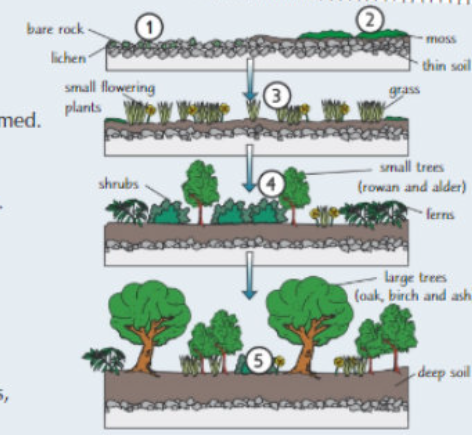
Bare rock to woodland
Pioneer species colonise the rocks e.g. lichens grown on + break down rocks, releasing minerals
Lichens die + are decomposed helping to form a thin soil - thickens as more organic material is formed - so other species e.g. mosses can grow
Larger plants that require water → can move in as soil deepens, e.g. grasses +flowering plants → soil continues to deepen as larger plants die + decomposed
Shrubs, ferns + small trees begin to grow → out-compete the grasses + smaller plants to become the dominant species. Diversity increases.
The soil is finally deep + rich enough in nutrients to support large trees → these become the dominant species + the climax community is formed
What results in different climax communities being formed? Example - ?
Different ecosystems
E.g. temperate climate → plenty of available water, mild temperatures + not much change between seasons → deep soils develop _ parge trees grwo