Enzymology
 Call Kai
 Learn
Learn Practice Test
 Spaced Repetition
 Match
Match Flashcards
 Knowt Play
1/77

There's no tags or description
Looks like no tags are added yet.
Name | Mastery | Learn | Test | Matching | Spaced | Call with Kai | Chat |
|---|
No analytics yet
Send a link to your students to track their progress
78 Terms
rules of catalysis
a catalyst can’t catalyse a thermodynamically unfavourable reaction
a catalyst can’t change the course of a reaction
a catalyst can’t change the equilibrium of a reaction, only the rate at which equilibrium is reached- it lowers the activation energy for the reaction
a catalyst may exert a directing influence. If 2 reactions are thermodynamically possible and a catalyst only catalyses one of them then that reaction will be favoured
a catalyst is recoverable, so only small amounts are necessary
specificity
enzymes are often specific for 1 reaction only
can distinguish between optical isomers
200 enzymes are commonly found in all organisms
catalysis occurs at the active site of the enzyme
the tertiary protein structure that determines the 3D shape of the enzyme is essential for its specific binding of substrates and its catalytic function
chemical identity
the properties of enzymes are associated with the structure of proteins (their function depends on their shape which is determined by the tertiary structure and held together by non-covalent bonds)
denaturation leads to loss of enzyme catalytic activity
mechanism of action
enzymes increases the rate of the reaction they catalyse more than simple chemical catalysts do
before a substrate can achieve this in its formation of products it must first pass through a higher energy state called the transition state. To do this it must acquire activation energy
mechanism of action of enzymes
lowers the activation energy for the reaction by binding the substrate(s) in its active site. This may have 1 or combination of effects:
the enzyme may position substrates in the active site and line up molecules precisely for reaction so that bonds can be broken or made more easily (‘orbital steering’)
some enzymes combine with the substrate to form an unstable covalent intermediate in a ‘ transition state’ that more readily undergoes reaction to form products. Substrates in the active site are oriented such that a transition state is readily formed
binding substrates in the active site increases the effective concentration of the reactants
binding substrates in the active site may bring them into close proximity to a catalytic group. enzymes may provide functional groups capable of acting as a portion donor or acceptor and an enzyme may bring about general acid- base catalysis
the enzyme may induce strain or distortion in the susceptible bond. these changes of shape are called conformational change
the active site
the enzyme protein has 3D shape from its tertiary structure that determines its active site
the amino acids forming the active site are few and my be far apart in the primary sequence but are spatially close due to the 3D structure
the functional groups in the side chains of the amino acids interact with the substrate through weak non-covalent forces such as ionic bonds and position the substrate within the active site
a transition state is formed between the enzyme and substrate (ES) which will then regenerate free enzyme plus products
Acetylcholinesterase
found in the synapse at the neuromuscular junction where its job is to destroy the neurotransmitter, acetylcholine, after it has medicated a nerve signal (action potential) across the synapse to the muscle. Acetylcholinesterase terminated the stimulatory signal
what is the active site of acetylcholinesterase made up of
the anionic subsite binds the positive quaternary amine of acetylcholine. 14 aromatic amino acids line the gorge leading to the active site- tryptophan 84 is essential
the esteratic subsite is where acetylcholine is hydrolysed to choline and acetate. a catalytic triad of 3 amino acid side chains: serine 203, histidine 447 and glutamic acid 334 attack the ester bond through the formation of a transition state in which the substrate is covalently bound to the serine prior to hydrolysis of the ester bond
mechanism of acetylcholinesterase
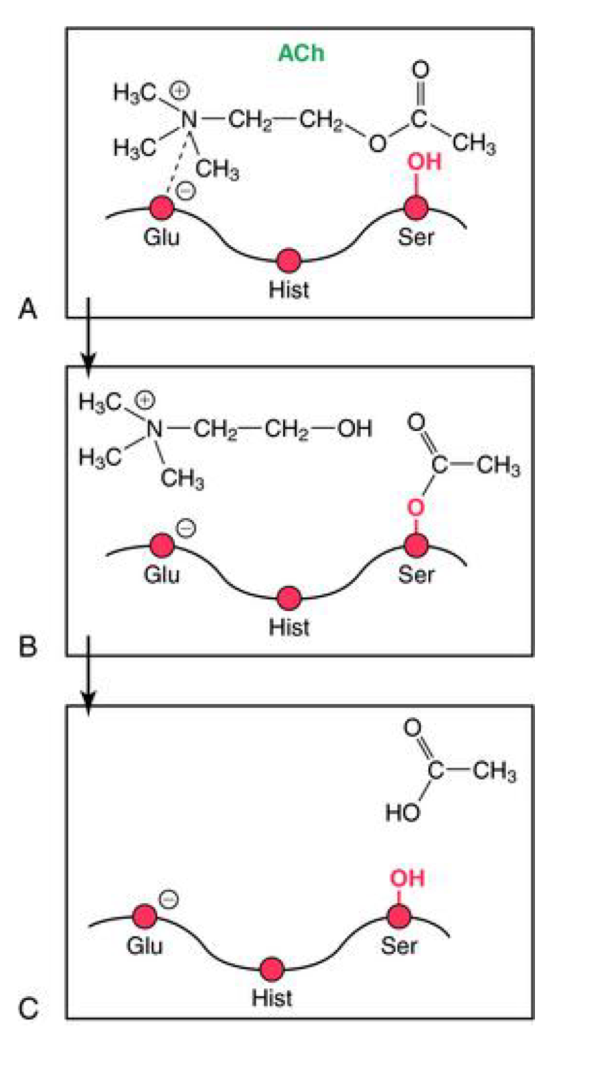
the enzyme has an anionic site in which negatively charged glutamic acid attracts the positively charged amine group of acetylcholine (A)
a specially activated serine in the active site is thus positioned next to and in line with the carbonyl of the ester group in the substrate. A covalent transition state intermediate is formed with this serine. Choline is released. (B)
This bond is then hydrolysed by a water molecule to release acetate (C)
nomenclature of enzymes
substrate + reaction + ase
type of reaction the enzyme catalyses
oxidoreducatases (or dehydrogenases)
transferases
hydrolases
lyases
isomerases
ligases
oxidoreductases (or dehydrogenases)
catalyse oxidation and reduction reactions
e.g. lactate dehydrogenase
transferases
transfer functional groups from donor to acceptor
e.g. aspartate aminotransferase
hydrolases
hydrolysis of C-O, C-N and C-C bonds
e.g. esterases, proteases
lyases
break bonds such as C-C, C-O, C-N
e.g. pyruvate decarboxylase '
isomerases
geometric or structural changes within a molecule
e.g. alanine racemase
ligases
joins molecules together, forms bonds, requiring ATP energy
e.g. glutamine synthetase
2 ways to measure enzymatic activity
the disappearance of substrate
the appearance of product
Factors affecting enzyme activity
Time
Enzyme concentration
Temperature
pH
Presence or absence of cofactors
Substrate concentration
Time
the velocity of an enzyme reaction is the change in reactant or product concentration with time
the initial velocity is the tangent to velocity at time 0
the slowing down of the reaction is due to:
the concentration of substrate decreases
the concentration of product increases and this may:
inhibit the reaction
increases the velocity of the reverse reaction
cause a change in pH and slow the reaction
initial velocity = change in product/ change in time
enzyme concentration
the more enzyme present the faster the reaction goes
if the product inhibits the enzyme then there may be a limit
the amount of enzyme present in a tissue sample can be calculated from an assay of activity assuming that this linear relationship holds. This is important in clinical measurements
temperature
the rate of an enzyme catalysed reaction increases with temperature
high temperature denatures most proteins
most enzymes are inactivated between 60-70 degrees
initial velocity increases with temperature, the actual amount of product decreases above a certain temperature
pH
enzymes are only active over a limited range of pH
enzymes exist in a whole series of different states of ionisation which depend on pH
extremes of pH will denature the enzyme and so destroy activity
Presence or absence of cofactors
coenzymes are complex organic molecules derived from water soluble vitamins
cofactors take part in reactions catalysed by the enzyme often as carriers of a particular chemical group
cofactors could be:
organic coenzymes like coenzyme A, NADH
inorganic ions or activators e.g. Mg2+, Mn2+, etc.
Substrate concentration
the value of Vmax will vary with the concentration of enzyme used
Michaelis-Menten equation
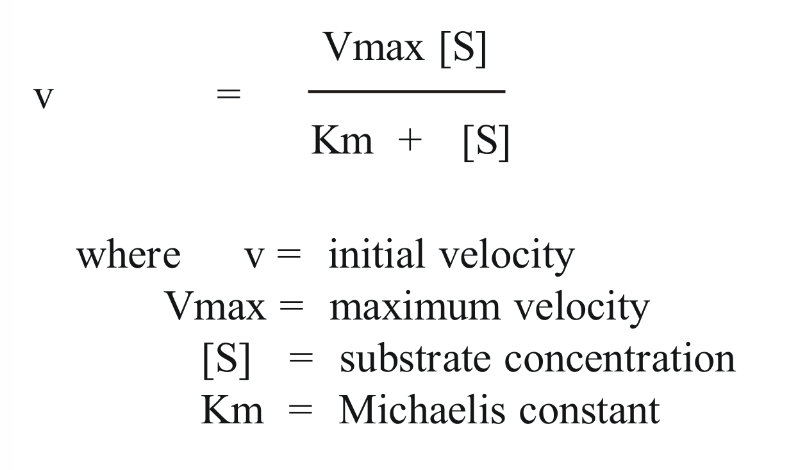
Km
a dissociation constant for a given enzyme
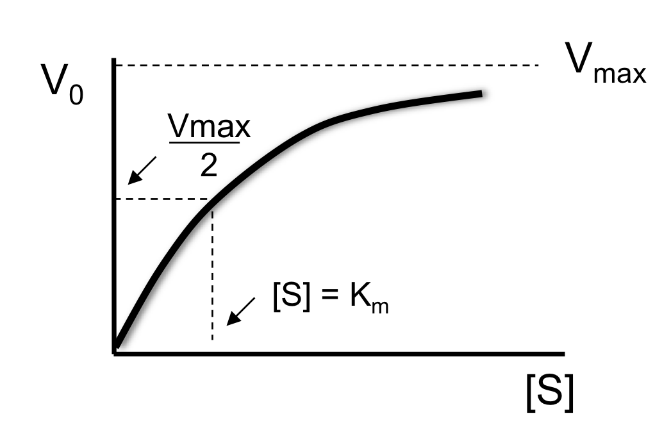
the concentration of substrate which allows the catalytic reaction to proceed at 0.5 Vmax
1/Km is a measure of the affinity between enzyme and substrate
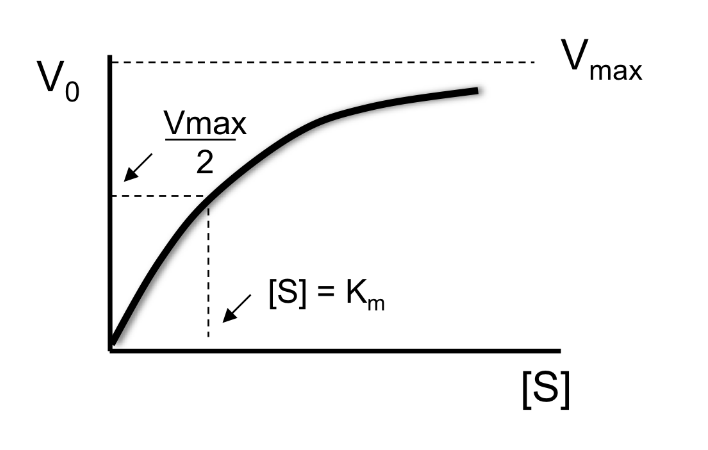
Vmax
a constant for a given enzyme
a quantitative assessment of the extent of catalysis
the theoretical maximal rate of the reaction but it will never be achieved
line weaver-burk equation
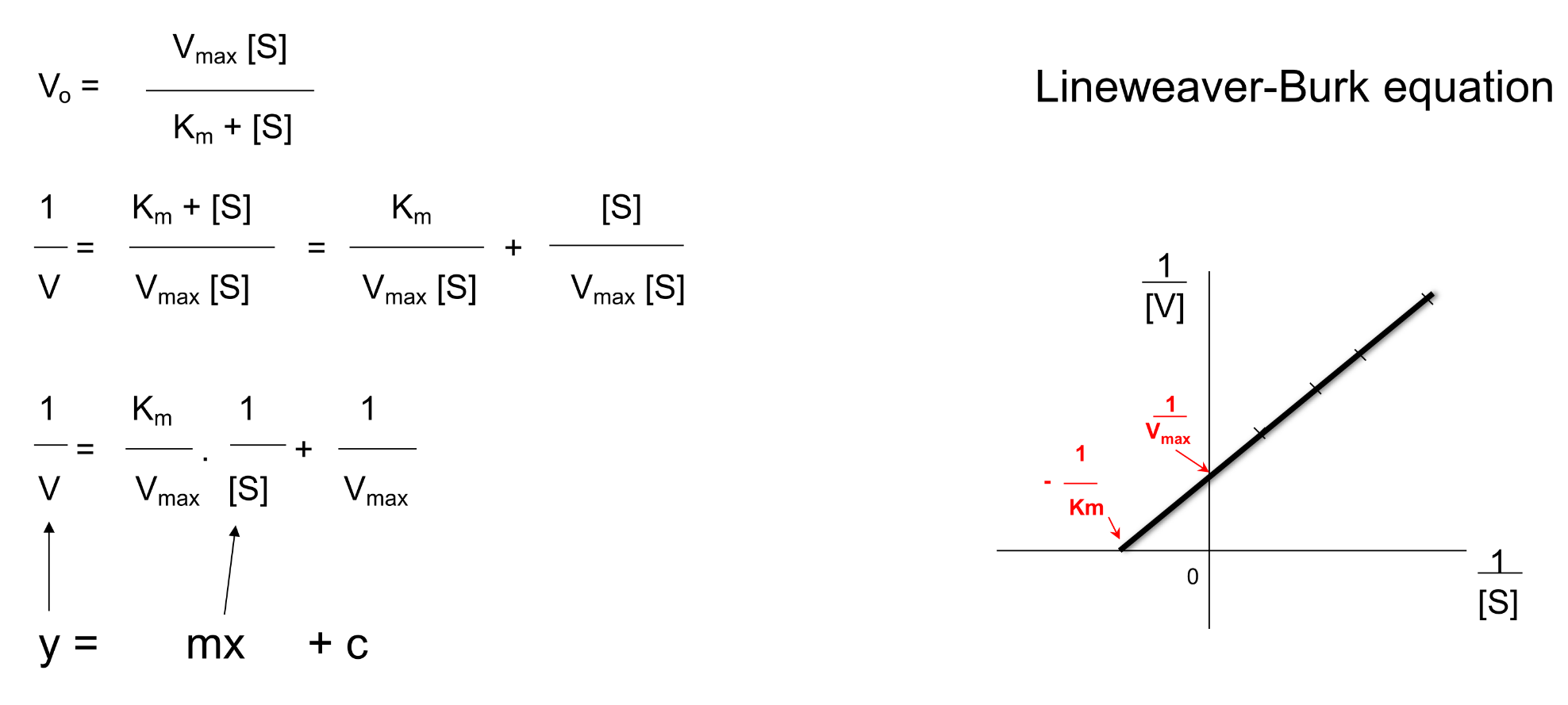
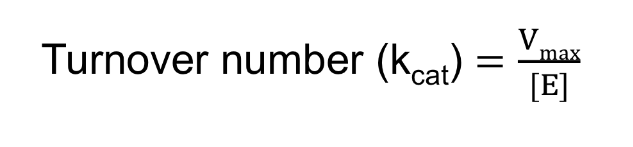
turnover number (Kcat)
gives the rate constant for the catalytic reaction
enzyme turnover numbers range from 10-107 per sec
an turnover number of 1000 sec-1 will catalyse the conversion of 1000 molecules of substrate to product per second
equation for turnover number
assumptions when calculating Michaelis-Menten enzyme kinetics
enzyme-substrate complex is formed
that the equilibrium where the rate of ES formation is equal to its breakdown is reached instantaneously
that the concentration of substrate in ES is negligible- enzyme concentration will probably be about 0.001% of the substrate concentration
there is no k-2 i.e. there is no chance of E + P forming ES- it’s an irreversible reaction
allosteric enzymes
distinct regulatory (allosteric) and catalytic sites
binding of an effector (allosteric modulator) can either stimulate or inhibit the enzyme activity
how do allosteric enzymes work
these enzymes also have an allosteric regulatory site distinct from the catalytic active site
this allows the binding of an activator or inhibitor molecule (effector) which is structurally unrelated to the substrate and which can either stimulate or inhibit the enzyme activity by changing the shape of the active site and thus changing its affinity for substrate
the effector could be another molecule in the metabolic pathway or even an ion such as Ca2+
Co-operative binding: aspartate transcarbamoylase (ATCase)
enzyme that catalyses an early step in synthesis of pyrimidines
ATCase is negatively regulated by CTP
ATCase is positively regulated by ATP
If ATP abundant, DNA and RNA synthesis active
If ATP abundant and [ATP] > [CTP], need for pyrimidine synthesis to match the availability of purines
![<ul><li><p>enzyme that catalyses an early step in synthesis of pyrimidines </p></li><li><p>ATCase is negatively regulated by CTP </p></li><li><p>ATCase is positively regulated by ATP </p><ul><li><p>If ATP abundant, DNA and RNA synthesis active </p></li><li><p>If ATP abundant and [ATP] > [CTP], need for pyrimidine synthesis to match the availability of purines </p></li></ul></li></ul><p></p>](https://assets.knowt.com/user-attachments/b0b5a06a-d6b6-44b8-8aad-c5b5048455e4.png)
isozymes
an enzyme which has multiple molecular forms catalysing the same reaction
an example of an isozymes
lactate dehydrogenase- can occur in 5 possible forms in organs of vertebrates
the enzyme is a tetramer made from 2 types of monomer- M (muscle) and H (heart) and these 2 in various combinations give the 5 isozymes
the various combinations have different kinetic properties depending on the physiological roles they perform
combinations of lactate dehydrogenase
LDH-1 (4H)- in the heart
LDH-2 (3H1M)- in the reticuloendothelial system
LDH-3 (2H2M)- in the lungs
LDH-4 (1H3M)- in the kidneys, placenta and pancreas
LDH-5 (4M)- in the liver and striated muscle
multifunctional enzymes
multiple active sits on a single polypeptide chain
example of multifunctional enzymes
mammalian fatty acid synthase has 7 different catalytic activities in 1 protein molecule. this allows a metabolic pathway to operate within a single enzyme which has advantage in terms of speed and control aa well as absence from interference
multienzyme complexes
there is an association of separate enzymes in separate subunits. the enzyme are organised physically so that the product of 1 becomes the substrate of another, without leaving the complex. this ensures a highly efficient progression from reactants to products
enzyme inhibition
many drugs exert their action by inhibition of enzyme activity in the body
inhibition may lead to death of the cell or organism
you can design new drugs which are enzyme inhibitors once a target enzyme has been identified
reversible inhibitors
the effect of the inhibitor is instantaneous and it can be removed from the enzyme by dialysis or dilution so that the enzyme activity is returned to normal. Such inhibitors react with the enzyme by weak noncovalent bonds to form an enzyme inhibitor complex
E + I ←> EI
irreversible inhibitor
bind very tightly to the enzyme sometimes by formation of covalent bonds to form an enzyme inhibitor compound rather than a loose complex. the effect is therefore progressive, reaching a maximum when all the enzyme has reacted. this is not easily reversible by simple physical treatments such as dialysis
E + I → EI
competitive reversible enzyme inhibitor
molecules which closely resemble the substrate in size, shape and charge distribution may also fit the active site of the enzyme and this may lead to inhibition because the active site is blocked
both I and S compete for the same active site, if [S] is increased sufficiently while [I] is constant, the proportion of I bound to E will decrease hence formation of ES will increase and the rate of enzyme action will increase. If sufficient [S] is present then eventually the inhibition by I will be overcome
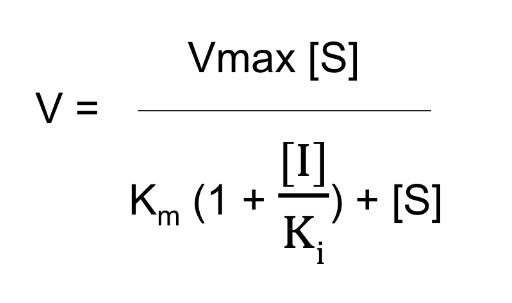
Michaelis-Menten equation for competitive reversible inhibitor
Vmax is unchanged
[I]
inhibitor concentration
ki
the dissociation constant for the equilibrium between E and I
the concentration of inhibitor required to slow the reaction to half the rate it shoes in the absence of inhibitor
line weaver burk plot for competitive reversible inhibitor
y-intercept = 1/Vmax
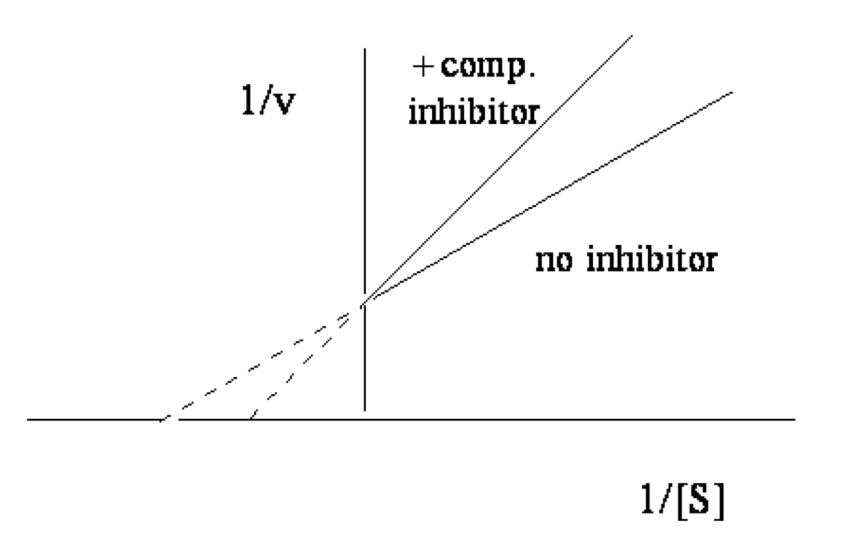
line weaver burk plot equation
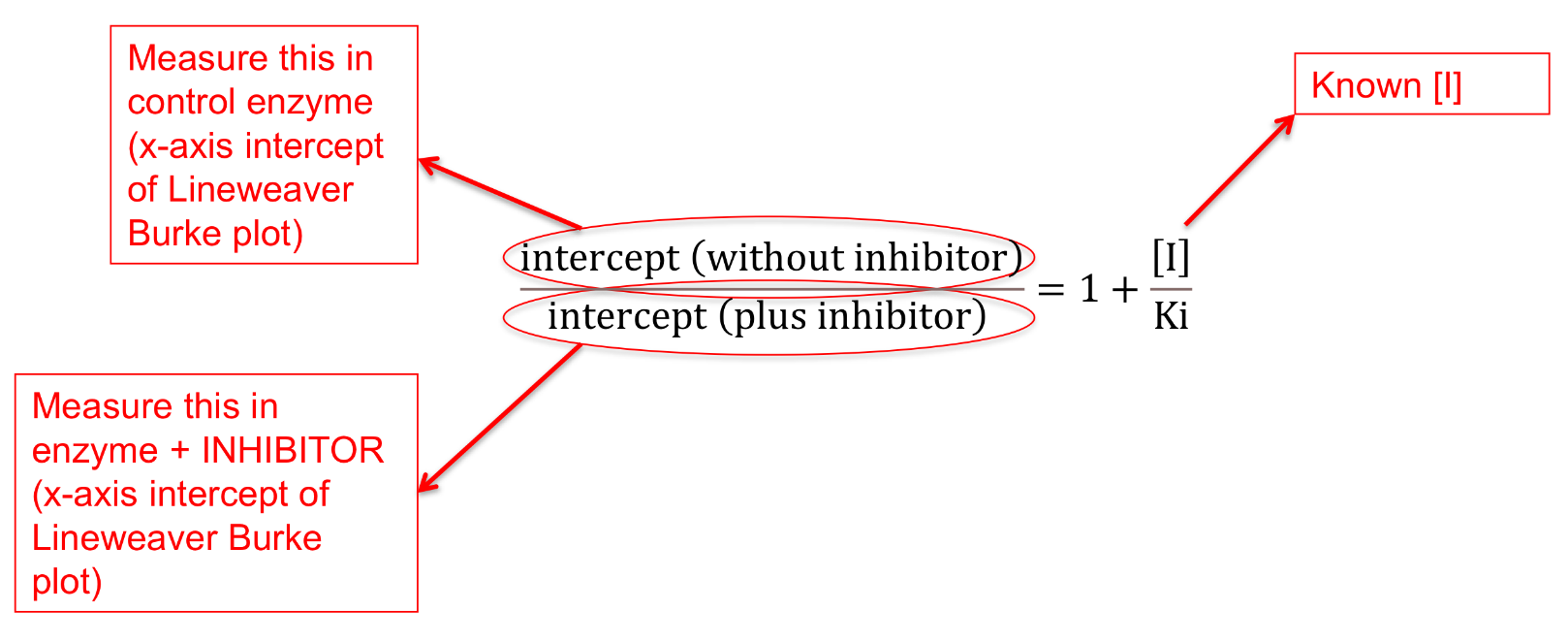
non-competitive inhibitor
reacts with the enzyme-substrate complex and slows the rate of reaction to form the enzyme-product complex
when both the substrate and inhibitor are bound, the enzyme-substrate- inhibitor complex can’t form product and can only be converted back to the enzyme-substrate complex or the enzyme-inhibitor complex
Vmax is changed
Km is unchanged

reversible
timescale of the inhibition is similar to that of enzyme action
irreversible
the enzyme activity is inhibited for times significantly longer than the assay times for the enzyme
quasi-irreversible
in between reversible and irreversible
including tight-binding inhibitor, transition state analogues and slowly dissociating intermediate
potency
the inhibitor will need to be potent enough so that the dose require is in the order of milligrams to grams
specificity- enzyme inhibitors as drugs
if a compound is a nonspecific enzyme inhibitor it is more likely to be toxic and exhibit side effects
simple reversible inhibitor
binds to the enzyme and decreases activity instantaneously and reverses within the time of the enzyme action
the inhibitor binds noncovalently to the enzyme and the strength of binding us of a similar order to the substrate
ki will be of similar size to km
tight binding inhibitors
binding is very tight (Ki in order of 10-9 mol L-1 to 10-10 mol L-1)
they are potent enough to act as drugs in vivo
transition state analogue
binds much tighter than an analogue of the substrate
the outcome is a potent in vivo and potentially specific inhibitor
competitive reversible inhibitors of acetylcholinesterase
Ki values of 10-3 mol L-1 to 10-5 mol L-1 so they are too weak to have much action in vivo
lower the Ki
the greater the affinity of the inhibitor and hence the greater its potency
examples of acetylcholinesterases
edrophonium
neostigtmine
physostigmine (eserine)
edrophonium
competitive reversible inhibitor of acetylcholinesterase used in the diagnosis of myasthenia gravis because in vivo its action is very short
has a quaternary amine giving it a positive charge and will react with the anionic site on acetylcholinesterase
edrophonium won’t react with the esteratic site because it has no ester bond
neostigmine
a more potent acetylcholinesterase
they bind to the enzyme with high affinity and remain on the enzyme for much longer
process of neostigmine
A. the quaternary (+) nitrogen of neostigmine is attracted to the anionic site positioning the ester portion of the molecule in close proximity to the catalytic site
B. the ester bond on neostigmine is cleaved, the enzyme is carbamylated, which prevents the enzyme from interacting with ACh and the remainder of the neostigmine molecule is released
C. hydrolysis of carbamylated enzyme occurs slowly casing reversible inhibition of the enzyme

physostigmine (eserine)
has parasympathomimetic properties and has been used in the treatment of glaucoma
example of irreversible anticholinesterases
organophosphates
organophosphates
a typical member is diisopropylfluorphosphate (DFP)
the active site serine reacts with organophosphates to form a covalent intermediate which is not hydrolysed and the inhibition is reversible
DFP causes severe in vivo symptoms resulting in death and is very toxic
although enzyme poisoned with organophosphates will not regenerate they can be reactivated using an antidote
3 levels of regulation of enzyme activity within cells
allosteric regulation
covalent modification
regulation of enzyme concentration
allosteric regulation of enzyme activity
some enzymes have binding sites for small molecules. the effectors can:
stimulate enzyme activity
inhibit enzyme activity
the allosteric binding sites are distinct from the active catalytic site of the enzyme
feedback inhibitor
allosteric inhibitors are often end-products of a pathway that feed=back and inhibit an early step in the pathway to prevent overproduction and wastage

feedforward activation
allosteric activators are often substrates for the reaction or the pathway that feed-forward to encourage the pathway to dispose of the substrate
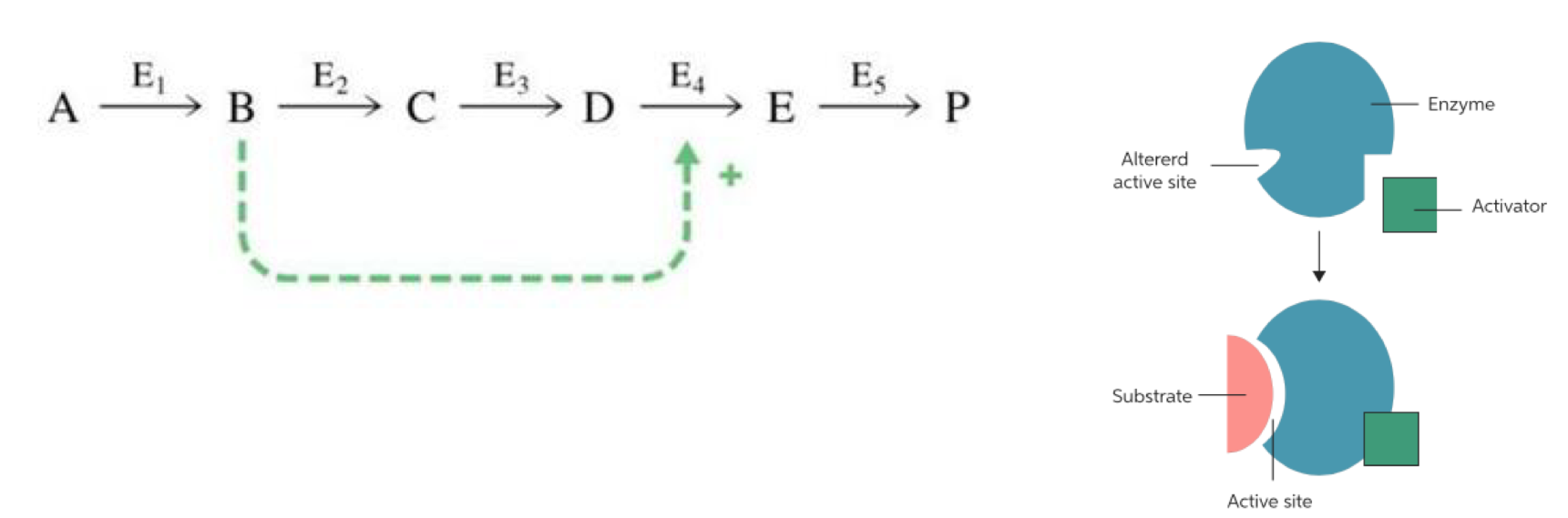
mechanism of allosteric sites
the allosteric effector binds specifically and reversibly to the allosteric sites on the enzyme and is done rather than non-covalent bonding. Binding at the allosteric site induces a conformational change in the protein that alters the shape of the active site
allosteric regulation
many regulatory enzymes are multimeric with several copies of a single polypeptide chain each with its own active site forming the quaternary structure of the enzyme
cooperativity
binding of substrate to the active site of 1 subunit causes a conformational change that is transmitted through the quaternary structure to the other subunits and makes it easier for these bind substrate
allosteric activators
stabilise the conformation of the substrate bound form
allosteric inhibitor
stabilise the conformation of the no-substrate bound form