PENNY chapt. 23 FIRST TRIMESTER
 Call Kai
 Learn
Learn Practice Test
 Spaced Repetition
 Match
Match Flashcards
 Knowt Play
1/59

There's no tags or description
Looks like no tags are added yet.
Name | Mastery | Learn | Test | Matching | Spaced | Call with Kai | Chat |
|---|
No analytics yet
Send a link to your students to track their progress
60 Terms
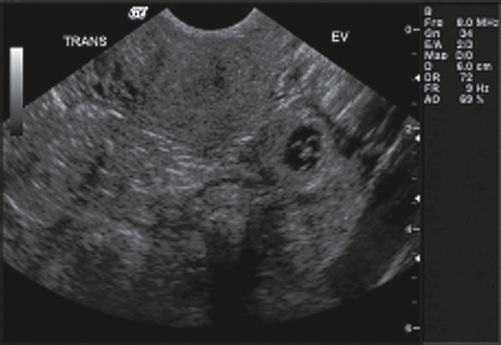
1. Which of the following is present in Figure 23-27?
a. Anembryonic gestation
b. Molar pregnancy
c. Miscarriage
d. Ectopic pregnancy
d. Ectopic pregnancy
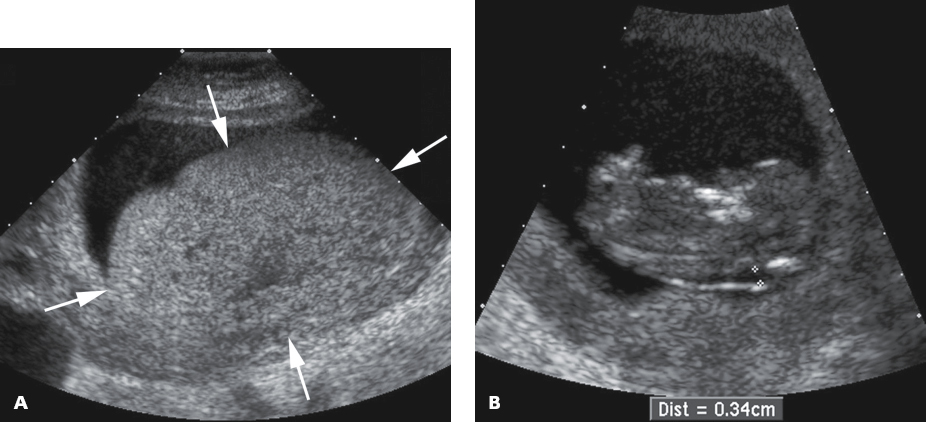
2. The patient in Figure 23-28 presented to the sonography department with nausea and vomiting, and a markedly elevated hCG level. What is the most likely diagnosis?
a. Miscarriage
b. Partial molar pregnancy
c. Complete molar pregnancy
d. Ectopic pregnancy
b. Partial molar pregnancy
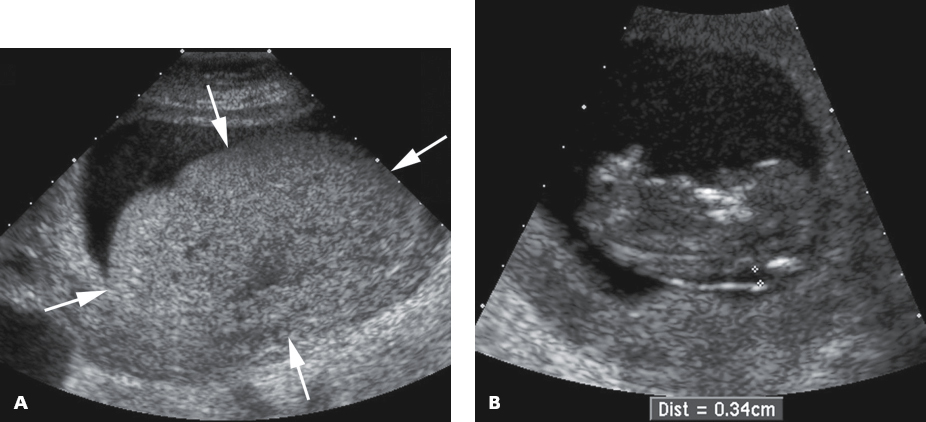
3. What do the arrows in Figure 23-28 A indicate?
a. Uterine fibroid
b. Subchorionic hemorrhage
c. Hydropic placenta
d. Miscarriage
c. Hydropic placenta
4. Which of the following would be the most likely aneuploidy noted in the fetus in Figure 23-28?
a. Triploidy
b. Trisomy 13
c. Turner syndrome
d. Trisomy 18
a. Triploidy
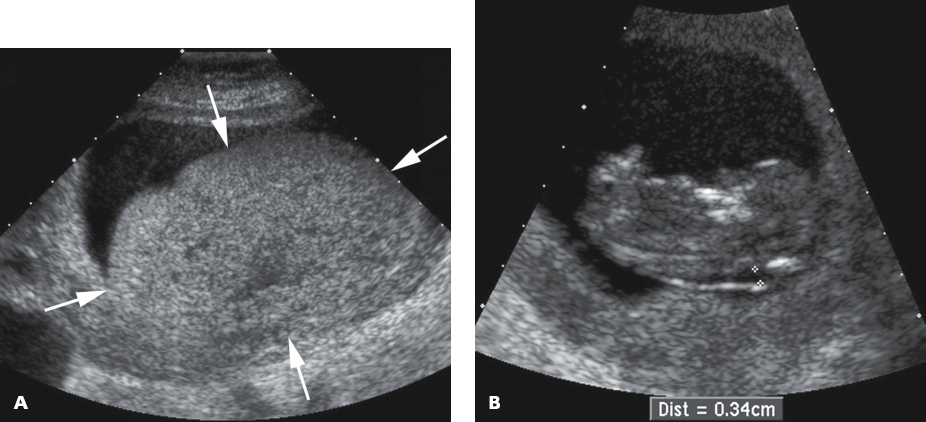
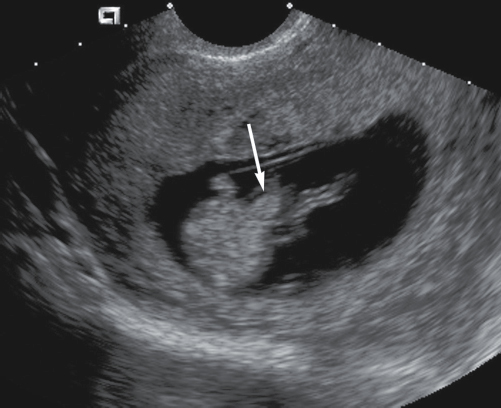
5. What does the arrow in the 11-week fetus in Figure 23-29 indicate?
a. Omphalocele
b. Physiologic bowel herniation
c. Gastroschisis
d. Ectopia cordis
b. Physiologic bowel herniation
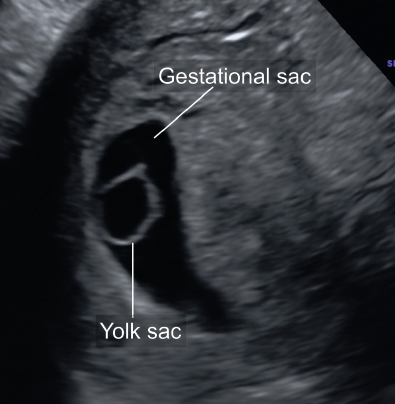
6. Which abnormality can be noted in Figure 23-30?
a. Subchorionic hemorrhage
b. Normal yolk stalk
c. Enlarged yolk sac
d. Enlarged chorionic sac
c. Enlarged yolk sac
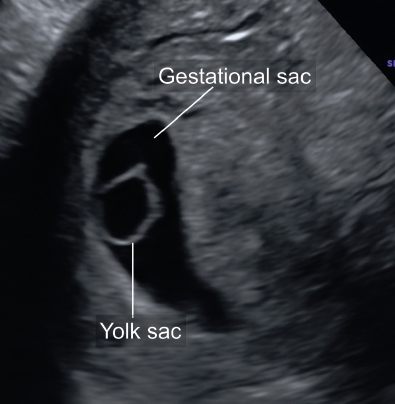
7. What is the likely outcome of Figure 23-30?
a. Normal pregnancy
b. Ectopic pregnancy
c. Anembryonic gestation
d. Abortion
d. Abortion
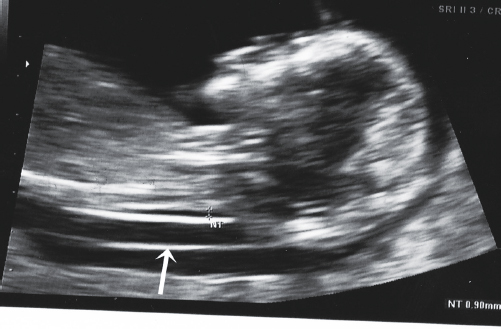
8. What does the arrow in Figure 23-31 indicate?
a. Chorionic cavity
b. Thickened NT
c. Amnion
d. Yolk sac
c. Amnion
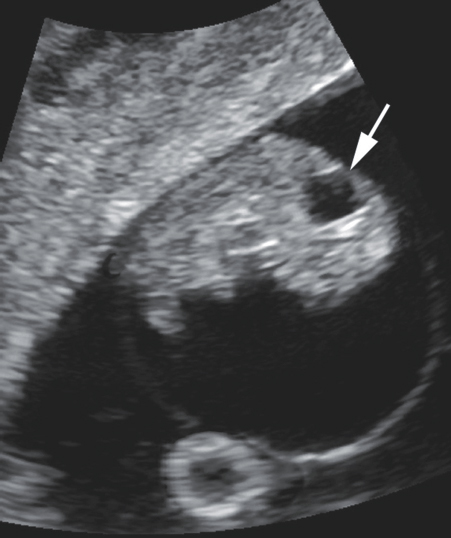
9. What does the arrow in Figure 23-32 indicate?
a. Cephalic cyst
b. Thickened NT
c. Fourth ventricle
d. Choroid plexus cyst
c. Fourth ventricle
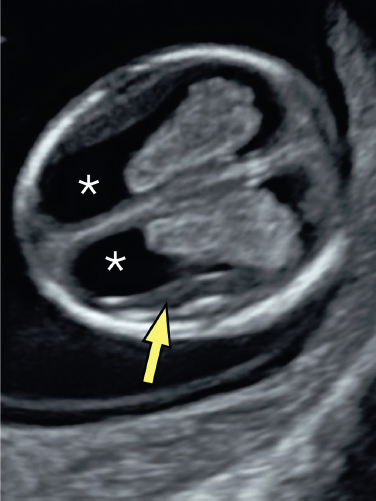
10. What do the “ * ” in Figure 23-33 indicate?
a. Choroid plexus
b. Lateral ventricles
c. Cebocephaly
d. Anencephaly
b. Lateral ventricles
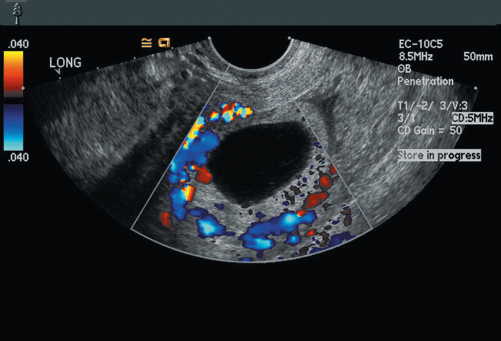
11. The adnexal finding in Figure 23-34 was discovered in a patient with a live 8-week IUP. She did not complain of pain or vaginal bleeding. What is the most likely diagnosis?
a. Corpus luteum
b. Ectopic pregnancy
c. Heterotopic pregnancy
d. Blighted ovum
a. Corpus luteum
12. The patient in Figure 23-35 complained of vaginal bleeding and hyperemesis. What is the most likely diagnosis?
a. Complete molar pregnancy
b. Anembryonic gestation
c. Miscarriage
d. Pseudogestational sac associated with an ectopic pregnancy
a. Complete molar pregnancy
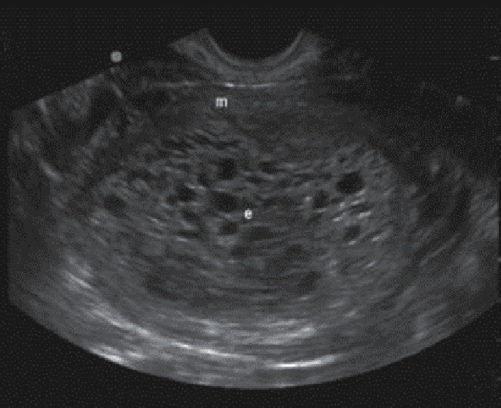
13. What do the multiple anechoic spaces within the endometrium (e) in Figure 23-25 represent?
a. Subchorionic hemorrhage
b. Demised fetus
c. Hydropic chorionic villi
d. Endometrial hyperplasia
c. Hydropic chorionic villi
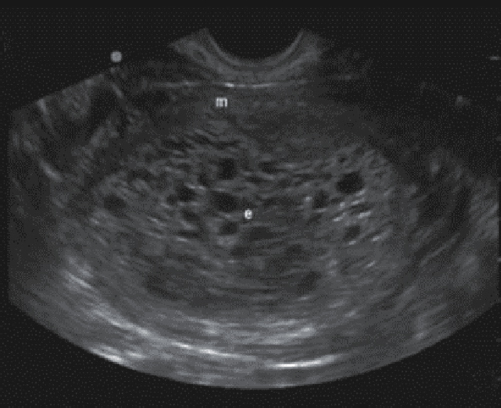
14. In Figure 23-25, what adnexal finding is likely present?
a. Cystic teratoma
b. Theca lutein cyst
c. Ovarian torsion
d. Hydrosalpinx
b. Theca lutein cyst
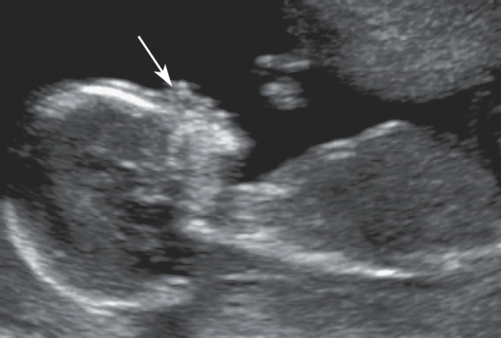
15. What abnormality is noted in Figure 23-36?
Figure 23-36
a. Increased nuchal fold
b. Increased NT
c. Enlarged chest
d. Absent nasal bone
d. Absent nasal bone
16. What abnormality is associated with Figure 23-36?Figure 23-36
a. Trisomy 21
b. Beckwith–Wiedemann syndrome
c. Triplexity
d. Monosomy Y
a. Trisomy 21
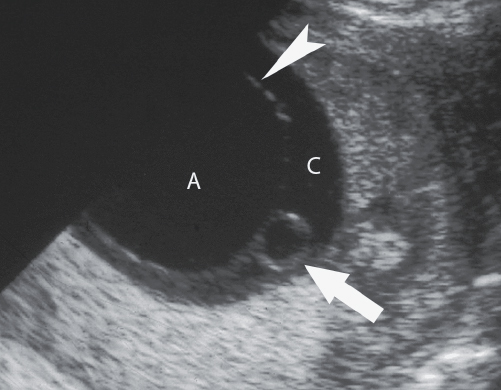
17. What does the white arrow (long) in Figure 23-37 indicate?
a. Amnion
b. Yolk stalk
c. Gestational sac
d. Yolk sac
d. Yolk sac
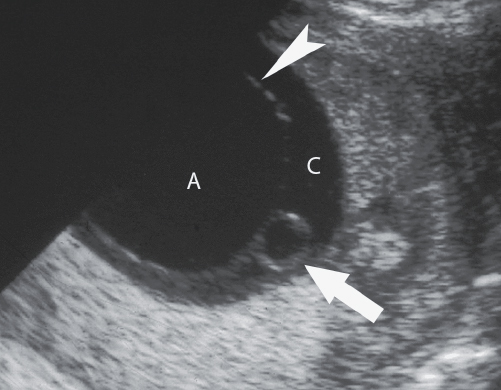
18. What does the white arrowhead in Figure 23-37 indicate?
a. Chorion
b. Chorionic cavity
c. Amnion
d. Gestational sac
c. Amnion
19. What is the outer membrane of the gestation?
a. Chorionic sac
b. Yolk sac
c. Chorionic space
d. Yolk sac cavity
a. Chorionic sac
20. What membrane in the early gestation is located across from the decidua basalis?
a. Chorion frondosum
b. Decidua vera
c. Chorion laeve
d. Decidua capsularis
d. Decidua capsularis
***21. What structure connects the embryo to the yolk sac?
a. Vitelline duct
b. Yolk stalk
c. Amnion
d. Chorionic stalk
a. Vitelline duct
22. What is the name of the dominant follicle before ovulation?
a. Graafian
b. Corpus luteum
c. Morula
d. Corpus albicans
a. Graafian
23. Fertilization typically occurs within ____ after ovulation.
a. 40 hours
b. 12 hours
c. 24 hours
d. 56 hours
c. 24 hours
24. The most common site of fertilization is within the:
a. isthmus of the uterine tube.
b. uterine fundus.
c. cornu of the uterine tube.
d. ampulla of the uterine tube.
d. ampulla of the uterine tube.
25. With a normal pregnancy, the first structure noted within the decidualized endometrium is the:
a. yolk sac.
b. chorionic sac.
c. amniotic cavity.
d. embryo.
b. chorionic sac.
26. The structure created by the union of sperm and egg is the:
a. blastocyst.
b. zygote.
c. morula.
d. ampulla.
b. zygote.
27. The trophoblastic cells produce:
a. estrogen.
b. progesterone.
c. follicle-stimulating hormone.
d. hCG.
d. hCG.
28. Sonographically, a normal-appearing 7-week IUP is identified. Within the adnexa, an ovarian cystic structure with a thick, hyperechoic rim is also discovered. What does this ovarian mass most likely represent?
a. Theca lutein cyst
b. Corpus luteum cyst
c. Corpus albicans
d. Ectopic pregnancy
b. Corpus luteum cyst
29. What is the stage of the conceptus that implants within the decidualized endometrium?
a. Blastocyst
b. Morula
c. Zygote
d. Ovum
a. Blastocyst
30. Another name for the chorionic sac is the:
a. chorionic cavity.
b. extraembryonic coelom.
c. amniotic sac.
d. gestational sac.
d. gestational sac.
31. What is often used to medically treat an ectopic pregnancy?
a. Dilatation and curettage
b. Dilatation and evacuation
c. Open surgery
d. Methotrexate
d. Methotrexate
32. What structure lies within the extraembryonic coelom?
a. Gestational sac
b. Embryo
c. Yolk sac
d. Amnion
c. Yolk sac
33. What hormone, produced by the corpus luteum, maintains the thickened endometrium?
a. Estrogen
b. Progesterone
c. hCG
d. Luteinizing hormone
b. Progesterone
34. What is the most common form of GTD?
a. Complete molar pregnancy
b. Partial molar pregnancy
c. Invasive mole
d. Choriocarcinoma
a. Complete molar pregnancy
35. In the first trimester, normal hCG levels will:
a. double every 48 hours.
b. triple every 24 hours.
c. double every 24 hours.
d. double every 12 hours.
a. double every 48 hours.
36. Compared with a normal IUP, the ectopic pregnancy will have a:
a. high hCG.
b. low hCG.
c. markedly elevated hCG.
d. high AFP.
b. low hCG.
37. Which of the following locations for an ectopic pregnancy would be least likely?
a. Isthmus of the tube
b. Ampulla of the tube
c. Ovary
d. Interstitial of the tube
c. Ovary
38. The first sonographically identifiable sign of pregnancy is the:
a. amnion.
b. yolk sac.
c. decidual reaction.
d. chorionic cavity.
c. decidual reaction.
39. The first structure noted within the gestational sac is the:
a. yolk sac.
b. embryo.
c. decidual reaction.
d. chorionic sac.
a. yolk sac.
40. NT measurements are typically obtained between:
a. 1 and 5 weeks.
b. 5 and 8 weeks.
c. 8 and 11 weeks.
d. 11 and 14 weeks.
d. 11 and 14 weeks
41. The normal gestational sac will grow:
a. 2 mm per day.
b. 3 mm per day.
c. 1 cm per day.
d. 1 mm per day.
d. 1 mm per day.
42. During a first-trimester sonogram, you note a round, cystic structure within the fetal head. This most likely represents the:
a. prosencephalon.
b. mesencephalon.
c. rhombencephalon.
d. proencephalon.
c. rhombencephalon.
43. The migration of the embryologic bowel into the base of the umbilical cord at 9 weeks is referred to as:
a. physiologic bowel herniation.
b. pseudo-omphalocele.
c. omphalocele.
d. gastroschisis.
a. physiologic bowel herniation.
44. During a 12-week sonogram, bilateral echogenic structures are noted within the lateral ventricles of the fetal cranium. These structures most likely represent:
a. cerebral tumors.
b. cerebral hemorrhages.
c. anencephalic remnants.
d. choroid plexuses.
d. choroid plexuses.
45. The most common pelvic mass associated with pregnancy is the:
a. uterine leiomyoma.
b. dermoid cyst.
c. theca luteum cyst.
d. corpus luteum cyst.
d. corpus luteum cyst.
46. All of the following are associated with an abnormal NT except:
a. trisomy 21.
b. Dandy-Walker malformation.
c. trisomy 18.
d. Turner syndrome.
b. Dandy-Walker malformation.
47. What hormone maintains the corpus luteum during pregnancy?
a. Estrogen
b. Progesterone
c. Follicle-stimulating hormone
d. hCG
d. hCG
48. The most common cause of pelvic pain with pregnancy is:
a. ectopic pregnancy.
b. heterotopic pregnancy.
c. missed abortion.
d. molar pregnancy.
a. ectopic pregnancy.
49. The most common location of an ectopic pregnancy is the:
a. ovary.
b. interstitial portion of the uterine tube.
c. cornual portion of the uterine tube.
d. ampullary portion of the uterine tube.
d. ampullary portion of the uterine tube.
50. All of the following are contributing factors for an ectopic pregnancy except:
a. pelvic inflammatory disease.
b. assisted reproductive therapy.
c. IUCD.
d. advanced paternal age.
d. advanced paternal age.
51. All of the following are clinical features of an ectopic pregnancy except:
a. pain.
b. vaginal bleeding.
c. shoulder pain.
d. adnexal ring.
d. adnexal ring.
52. In the early gestation, where is the secondary yolk sac located?
a. Chorionic cavity
b. Base of the umbilical cord
c. Embryonic cranium
d. Amniotic cavity
a. Chorionic cavity
53. All of the following are sonographic findings consistent with ectopic pregnancy except:
a. decidual thickening.
b. complex free fluid within the pelvis.
c. bilateral, multiloculated ovarian cysts.
d. complex adnexal mass separate from the ipsilateral ovary.
c. bilateral, multiloculated ovarian cysts.
54. All of the following are consistent with a complete hydatidiform mole except:
a. heterogeneous mass within the endometrium.
b. bilateral theca lutein cysts.
c. hyperemesis gravidarum.
d. low hCG.
d. low hCG.
55. A malignant form of GTD is:
a. choriocarcinoma.
b. hydatidiform mole.
c. anembryonic.
d. hydropic villi.
a. choriocarcinoma.
56. A sonographic examination was performed on a pregnant patient who complained of vaginal bleeding. Sonographically, a crescent-shaped anechoic area was noted adjacent to the gestational sac. The gestational sac contained a 6-week single live IUP. What is the most likely diagnosis?
a. Ectopic pregnancy
b. Molar pregnancy
c. Subchorionic hemorrhage
d. Anembryonic gestation
c. Subchorionic hemorrhage
57. All of the following would be associated with a lower-than-normal hCG level except:
a. ectopic pregnancy.
b. molar pregnancy.
c. blighted ovum.
d. spontaneous abortion.
b. molar pregnancy.
58. All of the following are clinical findings consistent with a complete molar pregnancy except:
a. vaginal bleeding.
b. hypertension.
c. uterine enlargement.
d. small for dates.
d. small for dates.
59. Which of the following is the most likely metastatic location for GTD?
a. Rectum
b. Pancreas
c. Spleen
d. Lungs
d. Lungs
60. All of the following may be sonographic findings in the presence of an ectopic pregnancy except:
a. pseudogestational sac.
b. corpus luteum cyst.
c. adnexal ring.
d. low beta-hCG.
d. low beta-hCG.