Dada and Surrealism
 Studied by 0 people
 Call with Kai
 Learn
Learn Practice Test
 Spaced Repetition
 Match
Match Flashcards
 Knowt Play
1/8

There's no tags or description
Looks like no tags are added yet.
Name | Mastery | Learn | Test | Matching | Spaced | Call with Kai |
|---|
No study sessions yet.
9 Terms
Dada
An early 20th-century art movement that rejected traditional art through absurdity, chance, and anti-art actions, responding to the trauma of World War I.
Born during World War I
Questions museums, authorship, and taste
Embraces absurdity, chance, provocation
Paves the way for Conceptual Art
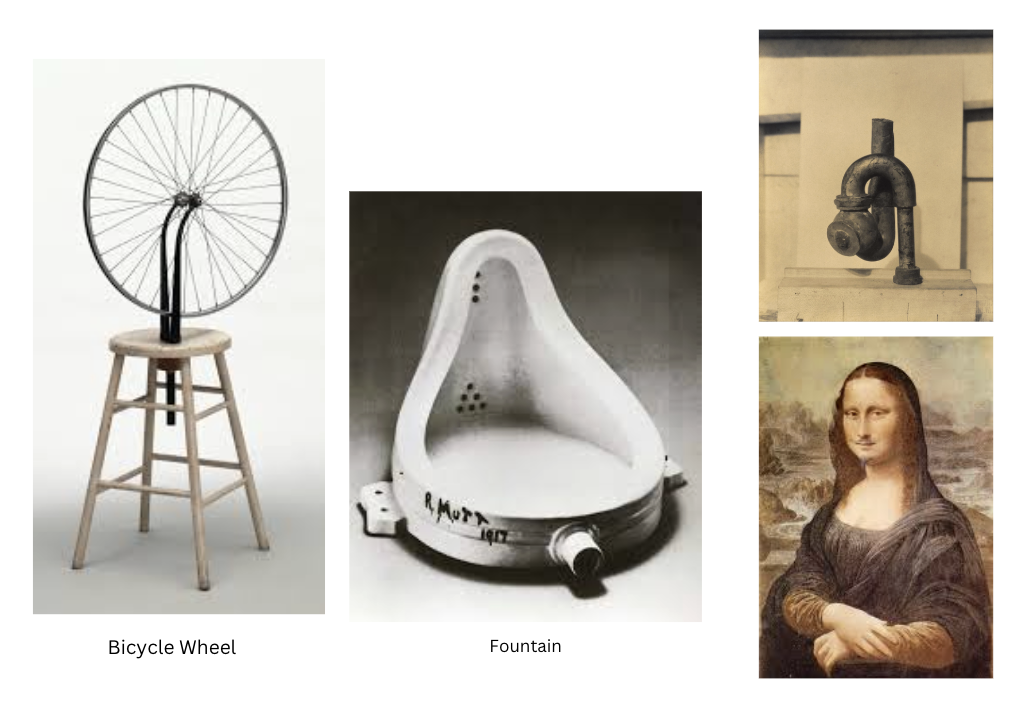
Readymades
Readymades are ordinary, mass-produced objects that an artist chooses and presents as art, without changing them, to challenge traditional ideas of skill, beauty, and what counts as art.
Marcel Duchamp – Bicycle Wheel (1913)
A bicycle wheel mounted on a stool; one of the first readymades.
Ordinary object declared art
No aesthetic transformation
Focus on idea, not skill
Questions “What is art?”
Marcel Duchamp – Fountain (1917)
Most famous readymade
Elsa von Freytag-Loringhoven & Morton Schamberg – God (1917)
Marcel Duchamp – L.H.O.O.Q. (1919)
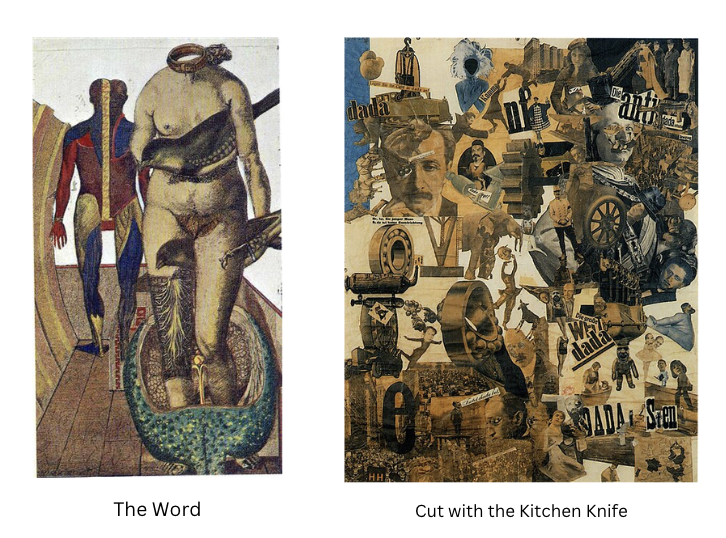
Dada Collage & Photomontage
Max Ernst – The Word (Woman-Bird) (1921)
Collage from found imagery
Dreamlike, irrational forms
Chance and association
Bridge from Dada to Surrealism
Hannah Höch – Cut with the Kitchen Knife… (1919–20)
Political photomontage
Fragmented modern identity
Feminist and anti-authority
Surrealism
an early–mid 20th-century art movement that sought to unlock the unconscious mind through dream imagery, automatism, and irrational juxtapositions, influenced by Freud’s theories.
Followed Dada, but constructive
Explores dreams, the unconscious, the uncanny
Aims at a “higher reality”
Mix of automatism and illusionistic painting
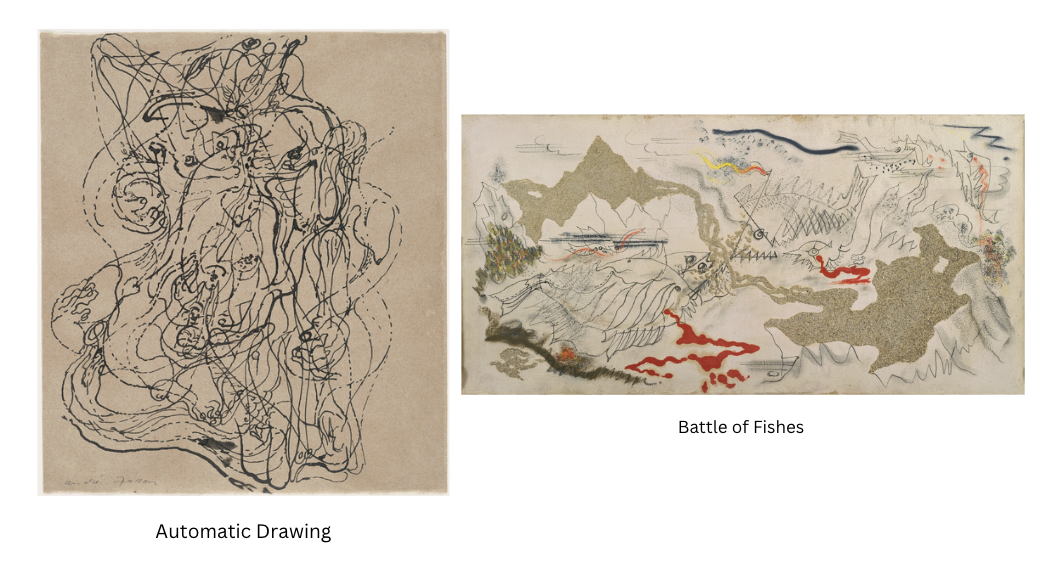
Automatism
making art without planning, letting the unconscious decide what appears.
André Masson – Automatic Drawing (1924)
Drawing without conscious control
Direct access to unconscious
Spontaneous line
Anti-rational process
André Masson – Battle of Fishes (1926)
Automatic drawing developed into painting
Sand and mixed media
Violent, primal imagery
Chance meets intention
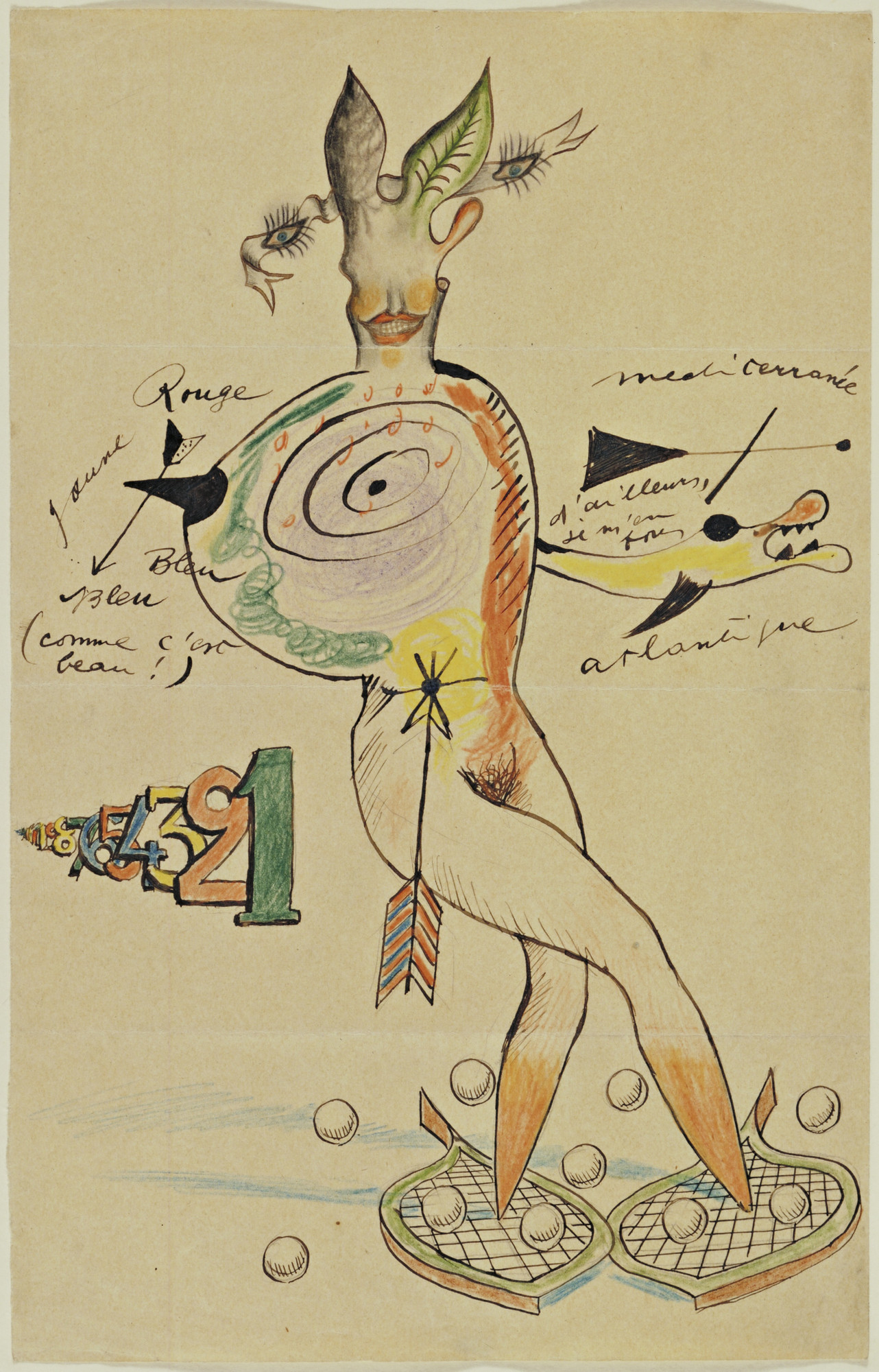
Exquisite Corpse
a Surrealist game where multiple artists create a single image or text collaboratively, each adding a part without seeing the others
Yves Tanguy, Joan Miró & Man Ray – Untitled (Exquisite Corpse) (1926–27)
Collaborative game
Each artist works blindly
Unexpected imagery
Collective unconscious
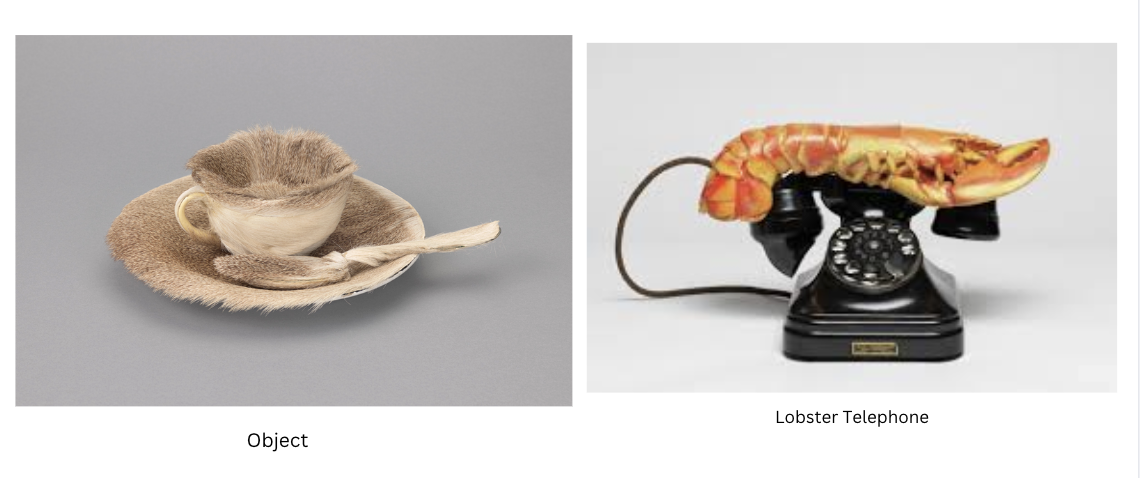
Uncanny Objects
Meret Oppenheim – Object (1936)
Fur-covered cup and saucer
Familiar made disturbing
Tactile unease
The uncanny
Salvador Dalí – Lobster Telephone (1938)
Absurd object combination
Sexual symbolism
Humor + discomfort
Surreal juxtaposition
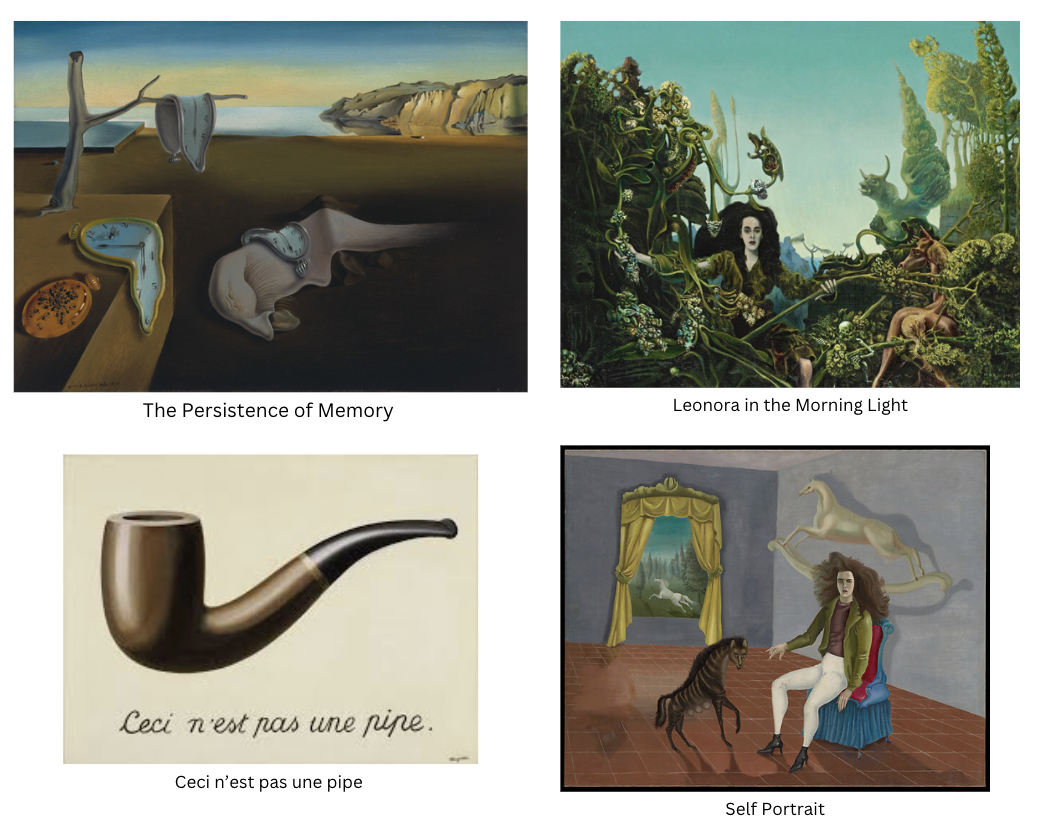
Surrealist Painting
Salvador Dalí – The Persistence of Memory (1931)
Melting clocks
Dream time
Hyper-realistic style
René Magritte – Ceci n’est pas une pipe (1929)
Challenges representation
Conceptual thinking
Max Ernst – Leonora in the Morning Light (1940)
Mythical transformation
Personal symbolism
Dream narrative
Surreal identity
Leonora Carrington – Self-Portrait (Inn of the Dawn Horse) (1939)
Female identity
Personal mythology
Dream logic
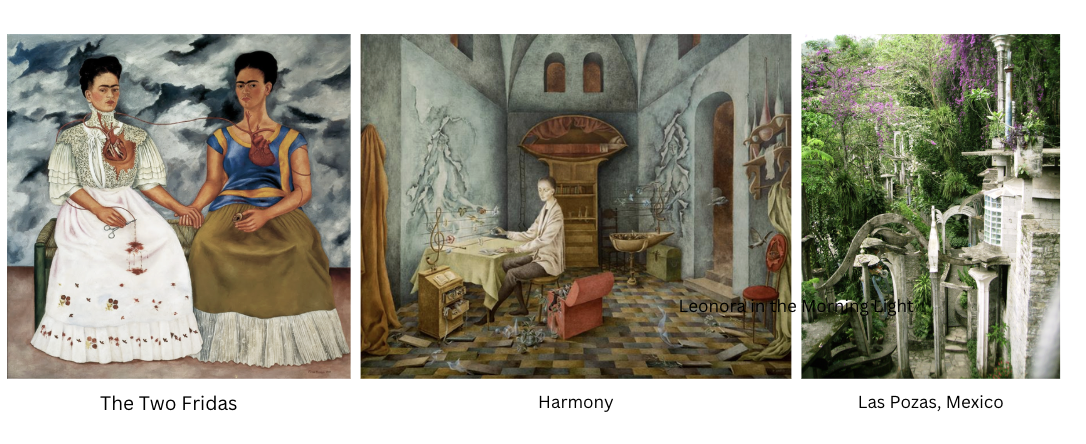
Surrealism in Mexico
Frida Kahlo – The Two Fridas (1939)
Split identity
Personal symbolism
Pain and psychology
Surrealism + autobiography
Remedios Varo – Harmony (1956)
Alchemy and science
Surrealism in design and advertising
Edward James – Las Pozas, Mexico (1940s)
Surrealist architecture
Dream environment
Nature + fantasy