BY 115 Integumentary System, Bone, and Cartilage
 Call Kai
 Learn
Learn Practice Test
 Spaced Repetition
 Match
Match Flashcards
 Knowt Play
1/259

There's no tags or description
Looks like no tags are added yet.
Name | Mastery | Learn | Test | Matching | Spaced | Call with Kai | Chat |
|---|
No analytics yet
Send a link to your students to track their progress
260 Terms
Skin
Epidermis + dermis
Epidermis
Superficial epithelial layer; keratinized stratified squamous epithelium; avascular; keratinization contributes to the protective, water-resistant barrier
Dermis
Deeper connective tissue layer
Subcutaneous layer/Hypodermis
Lies deep to the skin but is not part of it
Major functions of integument
Protection, prevention of water loss, temperature regulation, sensation, immune defense, secretion and metabolic functions
Epidermal Strata (Deep to Superficial)
Stratum basale, stratum spinosum, stratum granulosum, stratum lucidum, stratum corneum
Stratum basale
Deepest epidermal layer; keratinocytes attached near the basement membrane; mitotically (copies of identical cells) active cells produce new keratinocytes
Stratum spinosum
Several layers of keratinocytes which undergo structural changes at they move toward the surface; contains many epidermal dendritic cells; keratinocytes move superficially and continue differentiating
Stratum granulosum
Keratinocytes become flatter, keratinization becomes prominent; nuclei and organelles begin to degenerate
Keratinization
Progressive accumulation of keratin and transformation of keratinocytes as they move toward the surface
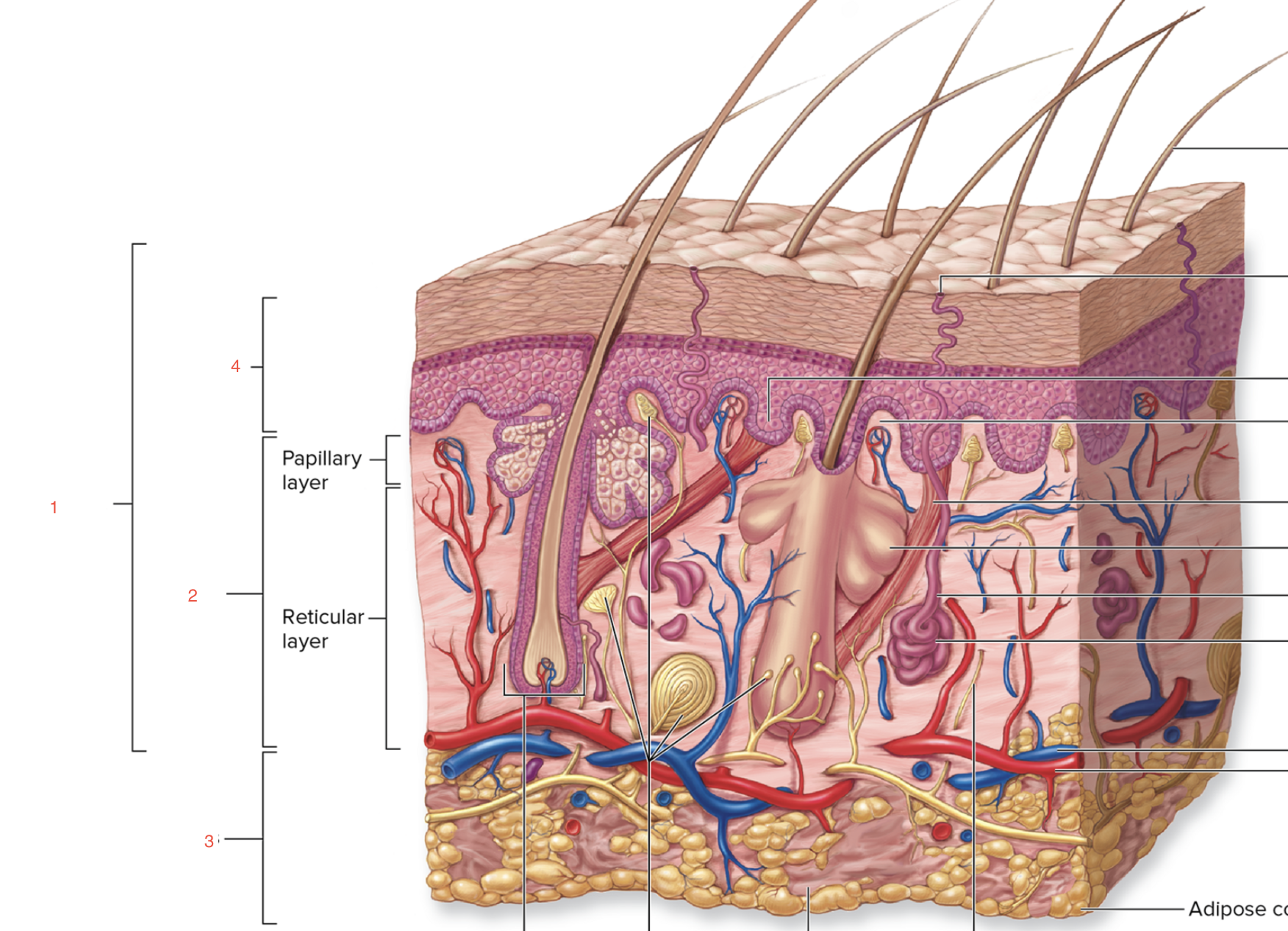
Identify 1
Integument
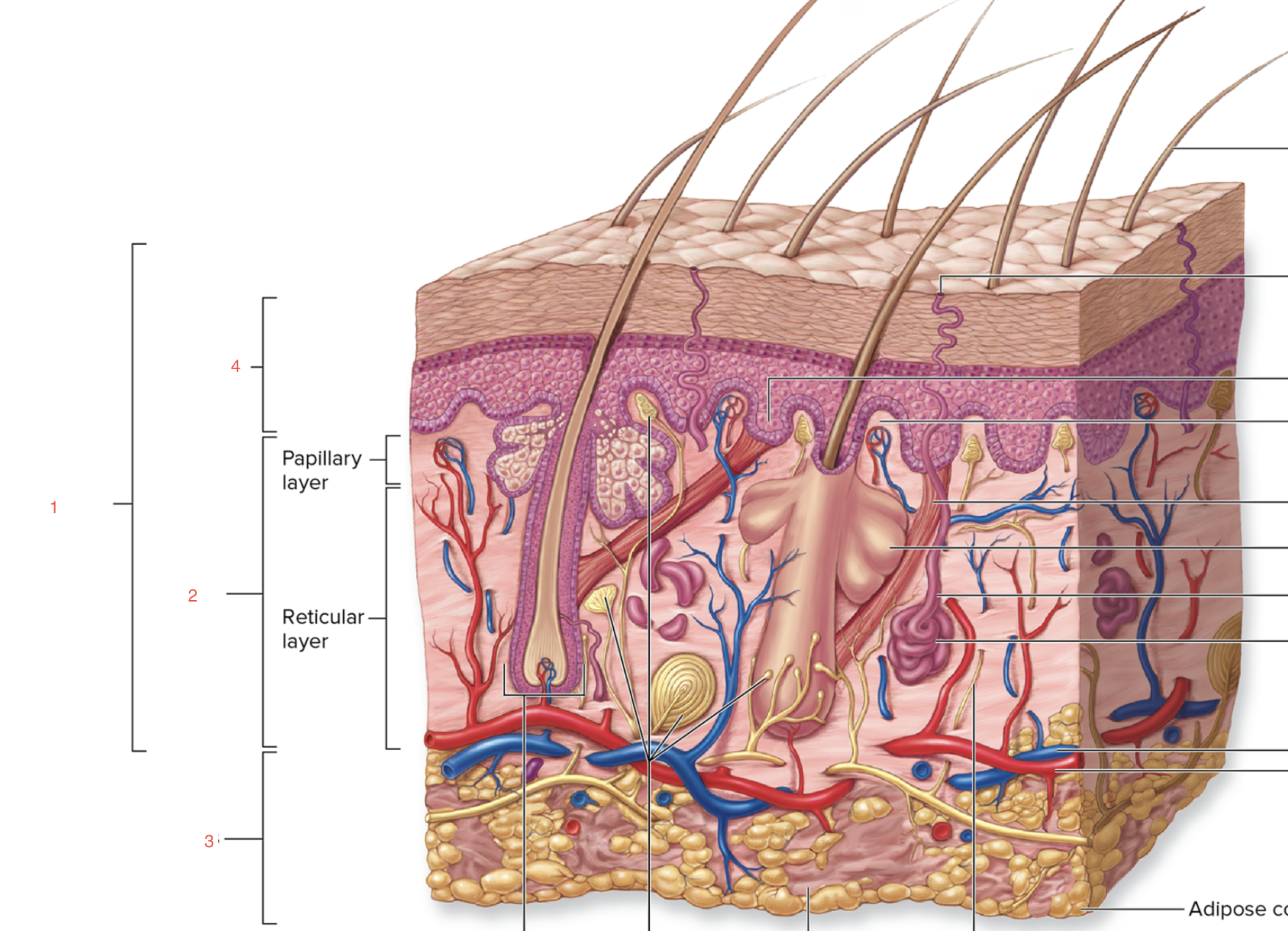
Identify 2
Dermis

Identify 3
Subcutaneous layer

Identify 4
Epidermis
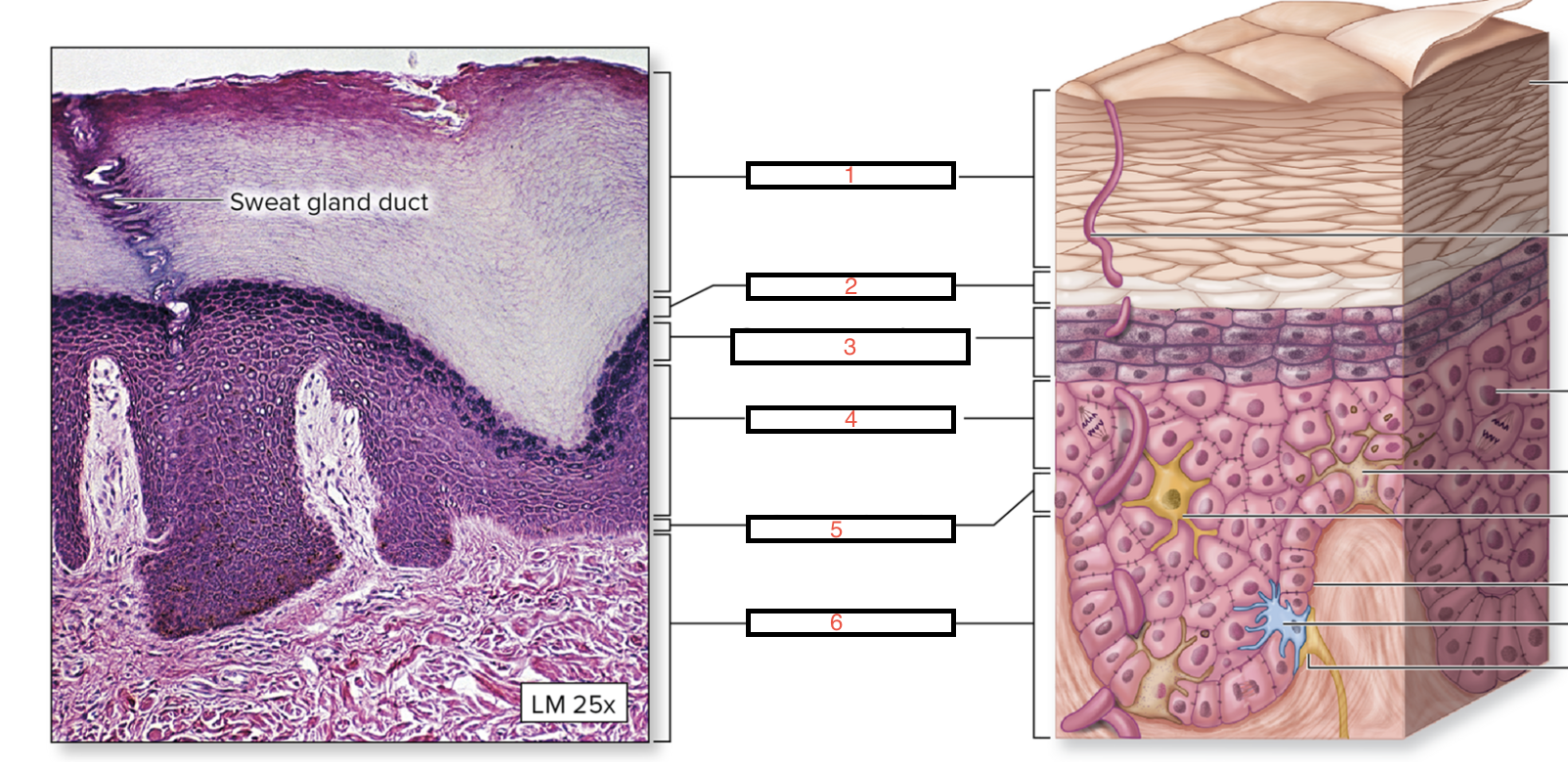
Identify 1
Stratum corneum

Identify 2
Stratum lucidum

Identify 3
Stratum granulosum

Identify 4
Stratum spinosum
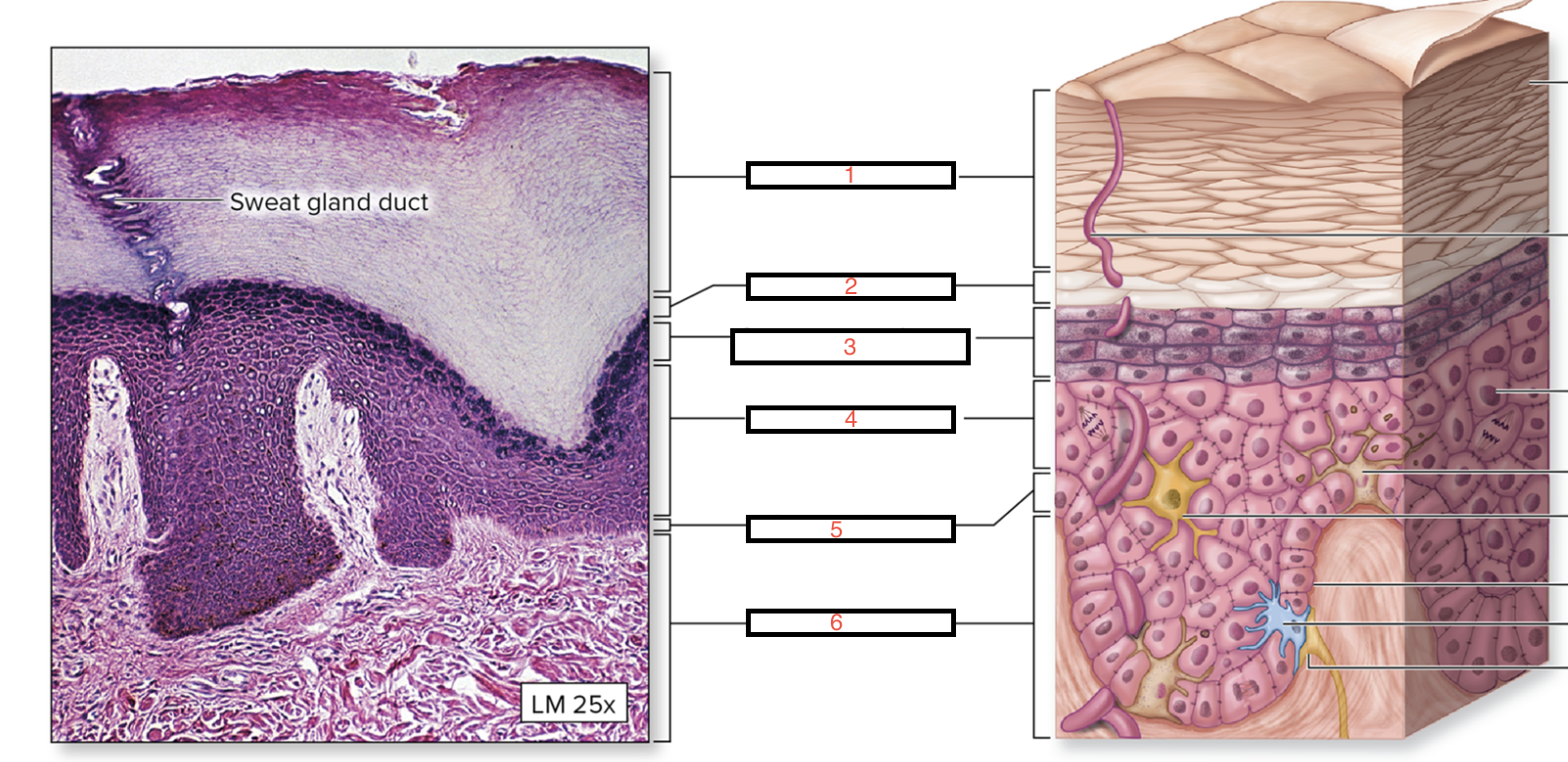
Identify 5
Stratum basale
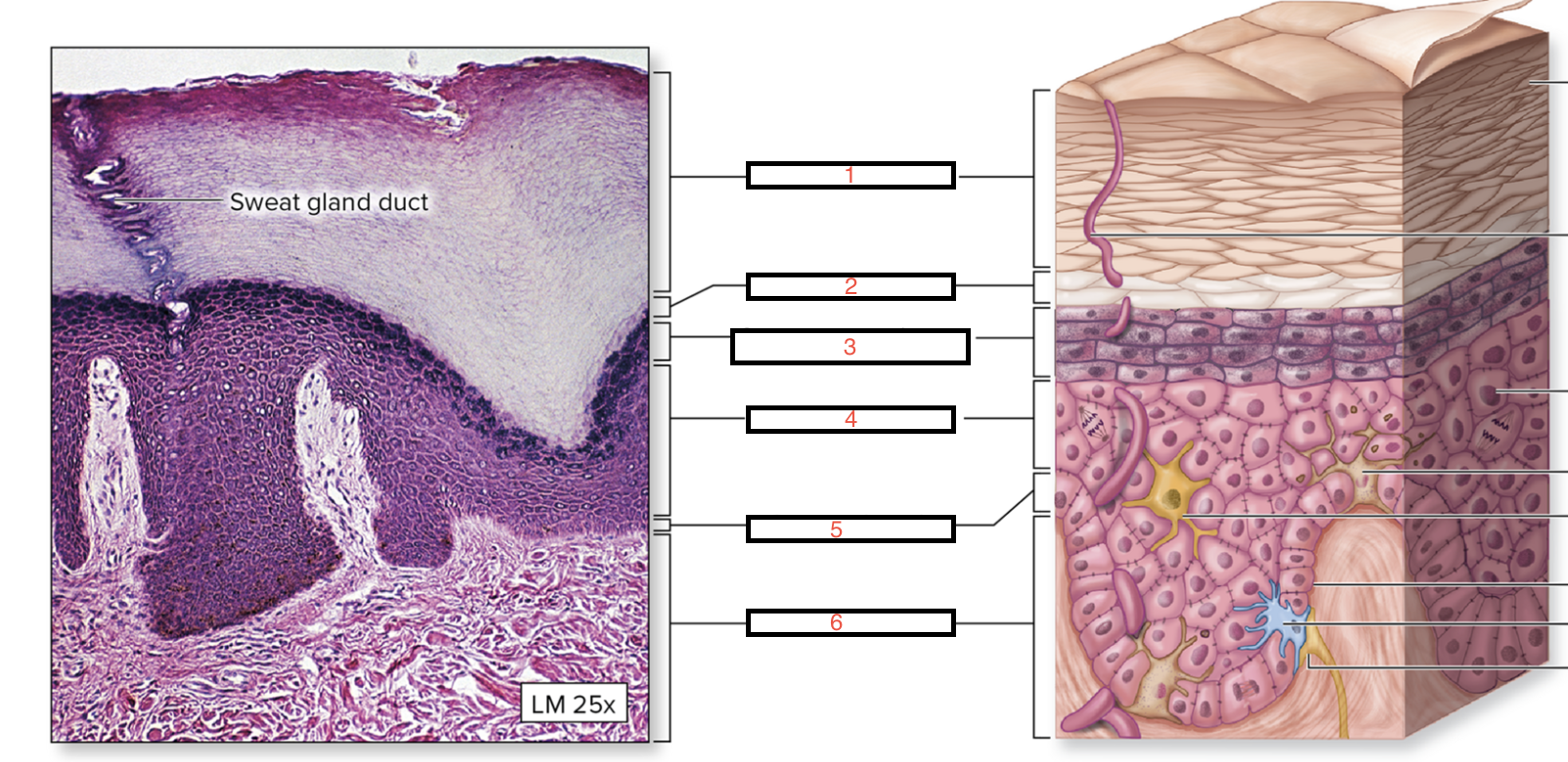
Identify 6
Dermis
Stratum lucidum
Present only in thick skin; thin, translucent layer; flattened anucleated keratinocytes
Stratum corneum
Most superficial epidermal layer; many laters of dead, keratinized cells that continuously shed; forms an important protective and water-resistant barrier
Thick epidermis
All five layers present; found on palms of hands and soles of feet
Thin epidermis
Have all epidermal layers except for stratum lucidum

Identify
Thick epidermis
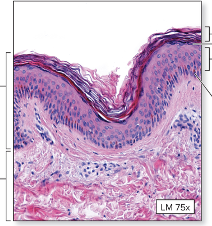
Identify
Thin epidermis
Keratinocytes
Throughout epidermis; produce keratin and act as a protective barrier
Melanocytes
Found in stratum basale; produces melanin
Epidermal dendritic cells
Primarily found in stratum spinosum; act as immune defense
Tactile cells
Found in stratum basale; serve as touch sensation
Dermis
Connective tissue layer deep to epidermis; consists of papillary layer and reticular layer; contains blood vessels, nerves, glands, and hair follicles
Papillary layer
Primarily areolar CT; superficial layer of dermis, contains dermal papillae, interdigitates with epidermis

Identify
Papillary dermis
Reticular layer
Primarily dense irregular CT; deeper and thicker dermal layer; contains blood vessels and nerves, glands, hair follicles
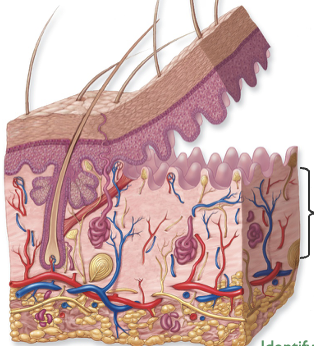
Identify
Reticular layer
Dermal fiber orientation
Collagen bundles in the reticular dermi have predominant orientations, which have tension/cleavage lines
Fiber organization
Affects how skin responds to mechanical stress
Perpendicular incisions
More likely to open due to cute elastic fibers
Parallel incisions
More likely to heal quickly

Identify
Perpendicular incision; more likely to open due to cut elastic fibers

Identify
Parallel incision; more likely to heal quickly
Subcutaneous layer
Also hypodermis and superificial fascia; lies deep to skin but not part of it; primarily areolar and adipose CT; anchors skin, cushions, insulates, and stores energy

Identify
Subcutaneous layer
Nails
Composed of keratinized cells; protects and supports the distal digits; consists of nail plate/bodyl root, bed, and matrix
Nail plate/body
Visible, hardened portion of the nail
Nail root
Proximal portion hidden beneath the skin
Nail bed
Tissue directly beneath and supporting the nail plate
Nail matrix
Growth region that produces new nail cells
Hair shaft
Portion that projects above the skin surface
Hair root
Portion located below the skin surface
Hair bulb
Enlarged base of the root where hair growth occurs
Hair follicle
Epidermal sheath that surrounds the root
Arrector pili muscle
Smooth muscle attached to the follicle; contraction raises the hair; involuntary
Hair
Consists of hair shaft, root, bulb, follicle, and arrector pili muscle; protects and receives sensory information
Merocrine sweat
Goes to skin surface, acts as thermoregulation
Merocrine
Intact cell
Apocrine Sweat
Goes to hair follicle, thick regional secretion
Sebaceous
Secretes sebum that usually goes to hair follicle, acts as a lubricant for skin and hair
Major functions of skeletal system
Support and protection, movement, hemopoiesis, mineral storage, energy storage
Movement
Attachment sites for muscles
Hemopoiesis
Blood cell production in red bone marrow
Mineral storage
Calcium and phosphate
Energy storage
Lipids stored in yellow bone marrow
Flat bones
Thin, flat surfaces
Examples of flat bones
Frontal bone, scapula, sternum
Irregular bones
Complex shapes
Examples of irregular bones
Vertebrae, hip bones, sphenoid bone
Long bones
Longer than wide
Examples of long bones
Humerus, fibula, tibia, ulna, radius, phalanges, metacarpals, metatarsals
Short bones
Nearly equal in length and width
Examples of short bones
Carpals, tarsals
Bone markings’ functions
Articulation, passage/opening, muscle/ligament attachment, depression/groove
Articulation
Head, condyle, facet
Passage/opening
Foramen, canal, meatus
Depression/groove
Fossa, sulcus
Diaphysis
Cylindrical shaft
Medullary cavity
Hollow space within the diaphysis; contains primarily yellow bone marrow in adults

Identify
Diaphysis

Identify
Medullary cavity
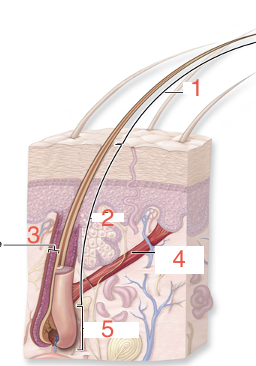
Identify 1
Hair shaft

Identify 2
Hair root

Identify 3
Hair follicle
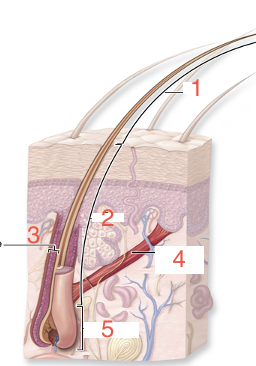
Identify 4
Arrector pili muscle

Identify 5
Hair bulb

Identify 1
Dead keratinocytes

Identify 2
Living keratinocyte

Identify 3
Melanocyte
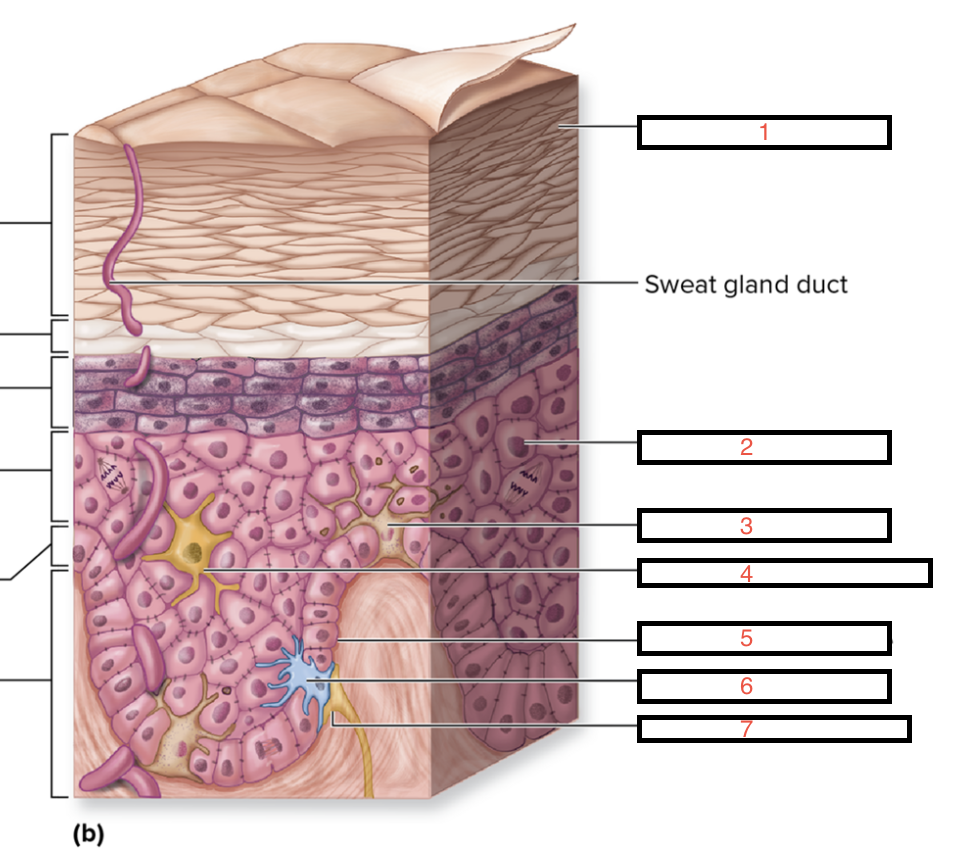
Identify 4
Epidermal dendritic cell

Identify 5
Basement membrane

Identify 6
Tactile cell
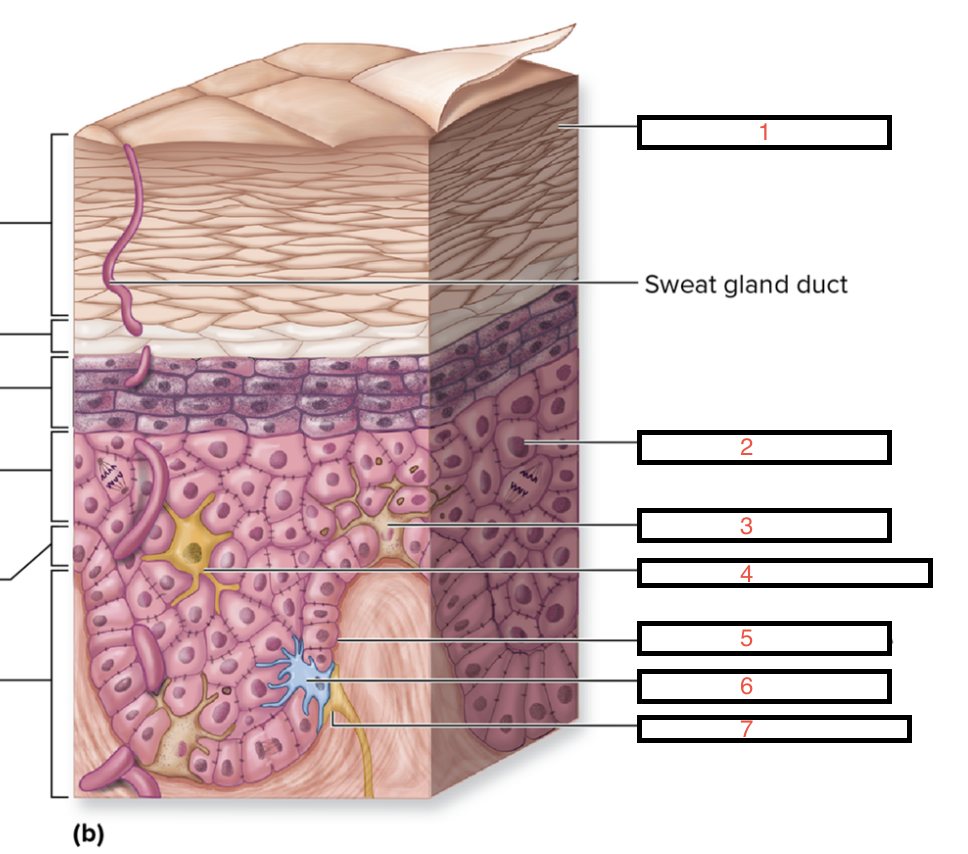
Identify 7
Sensory nerve ending
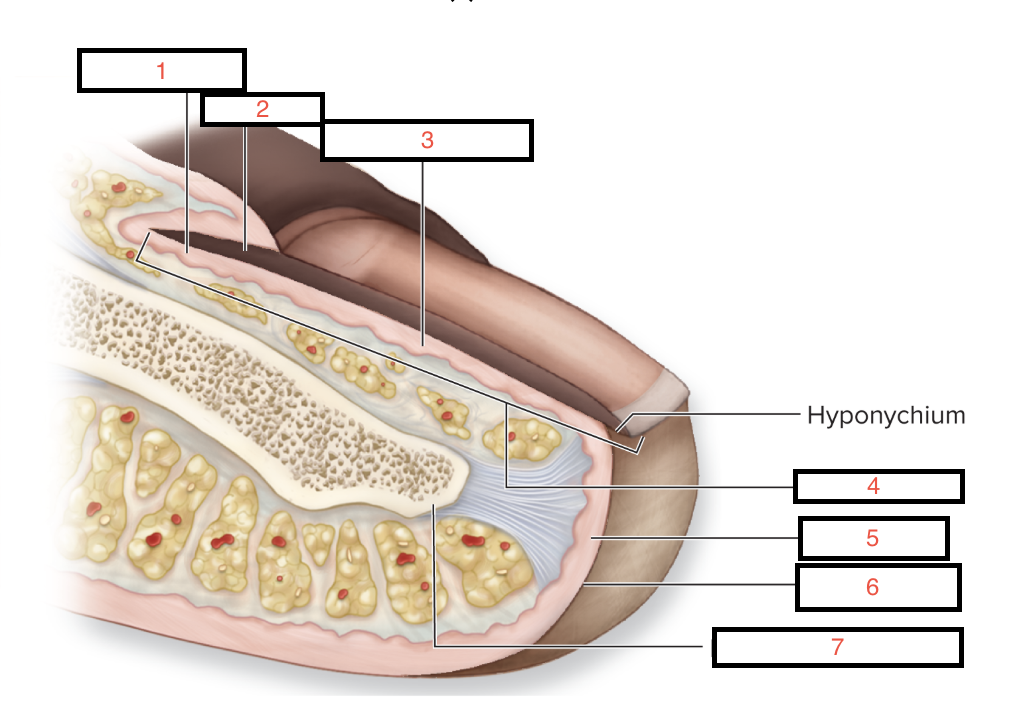
Identify 1
Nail matrix

Identify 2
Nail root

Identify 3
Nail bed

Identify 4
Nail plate

Identify 5
Dermis
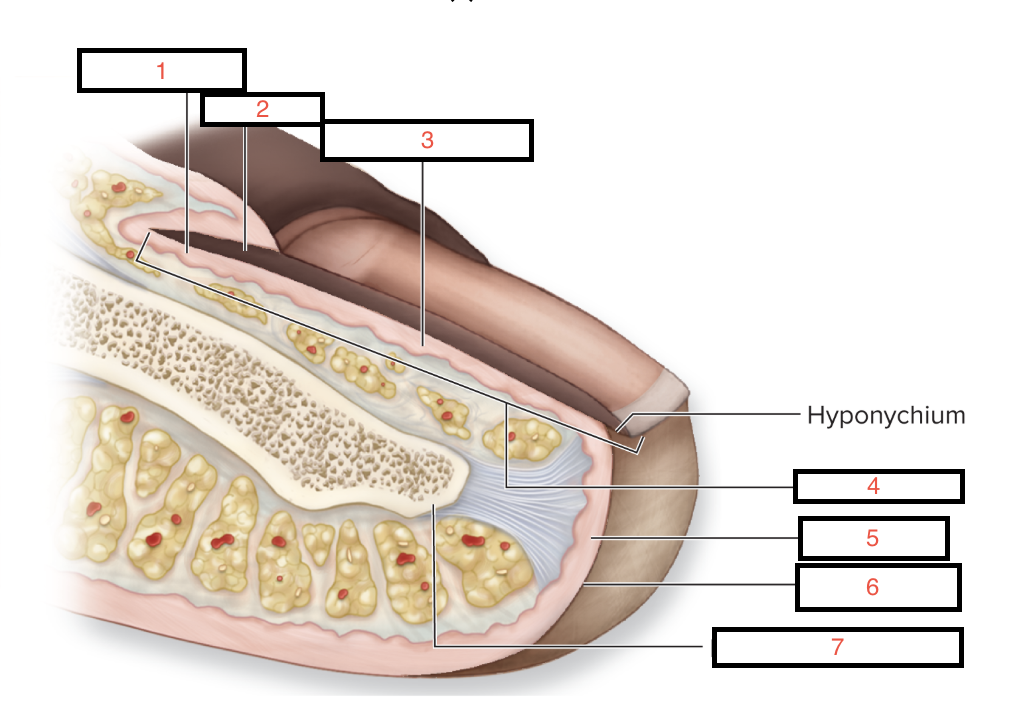
Identify 6
Epidermis
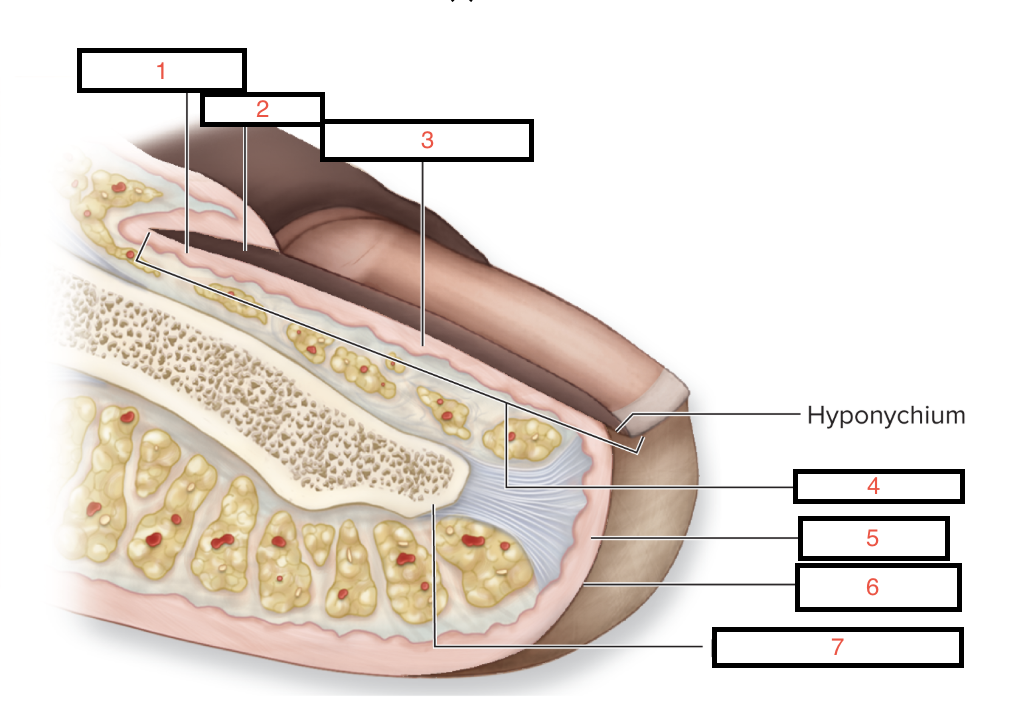
Identify 7
Phalanx