Bio III Exam (ch. 40, 41, 42, 45, 48)
 Call Kai
 Learn
Learn Practice Test
 Spaced Repetition
 Match
Match Flashcards
 Knowt Play
1/283

There's no tags or description
Looks like no tags are added yet.
Name | Mastery | Learn | Test | Matching | Spaced | Call with Kai | Chat |
|---|
No analytics yet
Send a link to your students to track their progress
284 Terms
Water balance (40)
an important component of homeostasis (maintenance of constant and favorable conditions in cells and tissues)
an animal achieves this when its water intake equals its water loss
it’s intimately associated w/ sustaining balanced concentrations of electrolytes throughout body
Electrolyte (40)
a compound that dissociates into ions when dissolved in water
they conduct electrical current (where name stems from)
Osmosis (40)
water enters and leaves cells by this process (water diffusion)
occurs only when solutions are separated by a membrane that permits water to cross but selectively holds back some or all solutes
Osmolarity (40)
the solute concentration of a solution
if the solutes are separated by a selectively permeable membrane and cannot cross that membrane, waters moves from the side of lower solute concentration to higher solute concentration
Isosmotic (40)
when the movement of water is equal in both directions
seawater is an example of this with the tissues of osmoconforming animals
Hyposmotic (40)
lower solute concentration
higher free H2O concentration
if two solutions differ in osmolarity, the net flow of water is from the less concentrated solution or ________ solution
Hyperosmotic (40)
higher solute concentration
lower free H2O concentration
if two solutions differ in osmolarity, the net flow of water is from the more concentrated solution or ________ solution
Osmotic stress (40)
occurs when the concentration of dissolved substances in a cell or tissue is abnormal
meaning that water and solute concentrations are different from their set points
can be caused by loss or gain of water or electrolytes to or from animal’s environment
Osmoregulation (40)
how organisms respond to osmotic stress
the process by which organisms control the concentrations of water and solutes in their bodies
this is required in marine vertebrates b/c seawater is hyperosmotic to their tissues
Osmoconformers (40)
an animal whose tissue osmolarity is isosmotic to its environment
do not regulate their osmolarity
live in water that has a stable composition
some marine animals (typically invertebrates)
e.g., sharks, rays, and akates
Osmoconformer: sharks (40)
animal whose tissue osmolarity is isosmotic to its environment
shark blood:
contains low concentrations of ions; high concentration of urea
this increases blood osmolarity so that it’s nearly isosmotic w/ seawater
requires energy expenditure to protect them from toxic effects of high urea concentrations
result:
they lose little water by osmosis
although they’re osmoconformers, they still maintain a relatively low concentration of salt (NaCl) in their blood
they secrete salt through their rectal gland
Osmoregulators (40)
an animal that actively regulates the osmolarity of its tissues
they must expend energy to maintain osmotic gradients (to control water uptake and loss in a hyperosmotic or hyposmotic environment)
e.g., marine and freshwater bony fishes and terrestrial animals
Energetics of osmoregulation (40)
osmoregulators must expend energy to maintain osmotic gradients
the amount of energy differs based on:
how different the animal’s osmolarity is from its surroundings
how easily water and solutes move across the animal’s surface
work required to pump solutes across the membrane
Transport epithelia (40)
specialized for moving solutes in specific directions
typically arranged in complex networks
Ammonia (40)
a form of nitrogenous waste
it’s toxic to cells b/c at high concentrations it raises the pH of intracellular and extracellular fluids enough to inactivate enzymes
some animals convert this to less toxic compounds prior to excretion
high solubility in water
high amount of water required for excretion
high toxicity
groups where it’s the primary waste:
most bony fishes, aquatic invertebrates
method of synthesis:
product of breakdown of amino acids and nucleic acids
low energy cost of synthesis
method of excretion:
in urine, and diffuses across gills
Nitrogenous wastes (40)
compounds excreted by animals to rid their bodies of excess nitrogen
main types:
ammonia
urea
uric acid
Urea (40)
a form of nitrogenous waste
medium solubility in water
medium amount of water required for excretion
medium toxicity
groups where it’s the primary waste:
mammals, most adult amphibians, sharks, rays, skates
method of synthesis:
synthesized in liver, starting w/ ammonia or amino groups from amino acids
high energy cost of synthesis
method of excretion:
in urine (mammals); diffuses across gills (sharks)
also involved in creating steep osmotic gradient in space surrounding nephron
concentration of this is high in inner medulla and low in outer medulla b/c the innermost section of collecting duct is permeable to this
Uric acid (40)
a form of nitrogenous waste
very low solubility in water
very low amount of water required for excretion
low toxicity
groups where it’s the primary waste:
birds and other reptiles, most terrestrial arthropods (insects, spiders)
method of synthesis:
synthesis starts w/ nucleic acids
high energy cost of synthesis
method of excretion:
with feces
Rectal gland (40)
organ that secretes a concentrated salt solution into it's rectum, where it’s then excreted into environment
early experiments showed that normal salt excretion occurred only if solution in this organ contained ATP (supported hypothesis that salt excretion involves active transport)
Molecular model for salt excretion (40)
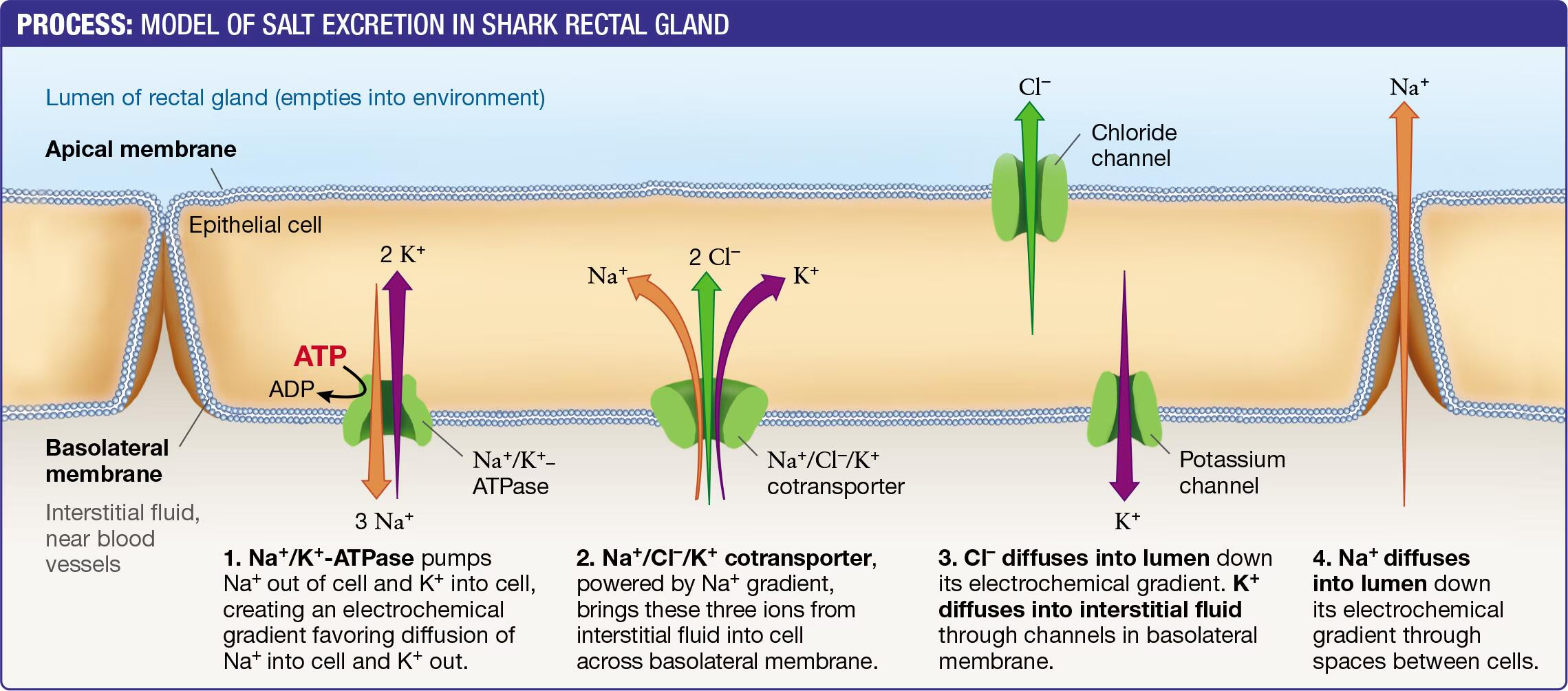
salt excretion in sharks is a multistep process, summarized:
Na+/K+-ATPase pumps Na+ out of epithelial cells across basolateral surface, into interstitial fluid (extracellular fluid surrounding rectal gland)
the pump also moves K+ into the cell from interstitial fluid, creating electrochemical gradient that favors diffusion of Na+ into cell and K+ out of cell
Na+/Cl-/K+ cotransporter moves these 3 ions into cell by secondary active transport, powered by Na+ gradient
this cotransporter allows sodium ions to diffuse into cell down electrochemical gradient, causing Cl- and K+ to move into cell against their electrochemical gradients
as Cl- builds up inside cell, it diffuses down its electrochemical gradient out of cell and into lumen of gland thru chloride channel located in apical membrane
at the same time, potassium diffuses out of cell into interstitial fluid thru basolateral potassium channels
following its electrochemical gradient, sodium diffuses from interstitial fluid into lumen of gland thru spaces b/w cells
How freshwater fishes osmoregulate (40)
freshwater fishes lose electrolytes across their gill epithelium by diffusion
to maintain homeostasis, they have to actively transport ions back into body across gill epithelium
sea bass & salmon:
sea bass & several salmon species move b/w salt water & freshwater
they move b/w environments w/ dramatically different osmotic stresses
marine bony fishes have specialized cells, called chloride cells
when sea bass & salmon are in salt water, these cells are abundant and active
Chloride cells (40)
specialized cells in gill epithelium of marine (saltwater) bony fishes
move salt using combination of membrane proteins used by epithelial cells in shark rectal gland
recent research suggest there’s a freshwater version of this cell that imports salt
osmoregulatory cells may be in different locations
different forms of Na+/K+-ATPase may be activated
orientation of a key transport protein “flips”
Chloride cells: freshwater (40)
evidence for existence of this cell:
osmoregulatory cells may be in different locations
salmon taken from freshwater and seawater have chloride cells in different locations on the gills (same is true for other species that switch b/w freshwater & saltwater)
suggests that when nature of the osmotic stress changes, the structure of the gill epithelium changes
different forms of Na+/K+-ATPase may be activated
salmon genome contains genes for different forms of Na+/K+-ATPase
form used in seawater differs from form used in freshwater
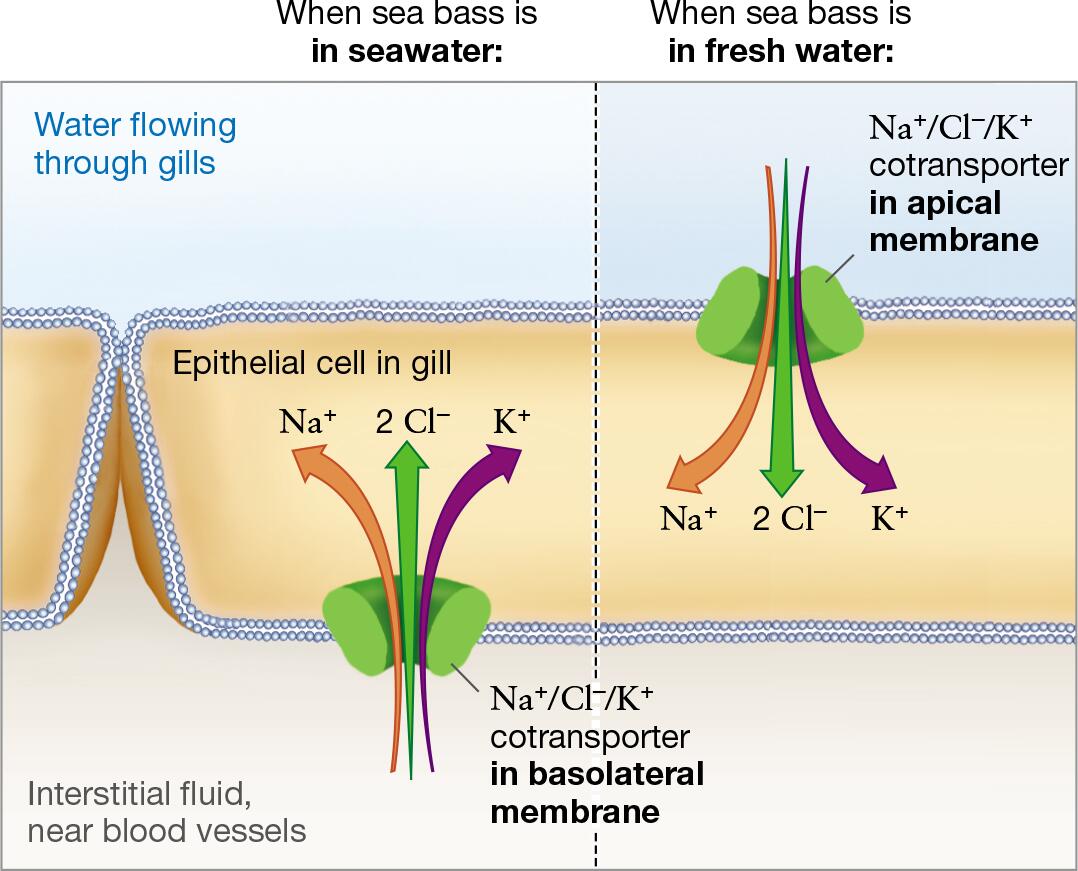
orientation of a key transport protein “flips”
when fish are in seawater, the protein (cotransporter) is located on basolateral side of chloride cells
in freshwater, the protein (cotransporter) is on apical side of chloride cell
Water and electrolyte balance in insects (40)
insects cope w/ their desert environment in two ways:
minimizing water loss from body surface
their exoskeleton consists of chitin, tough polysaccharide and layers of protein = cuticle
carefully regulating amount of water and electrolytes they excrete
Cuticle (40)
terrestrial insects’ exoskeleton consisting of chitin (tough polysaccharide) and layers of protein
this is covered w/ layer of waterproof wax, and adaptation to minimize evaporative water loss
Hemolymph (40)
blood-like fluid found in insects
pumped by the heart and transports electrolytes, nutrients, and waste products
modified in a regulated process to produce urine
insects regulate this to maintain homeostasis
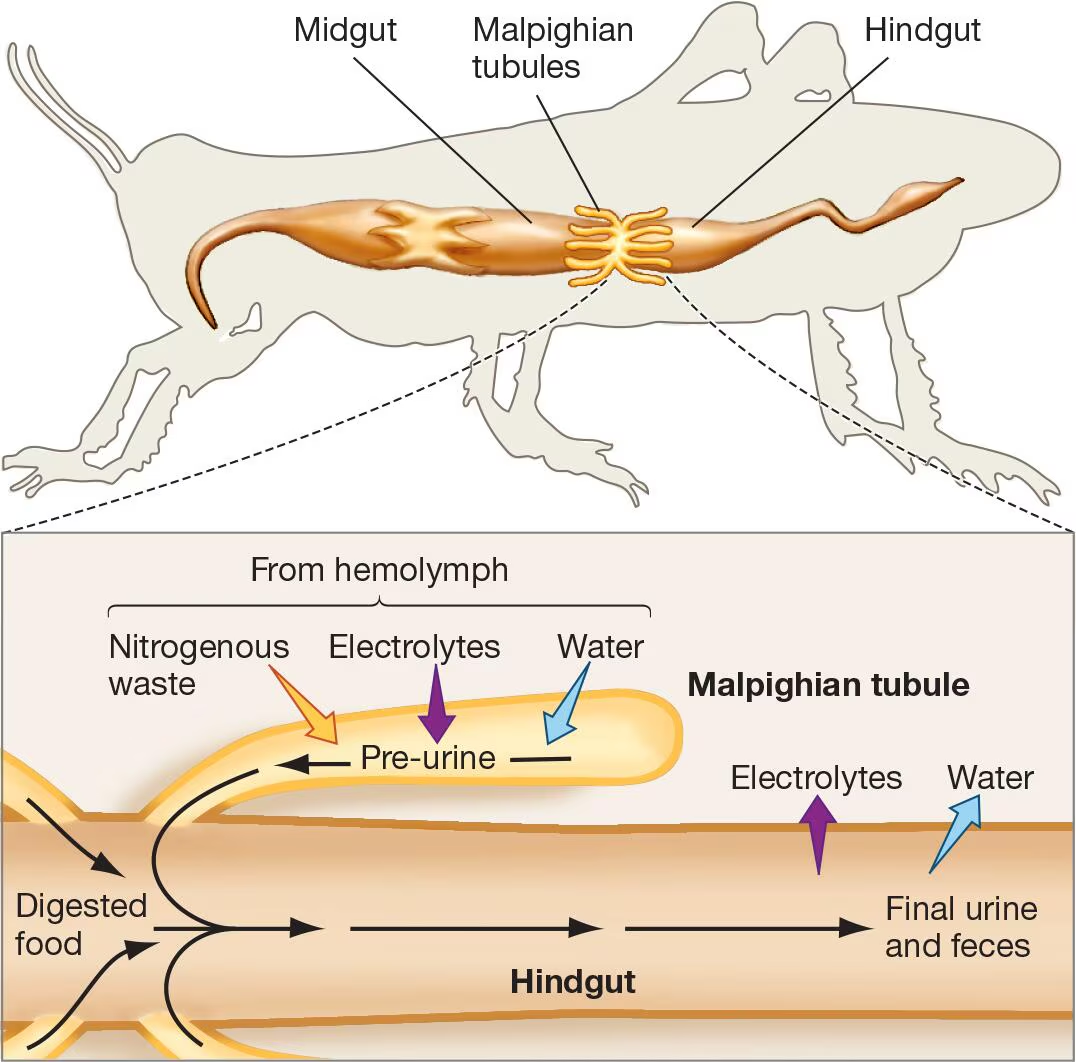
Malpighian tubules (40)
excretory organs found insects to maintain water and electrolyte balance
these organs have a large surface area
in direct contact with the hemolymph and empty into hindgut
these organs are also responsible for forming a filtrate, a filtered liquid, from the hemolymph
this “pre-urine” then passes into the hindgut, where it's processed and modified before excretion
Hindgut (40)
posterior portion of insects digestive tract that helped to maintain water and electrolyte balance
“pre-urine” passes into this portion where it's processed and modified before excretion
How insects make concentrated urine (40)
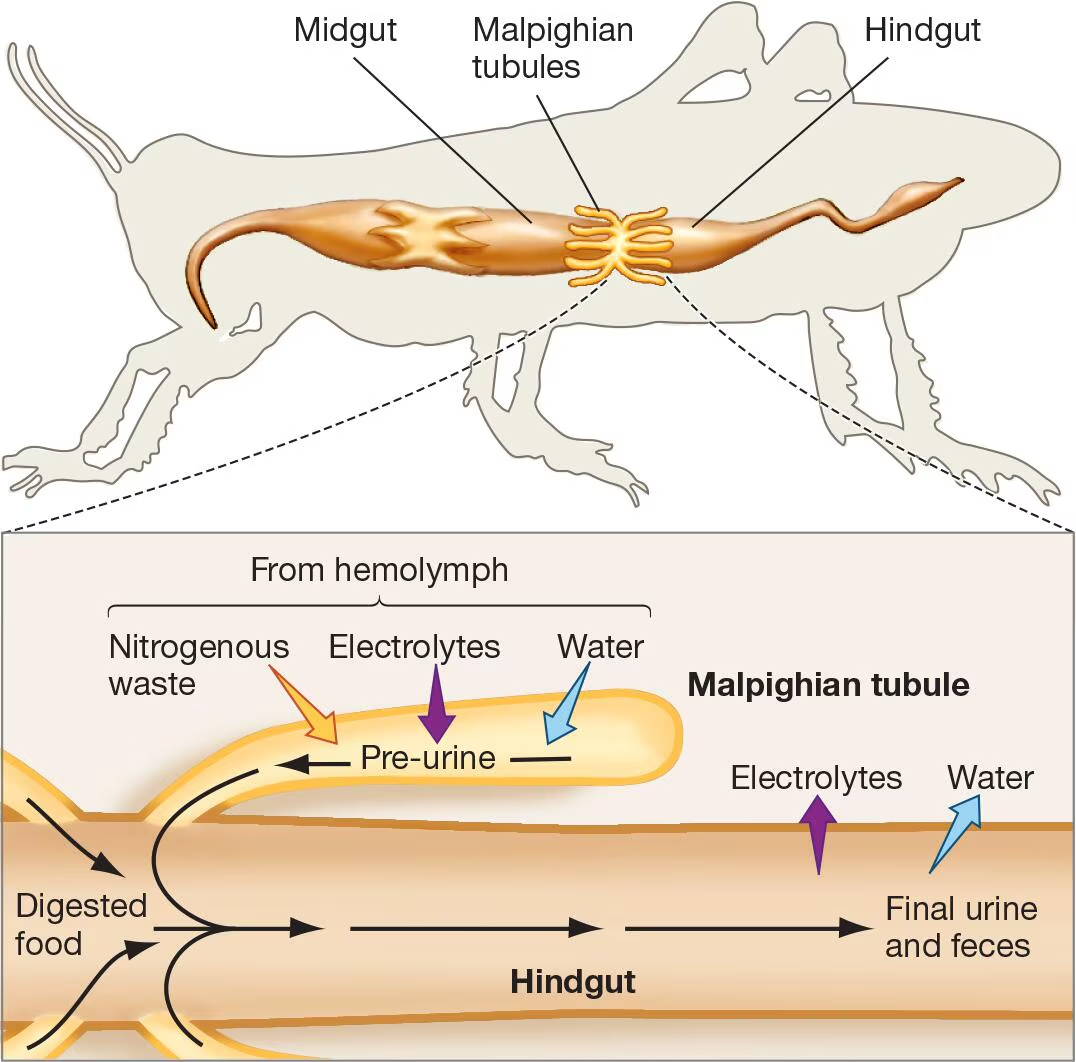
epithelial cells in malpighian tubules contain pumps that actively transport potassium ions into lumen of the organ
high concentration of potassium ion brings water into tubules by osmosis
other electrolytes and nitrogenous waste than diffuse into the filtrate
filtrate that accumulates inside the mouth and tubules flow into the hindgut, where it joins digested food
if an insect is osmotically stressed, electrolytes and water from the filtrate are reabsorbed from the hindgut and return to the hemolymph, while uric acid remains in the hindgut
absorption results information of hyper osmotic final urine, conservation of water, and efficient elimination of nitrogenous waste
Water and electrolyte balance industrial vertebrates (40)
the process of maintaining stable water and ion concentration in land dwelling vertebrates
prevents dehydration while maintaining homeostasis
the kidneys are the primary organs responsible for osmoregulation and nitrogenous waste removal
water is replaced primarily by drinking; electrolytes replaced through food
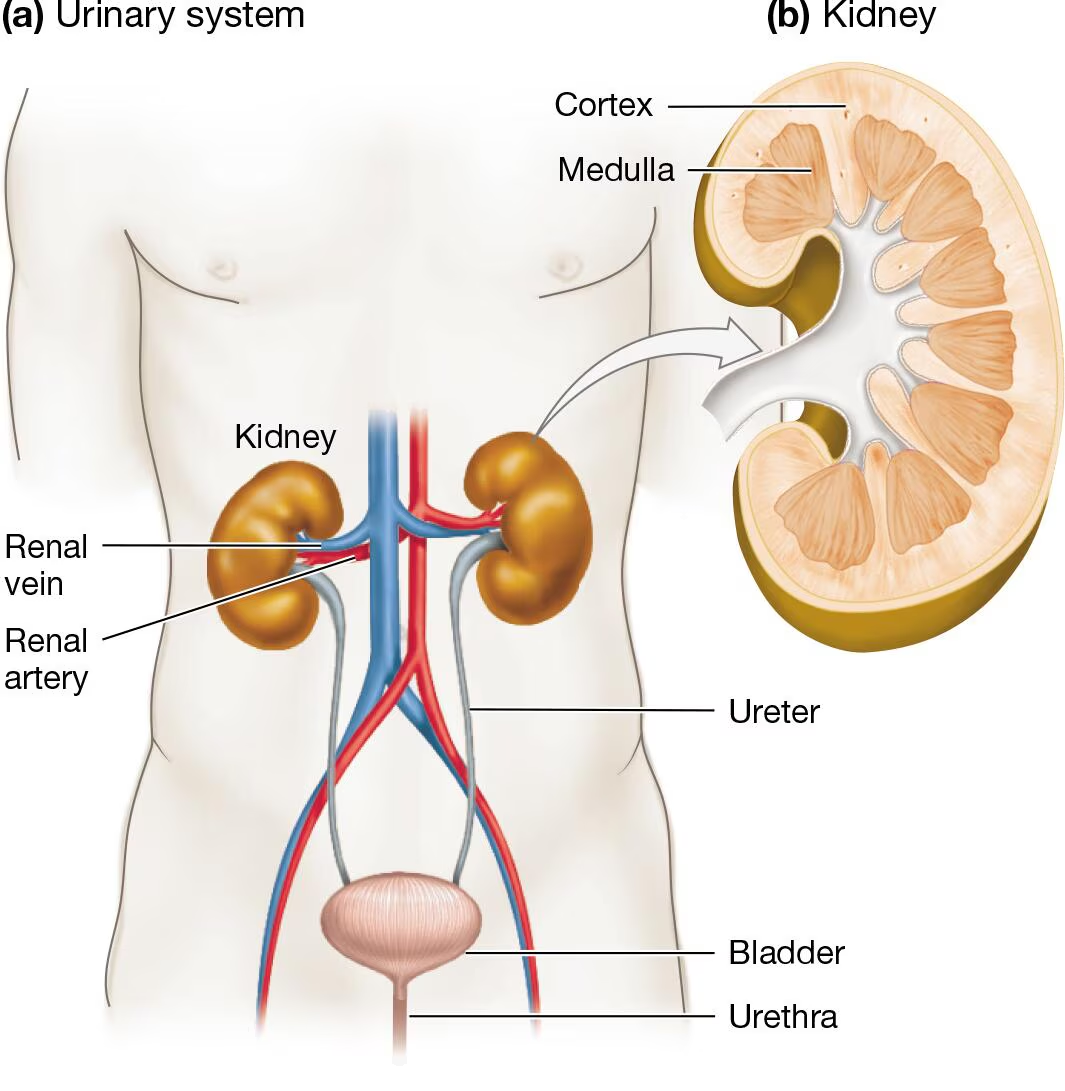
Kidney (40)
the primary Osmoregulatory organ of terrestrial vertebrates
Function:
Regulates water balance
Regulates electrolyte balance
Removes nitrogenous waste
Produces urine
Maintains internal homeostasis despite changes in the external environment
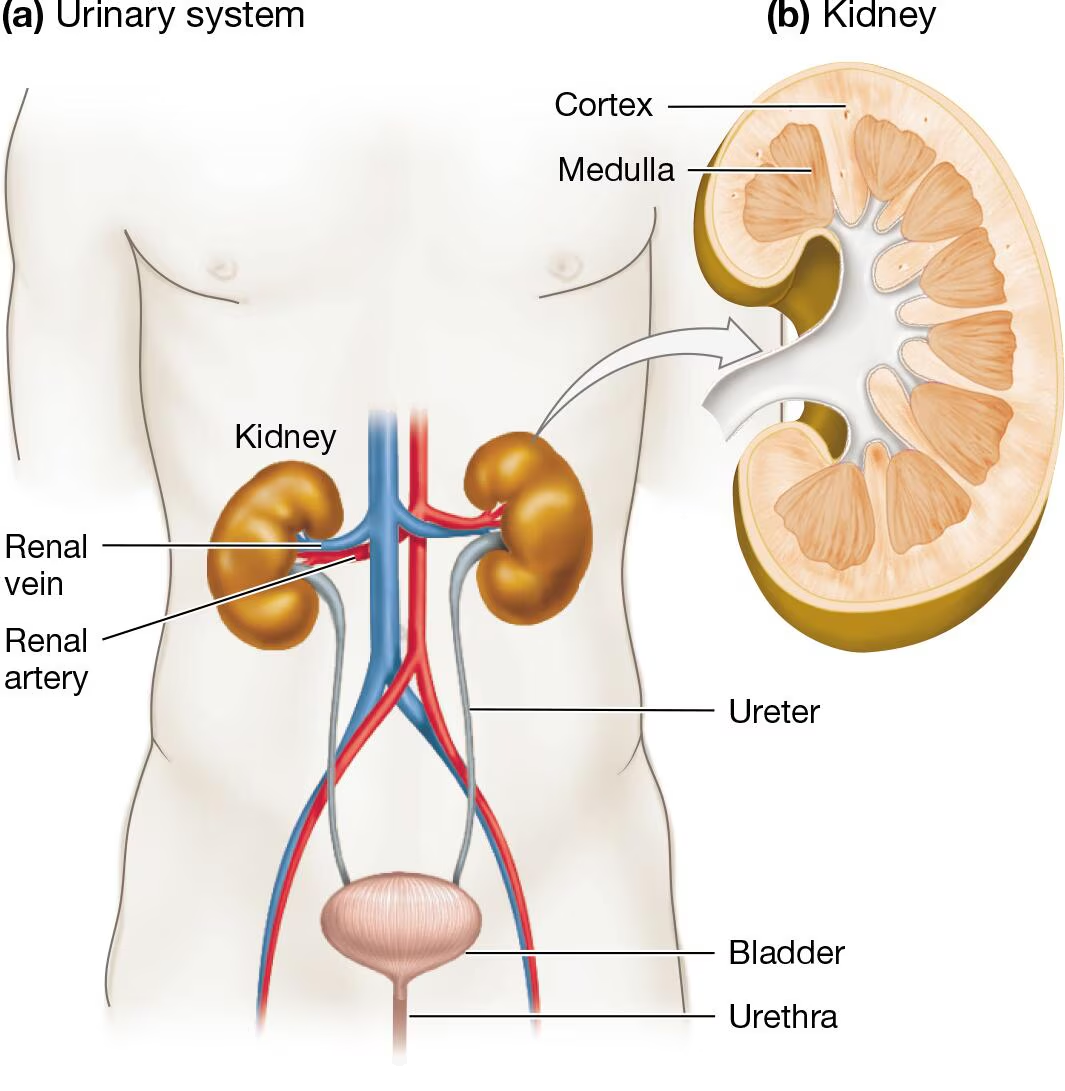
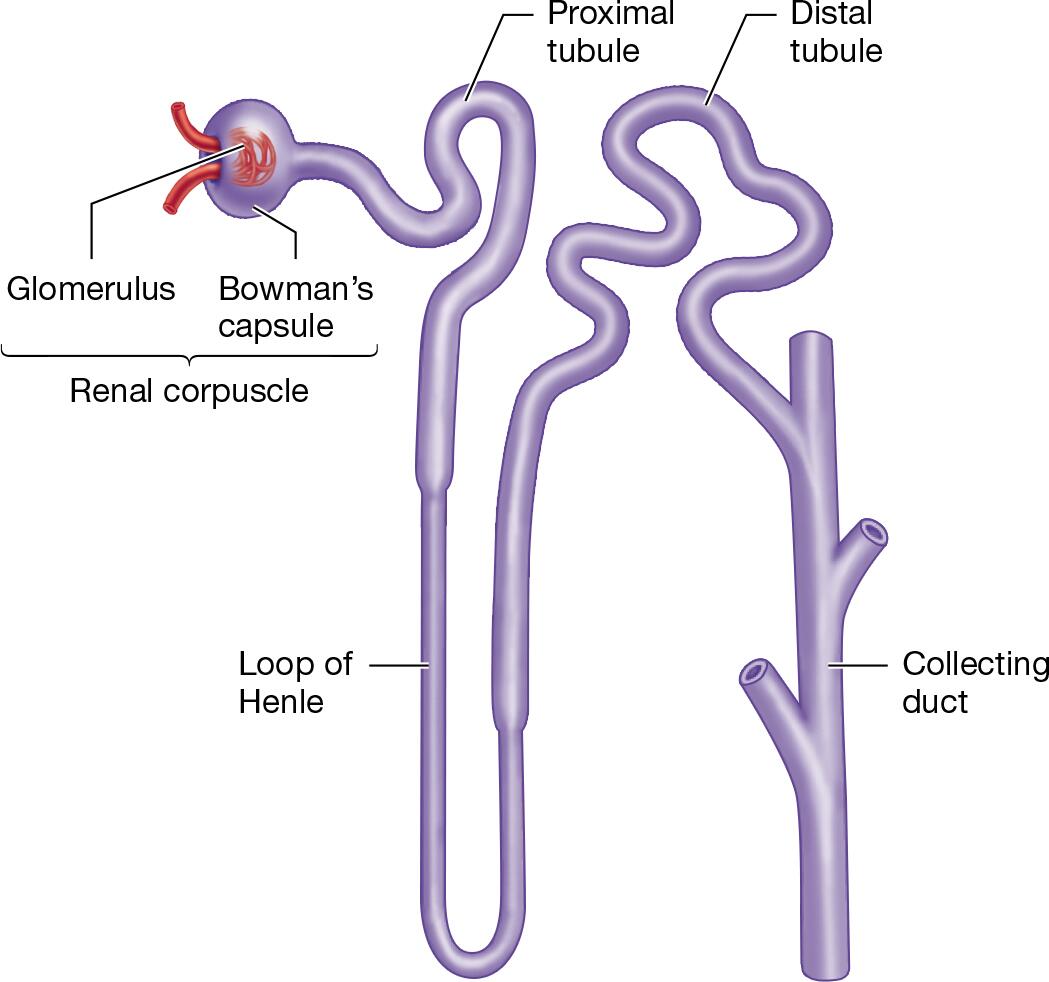
Nephron (40)
basic functional unit of the kidney; most of the kidneys masses made up of these small structures
the work involved in maintaining water and electrolyte balance occurs here
these are located almost entirely in the outer region of the organ (cortex), some extend from cortex into kidney’s inner region (medulla)
function:
filters blood
reabsorbs useful substances
secretes wastes
forms urine
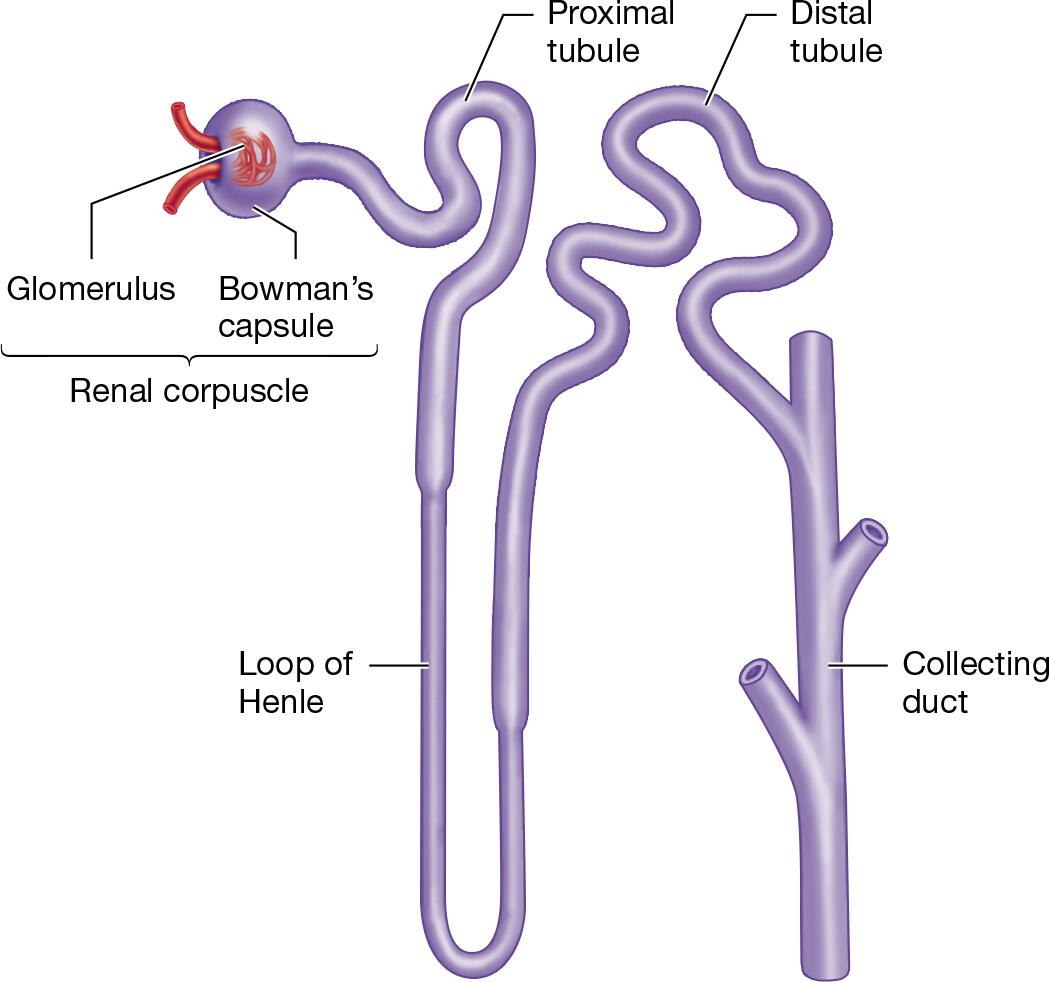
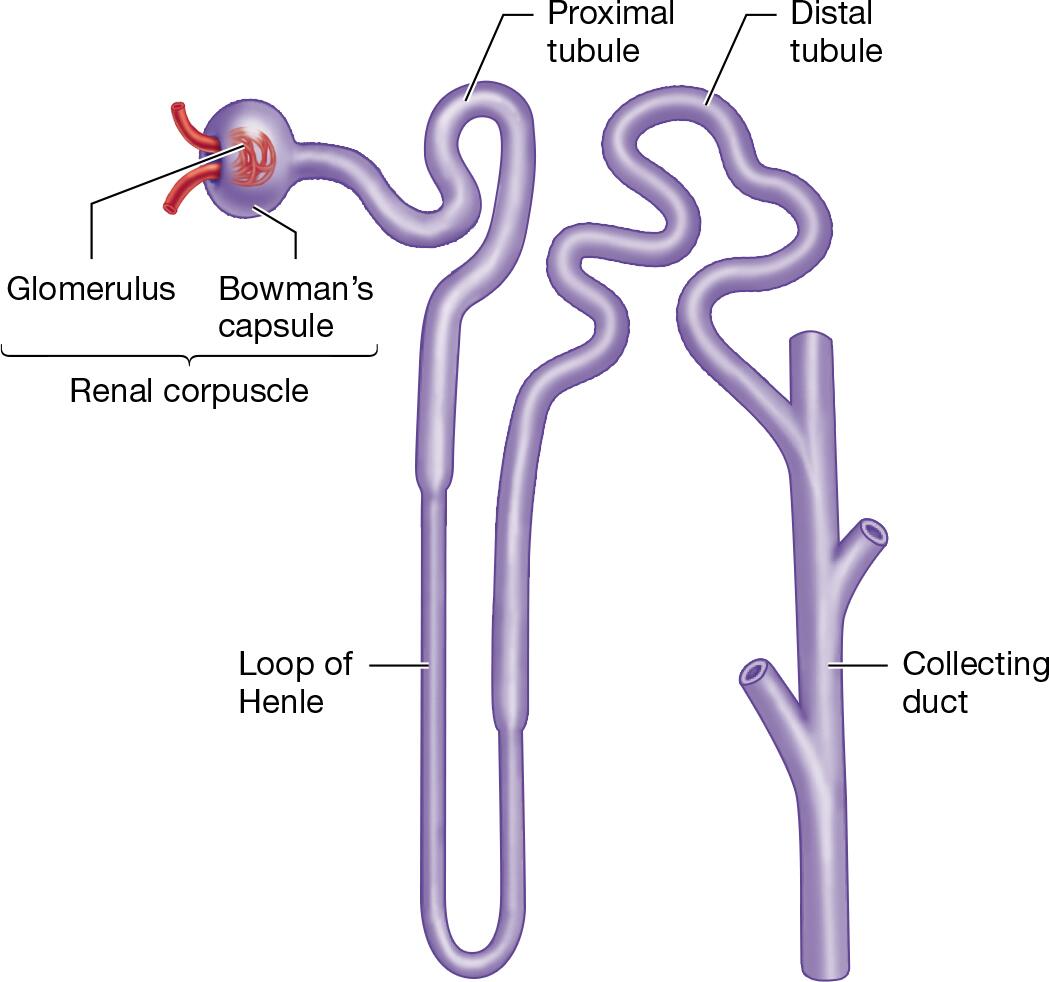
four major regions of this unit:
renal corpuscle
proximal tubule
loop of Henle
distal tubule
collecting duct (they empty into here)
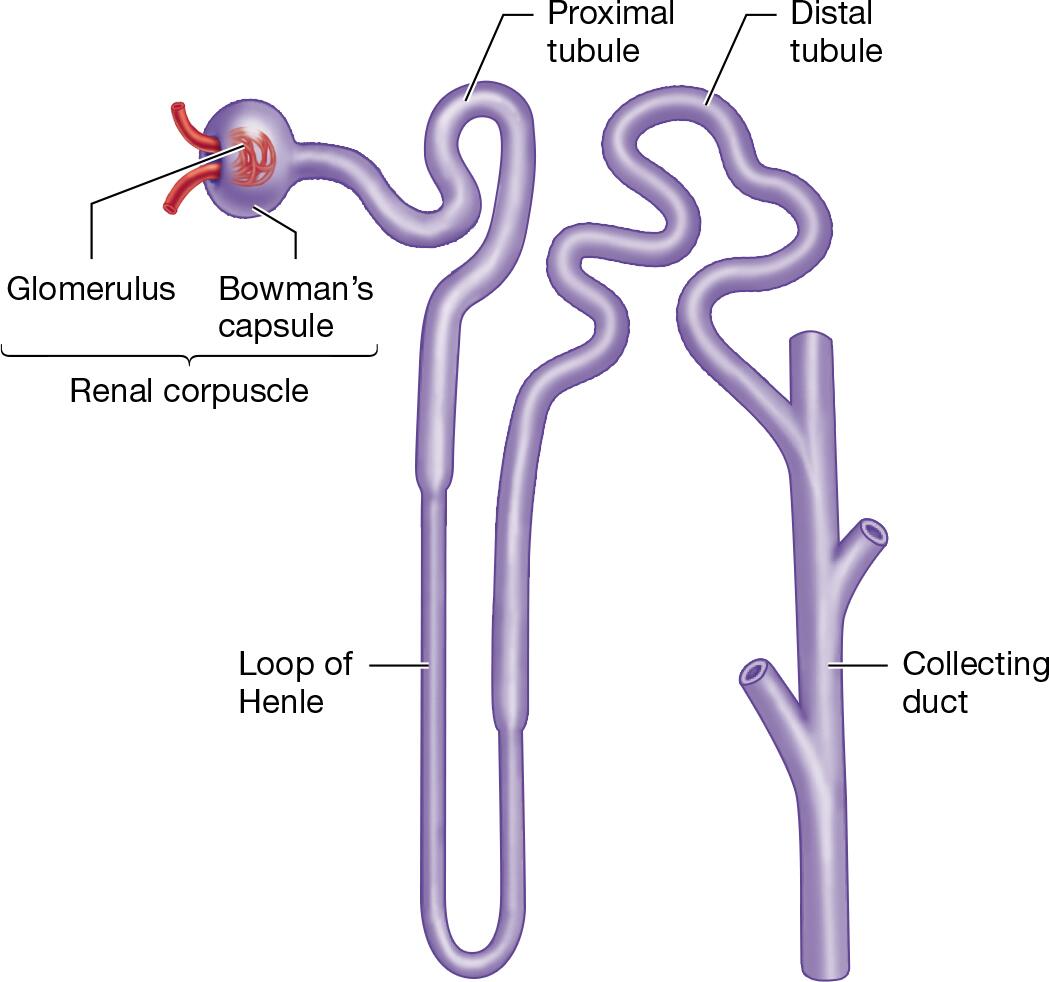
Renal corpuscle (40)
one of the major regions of the nephron
urine formation begins here
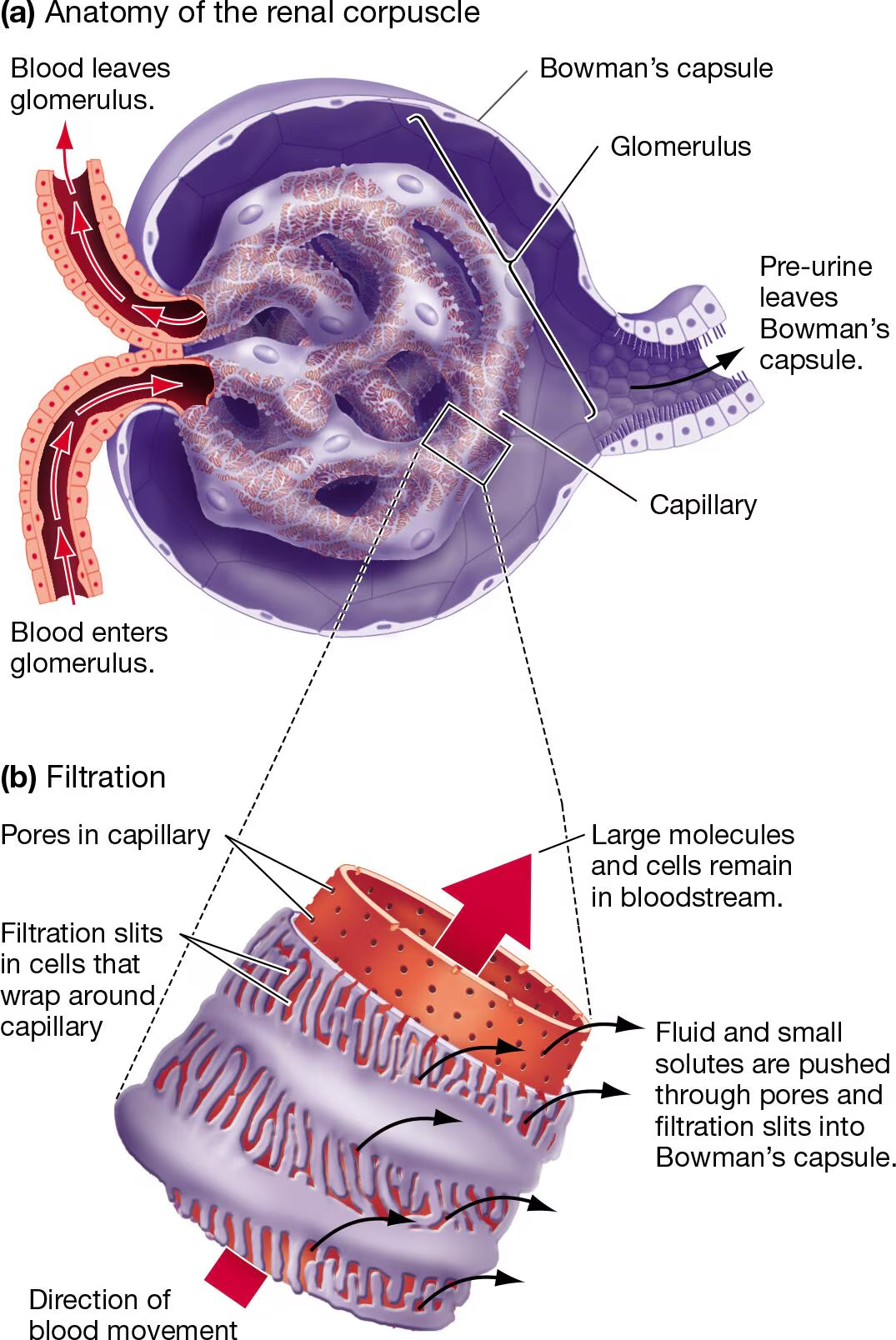
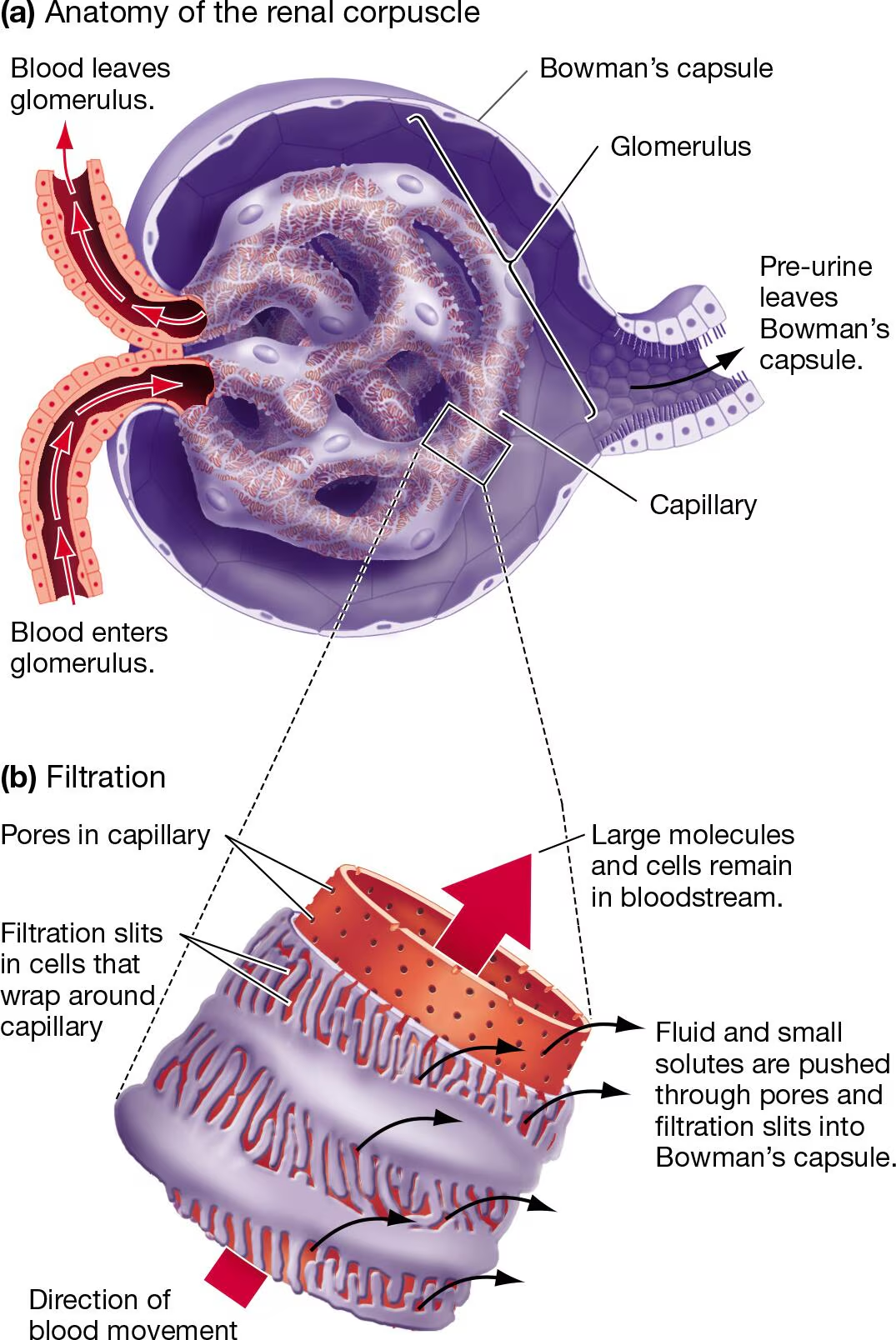
filters blood, forming a filtrate, or pre-urine, consisting of ions, nutrients, waste, and water
structure of this allows it to function as filtration device:
water and solutes forced from the blood and pass thru pores into Bowman’s capsule
structure & function:
forms a capsule that encloses a cluster of tiny blood vessels, or capillaries (glomerulus)
these vessels bring blood to nephron from renal artery
the glomerulus & Bowman’s capsule make up this region
can produce abt 180L of filtrate per day
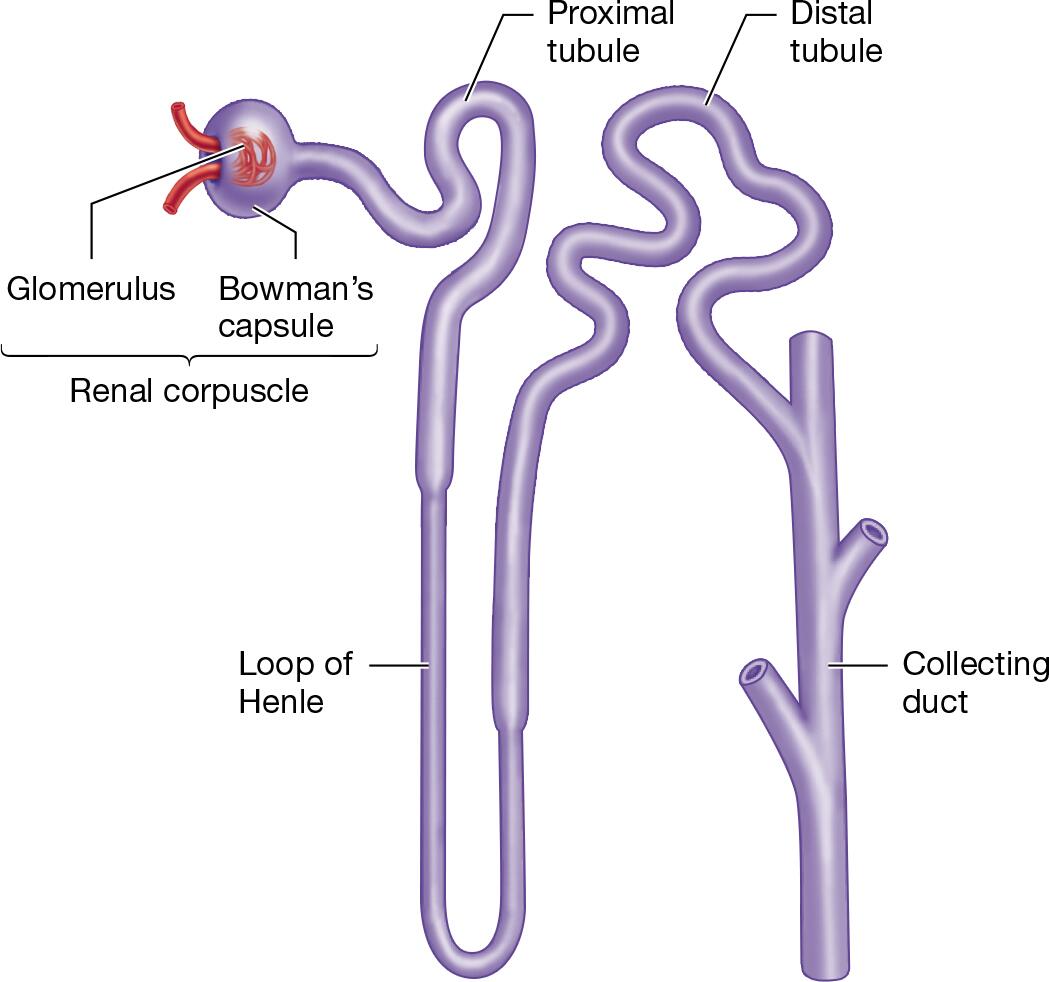
Glomerulus (40)
found in the renal corpuscle
forms a capsule that encloses this
ball-like cluster of capillaries surrounded by Bowman’s capsule
Bowman’s capsule (40)
found in the renal corpuscle
this & the glomerulus make up the renal corpuscle
region of nephron that surrounds the glomerulus
Proximal tubule (40)
one of the major regions of the nephron
has epithelial cells that reabsorb nutrients, ions, and water from the filtrate into the blood
filtrate inside this contains water and small solutes such as urea, glucose, amino acids, vitamins, electrolytes
some are waste; others are valuable nutrients
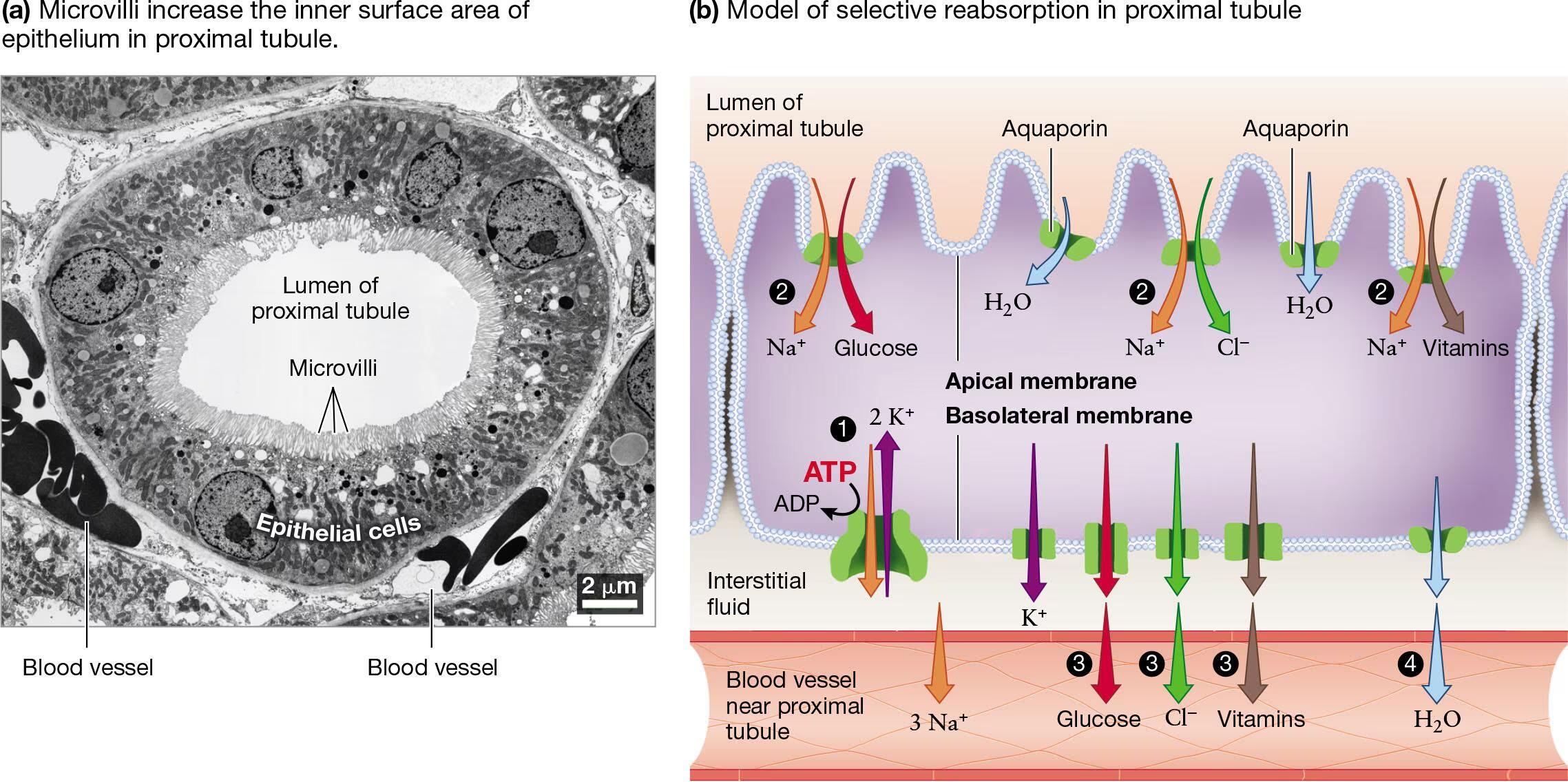
the epithelial cells of this region contain microvilli facing the lumen
microvilli increase the surface area
Proximal tubule: selective reabsorption (40)
model of molecular mechanisms involved in this process
active transport creates Na+ gradient
Na+/K+-ATPase in basolateral membrane moves sodium from interior of epithelial cells surrounding lumen to interstitial fluid
active transport of sodium out of cells creates concentration gradient favoring entry of sodium from lumen
Na+ gradient is used to remove solutes from filtrate
sodium-dependent cotransporters in apical membrane use the Na+ gradient to remove ions and nutrients selectively from filtrate in lumen
movement of sodium into cell, down its electrochemical gradient, provides means for moving other solutes against their gradient
removed substances diffuse into blood
solutes that move from lumen into cell diffuse across basolateral membrane into interstitial fluid and then into nearby blood vessels
water moves into blood by osmosis
water follows movement of solutes from proximal tubule into cell and then out of cell into blood vessels
Loop of Henle (40)
one of the major regions of the nephron; emerges from proximal tubule
establishes and maintains a strong osmotic gradient in the interstitial fluid surrounding this
osmolarity of the interstitial fluid increases as this descends into the medulla
in most nephrons, this is short and barely enters medulla
functions as a countercurrent exchanger and multiplier:
sets up and maintains a medullary osmotic gradient in interstitial fluid that surrounds it
countercurrent flow of fluid is self-reinforcing
has 3 distinct regions:
descending limn
thin ascending limb
thick ascending limb
mammals that inhibit dry environments have longer loops; mammals in fresh water have shorter loops
Vasa recta (40)
water and salt that move out of the loop of Henle diffuse into here
network of blood vessels that runs along the loop
as a result, water and electrolytes that are reabsorbed are returned to bloodstream instead of being excreted in urine

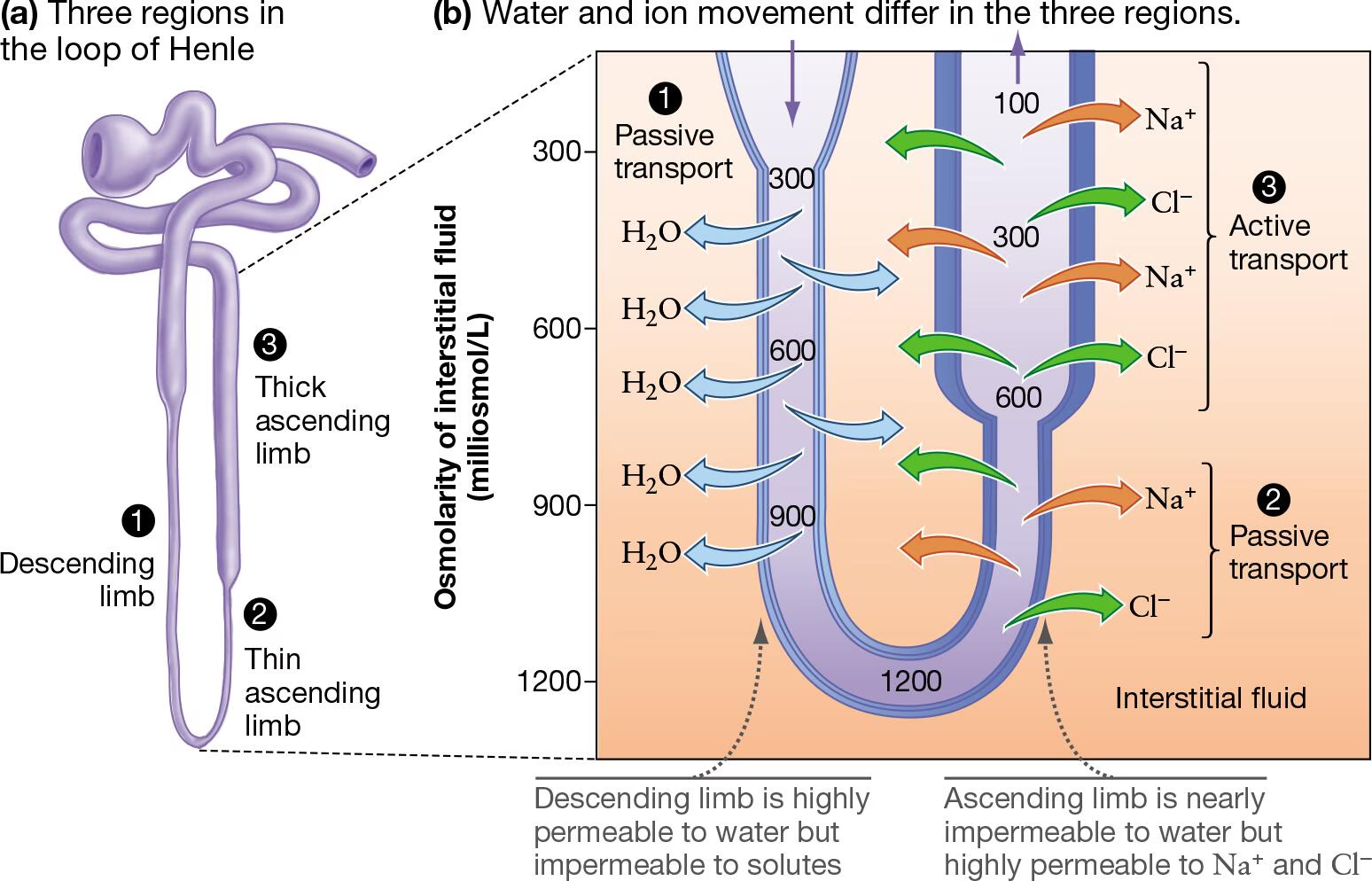
Loop of Henle: descending limb (40)
one of the regions of loop of Henle
as fluid flows down this region, fluid inside loop loses water to tissue surrounding nephron
this movement of water is passive, down its osmotic gradient
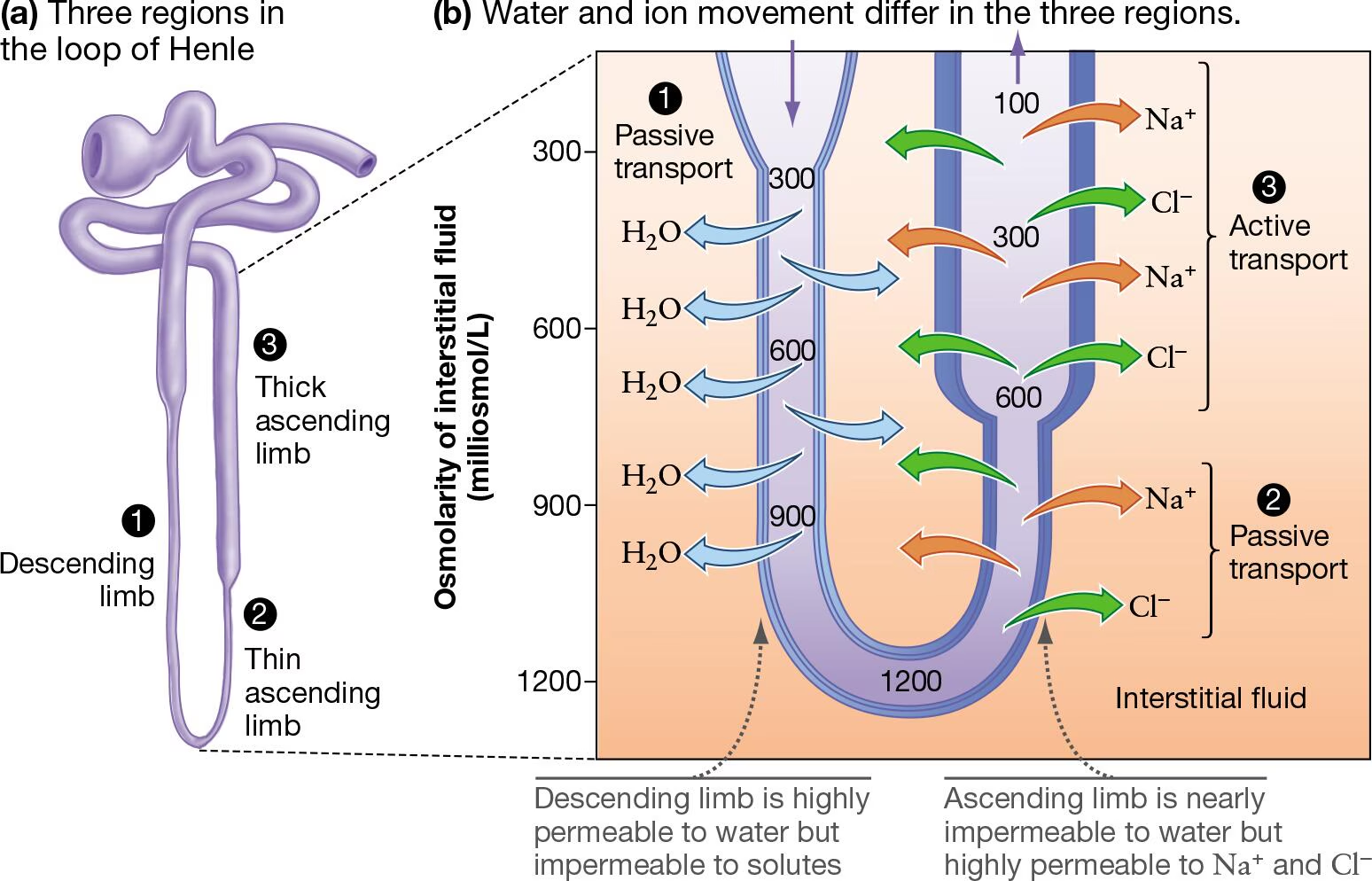
Loop of Henle: thin ascending limb (40)
one of the regions of loop of Henle
fluid inside nephron loses Na+ and Cl- in this region:
ions move passively along electrochemical gradients
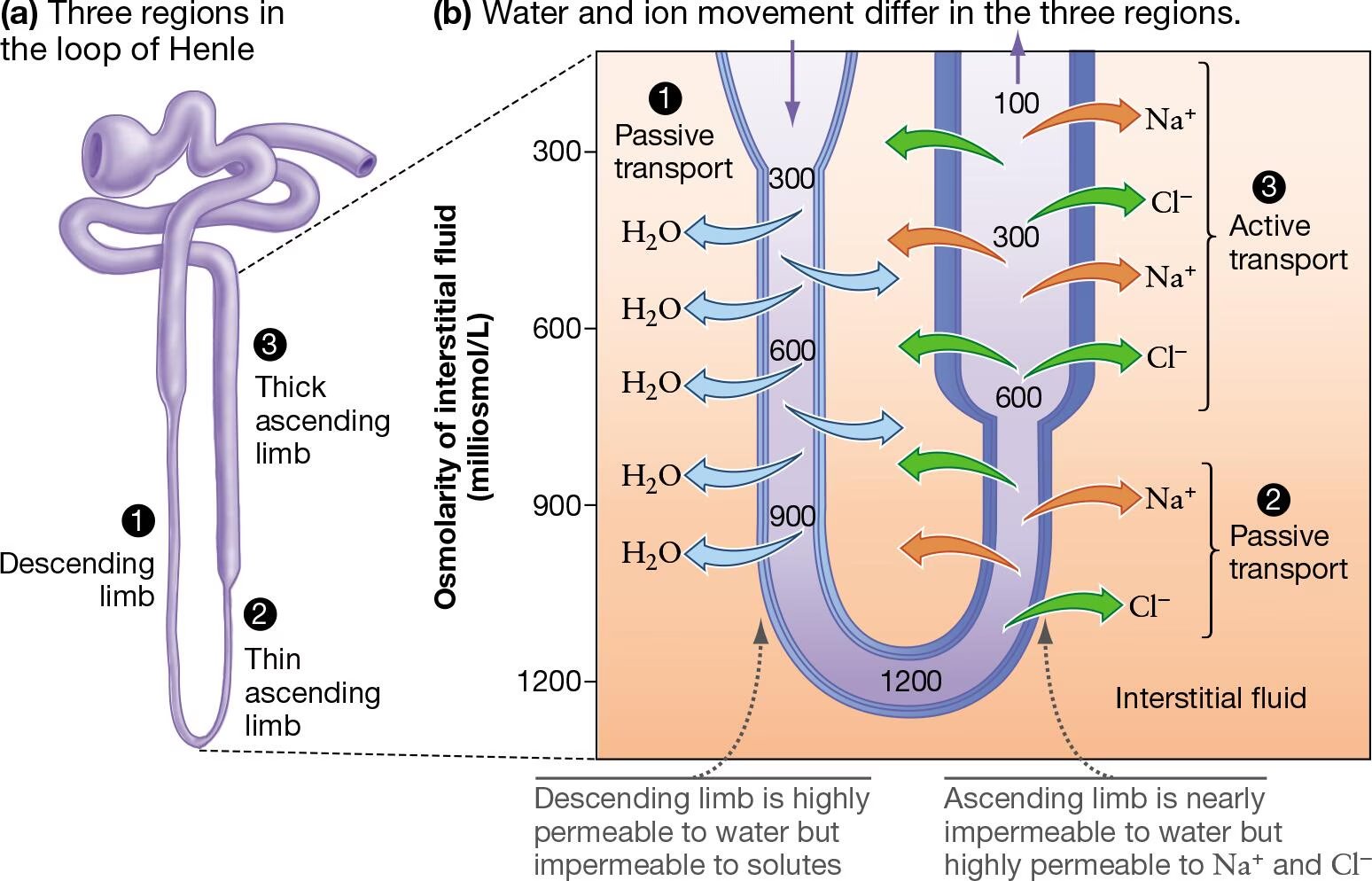
Loop of Henle: thick ascending limb (40)
one of the regions of loop of Henle
near the renal cortex, osmolarity of surrounding interstitial fluid is low
additional Na+ and Cl- are actively transported out of nephron in this region
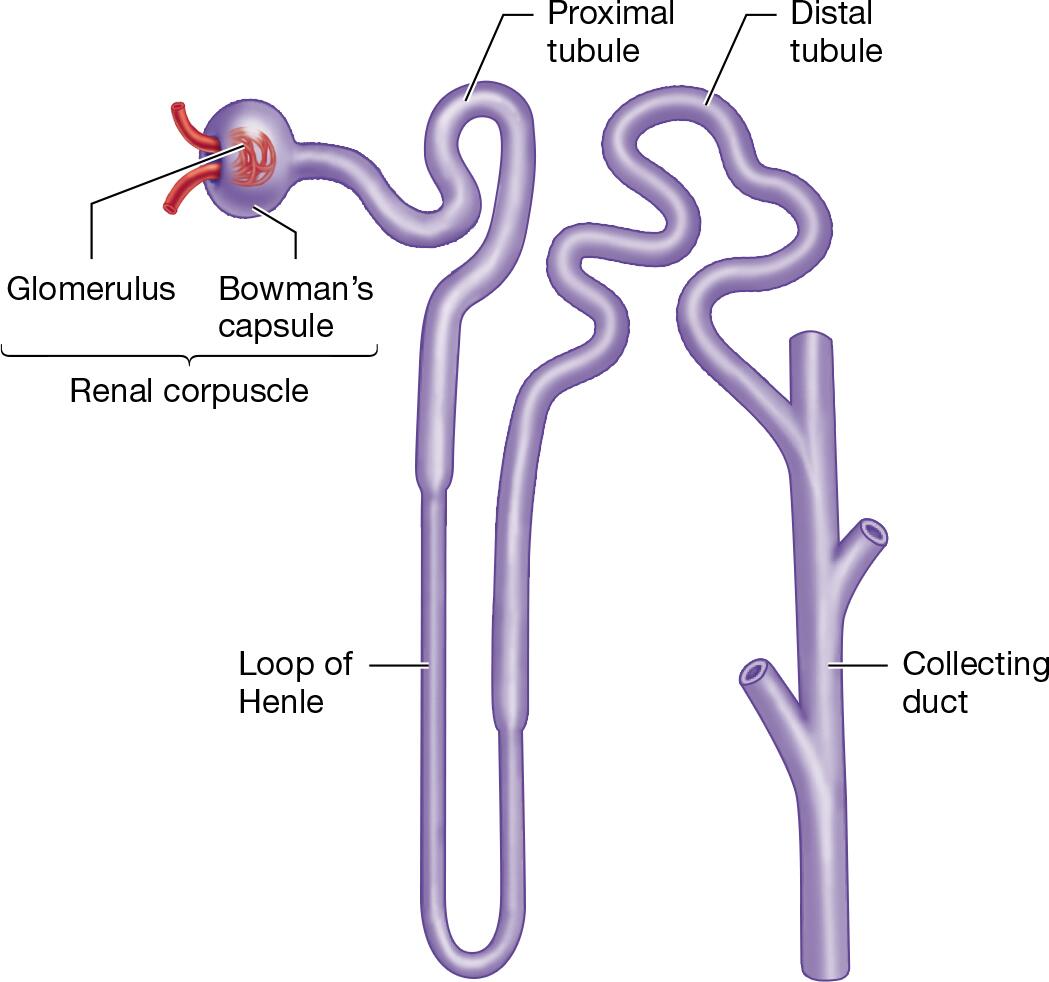
Distal tubule (40)
one of the major regions of the nephron
once filtrate has passed thru loop of Henle, it enters this region
reabsorbs ions and water from filtrate in a regulated manner
one that helps maintain water and electrolyte balance according to body’s needs
fluid that enters this is always dilute
Collecting duct (40)
end of the nephron where the major regions empty into
may reabsorb more water to maintain homeostasis
in addition, urea moves from urine to the interstitial fluid at the base of the collecting duct and contributes to medullary osmotic gradient set up by the loop of Henle
in contrast, urine that leaves this region is dilute when individual is well hydrated but concentrated when the individual is dehydrated
Distal tubule and collecting duct (40)
activity of these regions of the nephron is highly regulated and altered in response to osmotic stress
amount of Na+, Cl-, and water that’s reabsorbed in these regions varies with animal’s hydration
changes in these regions are controlled by hormones (signaling molecules in blood)
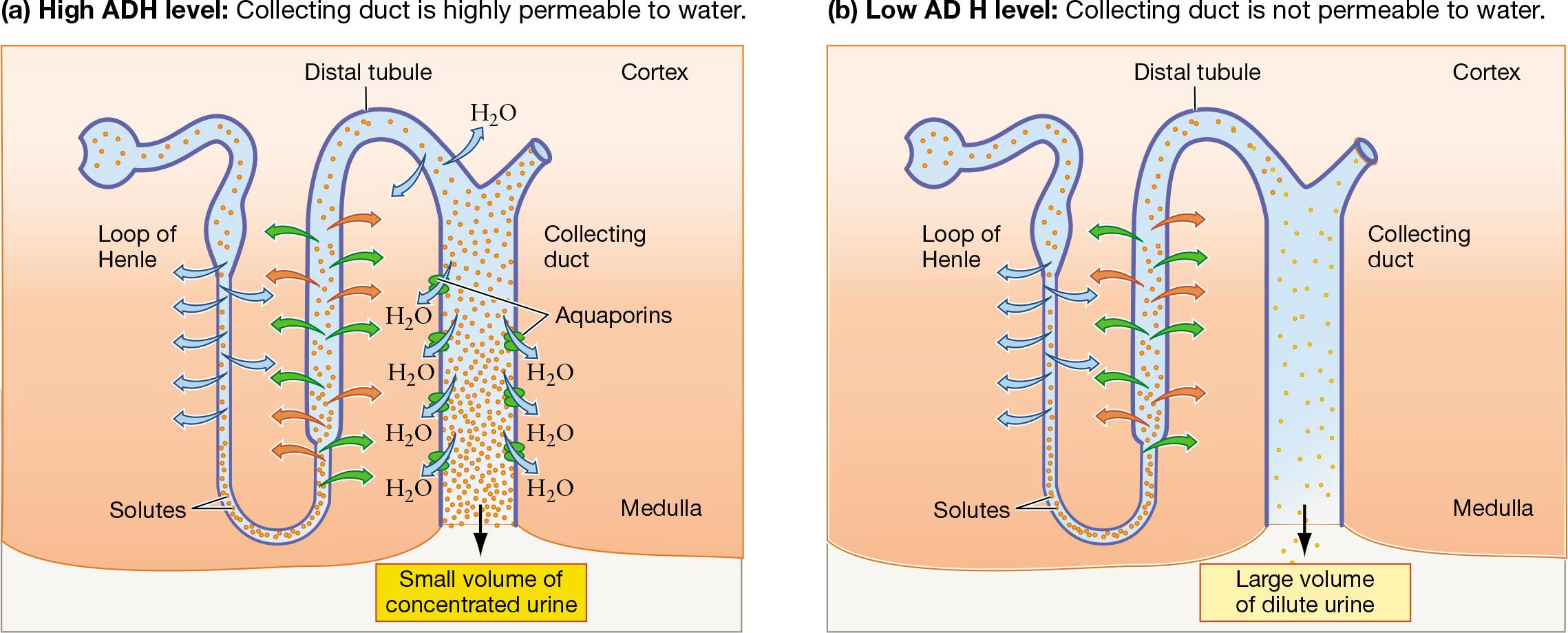
Antidiuretic hormone (ADH) (40)
important hormone in the regulation of water balance
released after increase in osmolarity
increases water reabsorption
makes collecting duct epithelium more permeable to water:
triggers insertion of aquaporins into apical membrane; as a result, cells become much more permeable to water and large amounts of water a reabsorbed
increases cell’s permeability to urea, which is reabsorbed into surrounding fluid; this helps create a concentration gradient favoring water reabsorption from filtrate
osmoreceptor cells in hypothalamus:
monitor osmolarity of blood
regulate the release of this hormone
Renin-angiotensin-aldosterone system (RAAS) (40)
vital hormone system that controls your blood pressure, blood volume, and fluid balance by managing sodium and water
responds to a decrease in blood volume
increases water reabsorption
Atrial natriuretic peptide (ANP) (40)
hormone made by the heart that lowers blood pressure, reduces salt, and decreases fluid volume
acts as a natural opposite to RAAS
released in response to an increase in blood volume and pressure
inhibits release of renin
Aquaporins (40)
specialized channel proteins in cell membranes that rapidly transport water, facilitating osmoregulation in living cells
function:
form pores that let water molecules pass thru in a single file at high speed
allow water to move freely while blocking charged ions and protons to protect cellular energy systems
Excretory processes (40)
key functions of most excretory systems (in order):
filtration—filtering of body fluids
based on size (large components of blood do not fit through pores in nephron)
reabsorption—reclaiming valuable solutes
secretion—adding nonessential solutes and wastes to filtrate
excretion—processed filtrate containing nitrogenous wastes is released from body
Cortex (40)
outer region of the kidney
contains most of the nephrons and is where blood filtration begins
houses the renal corpuscles, proximal tubes, and distal tubes, making it the primary site for filtration and much of reabsorption
this surrounds the medulla and receives a rich blood supply
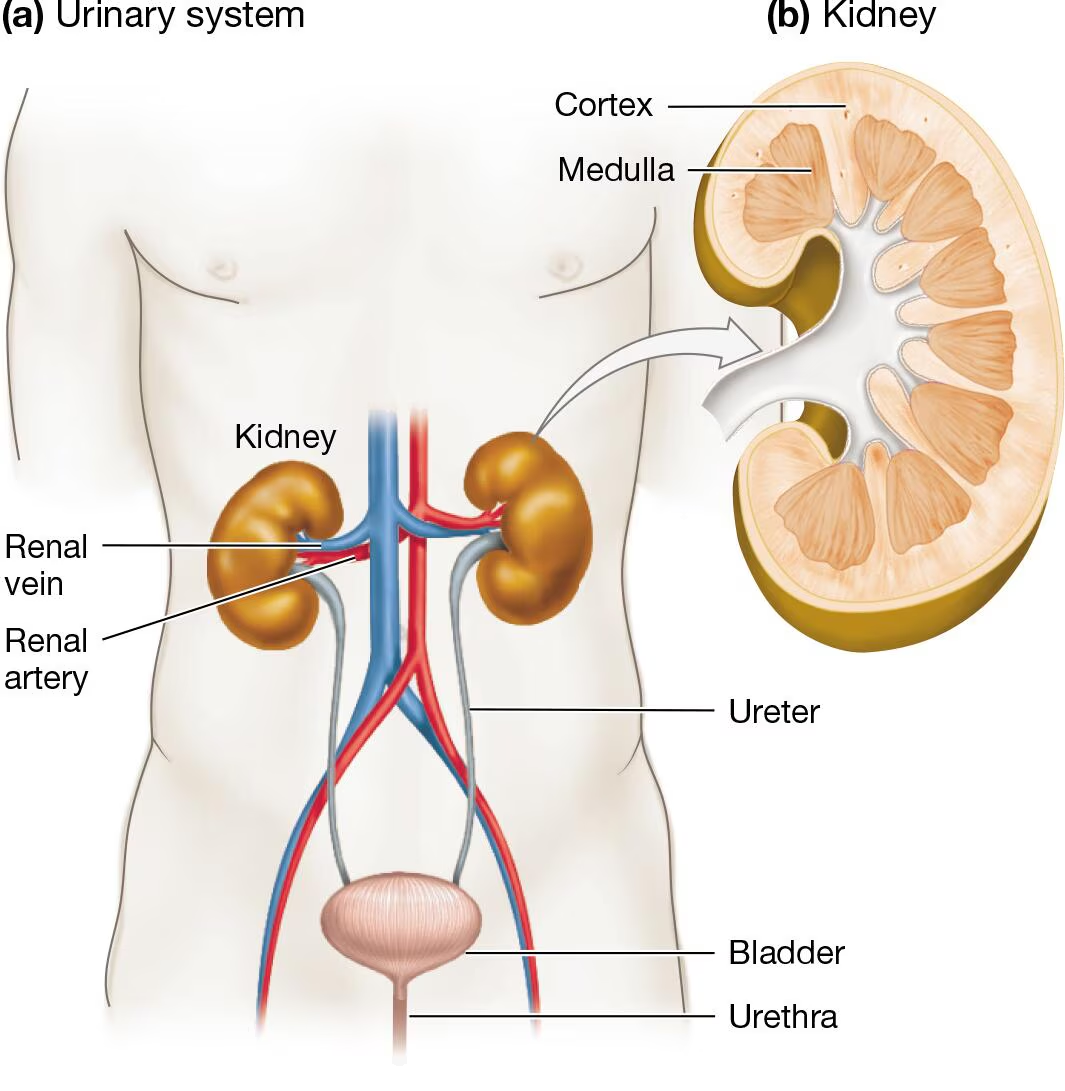
Medulla (40)
inner region of the kidney
Contains the loops of Henle and collecting ducts that establish osmotic gradient needed for water reabsorption
allows the kid to produce concentrated urine and conserve water
the osmolarity increases deeper into this region, creating the gradient that drives water absorption
Animal nutrition (41)
4 processes needed to obtain energy from food:
ingestion
digestion
absorption
elimination
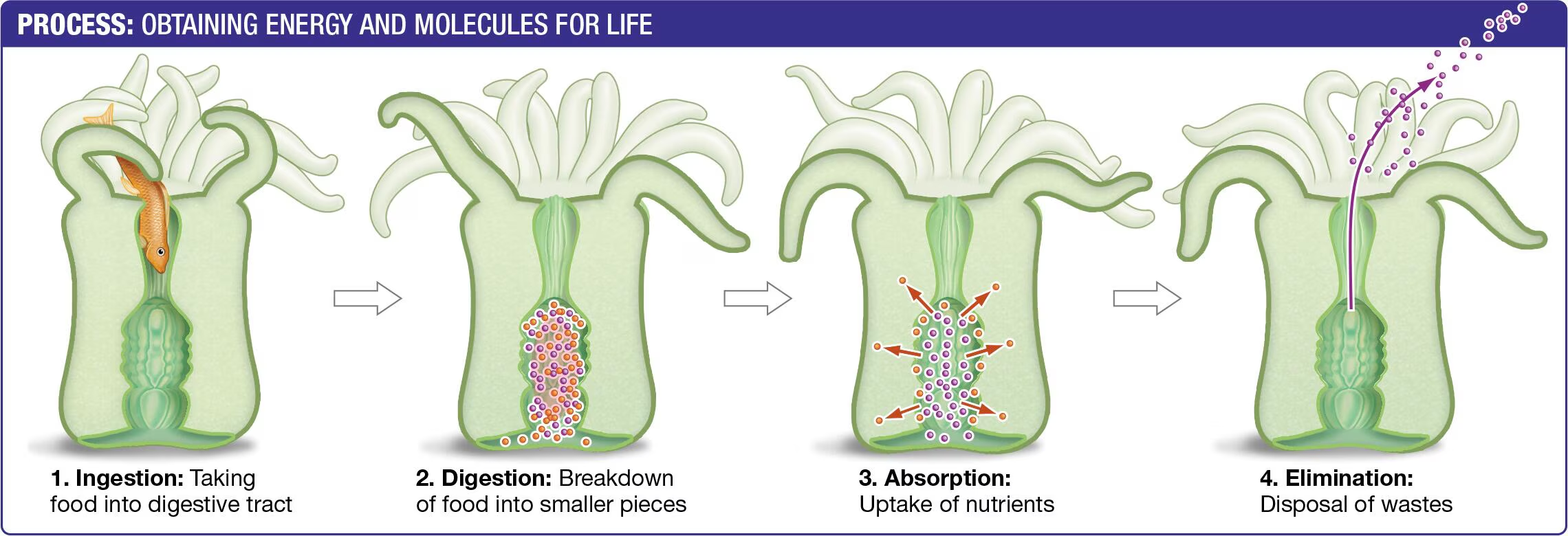
Ingestion (41)
process of bringing food into the digestive tract
Digestive tract (41)
also known as the alimentary canal, or gastrointestinal (GI) tract
series of connected chambers and tubes where digestion takes place
various accessory glands secrete enzymes into here that digest food into particles small enough for efficient absorption
two general designs:
incomplete
complete
Incomplete digestive tracts (41)
a type of digestive tract design
have a single opening, the mouth, through which the animal both ingests food and eliminates wastes
the mouth opens into a chamber (gastrovascular cavity) where digestion takes place
e.g., Porifera and Cnidarians
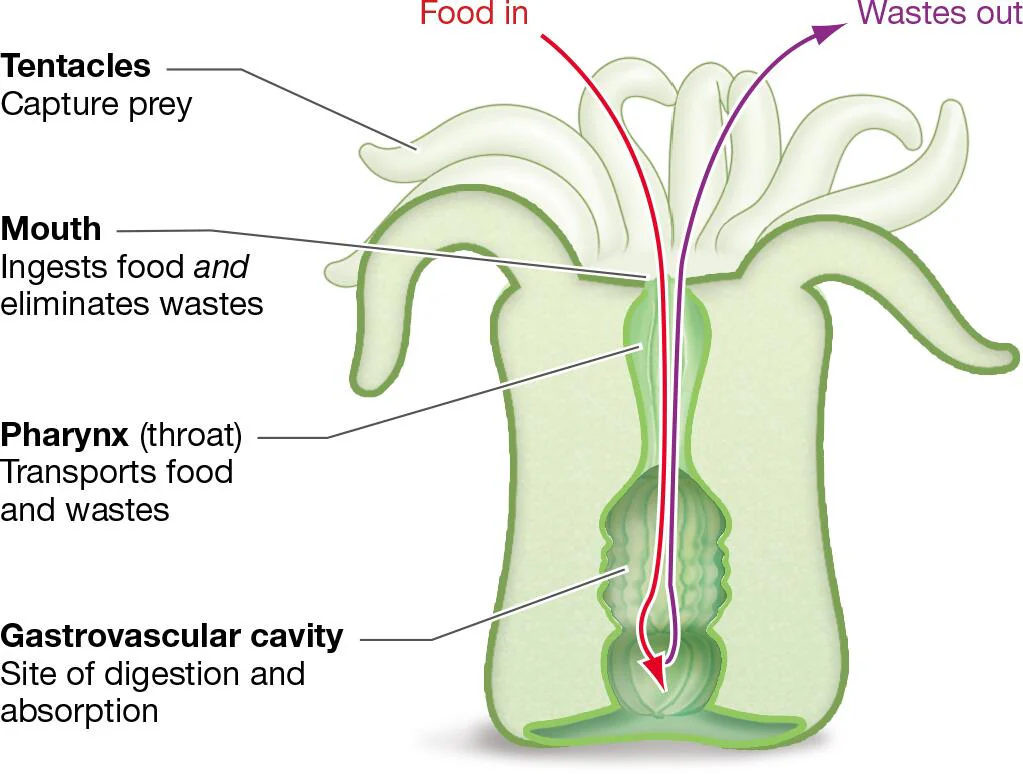
Complete digestive tract (41)
a type of digestive tract design
have two openings—start at the mouth and end at the anus
the interior of this tube communicates directly w/ the external environment via these openings
advantages:
different chemical and physical processes can be confined to different compartments so that they occur independently of each other and in sequence
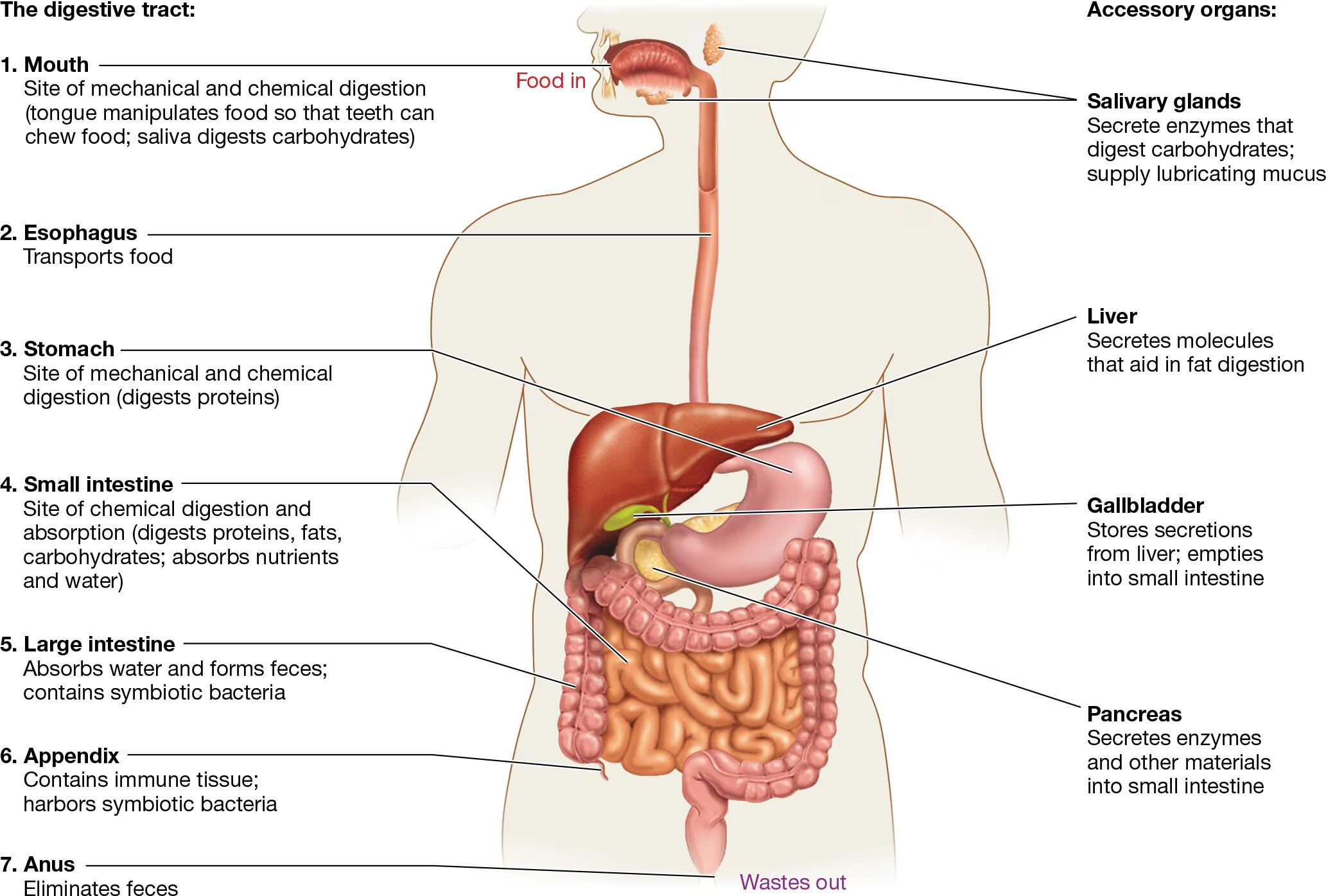
Digestion: mouth (41)
digestion starts here
in the process of mechanical digestion, humans break down large chunks of food into smaller pieces by chewing action of teeth
mechanical digestion increases surface area of food & mixes it into watery slurry so enzymes can do their job more easily (chemical digestion)
salivary glands secrete salivary amylase & mucus
cells in the tongue secrete lingual lipase
Salivary amylase (41)
enzymes responsible for carbohydrate digestion in the mouth
secreted by salivary glands in mouth
cleaves bonds in starch to release dextrins (smaller carbohydrates of various lengths) as well as some disaccharides (e.g., maltose)
Salivary glands
glands in the mouth that secrete amylase and a slimy substance (mucus)
water and mucus allow food to be swallowed
Lingual lipase (41)
cells in the tongue synthesize and secrete another salivary enzyme
begins the digestion of lipids by breaking triglycerides (common form of fat) into diglycerides and fatty acids
this enzyme plays only a minor role in digestion, mostly once it’s been swallowed into stomach
Digestion: esophagus (41)
once food is swallowed, it enters this muscular tube which connects the mouth and stomach
in response to nerve signals, the smooth muscles in this tube contract and relax (peristalsis)
these nerve signals are not the result of conscious choice, it’s a reflex
little if any digestion occurs here
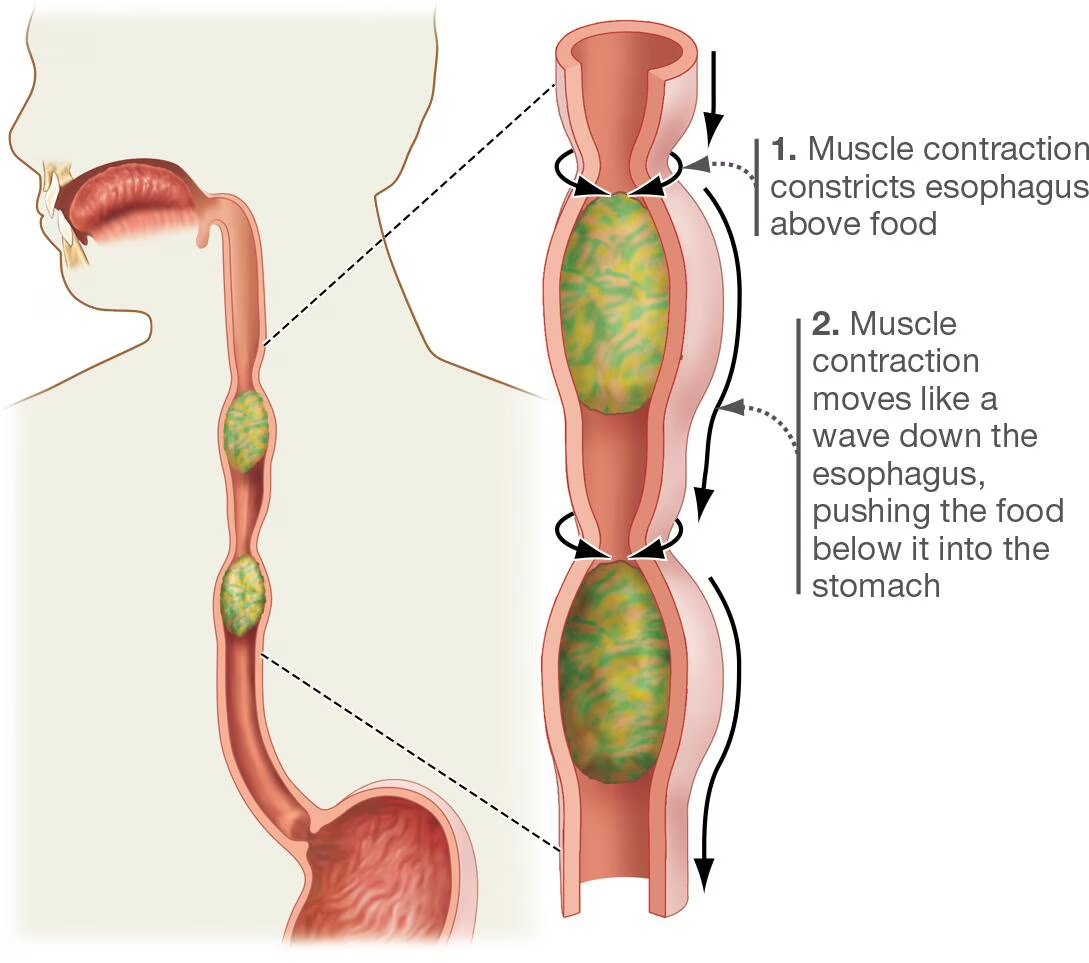
Peristalsis (41)
wave of muscle contractions that propels food down the esophagus
it’s a reflex—automatic reaction to a stimulus stimulated by the act of swallowing)
Crop (41)
bird species have a prominent, widened segment of esophagus, called this
food can be stored and processed
allows individuals to eat a large amount in a short time
then they retreat to a safe location while digestion occurs
in addition, some birds store food in this and then regurgitate it into the mouths of their young
Digestion: stomach (41)
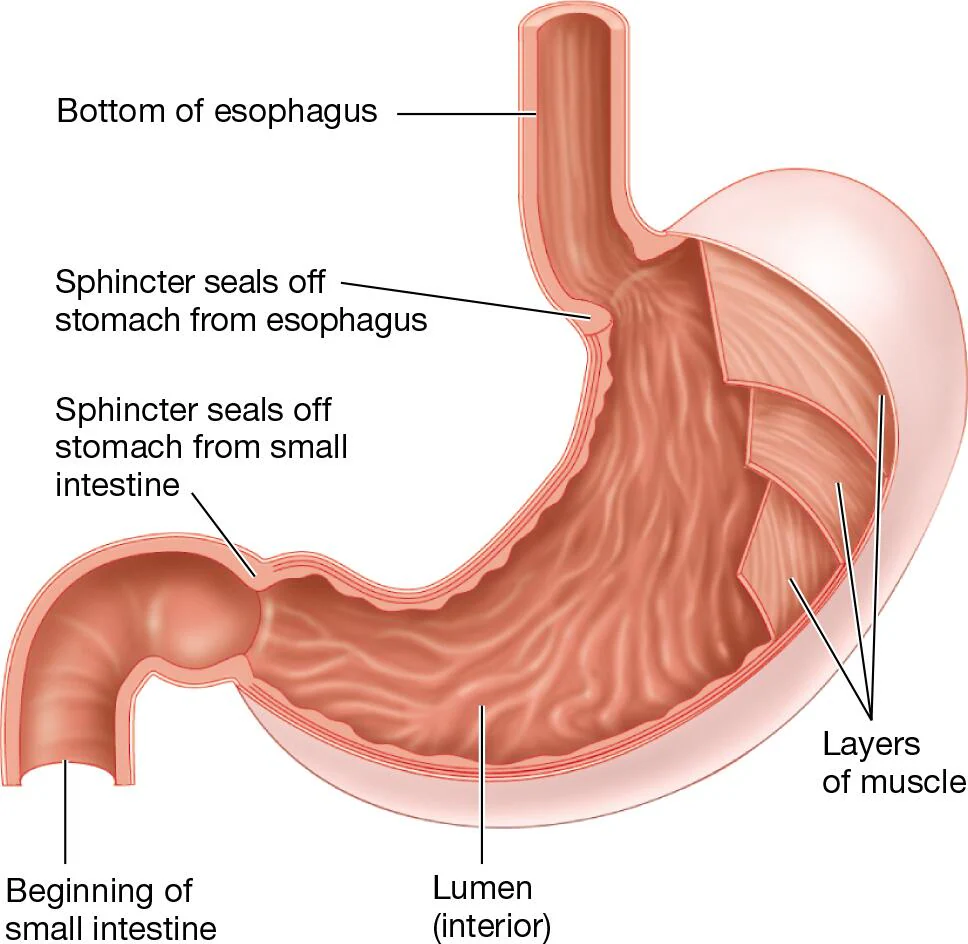
tough, muscular pouch in the digestive tract, bracketed on both the superior and inferior ends by ringlike muscles (sphincters)
stores food and processes it into a liquid suspension
secretes gastric juice
mixture of ingested food and gastric juice is called chyme
Sphincters (41)
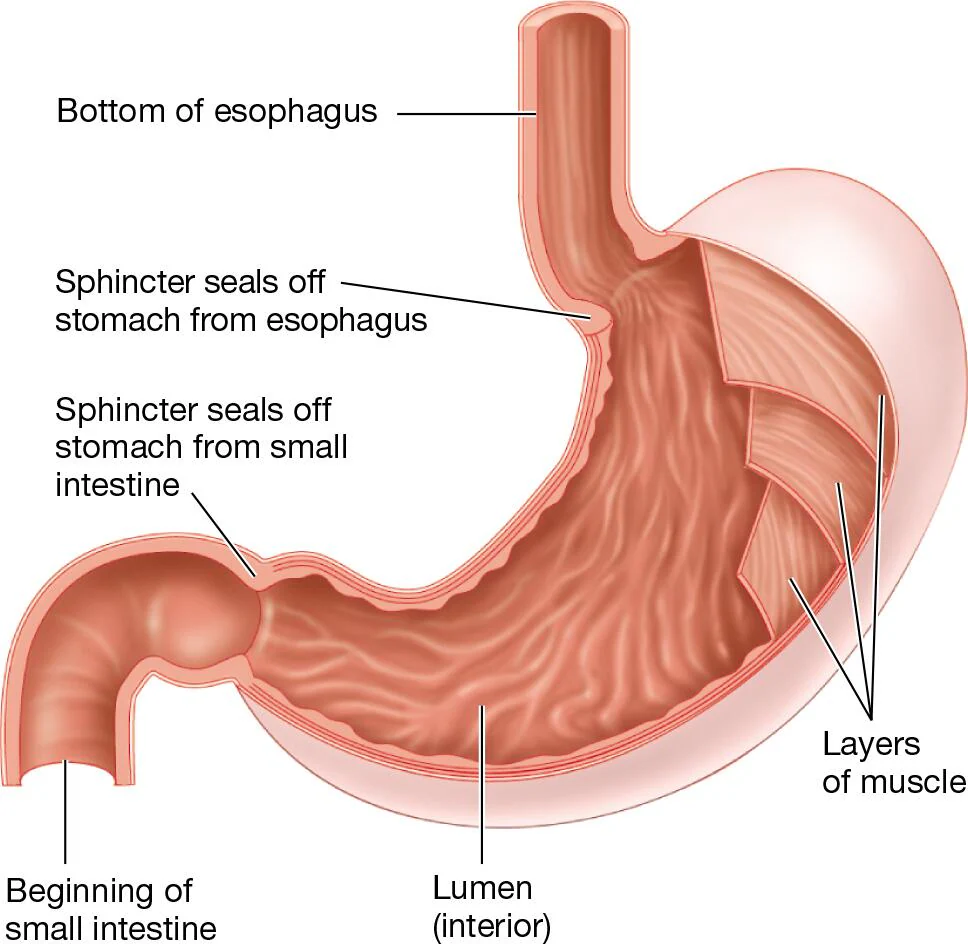
muscular valve that can close off a tube, as in a blood vessel or a part of the digestive tract
brackets the stomach on both the superior and inferior ends by these ringlike muscles
control the passage of material
these also prevent chyme (mix of ingested food & gastric juice) from entering the esophagus and regulate its entry into small intestine
Chyme (41)
a mixture of ingested food and gastric juice
formed in the stomach and moves into small intestine
Pepsin (41)
protein-digesting enzyme secreted in inactive form by chief cells in the stomach lining
Ruminant stomach (41)
stomach found in species called ruminants (e.g., cattle, sheep, goats, deer, antelope, giraffe, pronghorn)
stomach is specialized for digesting cellulose instead of proteins
has 4 chambers (in order):
rumen
reticulum
omasum
abomasum
animals do not produce the enzymes required to digest cellulose
yet cellulose is the main carbohydrate in leaves, stems, and twigs
after partial digestion, these animals regurgitate portions of the material into its mouth (cud), and animal chews cud and re-swallows it
Avian gizzard (41)
prominent type of modified stomach found in birds
particularly large and strong in birds that eat coarse foods
interpreted as an adaptation that allow birds to ingest food quickly and digest later
birds don’t have teeth and can’t chew food into small pieces
most species swallow sand and small stones that lodge here
as this muscular sac contracts, food is pulverized by the grit
Digestion: small intestine (41)
long tube that’s folded into a compact space w/in the abdomen
in here, partially digested food mixes with secretions from the pancreas, liver, and gallbladder
when passage through this structure is complete, digestion is mostly done
and most nutrients have been absorbed
epithelial lining of duodenum (first portion of this organ) produces several digestive enzymes
jejunum and ileum (portions of this organ) function mainly in absorption of nutrients and water
Pancreas (41)
connected to the small intestine by the pancreatic duct
produces proteases (protein-digesting enzyme) trypsin and chymotrypsin that are activated in the lumen of the duodenum
proteases aid in hydrolysis of peptide bonds
its solution is alkaline and neutralizes the acidic chyme
Pancreatic lipase (41)
completes digestion of lipids
results in release of fatty acids and monoglycerides
Digesting lipids: bile and transport (41)
pancreatic secretions include digestive enzymes that act on fats as well as proteins and carbohydrates
pancreatic lipase completes digestion of lipids, which results in release of fatty acids and monoglycerides
fats tend to enter small intestine in large globules:
must be broken by emulsification before pancreatic lipase can act on them
Bile (41)
made in the liver and stored in the gallbladder
aids in digestion and absorption of fats in the small intestine
increases surface area for hydrophilic lipases to gain access to and digest fat molecules
destroys nonfunctional red blood cells
Gallbladder (41)
small pouch that stores bile from the liver and releases it as needed into small intestine during digestion of fats
Liver (41)
large, complex organ that performs many functions:
storage of glycogen
processing and conversion of food and wastes
production of bile
Absorption: large intestine (41)
the primary function of this organ is to form feces by absorbing additional water and compacting the wastes that remain
includes:
colon, cecum, and rectum
although the kidneys are responsible for maintaining water balance, water absorption here is important for keeping body well hydrated
Colon (41)
main section of the large intestine
feces are formed in here by absorbing additional water and compacting the wastes that remain
Rectum (41)
final part of the large intestine
feces are held here until they can be eliminated through the anus
Cecum (41)
blind sac at the anterior end of the large intestine
aids in the fermentation of plant material
in some herbivores this is greatly enlarged b/c it contains symbiotic bacteria and protists that ferment cellulose
Appendix (41)
in humans, this narrow pouch emerges from the cecum
often has been described as vestigial b/c it doesn’t perform any obvious vital function
if it becomes inflamed, it can be surgically removed w/ no ill affects
contains immune system cells and appears to act as a haven for symbiotic microorganisms that inhabit colon
plays a very minor role in immunity
Digestion (41)
the mechanical and chemical breakdown of food
Absorption (41)
the uptake of specific ions and molecules across the epithelium that lines the digestive tract
Elimination (41)
the process of removing waste from the animal’s digestive tract
Nutrients (41)
substances that an organism needs to remain alive
animals get the chemical energy and building blocks they need from carbohydrates, proteins, and fats
food is any material that contains these substances
Essential nutrients (41)
although all nutrients are necessary for growth and survival of animals, these are nutrients are those that cannot be synthesized and must be obtained from the diet
4 classes of these nutrients:
amino acids
fatty acids
vitamins
minerals
Essential amino acids (40)
a class of essential nutrients
subunits of proteins obtained from the diet
amino acids that an animal cannot synthesize from simpler building blocks
the human diet requires 9 of these essential nutrients, which must be obtained from food
Essential fatty acids (41)
a class of essential nutrients
hydrocarbons obtained from the diet
fatty acids that an animal must obtain in its diet
humans can synthesize all fatty acids except 2, which must be obtained from eating certain plants or fish
Vitamins (41)
a class of essential nutrients
organic, or carbon-containing, compounds that are vital for health but are required in only minute amounts
they’ve a variety of roles:
several function as coenzymes in critical reactions
Minerals (41)
a class of essential nutrients
inorganic substances used as components of enzyme cofactors or structural materials
some, like calcium and phosphorus, are needed in large quantities
others, like iron and copper, are required in small amounts
this class include ions of electrolytes, which influence osmotic balance and required for normal membrane function
sodium, potassium, and chloride are the major ions of electrolytes in the human body
Four feeding techniques (41)
suspension feeders
deposit feeders
fluid feeders
mass feeders
Suspension feeders (41)
a type of feeding technique/strategy
filter small organisms or bits of organic debris from water by means of cilia, mucus-lined “nets,” or other structures
e.g., sponges and tubeworms
Deposit feeders (41)
a type of feeding technique/strategy
swallow sediments and other types of deposited material rich in organic matter
e.g., earthworms and sea cucumbers
Fluid feeders (41)
a type of feeding technique/strategy
suck or lap up blood, nectar, or other fluids
e.g., mosquitoes, leeches, hummingbirds, etc.
Mass feeders (41)
a type of feeding technique/strategy
seize and manipulate chunks of food
majority of animals feed this way
e.g., humans, carnivores, herbivores
Mouthparts as adaptations (41)
natural selection matched mouthpart structures to method of eating:
most mammals chew and swallow distinct boluses—small, rounded mass of substance
diversification of tooth shape allowed mammals to exploit range of foods
snakes have mobile skull bones; can ingest large prey w/o chewing or biting off pieces
obtaining nutrients is fundamental; natural selection is strong for food capture