ChTLE 2024 Organic Chemistry Pre-Board Exam 2 (2/4)
 Call Kai
 Learn
Learn Practice Test
 Spaced Repetition
 Match
Match Flashcards
 Knowt Play
1/49

There's no tags or description
Looks like no tags are added yet.
Name | Mastery | Learn | Test | Matching | Spaced | Call with Kai | Chat |
|---|
No analytics yet
Send a link to your students to track their progress
50 Terms
Which of the following is a chiral primary alcohol, C5H12O?
a) 3-methyl-2-butanol
b) 2-methyl-2-butanol
c) 3-methyl-1-butanol
d) 2-methyl-1-butanol
D.
The reaction of sodium ethoxide with iodoethane to form diethyl ether is classified as:
a) an electrophilic substitution
b) a nucleophilic substitution
c) a radical substitution
d) an electrophilic addition
B.
Which one of the following alcohols will be oxidized by Jones' reagent (CrO3 in 50% sulfuric acid) to a ketone having the same number of carbon atoms?
a) 1-methylcyclohexanol
b) 3,3-dimethylcyclopentanol
c) 3-methyl-1-hexanol
d) 3-ethyl-3-hexanol
B.
Which of the following reagents would be best for oxidizing a primary alcohol to an aldehyde?
a) H3PO4
b) PCC in CH2Cl2
c) Jones' reagent (H2CrO4)
d) OsO4
B.
Arrange according to increasing acidity.
I. methanol
II. phenol
III. p-nitrophenol
IV. p-methylphenol
a) I, II, III, IV
b) II, I, III, IV
c) I, II, IV, III
d) IV, III, I, II
C.
Which of the following indicates the order of decreasing acidity of the four molecules below:
I. CH3CH2COOH
II. CH3C2CH2OH
III. C6H5OH
IV. CH3C≡N
a) I> III > II > IV
b) II > I > IV > III
c) II >III > I > IV
d) IV> II > III > I
A.
Arrange the following according to increasing acid strengths:
I. benzoic acid
II. 4-methoxybenzoic acid
III. 4-cyanobenzoic acid
IV. 4-methylbenzoic acid
a) II < IV < I < III
b) IV < II < I < II
c) IV < II < III < I
d) III < I < II < IV
A.
Arrange the following in the order of decreasing stability:
I. 1-pentene
II. trans-2-pentene
III. cis-2- pentene
IV. 2-methyl-2-butene
a) I > II > III > IV
b) IV > III > II > I
c) IV > II > III > I
d) I > III > II > IV
C.
An industrial source of alcohol.
a) Coal
b) Fats
c) Sugar
d) Ethers
C.
The solvent used for the preparation of Grignard reagent.
a) Alcohol
b) Ether
c) Acid
d) Ester
B.
Rank the following cations according to increasing stability.
I. CH3+
II. +C(CH3)3
III. +CH(CH3)2
IV. +CH2CH3
a) IV, II, III, I
b) III, II, I, IV
c) I, II, III, IV
d) I, IV, III, II
D.
Predict the increasing order of reactivity by the SN2 mechanism:
I. CH3CH2−Cl
II. CH3−Cl
III. (CH3)2CH−Cl
IV. CH3CH2CH2−Cl
V. (CH3)3C−Cl
a) V, IV, II, I, II
b) V, III, IV, I, II
c) V, III, IV, II, I
d) II, I, IV, III, V
B.
Order the following set of compounds according to increasing rate of SN1 reactivity:
I. CH3CH2CH2−Cl
II. H2C=CHCH2−Cl
III. (CH3)3C−Cl
IV. CH3CH=CH−Cl
a) IV, I, II, III
b) I, IV, II, III
c) IV, I, III, II
d) III, II, I, IV
IDK
The enzyme that aids in the fermentation of sugar to alcohol.
a) Diastase
b) Zymase
c) Maltase
d) Glucosidase
B.
A reaction of ester that will produce another ester.
a) Alcoholysis
b) Ammonolysis
c) Hydrolysis
d) Ozonolysis
A.
The test for the presence of methyl carbonyl.
a) Benedict's
b) Fehling's
c) Haloforms
d) Tollen's
C.
An inorganic ester used as explosive.
a) ethyl nitrate
b) ethyl sulfate
c) pentyl nitrate
d) glyceryl trinitrate
D.
A reducing test that gives a brick red precipitate with aldehydes.
a) Benedict's
b) Millon's
c) Schiff's
d) Tollen's
A.
An exothermic reaction of alkanes.
a) Combustion
b) Reduction
c) Pyrolysis
d) Hydrogenation
A.
Which of the alkanes below has the lowest boiling point.
a) n-pentane
b) isopentane
c) neopentane
d) sec-pentane
C.
The aldehyde used as preservative.
a) Butanal
b) Propanal
c) Ethanal
d) Methanal
D.
An organic compound formed when an acid reacts with an alcohol.
a) Aldehyde
b) Ether
c) Ester
d) Ketone
C.
The IUPAC name of the simplest ketone.
a) Butanone
b) Pentanone
c) Hexanone
d) Propanone
D.
Freon is an example of:
a) hydrocarbon
b) alkyl halide
c) alcohol
d) aldehyde
B.
Rubbing alcohol is an example of:
a) normal alcohol
b) primary alcohol
c) secondary alcohol
d) tertiary alcohol
C.
The alcohol present in all drinking liquor.
a) Methyl alcohol
b) Ethyl alcohol
c) Isopropyl alcohol
d) Amyl alcohol
B.
What is the major product expected from the following reaction?
H3C-C≡C-H + excess HCl ----> ?
A.) CH3(Cl)C=CH3(Cl)
B.) CH3(H)C=H(Cl)
C.) CH3CH2CHCl2
D.) CH3C(Cl2)CH3
D.
The number of structural formulas possible for the alkyne C6H10.
a) seven
b) six
c) four
d) five
A.
The acid responsible for the irritating sting of ants.
a) Formic acid
b) Acetic acid
c) Citric acid
d) Lactic acid
A.
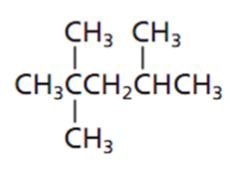
What is the IUPAC name for the following compound?
a) 1,1,1,3,3-pentamethylpropane
b) 1,1,3,3-tetramethylbutane
c) 2,4,4-trimethylpentane
d) 2,2,4-trimethylpentane
When proteins are broken down by enzymes, the products are:
a) amino acids
b) carbohydrates
c) fatty acids
d) nucleic acids
A.
Which of the following vitamins are all fat soluble.
a) ABCD
b) ACDE
c) ADEK
d) BCDE
C.
Deficiency of this vitamin will cause scurvy.
a) Vit A
b) Vit B
c) Vit C
d) Vit D
C.
The process of copying DNA molecule.
a) translation
b) reproduction
c) replication
d) transcription
C.
The preparation of alkyl halide that obeys Markovnikov's rule.
a) Hydrogenation
b) Halogenation
c) Hydrohalogenation
d) Hydration
C.
What is the best reagent to convert isopropyl alcohol to isopropyl bromide?
CH3-CH(CH3)-OH -->
CH3-CH(CH3)-Br
a) HBr
b) SOBr2
c) Br2
d) CH3MgBr
B.
Which of the following compounds is aromatic?
A. -
B. bicyclo[5.3.0]decapentaene
C. cyclooctatetraene
D. cycloheptatriene
B.
Complete and balance the equation for the reaction that occurs when methanol, CH3OH(l), is burned
in air. What is the coefficient of methanol in the balanced equation?
a) 1
b) 2
c) 3
d) 4
e) 3/2
A.
Which of the following statements is TRUE?
a) Tertiary-butyl free-radical intermediate is less stable than a methyl free-radical.
b) Anisole, C6H5-OCH3 is the same as para-methylphenol.
c) Phenol is hydroxycyclohexane.
d) 2-methyl-1,3-butadiene is also known as isoprene.
D.
Which of the following statements is not TRUE?
a) Compounds p-xylene & m-xylene are isomers of styrene.
b) Alkenes can be distinguished from alkanes by their oxidation with KMnO4 known as Baeyer's test.
c) CH2=CHOH is an isomer of ethylene oxide.
d) Benzylic carbocation is more stable than tertiary methyl cyclohexyl carbocation.
A.
The structure below is a component of folic acid, a vitamin, and is systematically named as:
a) o-aminobenzoic acid
b) a-amino acid
c) m-aminobenzoic acid
d) p−aminobenzoic acid
D.

Which of the following structural features is possessed by aldehydes but not by ketones?
a) At least one hydrogen atom is bonded to the carbonyl carbon atom.
b) At least one hydroxyl group is bonded to the carbonyl atom.
c) The carbonyl carbon atom is bonded to two other carbon atoms.
d) The carbonyl carbon atom is part of a ring structure.
A.
Which of the following statements about oxidation of aldehydes and ketones is correct?
a) Aldehydes readily undergo oxidation, and ketones are resistant to oxidation.
b) Ketones readily undergo oxidation, and aldehydes are resistant to oxidation.
c) Both aldehydes and ketones readily undergo oxidation.
d) Both aldehydes and ketones are resistant to oxidation.
A.
What principal product would you expect from acid-catalyzed hydration of 2-methyl-1-butene?
a) 2-methyl-1-butanol
b) 3-methyl-2-butanol
c) 2-methyl-2-butanol
d) none, no reaction occurs
C.
This test reaction is chiefly important for the identification of aldehydes and ketones.
a) 2,4-DNP
b) Lucas
c) Baeyer's
d) Tollen's
A.
Esters of long-chain carboxylic acids and the trihydric alcohol, glycerol, are known as ________.
a) triacyglycerides
b) saccharides
c) amides
d) nucleotides
A.
What is the structure of Benzaldehyde (Oil of Bitter Almonds)?
A. C6H5COOH
B. C6H5CHO
C. C6H5CH2OH
D. None of the above
B.
Upon treatment with H2SO4, a mixture of ethyl and n-propyl alcohols yields a mixture of three ethers. These ethers are as follows except:
a) ethyl ether
b) 1-ethoxypropane
c) 2-ethoxypropane
d) 1-propoxypropane
C.
Which carbonyl compounds have no a-hydrogen?
a) formaldehyde
b) ethanal
c) ethanol
d) acetone
D.
Classify the following amine: (CH3)3C-NH2
a) Primary Amine
b) Secondary Amine
c) Tertiary Amine
d) Quaternary Ammonium Salt
A.