1.2.3-Attack of the Superbugs
 Call Kai
 Learn
Learn Practice Test
 Spaced Repetition
 Match
Match Flashcards
 Knowt Play
1/14

There's no tags or description
Looks like no tags are added yet.
Name | Mastery | Learn | Test | Matching | Spaced | Call with Kai | Chat |
|---|
No analytics yet
Send a link to your students to track their progress
15 Terms
When a bacterium becomes unresponsive to an antibiotic what does this usually mean?
One or more three main things have usually happened which includes mutations, Inactivation, and Efflux.
What is a mutation when bacterium stop responding to antibiotics?
Mutation= A change in DNA sequence means a change in target
-They can mutate so quickly because they can go through many generations in a day
What is inactivation when bacterium stop responding to antibiotics?
-Codes a protein that will inactivate the incoming antibiotic.
-Destruction/inactivation of antibiotic via protein
-Gene is found on plasmid
What is efflux when bacterium stop responding to antibiotics?
-Channel that exports antibiotics out of cell
-Active transport
-Pump- creates concentration gradient to allow antibiotic to flow out of cell.
What are the three modes of genetic transmission for bacteria sharing their plasmids?
-Conjugation
-Transduction
-Transformation
What can susceptible bacteria do to resist antibiotics?
They can a biochemical mechanism to resist the antibiotic by mutation,destruction,inactivation, and efflux
How does destruction or inactivation work?
-Antibiotics are modified by enzymes before it reach the bacterial cell.
Destruction: Bacterial enzymes (such as β-lactamase) directly break key chemical bonds within the antibiotic, physically destroying the molecule before it can act.
Inactivation (Modification): Bacterial enzymes attach chemical groups (like acetyl, phosphate, or adenylyl groups) to the antibiotic molecule, changing its shape so it can no longer bind to its bacterial target.
How doe efflux work?
Antibiotics are actively pumped out by efflux pumps, reducing their intracellular concentration and effectiveness.

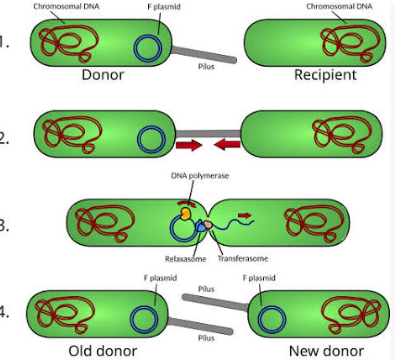
What is Conjugation?
-The one-way transfer of DNA between bacteria in cellular contact
-Plasmid, Pilus forms and plasmid copy travels through into another bacteria.
-Physical touch via pilus
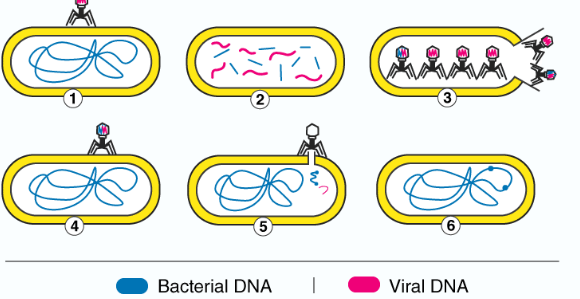
What is transduction?
-The transfer of genetic material from one organism (such as a bacterium) to another by a genetic vector
-Bacteriophage is transmitting resistant genes among different populations of bacteria.
-Bacteriophages enter bacterial cells, infect it and when the cell lysis it is released and will infect another bacteria with the newly acquired DNA.


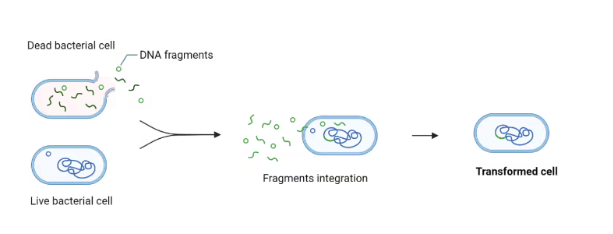
What is transformation?
- Plasmid is emitted into the environment by bacteria and then can be endocytosed by different strains of bacteria.(taken up through surface transport proteins by competent bacteria.)
-Cell lyses, releases DNA, transferred to other bacteria
-The genetic modification of a bacterium by incorporation of free DNA from another ruptured bacterial cell
Definition of Antibiotic.
A substance produced by or derived from a microorganism and able in dilute solution to inhibit or kill another microorganism
Definition of Antibiotic resistance.
Resistance to one or more antibiotics, usually due to additional genetic information
Definition of nucleoid.
The DNA-containing area of a bacterial cell
Definition of plasmid.
A small ring of DNA that carries accessory genes separate from those of the bacterial chromosome